Navigating the Profits Tax Computation: Understanding Form IR957
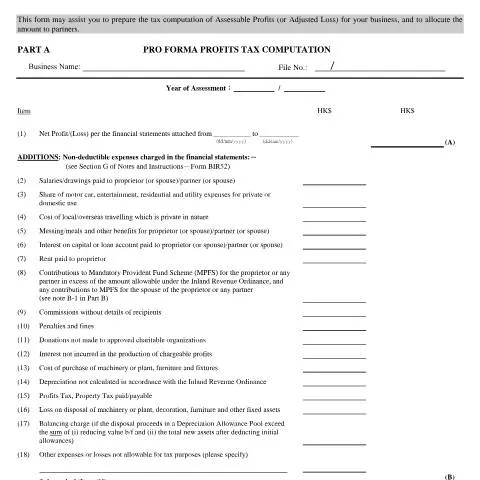
Navigating the world of business taxation in Hong Kong can be daunting. Among the essential documents is the Profits Tax Computation form, also known as IR957. This official form plays a crucial role in ensuring compliance with local tax regulations and accurately representing a business's financial situation.
The Significance of IR957 in Profits Tax Filing
The IR957 form serves as a structured framework for businesses to compute their assessable profits or adjusted losses. Understanding its significance goes beyond merely filling out a form; it reflects a commitment to transparency and legal compliance. This document allows businesses to align their profit figures accurately for tax purposes, ensuring that they are neither overtaxed nor underreporting their earnings.
Who Files the IR957?
This form is primarily filed by corporations and partnerships operating in Hong Kong. Each year, businesses must submit this computation as a part of their profits tax return, contributing to their overall tax liability. The requirement is applicable to both residents and non-residents engaged in trade, profession, or business activities within Hong Kong. In complex cases, such as when partnerships involve multiple stakeholders, individual partners may also be required to complete the form as a collective submission.
Timeline for IR957 Submission
The timeline for submitting the IR957 is critical, as it is tied to the fiscal year of the business. The tax year in Hong Kong runs from April 1 to March 31 of the following year. Businesses typically receive their profits tax returns in early April and must submit the completed IR957 by the specified deadline, usually around August 15 of the same year. Failure to meet these deadlines can lead to penalties, making it essential for businesses to stay organized.
Important Filing Deadlines
- April 1: Start of the fiscal year.
- Early April: Receipt of profits tax return by businesses.
- August 15: Deadline for submitting the completed IR957.
After submission, businesses can expect to receive an assessment notice from the Inland Revenue Department (IRD) within a few months, outlining the tax payable based on the computed profits.
Submission Channels: Online vs. Paper
Businesses have multiple options for submitting the IR957. The Inland Revenue Department encourages electronic submissions, which are processed more swiftly than paper forms. Filing online also provides immediate confirmation of receipt, which can be crucial for record-keeping.
Online Submission Advantages
- Faster processing times.
- Immediate confirmation of submission.
- Reduced risk of losing documents.
Paper Submission Process
For those opting to submit a hard copy, it is essential to ensure all required signatures are present and to keep a copy of the submission for personal records. Businesses may submit their documents either by post or directly at the IRD office.
Handling Common Issues: Refusals and Missing Information
Upon submission, it's not uncommon for businesses to encounter issues such as errors or omissions in their forms. If an error is identified, it is crucial to act swiftly. The IRD typically allows for corrections, although these should be documented clearly to avoid misunderstandings.
Steps to Address Submission Issues
- Identify the discrepancy or missing information.
- Prepare a clear explanation of the error and the necessary corrections.
- Submit the revised IR957 along with a cover letter detailing the changes.
- Keep copies of all correspondence for your records.
A Detailed Walkthrough of the IR957 Form
The IR957 form is divided into various sections, each requiring specific information related to the business's financial performance. Understanding these sections is key to completing the form accurately.
Section Breakdown
| Section | Description | Common Pitfalls |
|---|---|---|
| Part A | Pro forma profits tax computation | Omitting non-deductible expenses. |
| Part B | Notes and examples | Misunderstanding depreciation allowances. |
| Part C | Allocation among partners | Incorrectly calculating profit-sharing ratios. |
Each part of the form plays a critical role in ensuring that all assessable profits and losses are calculated correctly. Failure to accurately report any figures can lead to audits and potential penalties.
Special Circumstances: Non-Residents and Partnerships
When dealing with foreign entities or complex partnerships, additional rules may apply. Non-residents engaging in business activities in Hong Kong must also file the IR957, and may have unique adjustments based on their income sources.
Specific Considerations for Non-Residents
- Understanding the taxability of income sourced from Hong Kong.
- Potential double taxation agreements that may apply.
Partnership Filings
In the case of partnerships, all partners must ensure that the IR957 reflects the accurate distribution of profits. This includes understanding how to allocate profits or adjusted losses correctly among partners.
The Practical Implications of Filing the IR957
Filing the IR957 is not merely a bureaucratic exercise; the implications are significant. Completing this form accurately can open avenues for potential deductions and allowances that significantly affect a business's tax liability.
Rights and Obligations of Filers
- Right to claim all allowable expenses.
- Obligation to report all assessable income.
- Responsibility to maintain accurate records supporting the claims in the IR957.
Omitting key information can lead to unintended consequences such as increased tax assessments or legal ramifications. Therefore, businesses must approach the completion of the IR957 with diligence and care.
Final Thoughts: Strategic Tax Compliance
Successfully navigating the complexities of the Profits Tax Computation through form IR957 is essential for businesses operating in Hong Kong. By understanding the requirements, timelines, and implications of this form, businesses can ensure compliance while optimizing their tax obligations.
Investing time and resources into accurate tax reporting not only fosters goodwill with regulatory bodies but also contributes to a sustainable business model. As tax laws and regulations evolve, staying informed and adaptive is critical to maintaining compliance and leveraging potential benefits.
Understanding Profits Tax Computation for Different Business Structures
The Profits Tax in Hong Kong applies differently depending on the business structure you operate. Whether you run a sole proprietorship, a partnership, or a limited company, the way you compute your profits tax varies significantly. For instance, sole proprietors and partners are taxed on profits as personal income, while corporations face a flat rate of 16.5% on assessable profits. This section dives into the specifics.
1. Sole Proprietorship: A sole proprietor must include all income earned from the business in their individual tax return. The calculation involves total revenue minus expenses, with deductions permitted for business-related expenditures. It's crucial to maintain comprehensive records, as these will be required when you lodge your Individual Tax Return (Form BIR60).
2. Partnership: In a partnership, each partner is taxed individually on their share of the profits. The partnership itself is not taxed, but it must file a Partnership Tax Return (Form BIR51). Each partner should be aware of their share and ensure proper documentation of income and allowable deductions, which can include expenses directly related to business operations.
3. Corporations: Limited companies face a different structure altogether. They compute their profits tax based on the total assessable profits, which is determined by subtracting allowable deductions from total revenue. Companies must submit their Profits Tax Return (Form BIR51) within one month after the end of the accounting period, strictly adhering to the deadlines to avoid penalties.
The variations in tax computation underscore the importance of understanding your business structure and the implications this has for your tax liabilities. It's advisable to consult with a tax professional familiar with Hong Kong's tax regulations for tailored advice.
Key Deductions and Allowable Expenses in Profits Tax Computation
When computing your Profits Tax, understanding what qualifies as a deductible expense is critical. Hong Kong's tax regime allows for various deductions, which can significantly lower your taxable income. Here’s an overview of key deductions which businesses can claim:
1. Business Operating Expenses: These include typical costs associated with running your business such as rent, utilities, salaries, and office supplies. However, it’s important to distinguish between personal and business expenses; only those strictly necessary for generating income in your business are deductible.
2. Depreciation: Companies can claim capital allowances on fixed assets, such as machinery or equipment, over a specified period. This is particularly advantageous for businesses that heavily invest in capital assets. The deduction depends on the nature of the asset and its expected usage life.
3. Interest Expenses: If a business borrows money to fund its operations, the interest paid on that loan is typically deductible. This can provide cash flow relief and incentivize borrowing for growth, as it ultimately reduces the taxable profits for the year.
4. Losses Carried Forward: Businesses that incur losses during a financial year can carry these forward to offset future profits. This provision can be a lifesaver for startups or businesses navigating economic challenges, allowing them to minimize tax burdens in profitable years.
5. Charitable Donations: Contributions to approved charitable organizations can also be deducted, subject to certain limits. It can be beneficial not only for tax purposes but can also enhance a company's reputation and community relations.
Maintaining meticulous records and receipts for all expenses claimed is essential to substantiate your deductions should you face an audit from the Inland Revenue Department (IRD). Failure to provide proper documentation may result in disallowed expenses and increased tax liability.
The Role of E-Services in Profits Tax Submission
In line with Hong Kong's push towards digitalization, e-services play a vital role in streamlining the Profits Tax submission process. The IRD encourages businesses to utilize its online platform, which offers several advantages over traditional paper submissions. This section reviews the e-services available and their benefits.
1. Online Submission of Tax Returns: Businesses can complete and submit their Profits Tax Returns online through the IRD's eTax service. This not only simplifies the filing process but also ensures that you receive immediate confirmation of your submission, reducing the anxiety associated with potential postal delays.
2. Access to Tax Records: The eTax system allows registered users to access their tax records and prior submissions easily. This feature is particularly useful for preparing future tax returns, as it provides a clear history of previous filings and any outstanding issues that may need resolution.
3. Payment Options: Businesses can also settle their tax liabilities online, providing flexibility in managing cash flow. The IRD’s electronic payment options allow you to pay via multiple methods, ensuring convenience and security in your financial dealings.
4. Support and Guidance: The IRD’s website offers a wealth of resources, including guides on completing your Profits Tax Return, downloadable forms, and FAQs. Utilizing these resources can significantly enhance your understanding of the tax implications for your business.
5. Timely Updates: By registering for e-services, businesses can receive timely notifications regarding important deadlines and legislative changes that may impact their tax obligations. This feature helps ensure compliance and minimizes the risk of missing critical deadlines.
As e-services continue to evolve, they will likely provide even more functionalities to assist businesses in their tax compliance efforts. Embracing these digital tools can result in significant time savings and efficiency improvements in managing your Profits Tax obligations.