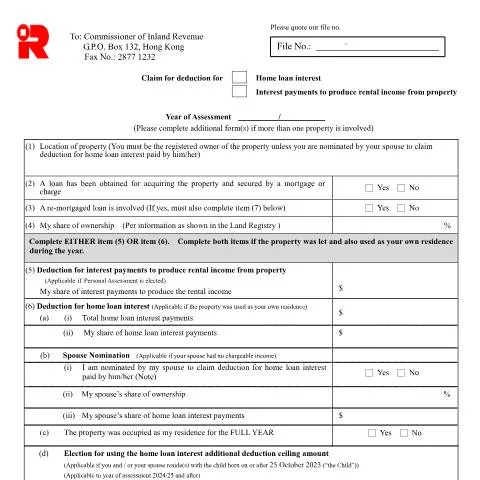
Navigating the IR 6072: A Comprehensive Guide to Claiming Deductions for Home Loan Interest
For many residents in Hong Kong, owning property is not just a dream but a significant financial commitment. As part of the Salaries Tax and Personal Assessment, the IR 6072 form plays a pivotal role in securing potential tax deductions through home loan interest claims. For individuals navigating this landscape, understanding the nuances of this document is essential for effective financial management and compliance.
Understanding the Context and Purpose of the IR 6072
The Claim for Deduction for Home Loan Interest / Interest Payments to Produce Rental Income from Properties form is not merely a bureaucratic requirement; it serves as a gateway for property owners to benefit financially. Individuals who pay interest on home loans or receive rental income from properties can leverage this form to ease their tax burdens.
More than just a formality, the IR 6072 enables taxpayers to:
- Reduce taxable income: By deducting interest payments, individuals can effectively lower their taxable income.
- Enhance cash flow: The financial benefit from these deductions can be reinvested or utilized in other areas of life.
Diving Deep into the Form: Section by Section Analysis
Item 1: Location of Property
This section requires the precise location of the property. Understanding local property registration is crucial. If you are not the registered owner but are claiming on behalf of a spouse, ensure you follow specific nomination procedures.
Item 2: Loan Acquisition
Here, taxpayers must declare if a loan was secured via a mortgage or charge. It’s essential to note that the existence of a loan is a prerequisite for the deduction claim. Any discrepancies may lead to processing delays.
Item 3: Re-Mortgaged Loans
If your loan has undergone re-mortgaging, this box must be checked. This disclosure informs the Inland Revenue Department (IRD) of any changes to the financing that could affect your claims.
Item 4: Share of Ownership
Filing for deductions requires clarity regarding ownership percentages. It’s imperative to ensure that this aligns with the Land Registry records, as inaccuracies can result in rejection of your application.
Items 5 and 6: Deductions for Income and Home Loan Interest
Here, taxpayers choose one of the two paths: either to claim deductions for rental income or home loan interest. It’s crucial to understand your eligibility for each category:
- Item 5: This is applicable if the property is rented out. You’ll need to indicate your share of income from the property.
- Item 6: This applies if the home has been your primary residence for the entire year.
Identifying Special Cases: Who Needs to Pay Attention?
There are particular scenarios that necessitate careful attention. This includes non-residents, minors, or individuals in unique family situations. For example, a foreign national must assess their eligibility based on residency and property ownership criteria.
The Importance of Nomination and Spousal Shares
Item 6(b) introduces a significant factor: spouse nomination. If one partner has no taxable income, they can be nominated to claim the deduction. This often maximizes the benefits available to married couples. It’s essential to understand how to document spousal shares correctly.
Supplementary Information: What’s Needed for a Successful Claim
The IRD requires supporting documents to substantiate claims. Be prepared to furnish items such as:
- Loan statements
- Proof of property ownership
- Rental agreements, if applicable
Failure to provide these can lead to delays or rejection of your claim.
Administrative Handling: From Submission to Processing
Once your form is completed, it’s submitted to the Commissioner of Inland Revenue. Understanding the timeline for processing can ease anxieties; typically, processing varies, but you can expect communication via post or e-services.
Next Steps: Monitoring Your Application Status
After submission, monitoring your application is crucial. You can follow up through the IRD’s online services, which provide real-time updates. If you find your claim under review, it may require additional documentation or clarification.
Dealing with Outcomes: Refusals and Corrections
Receiving a refusal can be disheartening. Understanding the grounds for rejection is the first step in addressing the issue. If your application is denied due to missing information or inaccuracies, you have the right to appeal or resubmit with the correct data.
The Bigger Picture: How the IR 6072 Fits into Your Financial Strategy
The IR 6072 is not an isolated document; it forms part of a broader financial strategy for tax management in Hong Kong. Aligning the deductions from this form with your overall financial position can lead to significant benefits. This includes understanding how these deductions complement other reliefs available under the Salaries Tax and Personal Assessment framework.
In conclusion, engaging with the IR 6072 is a journey that demands attention to detail and an understanding of both personal circumstances and regulatory requirements. By approaching it with diligence, taxpayers can better navigate their financial landscape in Hong Kong.
Understanding Home Loan Interest Deductions in Hong Kong
In Hong Kong, tax residents can claim deductions for home loan interest under the Salaries Tax and Personal Assessment. This provision is particularly essential for individuals who are homeowners, as it mitigates their overall tax burden. The maximum allowable deduction is up to HKD 100,000 per year, but this can be subject to certain conditions and limitations.
To qualify for this deduction, the loan must be secured on the residential property that is being used as a primary residence. Additionally, only the interest payments made during the relevant year of assessment can be claimed, which runs from 1 April to 31 March of the following year.
It is crucial to note that if the property is sold during the year, the taxpayer might need to adjust the deduction accordingly, as the deduction applies only for the periods when the property is occupied as a residence. This necessitates maintaining accurate records of the loan statements and payments made throughout the year.
Moreover, in instances where the home loan is refinanced, taxpayers should ensure that they have adequate documentation to support their claim. The Hong Kong Inland Revenue Department (IRD) requires the completion of Form IR 116 for claiming this deduction, which can be submitted alongside the annual tax return. It is advisable to consult with a tax professional or refer to the detailed guidelines provided by the IRD for specific questions regarding eligibility and the documentation required.
Interest Payments to Produce Rental Income: A Closer Look
Taxpayers in Hong Kong who own rental properties can also benefit from deductions related to interest payments on loans taken out to acquire these properties. This is a vital consideration for landlords, as it directly affects their taxable rental income. Similar to home loan deductions, the interest payments incurred on loans for producing rental income can be claimed, provided that the properties are rented out and generating income during the corresponding financial year.
The deduction applies to the actual interest paid on the loan and not the principal amount. As stipulated by the IRD, landlords must ensure that they are maintaining rigorous records of their income and expenses related to the rental business. To claim this deduction, taxpayers need to complete the appropriate section of the Property Tax Return (Form BIR60) to report rental income and the associated expenses, including mortgage interest payments.
It is essential to remember that the property must not be occupied or used by the taxpayer as a residence during the assessment year to qualify for this deduction. Any mixed-use properties (those used as both residence and rental) may lead to complications in claiming full deductions, necessitating the apportionment of expenses based on actual usage.
Furthermore, the IRD mandates that landlords who claim deductions must be able to demonstrate that the loan was specifically used for the purchase or improvement of the rental property. Supporting documentation such as loan statements, rental agreements, and proof of the property’s rental activity need to be provided along with the tax return. Proper filing and adherence to these rules will ensure that landlords can maximize their allowable deductions and minimize tax liabilities effectively.
Practical Steps for Filing Deductions Effectively
Claiming deductions related to home loan interest and rental income in Hong Kong can be a straightforward process if approached methodically. Here is a step-by-step guide to ensure compliance and maximize your claims:
- Gather Your Documentation: Collect all relevant documents, including loan agreements, interest payment statements, property rental agreements, and tax receipts. Ensure that these documents are accurate and up-to-date.
- Understand Your Eligibility: Review the eligibility criteria for deductions related to home loans and rental properties. Familiarize yourself with the specifics of what qualifies under the Salaries Tax and Property Tax frameworks.
- Document Your Interest Payments: Maintain detailed records of your interest payments throughout the year. It is advisable to keep a ledger or use a spreadsheet to track these payments, which simplifies the calculation process during tax filing.
- Complete the Appropriate Forms: Whether you are filing for Salaries Tax or Property Tax, ensure that you complete the correct forms. For home loan interest deductions, utilize Form IR 116, and for rental income deductions, use Form BIR60. Ensure that all forms are filled out accurately and completely.
- Consult Tax Professionals if Necessary: If your situation is complex or you are unsure about any aspect of the deductions, seeking the advice of a tax professional can provide clarity and ensure you are compliant with all regulations.
- Submit on Time: Be mindful of the deadlines for submission to the IRD. Late submissions can incur penalties or may lead to forfeiting your deductions entirely. The typical deadline for filing tax returns in Hong Kong is 1 June of the assessment year.
Following these steps will not only enhance the likelihood of successful claims but also help taxpayers navigate the complexities of Hong Kong's tax system related to home and rental property deductions.