Understanding the Significance of IR 6173: A Deep Dive into the Voluntary Health Insurance Scheme Policy Deduction
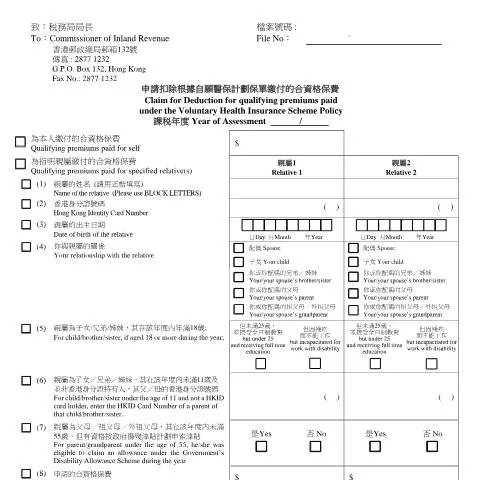
In Hong Kong, where healthcare costs can quickly escalate, many residents seek ways to alleviate their financial burden. The Claim for Deduction for qualifying premiums paid under the Voluntary Health Insurance Scheme Policy (IR 6173) offers a critical avenue for taxpayers to claim deductions for qualifying health insurance premiums. This article explores the intricacies of this form, the benefits it provides, and its role in the broader context of tax obligations in Hong Kong.
Contextualizing IR 6173 within the Framework of Salaries Tax
The IR 6173 form is part of the Salaries Tax and Personal Assessment framework, designed to accommodate taxpayers who wish to claim deductions for health insurance premiums. This deduction is particularly relevant to those enrolled in the Voluntary Health Insurance Scheme (VHIS), launched to encourage residents to obtain private health insurance and reduce the reliance on public healthcare services.
To appreciate the importance of IR 6173, it is essential to understand its placement within the tax process:
- Filing Requirements: Taxpayers must submit an annual tax return to the Inland Revenue Department, which typically covers the fiscal year from April 1 to March 31 of the following year.
- Specific Deductions: The IR 6173 form specifically targets claims related to qualifying health insurance premiums, allowing taxpayers to reduce their taxable income.
- Strategic Financial Planning: By utilizing this form, taxpayers can effectively manage their healthcare expenses and tax liabilities, contributing to better financial health.
Profiling the Claimant: Who Should Consider Submitting IR 6173?
The IR 6173 form is designed for a diverse range of taxpayers, including individuals and families. Understanding the different profiles of potential claimants can illuminate the specific situations that warrant the use of this form:
Individual Taxpayers
Individuals who have paid qualifying premiums for their health insurance can benefit from the deductions available. This is particularly valuable for self-employed individuals or employees with limited access to employer-sponsored health plans.
Families with Dependents
Families paying premiums for their spouses and children can claim additional deductions. However, certain conditions apply:
- Children aged 11 and under require specific documentation, such as the Hong Kong Identity Card (HKID) for dependent verification.
- For adult dependents, additional criteria such as incapacity or eligibility for government support schemes must be met.
Special Cases and Exceptions
Not every claimant will fit neatly into predefined categories. There are exceptions and variations worth noting:
- Claimants with multiple relational dependents must fill out IR 6173 in full, ensuring that all relevant details are accurately reported.
- Individuals who faced significant changes in their health insurance coverage during the assessment year may need to consult with tax professionals to determine eligibility.
Deciphering the Intricacies of the Form: Completing IR 6173
Filling out the IR 6173 form accurately is crucial for an effective submission. Here is a detailed breakdown of the form and guidance on its completion:
Essential Information Required
The form requires several key pieces of information:
- Personal Information: Name, daytime contact number, and signature.
- Premiums Paid: A detailed breakdown of qualifying premiums paid during the assessed year, including series of boxes for specifying relatives.
- Relationship to Dependents: Clear identification of the relationship to each dependent for whom the premium is being claimed.
Common Pitfalls in Form Completion
To ensure that the IR 6173 form is processed without delays, claimants should avoid common mistakes:
- Incorrectly filling in the HKID numbers for dependents can lead to complications.
- Failing to report all qualifying premiums paid in the relevant period may result in reduced deductions.
Submission Process: Where and How to File IR 6173
Once the IR 6173 form has been duly completed, the next step is submission. Understanding this process is key to ensuring timely claims:
Filing Location
The completed form should be sent to the Commissioner of Inland Revenue, using the provided address on the form:
G.P.O. Box 132, Hong Kong
Submission Deadlines
Timing is essential in the submission process:
- Forms should be submitted along with the annual tax return, typically due by early June following the end of the tax year.
- Extensions may be available upon request, but it's essential to confirm eligibility early to avoid penalties.
Post-Submission: What Happens Next?
Once the IR 6173 form is submitted, several steps follow:
Processing by the Inland Revenue Department
The Inland Revenue Department will review the submitted claim, which typically takes several weeks. Taxpayers can track the status of their claims and inquire about any additional documentation or clarifications needed by contacting the department directly.
Potential Outcomes
Taxpayers can anticipate one of several outcomes:
- Approval of the claim will lead to a revised tax assessment reflecting the deductions.
- If additional information is required, the department may issue a request, necessitating prompt follow-up from the claimant.
- In cases where claims are denied, taxpayers will receive a notification outlining the reasons for denial, providing an opportunity to appeal or re-submit if necessary.
Historical Context: The Evolution of the Voluntary Health Insurance Scheme
The introduction of the Voluntary Health Insurance Scheme was a strategic move by the Hong Kong government to enhance healthcare accessibility and affordability. Understanding the historical context can shed light on why forms like IR 6173 are essential:
Government Initiatives
Launched in 2019, the VHIS aims to promote private health insurance, thereby reducing the pressure on public healthcare services. This initiative reflects a broader governmental commitment to improving public health standards and ensuring that citizens have reliable access to health services.
Regulatory Framework
The framework surrounding the VHIS and related tax deductions is rooted in the Basic Law of the Hong Kong Special Administrative Region, ensuring that residents benefit from clear and accessible guidelines for health insurance:
- Understanding these regulations can empower taxpayers to make informed decisions about their healthcare and financial planning.
- Taxpayers should remain aware of any changes to these regulations which may affect their eligibility for deductions in future years.
Conclusion: Leveraging IR 6173 for Optimal Tax Outcomes
The IR 6173 form plays a crucial role in enabling Hong Kong residents to maximize their tax deductions related to health insurance premiums. By understanding the process, the necessary documentation, and the nuances of eligibility, taxpayers can effectively navigate this essential part of their financial planning. Armed with this knowledge, individuals can ensure compliance while strategically managing their healthcare expenses in an ever-evolving economic landscape.
Understanding the Voluntary Health Insurance Scheme (VHIS)
The Voluntary Health Insurance Scheme (VHIS) was established by the Hong Kong government to encourage residents to purchase private health insurance that meets specific quality standards. As opposed to the compulsory health insurance plans offered in other jurisdictions, the VHIS operates under a voluntary basis, allowing individuals to choose plans that fit their personal health needs.
Under the VHIS, policies are required to provide comprehensive coverage, including a fixed list of medical services and treatments, as well as ensuring guaranteed renewability. Insurers must adhere to the standards set by the Hong Kong Insurance Authority (IA), including provisions for pre-existing conditions after a waiting period.
For taxpayers, a significant advantage of the VHIS is the eligibility to claim deductions for qualifying premiums paid under the scheme. This not only promotes the uptake of private health insurance but also offers financial relief during tax assessments. The maximum allowable deduction per insured person is capped, and any premiums exceeding this limit will not be eligible for tax relief.
Eligibility Criteria for Deduction Claims
To successfully claim for deductions under the VHIS, taxpayers must meet certain eligibility criteria. Firstly, the insurance policy must be a qualified VHIS policy, which is defined as a policy that is registered under the scheme and meets all relevant standards and conditions set forth by the Insurance Authority.
In addition to having a qualifying policy, the taxpayer must also be a Hong Kong resident holding a valid Hong Kong Identity Card (HKID). Premium payments must be made for oneself, their spouse, or dependent children who are 18 years or younger, or mentally incapacitated, to qualify for the deduction. Note that while premiums for adult dependents (aged 19 or older) may also be deductible, there are specific stipulations regarding their eligibility, such as financial dependency and residency requirements.
Furthermore, while taxpayers can claim deductions for multiple policies, the total claim amount must not exceed the maximum deduction limit set by the authorities. As of the most recent tax year, taxpayers can claim up to HKD 8,000 for each insured person under the VHIS program. Should the premiums exceed this limit, only the amount up to the maximum allowable deduction will be considered during the assessment.
Filing the Claim: Documentation and Submission Process
Filing a claim for the deduction of qualifying premiums under the VHIS involves a clearly defined process that must be meticulously followed to ensure a successful assessment. Taxpayers should begin by gathering the necessary documentation, which includes proof of premium payments and the relevant VHIS policy details.
Documentation typically includes:
- A copy of the VHIS policy document, which outlines the terms and conditions of the coverage.
- Receipts or statements that verify the premium payments made during the tax year in question.
- Identification documentation such as the taxpayer's HKID and any additional evidence needed to substantiate dependent claims, if applicable.
Once the documentation is prepared, taxpayers need to complete the appropriate tax return form, specifically the Tax Return – Individuals (BIR60), where the VHIS premiums can be declared. It is crucial to fill out this form accurately, as any discrepancies may lead to delays or rejections in the assessment process.
The completed form, along with the supporting documents, must be submitted to the Inland Revenue Department (IRD) before the designated deadline, which is typically 1 month after the issuance of the tax return. For the tax year ending on March 31, the deadline usually falls at the end of May. Delayed submissions may result in penalties or complications in the processing of the claim.
Additionally, taxpayers should consider retaining copies of all submitted documents for their records, as these may be required in the event of a follow-up inquiry or audit by the IRD.