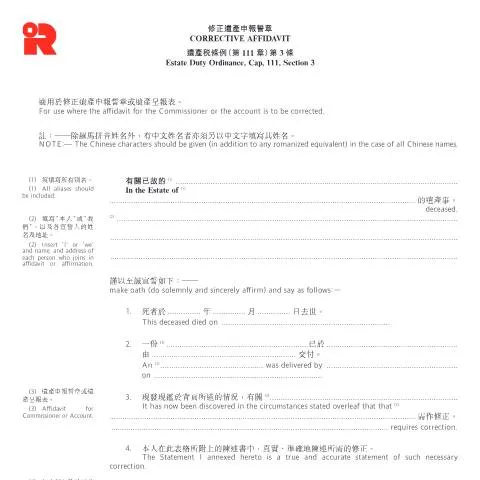
Navigating the Corrective Affidavit (IRED 11*) for Estate Duty in Hong Kong
In the realm of estate administration, accuracy is paramount. The Corrective Affidavit (IRED 11*) serves as a crucial instrument for rectifying discrepancies in estate duty declarations, ensuring that the deceased's estate is accurately assessed and taxed. This document not only safeguards against potential legal consequences but also assists in the equitable distribution of assets among beneficiaries.
Understanding the Context of the Corrective Affidavit
The Estate Duty Ordinance, under which the Corrective Affidavit is governed, mandates that all estates be assessed for duty based on their true value. This becomes particularly significant when errors or oversights occur in the initial declaration. The Corrective Affidavit acts as a vehicle for reporting these errors to the Commissioner of Estate Duty.
The Importance of Accurate Reporting
When a discrepancy is identified—be it underreporting or overreporting of the estate's value—the corrective affidavit must be submitted. Not only does this ensure compliance with Hong Kong law, but it also protects the fiduciary responsibilities of the executors and administrators of the estate.
Who Needs to Submit the Corrective Affidavit?
Primarily, the responsibility to submit the Corrective Affidavit falls on the executors or administrators of the deceased's estate. However, several scenarios necessitate its use:
- Executor or Administrator: The appointed individual or entity managing the estate’s affairs.
- Beneficiaries: In situations where beneficiaries notice discrepancies that could impact their inheritance.
- Legal Representatives: Attorneys or legal advisors acting on behalf of the estate.
Preparing to Complete the Corrective Affidavit
Completing the Corrective Affidavit requires meticulous attention to detail. All relevant documents must be gathered beforehand to ensure that the corrections align accurately with the original affidavit or account.
Documentation Requirements
Here is a detailed breakdown of the documents typically necessary for successfully filling out the Corrective Affidavit:
- Original Affidavit or Account: The initial submission that contains the errors.
- Supporting Documents: Any documents that substantiate the claims made in the corrective affidavit, such as property titles or financial statements.
- Identification: Legal identification of the executor or administrator, typically the Hong Kong Identity Card (HKID).
Critical Components of the Corrective Affidavit
Understanding the structure of the Corrective Affidavit is essential for effective completion. The document comprises several key sections:
1. Estate Identification
The form begins by requiring precise identification of the estate, including the name of the deceased and the estate reference number. This section is vital as it establishes the context for the corrections.
2. Statement of Corrections
Here, the specific errors must be detailed. This section typically requires:
- A clear description of what was reported in the original affidavit.
- The corrected information that reflects the accurate state of affairs.
- Rationale for the correction, explaining how the error occurred.
3. Financial Impact
This segment requests a breakdown of the financial implications of the corrections, including increases or decreases in estate values. A table may be provided for clarity:
| Particulars of Correction | Original Value | Corrected Value | Increase/Decrease |
|---|---|---|---|
| Real Estate Value | $1,000,000 | $1,200,000 | Increase: $200,000 |
| Cash Assets | $200,000 | $150,000 | Decrease: $50,000 |
4. Affidavit Certification
The final section requires the executor or administrator to affirm the accuracy of the information presented under oath. This ensures accountability and compliance with legal standards.
Submission Channels: How and Where to File the Corrective Affidavit
There are multiple channels through which the Corrective Affidavit can be submitted, each with its own advantages:
1. Online Submission
Utilizing e-services is encouraged for efficiency. Through the official government portal, users can fill out the form and submit it electronically, ensuring faster processing times.
2. Paper Submission
For those preferring traditional methods, the corrected affidavit can be printed and submitted at designated estate duty offices. Ensure that all copies are signed and dated correctly.
3. In-Person Filing
Executors or representatives may also opt to file the affidavit in person, allowing for immediate clarification of any queries by officers present.
The Consequences of Failing to Submit a Corrective Affidavit
Neglecting to address discrepancies through the Corrective Affidavit can have serious repercussions:
- Penalties: The Commissioner of Estate Duty may impose penalties for inaccuracies.
- Legal Action: In extreme cases, failure to comply can result in legal proceedings against the executor or administrator.
- Delayed Distribution: Beneficiaries may face delays in receiving their inheritance until all discrepancies are resolved.
Unique Aspects of the Corrective Affidavit Compared to Other Estate Duty Forms
While the Corrective Affidavit serves a specific purpose, it's essential to understand how it differs from other estate duty forms:
Form ED1: Original Affidavit
The ED1 Form is the foundational declaration for estate duty assessment. In contrast, the Corrective Affidavit is a subsequent measure undertaken when discrepancies arise.
Form ED2: Final Account
The ED2 Form represents the final accounting of the estate's assets and liabilities. The Corrective Affidavit can precede this form if corrections are necessary before finalization.
Post-Submission: What to Expect After Filing the Corrective Affidavit
Once the Corrective Affidavit has been submitted, the estate will enter a review process:
1. Acknowledgment of Receipt
The Commissioner of Estate Duty will provide an acknowledgment of receipt. This serves as confirmation that the corrections have been formally logged.
2. Assessment Outcome
Following the review, the estate may receive an assessment detailing any adjustments to the tax owed. This outcome will dictate the next steps for the executor or administrator.
3. Potential Queries
Should the Commissioner require further clarification, they may reach out for additional information. It is crucial to respond promptly to avoid delays.
Conclusion: The Importance of the Corrective Affidavit in Estate Management
The Corrective Affidavit (IRED 11*) is more than just a bureaucratic formality; it is an essential tool for maintaining the integrity of estate management in Hong Kong. By understanding its role, preparation requirements, submission processes, and potential consequences, executors and administrators can navigate the complexities of estate duty with confidence and accuracy.
Fill in your form directly online
No printing: type your details into the boxes of the official form, tick, then download the PDF ready to send.
- 1Type into the form boxes
- 2Tick in one click
- 3Save and download the PDF
In summary, staying informed and diligent in the use of the Corrective Affidavit not only aids in compliance but also ensures fair distribution among beneficiaries, ultimately upholding the deceased's wishes.
Understanding the Purpose and Importance of a Corrective Affidavit in Hong Kong
A Corrective Affidavit serves a critical function within the legal framework of Hong Kong, designed primarily to rectify errors or omissions in previous affidavits or documents submitted to the relevant authorities. This legal document ensures accuracy in public records and maintains the integrity of the judicial process. It is essential for parties involved in litigation, conveyancing, or any legal proceedings where prior declarations may have contained inaccuracies.
In practice, a Corrective Affidavit may be necessary due to a variety of reasons, such as typographical errors, misstatements, or even changes in the factual context that must be reflected in the documents. Failure to provide accurate information can lead to significant consequences, including delays in proceedings or even the rejection of applications. Hence, understanding its importance is crucial for legal practitioners and individuals alike.
Moreover, the Corrective Affidavit must conform to the standards set forth in the Basic Law of the Hong Kong Special Administrative Region and should be executed in accordance with the rules provided by the High Court and other relevant authorities. The affidavit must clearly state the errors identified and provide the corrected information in an organized manner, ensuring clarity and ease of understanding for all stakeholders involved.
Procedural Guidelines for Filing a Corrective Affidavit
Filing a Corrective Affidavit in Hong Kong involves specific procedural steps that must be meticulously followed to ensure compliance with legal requirements. Begin by preparing the affidavit, which should include essential details such as the title of the original affidavit, the date it was filed, and a comprehensive statement of the corrections being made. Clarity is key; the affidavit must be drafted in a way that allows the reviewing authority to easily identify and understand the corrections.
Once drafted, the Corrective Affidavit must be signed and sworn before a Commissioner for Oaths or a Solicitor, as required by local practice. After this, you should file the affidavit with the relevant court or authority. The filing process can often be completed through e-services provided by the Judiciary of Hong Kong, which facilitates a faster and more efficient submission process.
It's also important to ensure that the Corrective Affidavit is served to all parties involved in the original proceeding. This ensures transparency and maintains the rights of all stakeholders. Failure to serve the affidavit properly may lead to complications and undermine the intended corrections. Lastly, keep a copy of the filed affidavit for your records, as it may be necessary for future reference or in the event of disputes.
Common Scenarios Requiring a Corrective Affidavit
There are numerous scenarios where a Corrective Affidavit may be warranted. One common situation is in property transactions, where inaccuracies in the declaration of property details can hinder the transfer of title. For instance, if the original affidavit contains incorrect information about the ownership history or boundary details of a property, a Corrective Affidavit must be filed to amend these discrepancies to facilitate a smooth transaction.
Another instance is in family law cases, particularly during divorce proceedings where affidavits are used to declare assets, liabilities, and other relevant information. If a party realizes that they have inadvertently omitted an asset or misrepresented the value of certain items, filing a Corrective Affidavit becomes crucial to ensure that the court has a complete and accurate picture of the financial situation.
Similarly, businesses may need to submit Corrective Affidavits when dealing with corporate filings or statutory declarations. Errors in company incorporation documents, such as the name of the company or the details of directors, must be rectified to comply with the requirements set out by the Companies Registry (CR). In such cases, timely action via a Corrective Affidavit can prevent potential legal repercussions or administrative penalties.