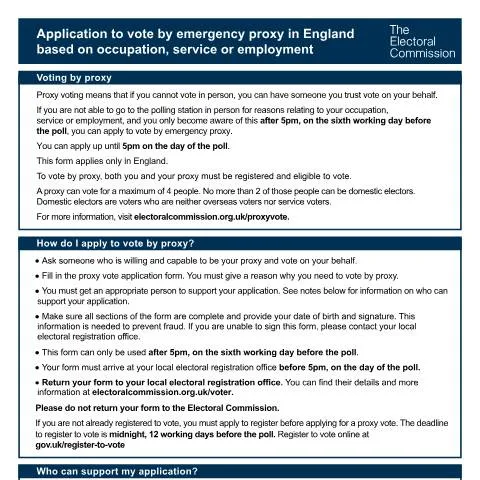
Navigating the Urgency: Emergency Proxy Voting in England
Imagine you have a critical work commitment that makes it impossible to vote in person on election day. This is where the Application to vote by emergency proxy due to employment comes into play. This document serves a vital role in the electoral process, allowing you to delegate your voting rights to a trusted individual when unforeseen circumstances arise. Understanding the nuances of this application is crucial for those who find themselves in such situations.
Who Can Benefit from Emergency Proxy Voting?
Emergency proxy voting is designed primarily for individuals who, due to their occupation or service, are unable to attend the polling station. Here are the profiles of people who might be eligible:
- Employed Individuals: If your job requires you to work on the polling day, you can apply for an emergency proxy.
- Self-employed Workers: Those who are self-employed can also apply, but they must provide a valid reason related to their occupation.
- Service Voters: Members of the armed forces, Crown servants, and British Council employees can also apply, as can their spouses and children.
Each of these categories has specific requirements regarding the reasons that justify the need for an emergency proxy vote.
Understanding the Timeline: Key Dates and Deadlines
Time is of the essence when applying for an emergency proxy vote. The following timeline outlines critical dates:
- Application Start: You can submit your application after 5 PM on the sixth working day before the election.
- Application End: The deadline for submitting your emergency proxy application is 5 PM on election day itself.
Missing these deadlines can disenfranchise you, so it's essential to be aware and act swiftly.
Decoding the Application Form: Section by Section
Filling out the application form correctly is vital for ensuring your vote counts. Below, we delve into each section of the form:
Section 1: Your Personal Information
This section requests your name, address, and optional contact details. Ensure all information is accurate. Double-check your address against your voter registration to avoid any discrepancies.
Section 2: Selecting Your Proxy
You must choose a reliable individual to represent you. This section requires the full name and address of your chosen proxy. Remember, your proxy must be eligible to vote themselves.
Section 3: Specifying Election Details
Here, indicate the specific election(s) for which you are requesting the proxy vote. Be precise in your dates to prevent any confusion in your application.
Section 4: Employment Details and Justification
This section is crucial as it necessitates a valid reason for your proxy request:
- 4A: For self-employed applications, indicate your profession and the reason you can't vote.
- 4B: Employed individuals must provide their employer's name, position, and the reason related to their employment.
- 4C: Service members or their families should specify their service status and provide a relevant reason for their absence.
Section 5: Notification of Your Circumstance
In this part, you indicate when you became aware of your inability to vote in person. Timing is important here, as it could affect your eligibility for an emergency proxy vote.
Section 6: Declaration and Verification
Finally, you need to confirm that your proxy is willing and capable of voting on your behalf. This section is crucial for preventing electoral fraud. Any inaccuracies could lead to rejection of your application.
Preparation Before You Apply: Necessary Documentation
Before submitting your application, ensure that you have the right supporting documents prepared:
- Proof of Employment: If employed, a letter from your employer may bolster your application.
- Identification: Your National Insurance number or any identification connected to your address may be required.
- Proxy's Eligibility: Ensure your proxy's eligibility is clear, as they must be registered to vote and not exceed the limit of four proxies.
The Legal Framework: How This Procedure Became Necessary
The provision for emergency proxy voting is rooted in the Representation of the People Act 1983. This legislation ensures that voters retain access to their democratic rights, even in unforeseen circumstances. The law recognises the importance of accommodating the diverse needs of the electorate, thus giving rise to this mechanism.
The Bigger Picture: Emergency Proxy Voting in the Electoral Process
Emergency proxy voting is not an isolated process but part of a broader electoral framework. It interlinks with several key electoral practices:
- Registration: Only registered voters can apply for a proxy vote. The registration deadline is midnight, 12 working days before the election.
- Proxy Voting Limitations: A proxy can only vote on behalf of four individuals at any election, ensuring fairness and accountability.
This interconnectedness highlights the importance of understanding how each element of the electoral process works together.
Consequences of Inaction: What Happens if You Forget?
Failure to submit an emergency proxy application on time can have serious repercussions:
- Loss of Voting Rights: If you miss the deadlines, you forfeit your right to vote in that election.
- Impact on Proxy: Your chosen proxy may be left without a vote, affecting their ability to participate in the democratic process.
- Future Registration Issues: Repeated failures to vote could complicate future voter registration or applications.
It is crucial to remain vigilant about deadlines and eligibility requirements to safeguard your voting rights.
Final Steps: What Happens After Your Application Is Submitted?
Once your application is in the hands of your local electoral registration office, the following steps occur:
- Your application will be reviewed, and you will receive confirmation of approval or rejection.
- If approved, your proxy will be informed of the election details and their voting responsibilities.
- You must communicate your voting preferences to your proxy to ensure that your voice is heard accurately.
This wrap-up of the application process underlines the importance of communication with your proxy to ensure your voting wishes are properly executed.
Understanding the Emergency Proxy Vote Process
The emergency proxy vote is a crucial provision for individuals who find themselves unable to attend their local polling station on election day due to unforeseen circumstances, particularly related to employment. It's essential to understand the specific criteria and requirements involved in applying for this type of proxy vote. This provision is designed to ensure that individuals whose work commitments prevent them from voting can still exercise their democratic rights.
To be eligible for an emergency proxy vote due to employment, you must meet certain conditions. Firstly, you need to demonstrate that your employment situation has changed after the standard proxy application deadline, which typically occurs shortly before an election. This might include situations where you are required to work unexpectedly on election day, such as emergency duty in health services or other critical sectors.
When applying for an emergency proxy vote, it's crucial to provide adequate evidence of your employment commitment. This could include a letter from your employer or documentation that proves your presence at work on the day of the election. The application must be submitted to your local Electoral Registration Office, and usually, you will need to do this no later than 5 pm on the day before the election.
The Application Process for Emergency Proxy Voting
The application process for emergency proxy voting is straightforward but requires attention to detail to ensure a smooth experience. Start by visiting the official website of your local council to access the necessary application forms. You can typically find the emergency proxy application form, often labeled as 'EP1' or similar, under the voting or elections section.
Once you have the form, fill it out accurately, ensuring that you specify the reason for your emergency proxy vote clearly. Alongside your application, you'll need to submit any supporting documents that validate your claim, such as proof of your work commitments. Failure to provide adequate evidence might result in the rejection of your application, so it is advisable to be as thorough as possible.
After submitting your application, you should receive confirmation from your local council regarding the status of your request. If approved, details of your emergency proxy, such as their name and address, will be recorded, and they will receive a ballot paper to vote on your behalf. It's important to remain in communication with your proxy to ensure they understand your voting preferences, as they will be responsible for casting your vote in alignment with your wishes.
Types of Employment Situations Eligible for Emergency Proxy Voting
Various employment situations qualify for emergency proxy voting, particularly those that involve unexpected work commitments. Understanding these circumstances can help ensure that you apply correctly and within the stipulated time frame. Here are some common scenarios that may warrant an emergency proxy vote application:
- Emergency Services: Individuals working in police, fire, or ambulance services who may be called to duty at short notice are prime candidates for this provision. If you're assigned to work on election day unexpectedly, you can apply for an emergency proxy vote.
- Health Sector Workers: Those in healthcare roles, such as doctors, nurses, and support staff, often face unpredictable work schedules due to the nature of their responsibilities. If you're required to work on an urgent basis on election day, this situation would qualify you for an emergency proxy vote.
- Transport and Logistics Employees: With the ongoing challenges in transport and supply chains, employees in these sectors may face sudden operational needs. If a last-minute shipment or transport duty arises, consider applying for an emergency proxy vote.
- Essential Public Services: Any individual whose job is classified as essential, where their absence could affect public welfare and safety, qualifies for an emergency proxy vote. This includes roles within utilities, environmental services, and similar sectors.
It's vital to keep in mind that the nature of the employment must genuinely disrupt your ability to vote. Applications from individuals who had prior knowledge of their work commitments or who could have arranged alternative work schedules may not succeed. Clear documentation and a well-reasoned explanation will significantly bolster your application, making it more likely to be approved.