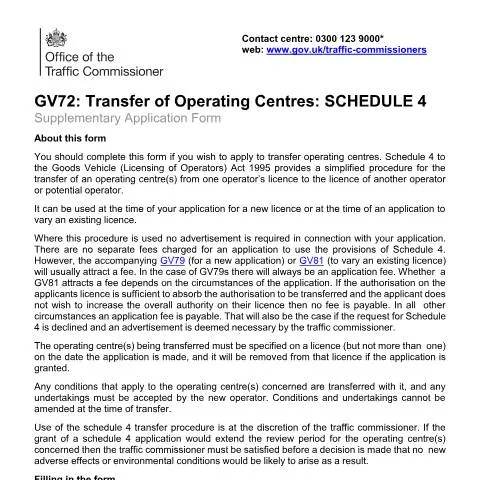
When Haulage Operations Change Hands: The Schedule 4 Transfer Process
The commercial transport industry frequently sees operating centres move between different licence holders—whether through business acquisitions, partnership changes, or strategic consolidation of operations. Rather than requiring operators to navigate the full application process with public advertisements and extended waiting periods, the Traffic Commissioners for Great Britain offer a streamlined mechanism through Schedule 4 of the Goods Vehicle (Licensing of Operators) Act 1995. This procedure, administered via form GV72, enables the direct transfer of operating centres between existing or prospective operators without the usual regulatory hurdles.
The transfer mechanism proves particularly valuable when established haulage businesses change ownership, merge operations, or when experienced operators acquire additional premises with existing authorisations. Unlike standard licence applications that can face objections from local authorities or interested parties, Schedule 4 transfers bypass the advertisement requirements entirely, provided both parties meet specific conditions and the Traffic Commissioner exercises their discretion favourably.
Dual-Party Coordination: Understanding Section A and Section B Requirements
Form GV72 operates on a dual-completion basis, requiring active participation from both the receiving operator (Section A) and the transferring operator (Section B). This structure reflects the legal reality that operating centre transfers involve the simultaneous removal of authorisation from one licence and its addition to another.
The Receiving Operator's Obligations (Section A)
The applicant seeking to acquire the operating centre must provide their existing operator licence number where applicable—a crucial detail that determines whether the application accompanies a new licence application (GV79) or a variation to an existing licence (GV81). The form requires precise details of each operating centre being transferred, including full addresses and postcodes. Where multiple centres are involved, continuation sheets become necessary to capture all relevant locations.
The declaration section carries significant legal weight, requiring the applicant to confirm all statements are true and acknowledge that false declarations constitute a criminal offence. The signature must come from the same individual who signs the accompanying GV79 or GV81 form, ensuring consistency across the application package.
The Transferring Operator's Responsibilities (Section B)
The current licence holder faces more complex obligations, beginning with comprehensive identification details including trading names, licence numbers, and contact information across multiple channels. Critical questions address whether the operating centres are currently specified on their licence and whether any other goods vehicle operators share the facilities.
Where shared usage exists, detailed information about other licence holders becomes mandatory, potentially complicating the transfer process. The transferring operator must explicitly choose between requesting removal of specific operating centres or offering complete licence surrender—a decision with significant operational implications.
| Transfer Scenario | Required Action | Implications |
|---|---|---|
| Partial centre transfer | Request removal of specified centres | Licence remains active for remaining operations |
| Complete business transfer | Offer licence surrender | Entire licence becomes void upon completion |
| Shared facility transfer | Identify all other operators | Additional coordination required |
The Traffic Commissioner's Discretionary Powers and Review Period Considerations
Schedule 4 transfers operate entirely at the Traffic Commissioner's discretion, creating uncertainty even when all procedural requirements are met. This discretionary element becomes particularly relevant when transfers would extend the review period for the operating centres concerned. In such circumstances, the Commissioner must satisfy themselves that no new adverse effects or environmental conditions would likely arise from the transfer.
The review period consideration reflects the regulatory framework's emphasis on local environmental protection. Operating centres undergo periodic review to assess their ongoing suitability, particularly regarding traffic impact, noise generation, and compliance with planning permissions. When a transfer would effectively reset or extend this review cycle, additional scrutiny becomes inevitable.
Environmental and Operational Continuity
Any existing conditions attached to the operating centre automatically transfer with the authorisation, creating immediate obligations for the new operator. These might include restrictions on vehicle movements during specific hours, limits on the number of vehicles that can be parked overnight, or requirements for noise mitigation measures. Crucially, these conditions cannot be amended during the transfer process—any desired modifications must be pursued through separate variation applications after the transfer completes.
Similarly, undertakings given by the previous operator regarding the centre's operation must be accepted by the new licence holder. These undertakings often emerge from previous regulatory proceedings or enforcement actions and may impose operational constraints that significantly impact business planning.
Fee Structures and Financial Implications Across Different Scenarios
While the Schedule 4 transfer itself attracts no separate fees, the accompanying applications follow standard Traffic Commissioner charging structures. New licence applications via GV79 always incur application fees, regardless of the transfer circumstances. However, licence variations through GV81 present more nuanced fee implications.
Where the receiving operator's existing licence already possesses sufficient authorisation to absorb the transferred operating centre capacity, and no increase in overall vehicle authority is sought, no variation fee becomes payable. This scenario typically occurs when established operators acquire additional premises to redistribute existing fleet capacity rather than expand operations.
Fee Scenarios and Strategic Considerations
- Capacity-neutral transfers: Existing authorisation absorbs transferred capacity without fee implications
- Capacity-increasing transfers: Standard variation fees apply when total vehicle authorisation increases
- Failed Schedule 4 applications: Advertisement fees become payable if the Commissioner requires standard application procedures
- New operator acquisitions: Full application fees apply regardless of transfer arrangements
The potential for Schedule 4 refusal adds another financial consideration. Should the Traffic Commissioner decline the transfer application and require standard advertising procedures, additional fees become payable for the mandatory advertisement process, effectively doubling the application costs.
Submission Procedures and Processing Through the Central Licensing Office
All completed GV72 forms must reach the Central Licensing Office in Leeds, accompanied by the relevant GV79 or GV81 application. The Traffic Commissioners maintain a paper-based processing system for these transfers, requiring physical submission rather than online alternatives. Forms must be completed in black ink to ensure processing compatibility with scanning and archiving systems.
The Central Licensing Office at Quarry House serves as the single processing point for all Schedule 4 applications across Great Britain, consolidating expertise and ensuring consistent decision-making standards. This centralised approach contrasts with other Traffic Commissioner functions that may be handled regionally.
Documentation Completeness and Processing Delays
Incomplete applications face inevitable processing delays, as the dual-party nature of GV72 means missing information from either section prevents assessment. Common completion issues include unsigned declarations, missing licence numbers, or inadequate operating centre descriptions that prevent accurate identification of the facilities concerned.
The requirement for identical signatories between GV72 Section A and the accompanying GV79 or GV81 creates additional coordination challenges, particularly in larger organisations where different individuals might typically handle various aspects of licence management.
Strategic Timing and Business Planning Around Transfer Applications
Schedule 4 transfers can accompany either new licence applications or variations to existing licences, creating strategic timing considerations for business planning. New operators acquiring established premises with existing authorisations must coordinate their GV79 submissions with the GV72 transfer request, ensuring both applications progress simultaneously.
For existing operators expanding through acquisition, the timing decision between immediate transfer and deferred variation affects operational continuity. Immediate transfers through GV81 variations enable swift operational integration but may face capacity constraints if existing licences lack sufficient authorisation headroom.
Operational Transition Management
The legal requirement that operating centres remain specified on the transferring licence until the application's determination creates potential operational complications. During the assessment period, the transferring operator retains legal responsibility for the premises, including compliance with any attached conditions or undertakings.
This transitional period requires careful coordination between parties, particularly where the acquiring operator intends immediate operational use of the facilities. Premature operational changes before formal transfer approval could result in compliance issues for both parties.
Data Protection Considerations and Criminal Liability Warnings
The Traffic Commissioners' data processing activities fall under their statutory authority as the competent body for assessing road transport operator access. Personal information provided through GV72 applications undergoes processing for regulatory assessment purposes, with retention periods aligned to ongoing licensing obligations and potential enforcement requirements.
The criminal liability warnings appearing throughout the form reflect the serious consequences of providing false information in regulatory applications. These warnings extend beyond simple administrative penalties to potential prosecution under fraud legislation, particularly where false declarations enable unauthorised transport operations.
Both parties to a Schedule 4 transfer face equal liability for the accuracy of their respective sections, creating shared responsibility for application integrity. The Traffic Commissioners maintain investigative powers to verify submitted information and may refer suspected false declarations to appropriate prosecution authorities.
When Schedule 4 Transfers Face Rejection and Alternative Pathways
Traffic Commissioners may decline Schedule 4 applications for various reasons, forcing applicants toward standard application procedures with advertisement requirements and extended timescales. Common rejection grounds include concerns about environmental impact, questions over the suitability of the proposed operator, or complications arising from shared facility usage.
Where environmental considerations prove decisive, the Commissioner's assessment focuses on whether the transfer would create new adverse effects beyond those associated with the centre's existing use. Changes in operational intensity, vehicle types, or operating patterns may trigger such concerns, particularly in sensitive locations near residential areas or environmentally protected sites.
Rejected applications don't necessarily prevent eventual operating centre acquisition, but they force applicants through lengthier standard procedures involving public advertisement and potential objection periods. This pathway typically adds several months to the acquisition timeline and introduces uncertainty through the objection process.
Understanding these potential complications enables operators to assess whether Schedule 4 transfers suit their particular circumstances or whether standard application routes might prove more predictable, despite their extended timescales and higher regulatory burden.
Managing Vehicle Operating Centre Transfers During Business Restructuring
Business restructuring scenarios present unique challenges for vehicle operating centre transfers, particularly when companies undergo mergers, acquisitions, or corporate reorganisations. The Traffic Commissioners recognise that commercial circumstances may require swift action, yet the regulatory framework maintains strict requirements regardless of business pressures.
During a company acquisition, the acquiring entity cannot simply assume control of the target company's operating centres without formal licence amendments. The Traffic Commissioner must approve the transfer through proper application procedures, even when the transaction involves related corporate entities. This requirement applies equally to parent-subsidiary relationships, where many operators mistakenly assume automatic transfer rights.
Insolvency proceedings create particularly complex situations for operating centre transfers. When a company enters administration or liquidation, the appointed insolvency practitioner must notify the Traffic Commissioner immediately. The licence typically becomes suspended pending resolution of the company's affairs. If another operator wishes to acquire the operating centre during this period, they must demonstrate to the Traffic Commissioner that the transfer serves the public interest whilst ensuring continuity of transport services.
Partnership changes require careful consideration of licence continuity. When a partnership dissolves or admits new partners, the operating licence may need complete renewal rather than simple transfer. The Traffic Commissioners examine whether the new partnership structure maintains the same legal identity or constitutes an entirely different entity. This determination affects whether existing operating centres can transfer seamlessly or require fresh applications.
Corporate restructuring involving holding companies adds another layer of complexity. When operational control shifts between subsidiaries within the same group, the Traffic Commissioner may require detailed explanations of the new management structure. The key consideration becomes whether the transport manager maintains effective control over operations regardless of the corporate reorganisation.
Timing considerations during business restructuring often conflict with regulatory requirements. While commercial transactions may demand completion within tight deadlines, operating centre transfers cannot be rushed beyond the Traffic Commissioner's standard processing times. Operators should factor regulatory approval periods into their transaction timelines, typically allowing 8-12 weeks for straightforward transfers and potentially longer for complex restructuring scenarios.
Financial standing requirements remain paramount during business transfers. The acquiring operator must demonstrate adequate financial resources not only for their existing operations but also for the additional capacity represented by the transferred operating centre. This may require updated financial evidence, particularly if the transfer significantly increases the operator's authorised vehicle numbers.
Cross-Border Operating Centre Considerations and International Implications
Operating centres located near international borders present unique regulatory considerations, particularly for operators conducting cross-border transport activities. The Traffic Commissioners must evaluate how operating centre transfers might affect international operating rights and compliance with bilateral transport agreements.
Northern Ireland operators face distinctive challenges when transferring operating centres, given the region's unique relationship with both GB and EU transport regulations. Following Brexit, operators must ensure their transferred operating centres comply with the Northern Ireland Protocol requirements, particularly if they engage in transport activities crossing the Irish border. The Department for Infrastructure in Northern Ireland works closely with the Traffic Commissioner to ensure regulatory consistency whilst respecting the region's special circumstances.
Scottish operators transferring operating centres must consider the Scottish Government's transport policies, which may differ from those in England and Wales. While the Traffic Commissioner for Scotland applies the same legal framework as their counterparts in other regions, local planning considerations and environmental policies may influence operating centre approvals. The Scottish Government's commitment to reducing transport emissions may affect how the Traffic Commissioner evaluates applications involving older or less environmentally efficient operating centres.
Welsh operators benefit from bilingual services throughout the transfer process, with all official communications available in both English and Welsh. The Traffic Commissioner for Wales ensures that language preferences do not create barriers to effective regulatory compliance. Operators should specify their preferred language when submitting transfer applications to ensure clear communication throughout the process.
International haulage operators must consider how operating centre transfers affect their Community Licence rights and bilateral permit allocations. The Driver and Vehicle Standards Agency (DVSA) coordinates with the Traffic Commissioners to ensure that transferred operating centres maintain the operational capacity necessary to support international transport rights. Operators engaged in European transport must demonstrate that their transferred operating centres provide adequate facilities for international operations, including secure parking for vehicles carrying international loads.
Border inspection facilities near operating centres may influence transfer decisions. Operators whose activities regularly involve customs procedures should consider proximity to designated inspection sites when evaluating potential operating centre transfers. The DVSA maintains relationships with HM Revenue and Customs to ensure efficient processing of vehicles operating from centres near international gateways.
Cabotage operations present additional considerations for operating centre transfers. UK operators conducting temporary transport services within EU member states must ensure their operating centres support compliance with cabotage regulations. This includes maintaining detailed records of international activities and ensuring adequate rest facilities for drivers engaged in extended European operations.
Environmental Compliance and Sustainability Factors in Operating Centre Transfers
Environmental considerations increasingly influence operating centre transfer decisions, as both operators and regulators focus on sustainability and emissions reduction. The Traffic Commissioners evaluate how proposed transfers align with local environmental policies and national climate objectives.
Air quality management areas (AQMAs) designated by local authorities may restrict certain types of transport operations. When transferring an operating centre within or near an AQMA, operators must demonstrate compliance with local emissions standards and potentially commit to using cleaner vehicles. The Traffic Commissioner may impose conditions requiring specific emission standards or limiting operating hours to protect local air quality.
Clean Air Zones (CAZ) implemented in major cities create additional compliance requirements for operating centres. Operators transferring centres within CAZ boundaries must ensure their vehicle fleet meets the required emission standards to avoid daily charges. Birmingham, Bath, Portsmouth, and other cities with operational CAZs require careful consideration during transfer planning. London's Ultra Low Emission Zone (ULEZ) presents similar challenges for operators considering transfers within the capital.
Noise pollution controls may affect operating centre transfers, particularly for centres located near residential areas. Local planning authorities often impose restrictions on operating hours, vehicle movements, or maintenance activities to protect residential amenity. The Traffic Commissioner considers these restrictions when evaluating transfer applications and may require noise assessments or mitigation measures for sensitive locations.
Sustainable transport initiatives influence how Traffic Commissioners evaluate operating centre transfers. Operators demonstrating commitment to alternative fuel vehicles, route optimisation, or modal shift initiatives may receive more favourable consideration for transfers to environmentally sensitive locations. The government's Road to Zero strategy encourages operators to adopt cleaner technologies, and this policy direction influences regulatory decision-making.
Waste management protocols at operating centres require careful attention during transfers. The Environment Agency regulates waste handling activities, and operators must ensure transferred centres comply with waste carrier licence requirements and duty of care obligations. Vehicle washing facilities, oil storage, and maintenance waste disposal must meet environmental standards regardless of the transfer circumstances.
Flood risk assessments may be required for operating centres in vulnerable locations. The Environment Agency's flood risk maps identify areas where climate change may affect future operations. Operators transferring to flood-prone locations should consider business continuity implications and may need to demonstrate resilience measures to satisfy the Traffic Commissioner's fitness requirements.
Biodiversity considerations affect operating centre transfers near protected habitats or wildlife corridors. Natural England, Natural Resources Wales, and NatureScot provide guidance on protecting sensitive ecosystems from transport operations. Operators may need to conduct ecological assessments or implement habitat protection measures as conditions of transfer approval.
Carbon reporting requirements increasingly influence operating decisions. While not yet mandatory for all operators, voluntary carbon disclosure and reduction commitments demonstrate environmental responsibility. Operators should consider how operating centre transfers align with their carbon reduction strategies and whether relocated operations offer opportunities for improved environmental performance through better routing, reduced empty running, or access to alternative fuel infrastructure.