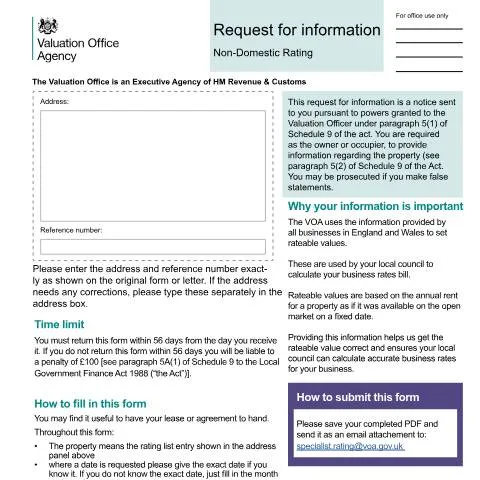
Understanding the Importance of VO 6056 in Non-Domestic Rating
The VO 6056 form is a critical document within the Non-Domestic Rating system in the UK, specifically designed for owners or occupiers of properties involved in electricity generation. This form facilitates the Valuation Office Agency (VOA) in determining accurate rateable values, which in turn influence local councils' calculations of business rates. This interplay not only impacts local governance funding but directly affects the financial obligations of businesses operating within these premises.
Who Must Submit the VO 6056 Form?
The obligation to submit the VO 6056 form falls primarily on individuals or entities operating electricity-generating installations. This includes renewable energy producers, fossil fuel generators, and any other establishments involved in electricity generation activities. They must provide comprehensive financial data concerning their operations, as this information is pivotal in establishing accurate rateable values.
In specific circumstances, the requirement to complete this form can extend to:
- Tenants or lessees who occupy properties with installed electricity generation capabilities.
- Landowners hosting such equipment, particularly when different entities manage the generation operations.
Failure to submit this form can lead to penalties, adding a layer of urgency to its completion, particularly for those unfamiliar with the non-domestic rating processes.
Gathering Required Information: A Step-by-Step Approach
Completing the VO 6056 form necessitates thorough preparation and the collection of various documents and data. Here’s a systematic approach to ensure all required information is at hand:
- Occupational Data: Confirm the details about your current occupancy. This includes the full postal address of the property, your status as the occupier, and any associated landlord details.
- Technical Specifications: You’ll need to provide specifics about the generator(s) used, including their installed capacity and technology type.
- Financial Information: Prepare accurate financial records that detail your trading receipts and expenditures over the last three financial years. This data is crucial for establishing your gross receipts and associated costs.
- Compliance Documentation: Include any lease agreements or contracts relevant to the property. These can provide context for your occupancy and financial obligations.
Key Deadlines and Consequences of Non-Compliance
Timeliness is essential when dealing with the VO 6056 form. Once received, it must be returned within 56 days; otherwise, the submitter faces a potential penalty of £100. This strict timeline enforces accountability and encourages prompt submissions to aid in the maintenance of accurate rating lists.
In situations where the deadline is missed, the following might occur:
- The potential for increased penalties, further hampering your business’s financial standing.
- Delayed processing of your rateable value, which may lead to inaccuracies in your business rates assessment.
- Increased scrutiny from the Valuation Office, which could result in more frequent requests for information in the future.
The Role of VO 6056 in Business Rate Assessments
The VO 6056 form serves as a pivotal element in a broader framework that impacts how business rates are calculated. The information supplied helps the VOA establish the annual rent value for properties as if they were available on the open market on a specified date.
This assessment process works as follows:
- The VOA collects information from various sources, including the data provided via the VO 6056 form.
- Rateable values, influenced by the reported financial data, are subsequently calculated and compiled into a rating list.
- Local councils utilize this rating list to determine the amount of business rates that each property owner or occupier must pay.
As such, the accuracy of the information provided on the VO 6056 form directly correlates to the legitimacy of the business rates charged.
Understanding the Financial Reporting Requirements
One of the most substantial components of the VO 6056 form is the detailed reporting of financial data over the last three years. This section not only asks for gross receipts but also necessitates a breakdown of specific revenue streams related to electricity generation:
- For Renewable Generators: This may include electricity sales, by-product sales, Renewable Heat Incentive payouts, and Feed-in Tariff revenues.
- For Fossil Fuel Generators: Expected categories here might cover fossil fuel electricity sales, sales of steam or heat, and payments received under various contracts.
Additionally, the form requires a declaration of costs associated with operating the business, including:
- Fuel or feedstock expenses.
- Wages and salaries, excluding National Insurance contributions.
- Maintenance and operational costs.
Potential Pitfalls: Avoiding Common Mistakes
While filling out the VO 6056 form, there are several pitfalls to be aware of to ensure successful submission:
- Inaccurate Information: Always double-check figures before submission. Misreporting income or expenses can lead to penalties or incorrect rateable values.
- Missing Deadlines: Develop a reminder system for submission timelines to avoid penalties associated with late submissions.
- Failure to Provide Documentation: Lack of supporting documents can lead to the form being deemed incomplete, prompting unnecessary delays and complications.
Final Steps in the Submission Process
Once the VO 6056 form is complete, the next steps involve submitting the form to the VOA. The preferred method is via email, ensuring that the completed form is saved and attached as a PDF for clarity and completeness.
Here’s the streamlined process for submission:
- Ensure that all sections of the form are filled out accurately.
- Compile any necessary supporting documentation that corroborates the financial data provided.
- Convert the completed form into a PDF format.
- Email the PDF to the designated address provided on the form.
After submission, you may receive confirmation from the VOA, which can take several weeks. It’s advisable to maintain a record of your submission for your files.
Post-Submission: What Happens Next?
The aftermath of submitting the VO 6056 can evoke mixed emotions. On one hand, timely submission allows for the maintenance of up-to-date rateable values; on the other hand, businesses may find themselves awaiting a response from the VOA.
Typically, the following occurs:
- The VOA reviews the submitted information, cross-checking it against existing data and other submitted forms.
- A determination is made regarding the rateable value for your property, which will be communicated back to you.
- If discrepancies arise, the VOA may reach out for additional information or clarification.
Being proactive and transparent during this process can ease concerns and establish a positive dialogue with the VOA.
Understanding the VO6056 Form for Rental Information
The VO6056 form is an essential document for landlords and property owners in the UK, specifically relating to the reporting of rental income and associated costs, particularly concerning electricity generators. Understanding the details and requirements of this form can significantly impact your tax responsibilities and property assessments. It is crucial to be aware of what information is required and how to maintain proper records.
When completing the VO6056, you must provide comprehensive details regarding the rental income earned from the property, as well as any expenses incurred in relation to the use of electricity generators. This includes costs associated with the installation, maintenance, and fuel usage of generators, which, if properly documented, can be offset against your taxable rental income.
Furthermore, maintaining clear receipts and documentation not only ensures that you comply with tax regulations set forth by HM Revenue & Customs (HMRC) but also substantiates your claims in case of any inquiries or audits. It is advisable to keep all relevant receipts for at least six years, as required by HMRC guidelines. This documentation should include invoices, fuel receipts, and any maintenance contracts related to the electricity generators utilized in the property.
Common Mistakes to Avoid When Submitting the VO6056
While filling out the VO6056 form, many landlords make common mistakes that can lead to complications or delays in processing. Here are some pitfalls to be mindful of:
- Incomplete Information: Ensure that all sections of the form are fully completed. Missing information can result in processing delays or rejected submissions. Double-check names, addresses, and financial figures.
- Inaccurate Financial Records: Maintaining accurate records of receipts and expenditures is crucial. Ensure that the amounts you report on the VO6056 match your actual records. Discrepancies can lead to questions from HMRC and potentially trigger an investigation.
- Ignoring Deadlines: Awareness of submission deadlines is vital. Submission of the VO6056 should align with your annual tax return deadlines. Failing to submit on time can incur penalties or interest on unpaid tax.
- Neglecting to Seek Professional Advice: If you are uncertain about any aspect of the form or how to report your expenses accurately, it is wise to consult a tax professional. They can provide guidance tailored to your specific situation and ensure compliance with all regulations.
By being aware of these common mistakes and taking proactive measures to avoid them, you can streamline the process of completing the VO6056 form and ensure that you are correctly reporting your rental income and related expenses.
Impact of Electricity Generators on Property Valuation
The inclusion of electricity generators in rental properties can significantly influence property valuation and the overall rental market. As the UK moves towards a more sustainable energy future, properties equipped with eco-friendly generators may see a positive increase in their market value.
When assessing a property for valuation, agencies such as the Valuation Office Agency (VOA) consider various factors, including the availability of utilities and the efficiency of energy sources. Properties with on-site electricity generation can be viewed as more attractive to potential tenants, particularly in the context of rising energy costs and environmental concerns.
Furthermore, energy efficiency ratings play an integral role in rental price settings. Properties with higher energy ratings often demand higher rents. If you are considering adding electricity generators to your property, it is advisable to conduct a cost-benefit analysis. Examine installation costs against potential rental income increases and consider consulting with estate agents or valuers to provide insights into how such improvements could affect your property's market position.
It is also worth noting that any improvements made to your property may require certain permissions or assessments to ensure compliance with local regulations. This may include notifying your local council about the installation of generators or adhering to specific environmental standards. Engaging with local authorities or a professional can help guide you through these requirements.