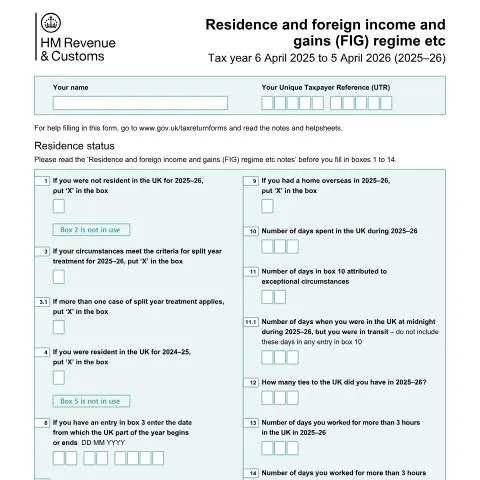
When International Tax Complexity Meets UK Self Assessment: SA109 Decoded
The SA109 form sits at the intersection of UK tax residence rules and international financial obligations, serving taxpayers whose lives span borders and whose income flows across jurisdictions. This supplementary page to the main Self Assessment return addresses some of the most intricate scenarios in UK taxation, from split-year treatment to the newly introduced Foreign Income and Gains (FIG) regime that replaced the remittance basis from April 2025.
Unlike straightforward domestic tax returns, the SA109 requires taxpayers to navigate residence tests, count physical presence days, and determine their status under complex international agreements. The form's four pages encompass residence determination, double taxation relief, overseas workday benefits, and transitional arrangements for those caught between old and new regimes.
Residence Tests and the Mathematics of Physical Presence
The opening section of SA109 revolves around establishing UK tax residence through a series of automatic tests and sufficient ties. Box 10 requires the precise count of days spent in the UK during the tax year, a seemingly simple request that conceals considerable complexity.
Days are counted using the midnight rule – you're present for a day if you're in the UK at midnight. However, box 11.1 specifically excludes transit days, recognising that brief airport stopovers shouldn't contribute to residence determination. Box 11 allows for exceptional circumstances, such as medical emergencies or natural disasters that prevented departure, to be excluded from the day count.
| Residence Category | Key Threshold | Additional Requirements |
|---|---|---|
| Automatic UK resident | 183+ days in UK | None required |
| Automatic overseas resident | Under 16 days in UK | No UK ties permitted |
| Sufficient ties test | 16-182 days | Ties assessment required |
Box 12 captures the number of UK ties, which include family connections, accommodation availability, substantive UK work, and spending more than 90 days in any previous tax year. The interaction between day counts and ties determines residence status for those falling between the automatic tests.
Split-Year Treatment: When One Tax Year Becomes Two
Boxes 3 and 3.1 address split-year treatment, a relief mechanism for those whose circumstances change mid-year. Rather than applying full-year residence rules, split-year treatment allows the tax year to be divided into UK and overseas portions. Box 6 requires the specific date when the UK portion begins or ends.
Multiple cases might apply simultaneously – someone might qualify under both the overseas work case and the partner's overseas work case, hence box 3.1's provision for overlapping scenarios. This commonly affects couples where one spouse's international assignment triggers split-year treatment for both partners.
Navigating Double Taxation Agreements and Non-Resident Allowances
The middle section of SA109 addresses the complex interplay between UK tax obligations and international agreements. Boxes 15 and 16 determine eligibility for personal allowances as a non-resident, a benefit typically reserved for UK residents but extended through Double Taxation Agreements (DTAs) or other specific provisions.
Box 17 requires country codes for nationality and residence, while box 18 captures tax residence in other jurisdictions. This information feeds into the dual residence provisions found in many DTAs, where tiebreaker rules determine the primary tax residence when someone qualifies as resident in multiple countries.
Relief Calculations Under International Agreements
Boxes 20-22 quantify relief claimed under DTAs, with specific references to Helpsheets 302 and 304 for detailed guidance. Box 21 addresses situations where a DTA awards residence to another country, effectively overriding UK residence determination for tax purposes. Box 22 covers other DTA provisions, such as specific exemptions for certain income types.
The requirement to submit additional claim forms alongside the SA109 reflects HMRC's need for detailed justification when international agreements override domestic tax rules. These calculations often involve partial relief where only certain income types benefit from DTA protection.
The Foreign Income and Gains Regime: Post-2025 Tax Planning
From April 2025, the FIG regime fundamentally altered how UK tax applies to foreign income and gains for non-domiciled individuals. Boxes 28 and 29 allow claims for relief under this new system, which provides a four-year exemption period for newly arrived UK residents.
Unlike the previous remittance basis, the FIG regime operates on a temporal basis rather than depending on whether foreign income is brought to the UK. Box 30 addresses the complex qualifying asset holding company (QAHC) rules, where UK income might be deemed foreign for FIG purposes.
Transitional Arrangements and Legacy Remittances
Box 37 continues to capture remittances of nominated income and gains from the pre-2025 era, recognising that the transition between regimes creates ongoing obligations. The £10 aggregate limit acknowledges that minimal remittances shouldn't trigger complex reporting requirements.
Boxes 38 and 39 address qualifying business investments, a relief mechanism allowing foreign income to be invested in UK businesses without triggering immediate tax charges. The provision for multiple company registrations reflects the commercial reality of diversified investment strategies.
Overseas Workday Relief: Employment Income Across Borders
The OWR provisions in boxes 40-49 address a specific scenario: UK residents with overseas employment income who can demonstrate that certain workdays were performed outside the UK. This relief prevents double taxation on employment income while maintaining UK residence benefits.
Box 40 covers the initial election, while box 41 addresses ongoing claims. The distinction reflects OWR's structure as an elective relief requiring formal notification to HMRC. Box 43 captures transitional provisions for those moving between different relief regimes.
The calculation boxes (44, 46-49) require careful apportionment between UK and overseas workdays. Box 47's financial limit prevents the relief from exceeding reasonable bounds, while boxes 48 and 49 capture the actual relief claimed and total amounts respectively.
Employment Gap Provisions
Box 8 specifically addresses employment gaps, recognising that career transitions often involve periods without formal employment. During these gaps, the normal workday-based calculations don't apply, requiring alternative approaches to determine relief eligibility.
Temporary Repatriation Facility: Managing Historical Accumulations
Boxes 50-53 introduce the Temporary Repatriation Facility, designed to address accumulated foreign income and gains from the pre-FIG era. This facility allows a managed transition for those with substantial overseas accumulations who might otherwise face significant tax charges.
The TRF operates through designations rather than actual remittances, allowing taxpayers to plan the tax impact of bringing foreign accumulations to the UK. Box 51 covers personal designations, while box 52 addresses trust-related amounts, reflecting the complex structures often used for international tax planning.
Box 53 captures actual remittances of previously designated amounts, creating a clear audit trail between designation and physical transfer. The reference to box 54 for additional information recognises that TRF calculations often require detailed explanations of complex international structures.
Documentation Requirements and Supporting Evidence
The SA109 demands substantial supporting documentation, particularly for international elements. Residence determination requires evidence of physical presence, often supported by passport stamps, travel records, and accommodation receipts. Employment-related claims need contracts, payslips, and workday records spanning multiple jurisdictions.
Double taxation relief claims require copies of foreign tax assessments and payment evidence. The form's references to specific helpsheets (302, 304) indicate where additional claim forms must accompany the SA109, creating a comprehensive submission package.
| Claim Type | Primary Evidence Required | Additional Forms |
|---|---|---|
| Residence determination | Travel records, accommodation proof | None |
| DTA relief | Foreign tax certificates | Helpsheet 302/304 claims |
| OWR claims | Employment contracts, workday logs | Detailed calculations |
| FIG regime | Arrival date evidence | Income source documentation |
Box 54: The Overflow Mechanism
The final box serves as an overflow mechanism for complex scenarios that don't fit standard form fields. Multiple boxes specifically reference box 54 for additional information, indicating HMRC's recognition that international tax arrangements often require narrative explanation beyond tick-boxes and figures.
This space commonly contains explanations of unusual circumstances, detailed breakdowns of complex calculations, and clarifications of international structures. The quality of information provided here often determines whether HMRC accepts claims without further enquiry.
Strategic Timing and Annual Obligations
SA109 submissions follow the standard Self Assessment timeline, with the form due by 31 January following the end of the tax year. However, the international elements often require earlier planning, particularly for elections and claims that must be made within specific timeframes.
The FIG regime's four-year exemption period creates planning opportunities for newly arrived residents, but requires careful coordination with arrival dates and income timing. Similarly, OWR elections must be made by specific deadlines to preserve relief eligibility for the relevant tax year.
The form's interaction with previous and future years – through boxes addressing prior residence and ongoing obligations – reflects the reality that international tax planning operates across multiple tax periods. Changes in residence status, employment arrangements, or family circumstances can retrospectively affect earlier tax years or create obligations for future periods.
For taxpayers navigating these complexities, the SA109 represents both an annual compliance obligation and a strategic tool for managing international tax exposure. The form's detailed requirements reflect the UK's sophisticated approach to taxing globally mobile individuals while preventing abuse of international arrangements.
Complex Scenarios: Multiple Residence Status Changes Within a Tax Year
Taxpayers who experience multiple changes in residence status during a single tax year face particularly complex SA109 reporting requirements. This commonly affects individuals in transitional career phases, those with family circumstances requiring frequent international travel, or professionals on temporary overseas assignments that extend or contract unexpectedly.
When your residence status changes multiple times between 6 April and 5 April, you must calculate your tax liability for each distinct period using the appropriate basis. For instance, if you become UK resident on 1 July, cease UK residence on 15 December, then resume UK residence on 20 February, you'll have three separate calculation periods requiring different treatment of foreign income and gains.
During periods of UK residence, you report worldwide income and gains on SA109, applying any available reliefs such as the remittance basis or split-year treatment where eligible. For non-resident periods, you generally only report UK source income, though certain foreign income may still be taxable if it relates to UK activities or if you remain ordinarily resident under the pre-2013 rules (for those with historic ordinary residence status).
The split-year provisions in sections 26-28 of ITA 2007 may apply to some of these periods, potentially reducing your UK tax liability during partial residence periods. However, split-year treatment requires meeting specific statutory tests, and not all residence changes qualify. Common qualifying scenarios include starting or ceasing full-time UK employment, moving overseas for full-time work, or returning to the UK after a period of overseas residence.
Capital gains tax calculations become particularly intricate with multiple status changes. You must determine your residence status on both the date of acquisition and disposal for each asset. Where you're resident for part of the ownership period only, time apportionment or rebasing to market value at the point of becoming resident may apply, depending on the specific circumstances and the nature of the asset.
HMRC expects detailed supporting documentation for multiple residence changes, including employment contracts, lease agreements, utility bills, and evidence of your main home during each period. The residence status for each period must be clearly established before completing the relevant sections of SA109, as errors in status determination will cascade through all income and gains calculations.
SA109 Supplementary Pages: When and Which Additional Forms Apply
The SA109 form often requires additional supplementary pages depending on your specific circumstances and types of foreign income or gains. Understanding which supplementary forms to include prevents delays in processing and ensures complete compliance with reporting obligations.
SA108 (Capital Gains) becomes mandatory when reporting foreign capital gains that don't qualify for private residence relief or other exemptions. This includes gains on overseas property, foreign securities, or disposal of interests in overseas partnerships and companies. The interaction between SA108 and SA109 is crucial for non-domiciled individuals claiming the remittance basis, as you must demonstrate that foreign gains haven't been remitted to the UK.
For individuals with foreign rental income, SA105 (UK Property) may seem irrelevant, but foreign property income is actually reported within SA109 itself. However, if you own UK property alongside foreign property, both SA105 and SA109 become necessary, with careful attention to avoid double-reporting rental losses that might offset other income categories.
SA103 (Self Employment) applies when foreign self-employment income exists alongside other foreign income types. This commonly affects consultants, freelancers, or professionals operating internationally. The foreign earnings deduction available under section 378 ITEPA 2003 may apply to some foreign employment income, but this relief doesn't extend to self-employment profits, creating different reporting requirements on SA103 versus SA109.
Partnership income from overseas partnerships requires SA104 (Partnership) in addition to SA109, particularly complex when the partnership has both UK and foreign source income. The mixed membership rules for partnerships with both resident and non-resident partners create additional complications, potentially affecting whether income is treated as arising in the UK or overseas.
Trustees of overseas trusts or beneficiaries receiving distributions must consider SA107 (Trusts) alongside SA109. The interaction between trust taxation and the remittance basis creates particularly complex scenarios, especially where trustees are non-UK resident but beneficiaries are UK resident non-domiciled individuals. The source of trust income and gains, timing of distributions, and beneficiary's residence and domicile status all influence the reporting requirements.
Employment-related securities and share schemes with international elements may require SA101 (Employment) supplementary pages alongside SA109. This particularly affects employees of multinational companies with share option schemes, where the employment is partly overseas, or where securities are in overseas companies. The interaction between employment income taxation and capital gains on share disposals requires careful coordination between these forms.
Record-Keeping and Evidence Requirements for International Tax Compliance
Comprehensive record-keeping for SA109 extends far beyond simple income records, encompassing residence evidence, remittance tracking, and detailed transaction documentation. HMRC's compliance approach for international taxpayers emphasises substance over form, requiring evidence that supports both the reported figures and the underlying tax positions claimed.
Residence status documentation must be contemporaneous and comprehensive. Bank statements alone are insufficient; HMRC expects evidence of your main home, family location, social and economic ties, and the substance of time spent in each jurisdiction. For statutory residence test purposes, detailed travel records including entry and exit stamps, boarding passes, hotel receipts, and diary entries become crucial evidence. Many taxpayers underestimate the importance of maintaining detailed day-count records, particularly when close to the 183-day threshold or when claiming treaty benefits.
Foreign income documentation requires original source evidence in the local language, with certified translations where necessary. Pay slips, employment contracts, rental agreements, bank statements from overseas accounts, and dividend vouchers must be retained in their original form. For rental income, detailed records of allowable expenses, currency conversion rates on the date of receipt, and evidence of any foreign taxes paid become essential for accurate reporting and relief claims.
Remittance tracking for non-domiciled individuals demands meticulous record-keeping of all UK receipts and their overseas sources. Each transfer to UK accounts must be traced to its specific overseas source, with clear segregation between capital, clean capital, and income. Mixed accounts require sophisticated record-keeping systems to track the composition of funds and apply HMRC's ordering rules correctly. Credit card usage overseas funded by UK accounts, or UK usage funded by overseas accounts, creates complex remittance scenarios requiring detailed transaction analysis.
Currency conversion records must be maintained for all foreign income and gains, using appropriate exchange rates for the date of receipt or disposal. HMRC accepts various exchange rate sources, including Bank of England rates, commercial rates, or average rates for regular income, but consistency in approach is essential. For significant transactions, evidence of the actual exchange rate used may be required, particularly where material differences exist between available rates.
Double taxation relief claims require comprehensive documentation of foreign taxes paid, including original tax certificates, payment confirmations, and evidence of the overseas tax computation. Where foreign taxes are paid in instalments or subject to withholding, detailed reconciliation of taxes paid to taxes due becomes necessary. Some jurisdictions issue tax certificates in local languages only, requiring certified translations for HMRC purposes.
Treaty benefit claims necessitate evidence of overseas tax residence, typically requiring tax residence certificates from the relevant overseas tax authority. These certificates often take considerable time to obtain and may require renewal annually. The interaction between treaty benefits and domestic law reliefs requires careful documentation of eligibility for each claimed position.
Electronic records are acceptable, but HMRC recommends maintaining both digital and physical copies of critical documents. Cloud storage systems should ensure UK data protection compliance, particularly when storing sensitive financial information. Regular backup systems prevent loss of crucial compliance evidence, and organised filing systems enable efficient response to HMRC enquiries or information requests.