The SA100 Self Assessment Tax Return: Navigating Your Annual Tax Declaration
Every spring, millions of UK taxpayers face the familiar ritual of completing their Self Assessment tax return, with the SA100 form serving as the cornerstone document for declaring income, capital gains, and claiming reliefs for the previous tax year. The form SA100 2018, covering the tax year from 6 April 2017 to 5 April 2018, represents more than just a bureaucratic requirement—it's a comprehensive financial snapshot that determines your tax liability and potential repayments. Unlike the straightforward PAYE system that handles tax automatically for many employees, Self Assessment places the responsibility squarely on the taxpayer to accurately report all sources of income and ensure compliance with HM Revenue & Customs requirements.
The SA100 differs significantly from other HMRC forms such as the P60 annual statement or P11D benefits declaration, as it requires active completion rather than passive receipt. While these documents provide information to you, the Self Assessment return demands that you provide comprehensive information to HMRC, backed by supporting documentation and careful calculation of your tax position.
Who Must Complete the SA100 and When Self Assessment Becomes Mandatory
The obligation to complete a Self Assessment tax return isn't universal—it typically applies to specific categories of taxpayers whose circumstances fall outside the standard PAYE system. Self-employed individuals and business partners must always file, regardless of their earnings level. Similarly, anyone with untaxed income exceeding £1,000 annually—including rental income, investment returns, or freelance earnings—generally needs to complete the SA100.
Higher earners face particular scrutiny: those with total income over £100,000 must file, as must anyone receiving the Child Benefit where either partner earns above £50,000 (triggering the High Income Child Benefit Charge). Capital gains exceeding the annual exempt amount also necessitate a return, even if no tax is ultimately due.
| Taxpayer Category | Filing Requirement | Key Threshold |
|---|---|---|
| Self-employed/Partnership | Mandatory | Any level of trading income |
| Rental income | Required if over £1,000 | £1,000 annual threshold |
| High earners | Mandatory | £100,000+ total income |
| Capital gains | Required if gains exceed exemption | Annual exempt amount |
| Child Benefit recipients | Required if partner earns £50,000+ | £50,000 income threshold |
HMRC typically issues notices to file around April, but the absence of a notice doesn't eliminate your obligation if you fall into a category requiring Self Assessment. Some taxpayers receive their first notice years after they should have been filing, particularly those whose circumstances change mid-year or who begin receiving untaxed income.
Critical Reference Numbers and Pre-Filing Preparation
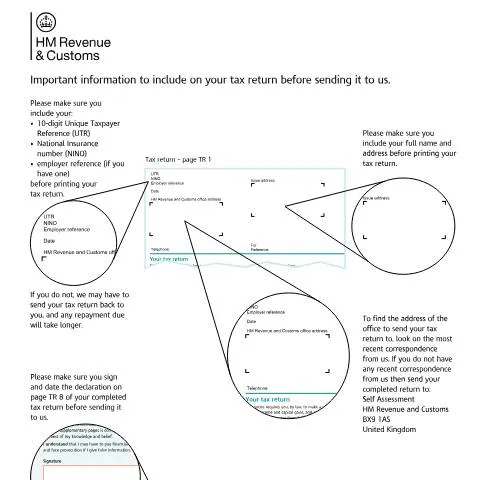
Before attempting to complete the SA100, three essential reference numbers must be secured and verified. The 10-digit Unique Taxpayer Reference (UTR) serves as your primary identifier within the Self Assessment system. This number, typically beginning with digits like 1, 2, or 7, remains constant throughout your taxpaying life and appears on previous tax returns, statements of account, and correspondence from HMRC.
Your National Insurance number (NINO) provides the secondary identification layer, linking your Self Assessment records to your broader HMRC profile including PAYE employment history and benefit claims. The format follows the pattern of two letters, six digits, and a final letter (e.g., AB123456C).
The employer reference, while not universally required, becomes crucial for taxpayers with multiple income sources or those who've changed jobs during the tax year. This reference helps HMRC reconcile your declared employment income with the PAYE information they've received from your employers via RTI (Real Time Information) submissions.
Missing or incorrect reference numbers represent one of the most common causes of processing delays. HMRC explicitly warns that returns submitted without proper identification may be returned unprocessed, significantly delaying any repayment due and potentially triggering late filing penalties even when the return was submitted on time.
Gathering Supporting Documentation
The SA100 requires substantiation for virtually every figure entered, making thorough preparation essential. Employment income needs verification through P60 certificates and P11D forms detailing benefits in kind. Self-employed taxpayers must compile comprehensive business records including invoices, receipts, bank statements, and mileage logs.
Investment income requires dividend certificates, interest statements, and details of any tax already deducted at source. Property investors need rental income records, mortgage interest statements, and receipts for allowable expenses including maintenance, insurance, and letting agent fees.
Decoding the SA100 Structure and Core Sections
The SA100 follows a logical progression from basic personal information through increasingly complex financial declarations. The opening section captures essential personal details, with particular emphasis on ensuring address accuracy for future correspondence. Date of birth verification serves a dual purpose—confirming identity and enabling HMRC's systems to calculate age-related allowances and State Pension entitlement automatically.
Phone number provision, while optional, significantly expedites query resolution. HMRC staff can clarify minor discrepancies or missing information without resorting to formal written correspondence, often preventing processing delays.
The income declaration sections follow the tax year structure from 6 April to 5 April, requiring careful attention to timing. Income received in April 2018, for instance, belongs to the 2018-19 tax year, not the 2017-18 return being completed. This timing distinction particularly affects self-employed taxpayers operating on different accounting periods.
Employment Income and PAYE Reconciliation
Employment pages require transcription of P60 information, but taxpayers must verify these figures against their own records. Discrepancies can arise from employer errors, unreported benefits, or timing differences in bonus payments. The form accommodates multiple employments, each requiring separate entry with its own employer PAYE reference.
Benefits in kind from P11D forms add complexity, covering everything from company cars and medical insurance to interest-free loans and accommodation benefits. These benefits often carry tax implications that weren't fully captured through PAYE, necessitating additional tax calculations.
Self-Employment and Business Income
Self-employed taxpayers face the most complex SA100 sections, requiring detailed profit and loss information. The form accepts either simplified cash basis accounting for smaller businesses or traditional accruals accounting for larger operations. This choice affects how expenses are treated and when income is recognised.
Capital allowances for business equipment require careful calculation, with different rates applying to various asset categories. Motor expenses can be claimed using either actual costs (requiring detailed mileage and expense records) or simplified mileage rates published annually by HMRC.
Paper Versus Online Filing: Strategic Considerations
While HMRC strongly promotes online filing, citing that 92% of taxpayers now submit electronically, paper returns retain relevance for specific situations. The SA100 paper form offers tangible benefits for taxpayers with complex affairs requiring extensive supplementary pages, those uncomfortable with digital platforms, or individuals lacking reliable internet access.
Paper filing imposes an earlier deadline—31 October following the tax year end—compared to 31 January for online submissions. This compressed timeline reflects the additional processing time required for manual data entry and verification. However, the October deadline can actually benefit organised taxpayers by forcing earlier completion and potentially earlier repayment processing.
Online filing provides immediate validation of calculations, automatic error checking, and instant acknowledgment of receipt. The system calculates tax liability automatically, reducing arithmetic errors that commonly affect paper returns. Electronic submission also enables faster repayment processing, typically within 5-6 weeks compared to 8-12 weeks for paper returns.
Calculation Methodology and Rounding Rules
The SA100 paper form specifies particular rounding conventions that differ from standard mathematical practice. Income figures should be rounded down to the nearest pound, while expenses and tax already paid should be rounded up. This taxpayer-favourable approach reduces declared income while maximising deductible expenses, potentially reducing overall tax liability.
These rounding rules apply throughout the form, affecting everything from employment income and dividend receipts to business expenses and charitable donations. The cumulative effect of consistent rounding can create meaningful differences in final tax calculations, particularly for taxpayers with multiple income sources.
Deadline Management and Penalty Avoidance
Self Assessment deadlines operate with mechanical precision, offering no discretion for late submission regardless of circumstances. The initial £100 penalty applies automatically to returns filed even one day late, escalating to daily penalties of £10 after three months of delay. These penalties accrue independently of any tax due—even taxpayers expecting refunds face identical penalty structures.
The penalty system distinguishes between filing delays and payment delays, with separate charges applying to each. Late payment penalties start at 5% of unpaid tax after 30 days, rising to 10% after six months and 15% after 12 months. Interest charges accrue daily on both unpaid tax and penalties, compounding the cost of delay.
HMRC's definition of "receipt" requires physical arrival at their processing centres for paper returns or successful electronic transmission for online submissions. Postal delays, courier failures, or technical website issues don't excuse late filing, making early submission essential for paper filers.
Payment Timing and Methods
Tax payments follow the same 31 January deadline regardless of filing method, but payment timing affects cash flow planning. Taxpayers can make payments before completing their returns, particularly useful when estimated liability exceeds available funds on the deadline date.
Payments on account complicate the calculation for many taxpayers, requiring 50% of the previous year's tax liability to be paid by 31 January during the tax year, with the balance due alongside the final return. This system ensures steady revenue flow for HMRC but creates cash flow challenges for taxpayers with irregular income patterns.
Processing Journey and Post-Submission Procedures
Once submitted, SA100 returns enter HMRC's processing pipeline, where different pathways apply depending on submission method and complexity. Simple returns with minimal queries typically process within 4-6 weeks for online submissions or 8-12 weeks for paper returns. Complex returns involving multiple income sources, substantial expenses, or unusual circumstances may require additional scrutiny, extending processing times considerably.
HMRC's processing systems automatically cross-reference declared income against third-party data including employer RTI submissions, bank interest reports, and dividend notifications. Significant discrepancies trigger queries that can delay processing while awaiting taxpayer explanation or supporting documentation.
Repayment claims receive particular attention, with HMRC applying enhanced verification procedures to prevent fraudulent claims. Large repayment requests often prompt detailed reviews including requests for additional evidence and, in some cases, compliance visits to verify claimed circumstances.
Tracking Your Return's Progress
Online account holders can monitor their return's processing status through HMRC's digital services, receiving updates as the return progresses through various stages. Paper filers rely on postal correspondence, making accurate address information crucial for receiving processing updates and queries.
Statement of account documents provide the definitive record of your tax position, showing calculated liability, payments received, and any outstanding balance. These statements typically arrive 4-8 weeks after return processing, serving as formal confirmation of HMRC's acceptance of your declared position.
Supplementary Pages and Complex Income Scenarios
The core SA100 form accommodates standard income types, but many taxpayers require additional supplementary pages for specific circumstances. Partnership income necessitates SA104 pages detailing your share of partnership profits, losses, and tax credits. Property income requires SA105 pages covering rental receipts, allowable expenses, and capital improvements.
Foreign income creates particular complexity, requiring SA106 pages that address overseas earnings, foreign tax credits, and potential double taxation relief. These pages demand careful attention to timing differences between UK and foreign tax years, currency conversion calculations, and treaty provisions affecting tax liability.
Capital gains reporting through SA108 pages requires detailed transaction records including acquisition dates, disposal proceeds, and allowable costs. The annual exempt amount application and loss relief claims add further complexity, particularly for taxpayers with multiple disposals across different asset classes.
Reliefs and Allowances Optimisation
The SA100 provides opportunities to claim various reliefs and allowances that can significantly reduce tax liability. Pension contributions, charitable donations, and business losses all offer potential tax benefits, but claiming these reliefs requires careful documentation and, in some cases, specific timing considerations.
Carry-back elections for losses and pension contributions can affect previous year tax calculations, potentially generating unexpected repayments. However, these elections often have strict time limits and may require amended returns for earlier years, adding complexity to an already demanding process.
The SA100 Self Assessment tax return represents a cornerstone of the UK tax system, requiring careful preparation, accurate completion, and timely submission. Success depends on understanding your obligations, maintaining comprehensive records, and allowing sufficient time for the complexities inherent in declaring diverse income sources and claiming appropriate reliefs. While the process may seem daunting, systematic approach and attention to HMRC's specific requirements ensure compliance and optimise your tax position within the bounds of current legislation.