When Two Decades of VAT Optioning Reaches Its Crossroads
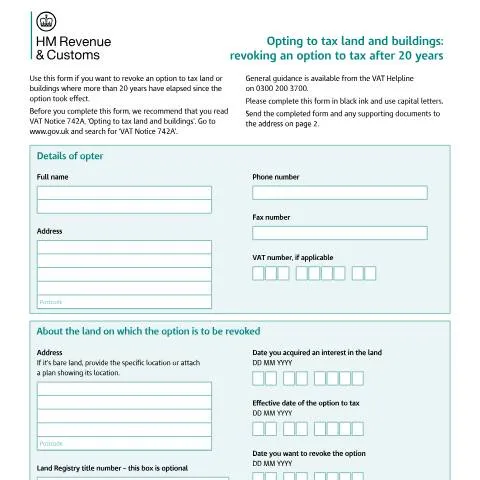
After twenty years of charging VAT on land or buildings through an option to tax election, property owners face a pivotal moment. The VAT1614J form represents their gateway to potentially stepping back from this commitment—but only under strictly defined circumstances that reflect the complex interplay between commercial property taxation and business strategy in the UK.
This isn't simply about paperwork; it's about fundamentally altering the VAT treatment of property transactions that may have shaped business relationships, rental agreements, and financial planning for two decades. The decision to revoke carries implications for future supplies, relationships with tenants, and the broader commercial property portfolio strategy.
The Five-Condition Framework: Your Path to Revocation
HMRC has established a precise hierarchy of conditions that determine whether revocation is possible, and crucially, whether prior permission is required. Understanding this framework is essential before completing any section of the VAT1614J.
The Relevant Interest Condition: The Golden Ticket
Condition 1 stands apart from all others. If you no longer hold a relevant interest in the land or buildings—meaning you've disposed of your legal or beneficial interest—revocation becomes a straightforward notification process. This might occur following a sale, lease expiry, or other disposal that severs your connection to the property.
Meeting this condition bypasses the need to satisfy any of the other four requirements. You simply complete the form, tick the appropriate boxes, and notify HMRC of the revocation. The elegance of this provision recognises that continuing an option to tax on property you no longer control serves no practical purpose.
The Quartet of Technical Conditions
When Condition 1 doesn't apply, you must navigate Conditions 2 through 5, each addressing different aspects of the VAT implications:
| Condition | Requirement | Business Impact |
|---|---|---|
| Condition 220-year rule | At least 20 years must have elapsed since the option took effect | Fundamental eligibility—without this, revocation is impossible unless Condition 1 applies |
| Condition 3Capital items | No outstanding capital item adjustments or all adjustment periods have expired | Prevents revocation where VAT recovery positions remain unsettled |
| Condition 4Valuation | Property value considerations under specific circumstances | Links revocation to current property valuations and market conditions |
| Condition 5Pre-payment | No relevant pre-payments received that would be affected | Protects against disruption to existing contractual arrangements |
The interplay between these conditions determines your route forward. Meeting all four allows automatic revocation upon notification. Meeting only Condition 2 while failing others requires seeking HMRC's discretionary permission—a more complex process requiring detailed justification.
Timing Strategies and Effective Date Planning
The VAT1614J includes a critical choice regarding the effective date of revocation. By default, revocation takes effect from the date HMRC receives your completed form. However, you can specify a later date to align with business planning, lease renewals, or other commercial considerations.
Crucially, you cannot backdate a revocation. This prohibition prevents manipulation of VAT positions on supplies that have already occurred. If you're approaching a significant transaction or lease negotiation, timing your revocation submission becomes a strategic consideration.
The 20-Year Anniversary Window
Many property owners assume they must act immediately upon reaching the 20-year milestone. In reality, there's no expiry date for making a revocation application once the qualifying period has passed. However, each additional year of delay means another year of continued VAT obligations on relevant supplies.
Consider a scenario where your option took effect on 15 March 2004. You become eligible to revoke from 15 March 2024, but you might choose to delay until 1 April 2025 to align with a new lease term or business year. The form accommodates this flexibility while preventing any retrospective unwinding of the VAT treatment.
Property Identification and Documentation Requirements
The form demands precise identification of the land or buildings subject to revocation. This isn't merely administrative—incorrect property identification can invalidate the entire application or create uncertainty about which parts of a larger property portfolio remain opted.
Complex Property Portfolios
Where the original option covered multiple properties or a single option applies to various buildings on one site, each property requiring revocation needs clear identification. The form provides space for Land Registry title numbers, but these remain optional. However, including them significantly reduces the risk of confusion, particularly where properties have been subdivided or consolidated since the original option.
For bare land, the identification requirements become more demanding. Without buildings to provide obvious landmarks, you must either provide a specific location description or attach a plan showing the land's boundaries and location. This requirement reflects the difficulty HMRC would otherwise face in determining exactly which land is affected by the revocation.
Supporting Documentation Strategy
While the form doesn't specify mandatory supporting documents in all cases, strategic document submission can expedite processing and reduce queries. Consider including:
- Copy of original option notification if available, particularly where the effective date might be disputed
- Recent property valuations where Condition 4 applies, demonstrating compliance with valuation requirements
- Legal documentation evidencing disposal where Condition 1 is claimed
- Capital item schedules showing completion of adjustment periods where relevant to Condition 3
Authority and Signature Complications
The signature requirements on VAT1614J reflect HMRC's need to ensure legitimate authority for what can be a commercially significant decision. The form accepts signatures from directors, company secretaries, sole proprietors, partners, or trustees—but notably excludes VAT agents or other third parties unless specific authority is provided.
When Standard Agent Authority Isn't Enough
A critical trap awaits those relying on standard agent arrangements. The form explicitly states that Form 64-8 authorisation doesn't permit agents to sign on behalf of clients for option to tax revocations. This means even long-established agent relationships require additional written authority specifically for this purpose.
This requirement stems from the potentially irreversible nature of revocation decisions and their significant commercial implications. HMRC wants clear evidence that the decision comes from someone with proper authority to bind the business to this choice.
Corporate Governance Considerations
For companies, the signature should come from someone whose authority to make VAT elections is clear from their corporate role. While directors have general authority, company secretaries may need to demonstrate specific authorisation for VAT matters, particularly in larger organisations with defined delegation policies.
Partnerships face additional complexity where the original option was made by different partners than those currently involved. The signature should reflect current partnership authority, potentially requiring evidence of the signatory's current partnership status.
Permission Scenarios: When HMRC Discretion Applies
Meeting Condition 2 (the 20-year rule) but failing to satisfy Conditions 3, 4, or 5 doesn't end your revocation hopes—it shifts the process from automatic notification to discretionary permission. This route requires more detailed justification but recognises that rigid application of all conditions might produce unfair results in specific circumstances.
Building Your Permission Case
Where discretionary permission is required, your explanation must address why the failed conditions cannot be met and why revocation remains appropriate despite this failure. HMRC will consider:
- The commercial rationale for revocation despite technical condition failures
- Whether the condition failure creates genuine VAT avoidance opportunities
- The impact on affected third parties, particularly tenants or purchasers
- Whether alternative approaches might achieve similar commercial outcomes while meeting all conditions
For example, outstanding capital item adjustments (Condition 3 failure) might be justified where the adjustment periods would extend well beyond any reasonable revocation timeframe, or where the amounts involved are minimal compared to the commercial benefits of revocation.
Digital Submission and Processing Pathways
VAT1614J offers multiple submission routes, reflecting modern administrative practices while maintaining audit trails. The traditional postal route to BT VAT at the Bexhill processing centre remains available, but scanned copies can be emailed to the specialist option to tax unit.
Email Submission Advantages
The email route ([email protected]) often provides faster processing and immediate confirmation of receipt. However, ensure your scanned document maintains complete legibility, particularly for signatures and handwritten entries. Poor scan quality can delay processing or trigger requests for resubmission.
When emailing, include a clear subject line referencing the VAT number and property location to aid HMRC's internal routing. Large supporting documents might require multiple emails or compression, but avoid formats that could compromise document integrity.
Processing Timeline Expectations
HMRC doesn't publish specific processing times for VAT1614J applications, but the distinction between notification (where all conditions are met) and permission applications (where discretion is required) significantly affects timescales. Notifications typically process within standard administrative timeframes, while permission applications may require weeks or months depending on complexity and supporting documentation quality.
The VAT Helpline (0300 200 3700) provides general guidance but cannot offer case-specific advice on whether revocation is appropriate for your circumstances. For complex situations, consider whether professional advice might clarify condition compliance before submission.
Post-Revocation Implications and Business Continuity
Successful revocation fundamentally alters the VAT treatment of future supplies from the effective date. This creates a clear before-and-after distinction that affects ongoing commercial relationships, particularly with existing tenants who may have structured their own VAT affairs around your opted status.
Existing lease agreements might include VAT clauses assuming continued opted status. While revocation doesn't breach these agreements, it may trigger rent review clauses or require renegotiation of terms to reflect the changed VAT position. Early communication with affected tenants can prevent disputes and maintain commercial relationships.
The revocation also affects any future option to tax elections on the same property. While not permanently prohibited, making a fresh election soon after revocation might attract HMRC scrutiny regarding the commercial rationale for the change.
Record-Keeping Post-Revocation
Maintain comprehensive records of the revocation process, including copies of the submitted form, HMRC's acknowledgment, and any correspondence. These records become crucial for demonstrating the effective date of revocation in future VAT compliance activities or property transactions.
The 20-year journey that led to eligibility for revocation represents a significant chapter in your property's VAT history. The VAT1614J form marks not just an administrative process, but a strategic business decision with lasting implications for how commercial property generates and accounts for VAT obligations in the years ahead.
Strategic Considerations for Post-20-Year Revocation Decisions
The decision to revoke an option to tax after the 20-year cooling-off period requires careful strategic planning that extends beyond immediate VAT implications. Property owners must evaluate how revocation aligns with their broader business objectives and long-term property strategy.
Market positioning plays a crucial role in this decision-making process. Properties that have been subject to VAT for two decades may have established tenant relationships based on this tax structure. Commercial tenants who have claimed input tax on their rent payments may view a sudden shift to exempt supplies unfavourably, particularly if they cannot adjust their own pricing structures accordingly. Conversely, tenants who cannot recover VAT—such as financial services firms or certain public sector organisations—may welcome the change.
The timing of revocation can significantly impact rental income streams. Properties approaching lease renewal dates present optimal opportunities for revocation, allowing landlords to negotiate new terms that reflect the changed VAT status. However, mid-lease revocations can create complications, particularly where rent review clauses specify VAT-inclusive or VAT-exclusive amounts.
Capital expenditure planning becomes particularly complex when considering revocation. Major refurbishment projects or structural improvements may qualify for input tax recovery if undertaken whilst the option remains in force. However, if revocation occurs before completion of such works, the ability to recover VAT on construction costs may be compromised. This creates a strategic imperative to coordinate revocation timing with planned capital works.
Portfolio-wide implications demand attention for property investors holding multiple assets. Revoking the option on one property whilst maintaining it on others can create administrative complexity, particularly where properties share common services or management structures. The VAT treatment of shared costs, management fees, and service charges requires careful consideration to ensure compliance across the entire portfolio.
Professional advisory costs associated with revocation decisions can be substantial, encompassing legal, tax, and valuation expertise. These costs should be factored into the overall economic assessment, particularly where complex lease arrangements or mixed-use properties are involved.
Impact on Different Property Types and Usage Categories
The implications of revoking an option to tax vary significantly depending on the property type and its intended use. Understanding these variations is essential for making informed decisions about revocation timing and strategy.
Office buildings represent the most straightforward category for revocation consideration. Typically occupied by businesses that can recover VAT on their premises costs, these properties may see limited tenant resistance to maintaining taxable status. However, where office space is let to exempt businesses—such as banks, insurance companies, or educational institutions—revocation can provide a competitive advantage by reducing overall occupancy costs.
Retail properties present more complex considerations due to the diverse nature of retail businesses. High street retailers generally prefer VAT-inclusive arrangements as they can recover input tax, whilst small retailers operating below the VAT threshold may favour exempt supplies. Shopping centres and retail parks must consider the mixed tenant profile, where anchor tenants may have different preferences from smaller units.
Industrial and warehouse properties often involve long-term leases with tenants engaged in manufacturing, distribution, or logistics activities. These businesses typically have significant VAT reclaim capabilities and may prefer continued taxable supplies. However, where properties are used for exempt activities—such as postal services or certain transport operations—revocation may be beneficial.
Mixed-use developments require particularly careful analysis. Where residential elements exist alongside commercial space, the option to tax may only apply to the commercial portions. Revocation decisions must consider how this affects the overall development economics and whether partial revocation is appropriate.
Specialist property types, such as healthcare facilities, educational establishments, or leisure centres, often involve occupiers with limited VAT recovery capabilities. These properties may benefit significantly from revocation, particularly where the end users are charities, local authorities, or other exempt organisations.
The agricultural sector presents unique considerations, as many farming activities benefit from special VAT schemes or exemptions. Farm buildings subject to options to tax may see limited benefit from continued taxable status if the agricultural tenant cannot effectively utilise input tax recovery.
Hotels and hospitality properties operate in a partially exempt environment, with accommodation supplies being exempt whilst food, beverages, and conference facilities remain taxable. The impact of revoking an option to tax on the underlying property must be assessed alongside the mixed VAT position of the hospitality business itself.
Compliance Monitoring and Post-Revocation Obligations
The administrative responsibilities following a successful revocation extend well beyond the initial HMRC notification. Property owners must establish robust systems to ensure ongoing compliance with their changed VAT status and monitor for circumstances that might affect future tax planning decisions.
Record-keeping requirements remain stringent following revocation. HMRC expects comprehensive documentation of the revocation process, including copies of the original option notification, evidence supporting the 20-year eligibility period, and correspondence relating to the revocation request. These records should be maintained for at least six years from the revocation date, consistent with standard VAT record-keeping obligations.
Ongoing monitoring of property usage becomes critical after revocation. Changes in tenant profile, lease terms, or property use may create situations where a new option to tax becomes beneficial or necessary. Property owners should establish regular review procedures to assess whether their VAT strategy remains optimal as circumstances evolve.
The interaction between revoked options and future property transactions requires careful attention. Sale transactions involving properties where options have been revoked may qualify for exemption, potentially affecting the purchaser's VAT recovery position. However, if the purchaser intends to make taxable supplies, they may need to exercise a fresh option to tax, creating timing and cash flow implications.
Lease documentation must be updated to reflect the changed VAT status following revocation. Standard lease clauses relating to VAT treatment, service charge recovery, and rent review mechanisms may require amendment to ensure they remain appropriate for exempt supplies. Failure to update lease terms can create disputes and potential liability issues.
Professional indemnity considerations become relevant where property agents, surveyors, or other professionals have advised on the revocation decision. Ensuring appropriate professional indemnity coverage remains in place provides protection against potential challenges to the revocation strategy or subsequent compliance issues.
Cross-border implications may arise where property ownership involves non-UK entities or where tenants operate internationally. The VAT treatment of exempt supplies to overseas businesses differs from that applicable to taxable supplies, potentially affecting the overall tax efficiency of international property investment structures.
Regular compliance health checks should be instituted following revocation, particularly during the first year when the change in VAT treatment is bedding in. These reviews should encompass tenant billing procedures, service charge apportionment, and any shared cost allocations to ensure all aspects of the property operation reflect the exempt status correctly.
Integration with broader tax planning strategies requires ongoing attention. Changes in corporation tax rates, capital gains tax treatment, or stamp duty land tax rules may affect the relative benefits of exempt versus taxable supplies, necessitating periodic review of the revocation decision's continued appropriateness.