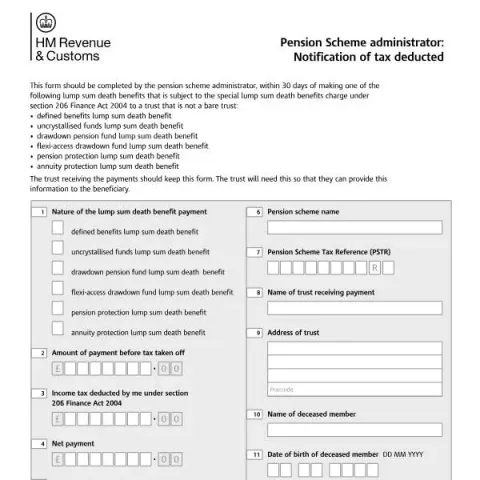
The Vital Role of Form R185 in Pension Administration
When dealing with pension schemes, particularly following the death of a member, the completion of official documentation is crucial. Among these, Form R185 serves an essential purpose in notifying HM Revenue & Customs (HMRC) about tax deductions on lump sum death benefits. This form must be filled out by the pension scheme administrator within 30 days of making a relevant payment, ensuring compliance with tax regulations under the Finance Act 2004.
A Deep Dive into the Types of Lump Sum Death Benefits
Understanding the types of payments subject to notification through Form R185 is vital for administrators. Here’s a breakdown of the lump sum death benefits that necessitate the completion of this form:
- Defined Benefits Lump Sum Death Benefit: Payments made from defined benefit pension schemes.
- Uncrystallised Funds Lump Sum Death Benefit: Payments made before the funds have been accessed.
- Drawdown Pension Fund Lump Sum Death Benefit: Payments made from a drawdown pension.
- Flexi-access Drawdown Fund Lump Sum Death Benefit: More flexible withdrawal options post-75.
- Pension Protection Lump Sum Death Benefit: Payments made under pension protection regimes.
- Annuity Protection Lump Sum Death Benefit: Payments related to annuity contracts.
Each of these categories carries specific implications for taxation and eligibility requirements. Pension scheme administrators must be familiar with these distinctions to ensure accurate reporting and compliance.
Consequences of Failing to Notify or Incomplete Submission
Neglecting to submit Form R185 or providing incomplete information can have significant repercussions for both the trust and beneficiaries involved. Here are some potential outcomes:
- Tax Liabilities: If the form is not submitted, the trust may face unexpected tax liabilities due to incorrect assumptions about tax deductions.
- Delays in Payment: Beneficiaries may experience delays in receiving their payments if the necessary documentation is not completed correctly.
- Legal Repercussions: Failing to comply with HMRC regulations could lead to legal issues for the pension scheme administrator.
Therefore, ensuring the proper completion and submission of Form R185 is not merely a bureaucratic task; it is a critical responsibility that carries financial and legal weight.
Navigating the Form: A Section-by-Section Breakdown
Completing Form R185 accurately is essential. Let’s explore the form’s sections and their specific requirements:
| Section | Description |
|---|---|
| 1 | Nature of the Lump Sum Death Benefit Payment: Select the appropriate type of payment from the defined categories. Accurate selection is crucial to ensure proper tax treatment. |
| 2 | Amount of Payment Before Tax: Enter the gross amount before any tax deductions. |
| 3 | Income Tax Deducted: Report the tax taken off, ensuring it complies with the stipulations of Section 206 of the Finance Act 2004. |
| 4 | Net Payment: This is the amount received by the trust after tax deductions. |
| 5 | Date Payment Was Made: Provide the payment date in the specified format. |
| 6 | Pension Scheme Name: Insert the official name of the pension scheme involved. |
| 7 | Pension Scheme Tax Reference (PSTR): This is a unique identifier for the pension scheme, critical for HMRC records. |
| 8 | Name of Trust Receiving Payment: Clearly state the name of the trust which will receive the lump sum. |
| 9 | Address of Trust: Complete address, including postcode, to ensure accurate correspondence. |
| 10 | Name of Deceased Member: Full name of the deceased pension scheme member. |
| 11 | Date of Birth of Deceased Member: This must be provided to verify the identity of the deceased. |
| 12 | Date of Death of Deceased Member: This date is critical in assessing the legitimacy of the payment. |
Providing accurate and complete information in these sections is essential. Even minor mistakes could result in delays or penalties, underscoring the importance of meticulous attention to detail.
Following Up: What Happens After Submission?
Once Form R185 is submitted, the journey doesn’t end there. Understanding the subsequent steps is crucial for both the pension scheme administrator and the trust. Here’s what typically unfolds:
- HMRC Processing: After submission, HMRC will process the form, which can take several weeks. The trust must keep a copy of the form for its records.
- Beneficiary Notification: The trust should inform the beneficiaries of the payment details, including the net amount they will receive after tax deductions.
- Possible Queries from HMRC: If HMRC has questions or requires additional information, they will reach out to the pension scheme administrator for clarification.
- Record Keeping: It’s imperative for both the trust and the scheme administrator to maintain records of the transaction and the completed Form R185 for at least six years, as HMRC may conduct audits or reviews.
The importance of maintaining open lines of communication between the trust and beneficiaries is paramount throughout this process. Transparency ensures that all parties are informed and aware of their rights and responsibilities.
Preparing the Necessary Documentation: A Checklist
Completing Form R185 may seem straightforward, but being well-prepared with necessary documentation can ease the process. Here’s a checklist that can assist pension scheme administrators:
- Death Certificate: A copy of the death certificate may be required to validate the claim and verify the identity of the deceased.
- Trust Deed: Ensure that the trust deed is available to confirm the legitimacy of the trust receiving the payment.
- Pension Scheme Documentation: Relevant documents from the pension scheme, including the Trust’s PSTR and scheme rules, will aid the completion of Form R185.
- Identification of the Trust: Have the trust’s unique identification numbers and official address at hand to complete the form accurately.
Being equipped with these documents will not only facilitate the smooth completion of Form R185 but will also help in addressing any queries that may arise during the review process.
Common Pitfalls and How to Avoid Them
As pension scheme administrators navigate the completion of Form R185, it’s essential to be aware of common mistakes that can lead to complications. Here are some pitfalls to watch out for:
- Incorrect Type of Payment Selected: Ensure that the nature of the lump sum death benefit is selected accurately, as this determines the applicable tax treatment.
- Missing Signatures: The document must be signed by the administrator to validate the information provided. Omitting this step can delay processing.
- Inaccurate Dates: Ensure that all dates are entered in the correct format (DD MM YYYY) to prevent confusion and potential delays.
- Failure to Keep Copies: Always keep copies of the submitted form for your records, as these may be needed for future reference or audits.
By being aware of these common pitfalls and taking proactive measures to avoid them, administrators can streamline the process and minimize the risk of errors in Form R185 submission.
Conclusion: The Importance of Form R185 in Pension Scheme Compliance
Form R185 is far more than a mere bureaucratic requirement; it plays a pivotal role in ensuring compliance with UK tax laws in relation to pension schemes. By understanding its significance, the types of payments it covers, the correct completion of its sections, and the procedures that follow submission, pension scheme administrators can navigate this essential task with confidence.
Ultimately, the effective management of Form R185 not only safeguards the interests of the trust and the beneficiaries but also upholds the integrity of the pension system as a whole. Proper administration of this form is an integral aspect of sound financial stewardship and compliance within the UK's pension landscape.
Understanding the R185 Form: Purpose and Importance
The R185 form, officially known as 'Tax deducted from pension scheme payments’, serves a crucial role in the broader context of pension administration in the UK. Issued by pension scheme administrators, it outlines the tax that has been deducted from your pension payments during a tax year. Understanding the R185 form is essential for both pensioners and administrators, as it impacts personal tax returns and the overall tax obligations of individuals receiving pensions.
For pension scheme members, the importance of the R185 is twofold: it not only ensures transparency regarding tax deductions but also provides essential information needed to report income accurately to HM Revenue & Customs (HMRC). The R185 form acts as a certificate, confirming the tax already paid on pension income, which can significantly affect the amount owed or due to be refunded to the taxpayer when completing the Self Assessment tax return (SA100). This accuracy is critical, as incorrect information could lead to penalties or overpayment of taxes.
Moreover, the R185 form serves as a safeguard for pensioners, providing them with the necessary documentation should discrepancies arise in their tax records. It's advisable for pensioners to keep this form safely stored, as it may be required for future reference or in the event of an audit.
Fill in your form directly online
No printing: type your details into the boxes of the official form, tick, then download the PDF ready to send.
- 1Type into the form boxes
- 2Tick in one click
- 3Save and download the PDF
Who Needs to Issue an R185 Form?
The responsibility for issuing the R185 form lies with pension scheme administrators. This typically includes private pension companies, occupational pension schemes, and even personal pension plans. These administrators are obligated to provide R185 forms to individuals who have received pension payments during the tax year and from whom tax has been deducted. However, not every pension payment leads to the issuance of an R185.
For instance, if a pensioner is below the personal tax allowance threshold, which is £12,570 for the current tax year (2023/24), tax may not have been deducted from their payments. In such cases, the administrator has no obligation to issue the R185. Additionally, those receiving pension payments from overseas schemes may have different regulations regarding the issuance of tax documentation. It is also essential for pension scheme members to ensure that their administrators have the correct contact details to facilitate proper communication regarding the issuance of the R185 form.
Furthermore, if changes occur in the pension's status—such as transitioning into drawdown, changing pension schemes, or the member's tax residency status—these can prompt the need for new or amended R185 forms. Keeping lines of communication open with the pension administrator is vital in these situations to ensure that the correct information is documented and shared.
How to Use the R185 Form for Your Tax Return
Utilizing the R185 form accurately is essential when completing your Self Assessment tax return. When you receive your R185, it will typically outline not only the total amount of pension income received but also the total tax deducted. Both figures are critical for accurately reporting your income and tax liabilities to HMRC.
When filling out your SA100, you will need to report the gross amount of your pension income alongside the amount of tax that has been deducted, as noted on the R185. This allows HMRC to calculate your total income and determines whether you owe additional tax or are due a refund. If your total income, including your pension, exceeds your personal allowance, you may find that you owe tax on the excess amount. Conversely, if your total income is below the threshold, any tax deducted will likely be refunded.
It's also worth noting that if you have multiple sources of income, including other pensions or earnings, you will need to aggregate these amounts with those reported on your R185. This comprehensive view allows for a clearer assessment of your overall tax liability.
In the case of errors on the R185 form, such as incorrect amounts or missing information, it is imperative to contact your pension scheme administrator promptly. Ensuring that all information is correct before submitting your tax return can prevent delays and complications in processing your return or resolving issues with HMRC.