Understanding Your Obligations When Death Affects Trust Arrangements
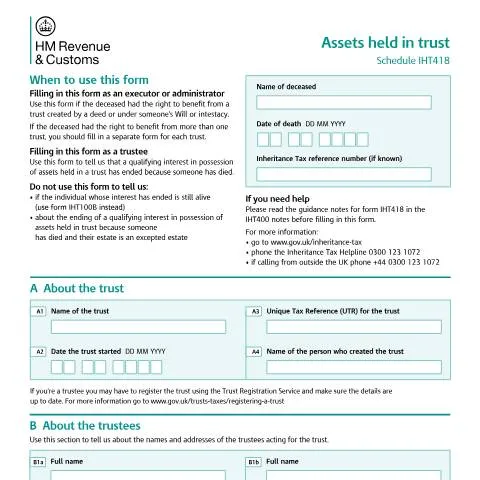
When someone dies who had financial interests in trust arrangements, their passing triggers specific reporting obligations to HM Revenue & Customs. The IHT418 form becomes the crucial bridge between complex trust structures and inheritance tax compliance, yet many executors and trustees discover its requirements only when navigating the aftermath of bereavement. Unlike straightforward estate declarations, trust-related deaths create dual reporting pathways that can catch families and professional advisors off guard.
The form addresses two distinct scenarios that often overlap in practice. Executors dealing with deceased beneficiaries must account for trust interests as part of the estate, while trustees face separate obligations when qualifying interests in possession terminate due to death. This dual nature means that in some cases, the same death triggers multiple IHT418 submissions from different parties, each capturing different aspects of the same underlying trust arrangements.
Trust structures, whether established through lifetime deeds or testamentary provisions, create ongoing relationships between trustees, beneficiaries, and tax authorities. When death severs these relationships, the form ensures HMRC maintains visibility over assets that might otherwise slip between administrative cracks. The timing requirements are unforgiving, and the complexity increases exponentially when multiple trusts or cross-border elements are involved.
Navigating the Executor's Perspective on Trust Assets
For executors and administrators, completing IHT418 requires understanding exactly what constitutes a qualifying interest in possession. The form specifically targets interests that began before 22 March 2006 and remained intact until death, immediate post-death interests, disabled person's interests, transitional series interests, and purchased interests in possession. Each category carries different implications for inheritance tax calculations.
The critical distinction lies between assets the deceased controlled directly and those where they held future rights. Section D2 focuses exclusively on substantial assets—houses, land, buildings, businesses, and controlling shareholdings—that formed part of trust arrangements. These require actual valuations at the date of death, not estimates, creating immediate pressure to secure professional valuations even while funeral arrangements proceed.
Executors often stumble over the future rights provisions in section D4. When the deceased held reversionary interests—waiting for someone else's death to inherit trust assets—the form demands careful analysis of whether these rights were purchased, arose from settlements by the deceased or their spouse, or involved life lease arrangements treated as settlements. The complexity multiplies when determining current values for assets the deceased never directly controlled.
| Asset Category | Valuation Requirement | Reporting Section | Special Considerations |
|---|---|---|---|
| Property and land | Professional valuation at death date | D2 | Include only if trust-held |
| Business interests | Formal business valuation | D2 | Control threshold critical |
| Controlling shares | Market value with control premium | D2 | Define control carefully |
| Bank accounts | Balance at death date | D3 | Include accrued interest |
| Non-controlling shares | Market value | D3 | Exclude from D2 |
| Future interests | Actuarial estimation | D6 | Complex valuation required |
The form's structure forces executors to segregate trust assets by category and control level, but real-world trust arrangements rarely fall into neat categories. Mixed portfolios, part-business part-investment holdings, and properties with commercial and residential elements require judgment calls that affect both immediate reporting and long-term tax consequences.
The Trustee's Duty When Beneficial Interests Terminate
Trustees face fundamentally different obligations under IHT418, focusing on the termination of qualifying interests rather than estate valuation. When a beneficiary dies, trustees must navigate sections E through H, providing comprehensive details about trust assets, the deceased beneficiary's interest, and the consequences of that interest's termination.
The trustee's version requires exhaustive asset disclosure, including detailed descriptions, valuations, and the specific nature of the deceased's beneficial interest. Unlike executors who may use estimated values, trustees must provide precise figures that reflect the trust's actual financial position at the date of the beneficiary's death.
Trustees must also address the continuing life of the trust post-death. The form captures not only what the deceased beneficiary held, but how their death reshapes the trust's beneficial interests. This might involve new beneficiaries acquiring rights, changes to income distribution arrangements, or fundamental alterations to the trust's structure.
Trust Registration Service compliance becomes crucial for trustees. The form explicitly references the requirement to register trusts and maintain current information. Trustees who have neglected registration obligations may find themselves facing multiple compliance issues simultaneously—the immediate IHT418 requirement plus retrospective registration duties.
Decoding Trust Structures and Beneficial Interests
Section A of IHT418 demands precise trust identification, starting with the trust's formal name, commencement date, and Unique Tax Reference. Many trusts, particularly older arrangements, lack clear naming conventions or formal documentation, forcing trustees and executors to reconstruct trust histories from fragmentary records.
The person who created the trust field appears straightforward but can prove complex for trusts established through multiple settlements, corporate arrangements, or international structures. Testamentary trusts might name the deceased testator, but lifetime trusts involving multiple contributors require careful identification of the principal settlor for tax purposes.
Trust commencement dates affect the classification of beneficial interests, particularly the crucial distinction between pre-22 March 2006 interests and later arrangements. This date marks a watershed in inheritance tax treatment, making accurate dating essential for correct tax calculations. Documentation gaps often leave trustees guessing about precise commencement dates, potentially triggering disputes with HMRC over tax treatment.
The Unique Tax Reference requirement assumes trustees have maintained proper registration with HMRC. Unregistered trusts face immediate compliance challenges, as obtaining a UTR typically requires extensive documentation and may delay IHT418 submission beyond acceptable timeframes.
Multiple Trustee Coordination
Modern trust arrangements often involve multiple trustees across different jurisdictions, creating coordination challenges for IHT418 completion. The form accommodates up to four trustees directly, but larger trustee bodies require careful selection of representatives and clear authority delegation.
Professional trustees—banks, solicitors, and trust corporations—bring expertise but also potential conflicts over who bears completion responsibility. The form allows for solicitor or agent involvement, but ultimate legal responsibility remains with the named trustees, regardless of professional delegation arrangements.
Strategic Considerations for Dual-Capacity Situations
The most complex scenarios arise when individuals serve simultaneously as executors and trustees, creating overlapping obligations under different sections of IHT418. Section C forces explicit declaration of capacity, but the practical implications extend far beyond form completion.
Dual-capacity situations often indicate family trust arrangements where the deceased was both beneficiary and trustee, or where surviving family members inherit both estate administration and trustee responsibilities. These arrangements require careful segregation of assets and interests to avoid double-counting or omissions that could trigger HMRC investigations.
When acting in dual capacity, the form directs completion of sections E through I plus the formal declaration, bypassing the executor-only section D. This approach recognises that trustee obligations encompass broader disclosure requirements than simple estate administration, but it can leave executors feeling they've provided incomplete estate information.
Professional advisors often recommend separate IHT418 submissions for each capacity, even when the same individual holds both roles. This approach provides clearer audit trails and reduces the risk of confusion during HMRC review processes, though it requires careful coordination to ensure consistent asset valuations across submissions.
Cross-Reference Requirements with Other IHT Forms
IHT418 rarely stands alone in inheritance tax compliance. Executors must ensure consistency with main IHT400 returns, particularly when trust assets affect the overall estate valuation. Box 76 of IHT400 specifically references future trust rights valued in IHT418, creating a direct link that HMRC systems will cross-check.
The relationship with IHT100B becomes crucial when beneficial interests change without death. Trustees must understand when to use IHT418 versus IHT100B, as incorrect form selection can delay processing and create compliance issues. The key distinction lies in whether the triggering event involves death (IHT418) or lifetime changes (IHT100B).
Practical Asset Valuation Challenges
Trust asset valuation for IHT418 purposes often proves more complex than standard estate valuation. Trust assets may be subject to restrictions, lack ready markets, or involve shared beneficial interests that complicate standard valuation approaches. The form's segregation requirements—separating substantial assets from other holdings—force trustees and executors to make threshold decisions that affect tax calculations.
Properties held in trust present particular challenges, especially when beneficiaries have occupied properties rent-free or below market rates. The form requires market values at death date, but determining these values requires consideration of any restrictions imposed by trust terms, beneficial occupation rights, or planning permissions that might affect marketability.
Business assets in trust arrangements often involve complex valuation methodologies, particularly when the deceased held controlling interests through trust structures. Professional business valuers must consider both the underlying business value and the specific rights and restrictions attached to trust-held interests.
Quoted shares and securities might appear straightforward, but trust-held investments can involve complex arrangements including voting trusts, share classes with different rights, or holdings that straddle the control threshold. The form's distinction between controlling and non-controlling interests requires careful analysis of voting rights, board representation, and practical influence over company affairs.
International Complications
Cross-border trust arrangements create additional valuation and reporting complications. Foreign assets require conversion to sterling at appropriate exchange rates, typically using rates prevailing at the death date. However, some foreign assets may be subject to restrictions on repatriation or local tax obligations that affect their UK inheritance tax value.
Trustees dealing with offshore trust structures must navigate both UK reporting requirements under IHT418 and local compliance obligations in the trust's jurisdiction. Professional advice becomes essential to ensure coordinated compliance across multiple tax systems.
Submission Procedures and HMRC Interaction
IHT418 submission follows standard HMRC inheritance tax procedures, but the trust context creates additional verification requirements. HMRC may request supporting documentation including trust deeds, valuations, and beneficiary identification records. Trustees should prepare comprehensive document packages before submission to avoid delays in processing.
The Inheritance Tax Helpline (0300 123 1072) provides specialist support for trust-related queries, but complex arrangements often require written correspondence to ensure accurate technical guidance. International callers can access the same expertise through +44 0300 123 1072, though time zone differences may affect response times.
Electronic submission capabilities vary depending on the complexity of the trust arrangement and whether professional agents handle the submission. Many practitioners prefer paper submission for complex trust cases to ensure complete documentation reaches HMRC together.
Processing times for IHT418 can extend beyond standard inheritance tax returns, particularly when HMRC requires additional information about trust structures or asset valuations. Trustees and executors should factor these extended timescales into estate administration planning, especially when property sales or other time-sensitive transactions depend on tax clearances.
Ongoing Compliance Monitoring
IHT418 submission creates ongoing relationships with HMRC that extend beyond the immediate death notification. Trustees may face periodic reviews of trust arrangements, particularly where substantial assets or complex structures are involved. Maintaining comprehensive records and professional relationships becomes crucial for managing these ongoing obligations.
The Trust Registration Service requirements continue to evolve, and trustees must monitor changes that might affect their compliance obligations. Regular review of trust structures and beneficiary arrangements helps identify potential IHT418 triggers before they become urgent deadlines.
Understanding the Different Types of Trusts and Their IHT418 Requirements
The nature of your trust fundamentally determines how you complete form IHT418 and which assets require disclosure. HMRC categorises trusts into several distinct types, each carrying specific inheritance tax implications and reporting obligations.
Discretionary trusts present the most complex reporting scenario. Here, trustees hold complete discretion over distributions to beneficiaries, and the trust typically faces the periodic charge every ten years. When completing IHT418, you must declare all trust assets at their full market value, including any accumulated income that hasn't been distributed. Pay particular attention to sections covering investment portfolios, as discretionary trusts often hold diverse asset classes that require separate valuation methodologies.
Interest in possession trusts created before 22 March 2006 benefit from more favourable tax treatment, but still require careful IHT418 completion. The beneficiary with the interest in possession is treated as owning the trust capital for inheritance tax purposes, which affects how you report asset values. When the life tenant dies, you'll need to complete IHT418 as part of the estate's IHT account, detailing how the trust assets transfer or continue.
Bare trusts represent the simplest structure for IHT418 purposes. Since beneficiaries are treated as absolute owners of trust assets, the trust itself typically doesn't face inheritance tax charges. However, you may still need to complete IHT418 when assets transfer into or out of the bare trust, particularly if the settlor retains any benefit or the transfer exceeds annual exemption limits.
Charitable trusts enjoy significant inheritance tax reliefs, but IHT418 completion remains necessary to claim these exemptions formally. Focus on sections detailing charitable purposes and ensure your asset valuations reflect any restrictions on use. Mixed trusts with both charitable and non-charitable purposes require particularly careful attention, as only the charitable portion qualifies for relief.
For employee benefit trusts, IHT418 completion involves additional complexities around employment-related assets. Share options, pension contributions, and other employment benefits held in trust may qualify for business property relief or other exemptions, but you must provide detailed evidence of their qualifying status.
Pilot trusts established to utilise nil rate band allowances require specific attention when completing IHT418. Although these trusts typically hold minimal assets initially, subsequent additions or the ten-year periodic charge can trigger significant reporting obligations. Document carefully any connected trusts or arrangements that might affect the available nil rate band.
When dealing with offshore trusts, IHT418 completion becomes significantly more complex. You must consider the residence status of trustees, the domicile of beneficiaries, and the location of trust assets. Non-UK assets may require different valuation approaches, and currency fluctuations can affect reported values. Ensure you understand which assets fall within the UK inheritance tax net and which benefit from excluded property status.
Protective trusts that include determinable life interests present unique challenges for IHT418 completion. The potential for the interest to determine affects asset valuation, and you may need actuarial calculations to establish the appropriate inheritance tax treatment. Professional valuation becomes particularly important where the protective element significantly affects asset values.
Navigating Complex Asset Valuations and Professional Requirements
Accurate asset valuation forms the cornerstone of proper IHT418 completion, yet many trustees underestimate the complexity involved in establishing market values for inheritance tax purposes. HMRC's approach to valuation scrutiny has intensified significantly, making professional expertise increasingly essential for substantial or unusual assets.
Unquoted company shares represent one of the most challenging valuation exercises for IHT418 purposes. You cannot simply rely on the company's balance sheet or recent transaction values. HMRC expects a comprehensive analysis considering the company's trading position, asset backing, dividend history, and marketability restrictions. The size of the holding affects valuation methodology – a controlling interest commands a premium, while minority holdings may suffer a discount for lack of control.
Consider whether business property relief applies to reduce the taxable value. Trading companies typically qualify for 100% relief, but investment companies or those with significant non-trading assets may qualify for reduced relief or none at all. Mixed trading and investment activities require careful analysis to determine the qualifying proportion. Document thoroughly the company's activities and asset composition, as HMRC increasingly challenges business property relief claims.
Commercial property valuations for IHT418 require professional surveyor input, particularly for investment properties or those with development potential. The valuation date becomes crucial – you must use the value at the relevant chargeable event, not current market conditions. Factors affecting value include lease terms, tenant quality, planning permissions, and market conditions at the valuation date.
For agricultural property, establish whether agricultural property relief applies before determining the taxable value. Working farms and agricultural land typically qualify for 100% relief, but diversified enterprises or land with development hope value may not qualify fully. The occupation requirement becomes critical – ensure the land has been occupied for agricultural purposes for the required period. Tenanted agricultural land may qualify for reduced relief rates depending on the lease terms and tenancy type.
Residential property valuations appear straightforward but contain numerous pitfalls for IHT418 completion. Joint ownership arrangements, rights of occupation, and restrictive covenants all affect market value. Properties with sitting tenants require careful analysis of rental income, tenant rights, and vacant possession values. Listed buildings or those in conservation areas may face restrictions that significantly impact marketability and value.
Art, antiques, and collectibles require specialist valuation for IHT418 purposes. Insurance valuations typically exceed market value and aren't appropriate for inheritance tax. Establish provenance, condition, and current market demand for similar items. Consider whether conditional exemption might apply for items of outstanding national importance – this can provide significant inheritance tax savings but involves ongoing obligations and restrictions.
Investment portfolios need careful attention to valuation dates and methods. Listed securities use the quarter-up rule (lower of closing price or average of highest and lowest marked bargains), while unit trusts and investment funds may have different valuation conventions. Accrued interest, dividend entitlements, and dealing costs all affect the reportable value.
For overseas assets, currency conversion rates at the valuation date determine sterling values for IHT418 purposes. Use HMRC's published exchange rates or, if unavailable, rates from reputable financial sources. Consider whether assets qualify as excluded property due to the domicile status of the settlor or beneficiaries – this can remove assets entirely from UK inheritance tax scope.
Debts and liabilities reduce the taxable value of trust assets, but HMRC applies strict criteria for allowable deductions. Commercial debts at arm's length typically qualify, but loans between connected parties face scrutiny. Ensure debts are legally enforceable and represent genuine obligations. Contingent liabilities may not qualify for deduction unless the liability crystallises before the valuation date.
When professional valuations are required, ensure valuers understand inheritance tax requirements and have appropriate qualifications. The Royal Institution of Chartered Surveyors (RICS) provides guidance for property valuations, while the Institute of Chartered Accountants offers guidance for business valuations. Obtain written valuation reports that clearly state the methodology, assumptions, and inheritance tax context.
Consider the cost-benefit of challenging HMRC valuations. Professional valuation costs can be substantial, but the inheritance tax savings from reduced values often justify the expense. However, unrealistic valuations may trigger penalties, so ensure professional advice supports your position before submitting IHT418.
Managing Compliance Deadlines and Penalty Avoidance Strategies
Meeting HMRC's strict deadlines for IHT418 submission requires careful planning and systematic record-keeping throughout the trust's operation. The penalty regime for late or incorrect submissions has become increasingly severe, making proactive compliance management essential for trustees.
Ten-year anniversary charges create the most predictable deadline pressure for discretionary trusts. You must submit IHT418 and pay any inheritance tax due within six months of the anniversary date. However, starting preparation well in advance proves crucial, as asset valuations, particularly for unquoted investments or property, can take several months to complete properly. Begin the valuation process at least nine months before the anniversary to allow for potential complications or professional disagreements.
The calculation itself involves complex interactions between the trust's nil rate band, previous chargeable transfers, and the effective rate applicable to the trust property. Changes in nil rate bands between chargeable events can significantly affect the calculation, requiring careful analysis of historical rates and their application to trust circumstances.
Exit charges when capital leaves discretionary trusts create unpredictable deadline pressures. You have six months from the exit event to submit IHT418 and pay any charge due. The challenge lies in identifying exit events correctly – some distributions that appear straightforward may not constitute exits, while others that seem routine trigger unexpected charges.
Consider the timing of exit charges carefully within your overall trust management strategy. Distributions shortly before ten-year anniversaries may attract higher effective rates than those made shortly after. The interaction between exit charges and subsequent ten-year calculations requires careful modelling to optimise the overall inheritance tax position.
Addition of property to existing trusts may trigger immediate IHT418 obligations, particularly where the settlor has exhausted annual exemptions or the addition exceeds the nil rate band. The six-month deadline runs from the date property enters the trust, not from when trustees become aware of inheritance tax implications. This makes it crucial to assess tax consequences before accepting additional property into trust.
For interest in possession trusts, IHT418 deadlines typically align with the death of the life tenant or termination of the interest. However, some events during the trust's operation may also trigger reporting requirements. Changes in beneficiary circumstances, variations in trust terms, or appointments of new interests can all create unexpected compliance obligations.
Penalty mitigation becomes essential when deadlines cannot be met despite best efforts. HMRC operates a penalty regime that escalates based on the length of delay and perceived culpability. Initial penalties for late submission may be relatively modest, but daily penalties and tax-geared penalties can become substantial for significant delays.
Reasonable excuse provisions offer protection where delays result from circumstances beyond trustees' control. However, HMRC's interpretation of reasonable excuse has narrowed considerably, and reliance on professional advisers doesn't automatically provide protection. Document carefully any circumstances that might constitute reasonable excuse, and notify HMRC promptly when problems arise.
Record-keeping requirements extend well beyond IHT418 submission deadlines. HMRC can enquire into trust tax affairs for up to four years after submission, or longer where they suspect careless or deliberate errors. Maintain comprehensive records of asset acquisitions, disposals, valuations, and distributions. Professional correspondence, valuation reports, and legal advice should all be retained systematically.
Digital record-keeping offers advantages for trust administration, but ensure backup systems protect against data loss. HMRC increasingly expects electronic records to be readily accessible and properly organised. Consider using professional trust administration software that maintains audit trails and facilitates compliance reporting.
Voluntary disclosure procedures provide opportunities to correct errors in previous IHT418 submissions before HMRC discovers them. The Contractual Disclosure Facility offers reduced penalties for voluntary corrections, but requires full disclosure of all irregularities across all relevant periods. Consider professional advice before making voluntary disclosures, as the process can have wider implications for trust taxation generally.
Payment arrangements for inheritance tax due can help manage cash flow pressures, particularly where trust assets are illiquid. HMRC offers time to pay arrangements in appropriate circumstances, but these must be requested before the payment deadline expires. Interest charges apply to delayed payments, but these may be preferable to forced asset sales in unfavourable market conditions.
For trusts holding business assets, consider whether payment by instalments might apply. Business property and agricultural property may qualify for payment over ten annual instalments, reducing immediate cash flow pressure. However, interest still applies to outstanding amounts, and the relief can be withdrawn if assets are subsequently sold.
Professional indemnity considerations become relevant where trustees rely on professional advice for IHT418 compliance. Ensure advisers carry appropriate professional indemnity insurance and understand their responsibilities under trust law. Trustees remain ultimately responsible for compliance, regardless of professional advice received, making it essential to understand the advice given and its implications for trust administration.