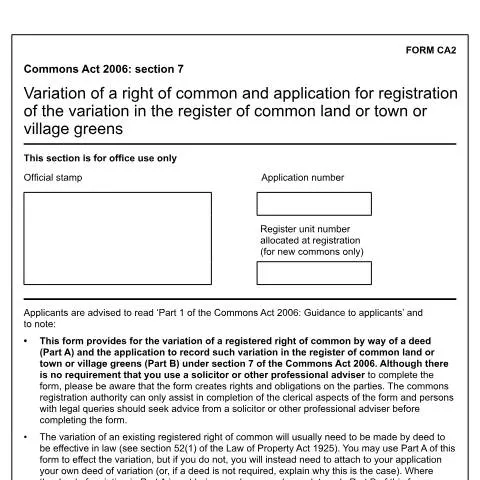
Navigating the Complexities of Form CA2: Your Guide to Changing a Right of Common
Engaging with land rights in the UK, particularly when it involves modifications to a right of common, can be daunting. The Commons Land and Greens: Changing a Right of Common (CA2) form plays a pivotal role in this process. Whether you're a landowner or a community member advocating for access rights, understanding the intricacies of this form can make a significant difference in securing your interests. Here, we delve into the nuances of this official document, exploring each aspect in detail.
Understanding the Context: The Role of the Commons Act 2006
The Commons Act 2006 serves as the legislative framework governing the rights of common in England and Wales. This act provides the mechanism for individuals to register and change their rights over common land and village greens. Understanding this backdrop is crucial for anyone considering the use of form CA2, as it establishes the legal basis upon which your application rests.
Rights of Common Defined
A right of common refers to a right enjoyed by individuals or groups to access and use common land for specific purposes, such as grazing livestock or collecting firewood. Variations in these rights can arise due to changes in land ownership or usage, necessitating the use of form CA2. Within this context, the act delineates two main parts of the form: Part A (Deed of Variation) and Part B (Application for Registration).
Unpacking the Form: A Deep Dive into Its Sections
Form CA2 is compartmentalized into distinct sections, each serving a unique function. Understanding these sections is essential to avoid common pitfalls and ensure a smooth application process.
Part A: Deed of Variation
This section focuses on variations to an existing right of common. Here’s a closer look at the key components:
- Existing Servient Landowner(s): You must specify the name and address of the current landowner(s) from whom the right of common is exercisable.
- New Servient Landowner(s): If the right of common is being transferred to a new landowner, their details must also be provided. Ensure accuracy, as errors can delay processing.
- Variation Details: Outline the specifics of the variation. This should explain what rights are being modified and how.
Part B: Application for Registration
This part is critical for formalizing the change in rights. You will need to:
- Provide comprehensive details about the land and the rights being registered.
- Submit evidence supporting your claim, such as historical documents or maps.
- Pay a registration fee, unless your application is exempt.
Filing Your Application: Channels and Procedures
Once you've completed form CA2, the next step involves submission. The process can be executed through different channels, each with its unique considerations.
Online Submission vs. Paper Application
| Channel | Advantages | Disadvantages |
|---|---|---|
| Online | Fast processing, immediate confirmation | Requires technical proficiency |
| Paper | Physical documentation, less technical | Longer processing time, potential postal delays |
Choosing the right method of submission largely depends on your comfort level with technology and the urgency of your application. Regardless of the method, ensure that you retain copies of all submitted documents.
Special Considerations: Handling Unique Situations
Not every application fits neatly into standard categories. Unique circumstances can arise that require additional consideration.
Applications from Foreign Individuals
If you are not a UK resident but wish to submit an application, you may need to provide additional documentation, demonstrating your legal standing and rights concerning the land in question.
Complex Ownership Structures
In cases where multiple landowners exist, or if the land is owned by corporate entities, ensure that all relevant parties are included in the application. This can complicate the process, so clarity and thoroughness are essential.
The Path to Decision: Chronology of the Application Process
Understanding the timeline from submission to decision is vital. Here’s a typical timeline for processing form CA2:
- Submission: Once submitted, your application will enter the queue for review.
- Initial Review: The Commons Registration Authority will assess the completeness of your application.
- Consultation Period: There may be a consultation period where interested parties can raise objections.
- Final Decision: Following the consultation, a decision will be made, and you will be notified.
It is crucial to remain patient during this process, as it can take several weeks or even months, depending on the complexity and the volume of applications being processed.
Post-Submission: What Happens Next?
After receiving a decision, understanding the possible outcomes is essential, especially if your application is contested or denied.
In Case of Refusal
If your application is denied, you will receive a detailed explanation of the reasons for refusal. You have the right to appeal this decision, a process that requires careful attention to legal protocols.
Missing Information
Should your application be incomplete or lacking essential documentation, the registration authority will notify you. It is crucial to respond promptly to rectify any omissions.
Preparing Essential Documentation: A Checklist
Before submitting form CA2, preparing the necessary documentation can save time and prevent delays. Here’s a checklist of essential documents:
- Proof of Identity: Such as a national ID or passport.
- Title Deeds: Documentation proving ownership of the land.
- Map of Land: An up-to-date map marking the areas affected by the right of common.
- Supporting Evidence: Any historical documents that substantiate your claim to the right.
Gathering these documents ahead of time streamlines the application process and fosters a more effective interaction with the registration authority.
Conclusion: The Importance of Diligent Preparation
Form CA2 and the associated processes are vital for ensuring that rights over common land are respected and correctly managed. The stakes can be high, as land rights can impact not only individuals but communities as well. By carefully navigating through each section of the form, understanding the nuances of the application process, and preparing adequately, you can set a solid foundation for a successful application.
Understanding Rights of Common: What They Entail
Rights of common refer to the legal entitlements enjoyed by individuals or groups over land that is not owned by them. These rights can encompass a range of activities such as grazing livestock, collecting firewood, or taking water from a common land area. In the UK, these rights can often be traced back to historical customs and practices, and they are typically governed by specific legal frameworks, which can vary depending on local laws and regulations.
It's important to note that the rights bestowed upon individuals may differ widely based on the type of common land in question. For example, a 'common pasture' might allow for the grazing of animals, while a 'common wood' may grant rights related to timber and firewood collection. Furthermore, users must also be aware that these rights are subject to regulations aimed at protecting the land and ensuring sustainable use. In many cases, the rights of common are documented in a scheme known as the 'Register of Common Land,' maintained by the relevant local authority or land registry.
The Process of Changing a Right of Common
Changing a right of common is not a straightforward task; it involves a structured legal process that must be adhered to in order to ensure compliance with existing statutes and local regulations. The process typically begins with an application to the relevant authority, which in many cases is the local council or the Office of the Deputy Prime Minister, depending on the specific nature of the request.
Applicants will need to provide comprehensive details about the proposed changes, including the rationale behind the request and how the alterations will impact both the common land and existing rights holders. Public notices may also need to be issued to inform the community about the proposed changes, allowing for a period of consultation where objections can be raised. This is vital, as existing rights holders may have concerns that need to be addressed prior to any amendments being approved.
It is also beneficial for applicants to consult the relevant legislation, such as the Commons Act 2006, which outlines the processes and legal requirements for making changes to rights of common. Failing to adhere to these regulations can lead to significant delays or outright rejection of the application.
Dispute Resolution in Common Land Rights
Disputes regarding common land rights can arise for a variety of reasons, including conflicting claims to rights, changes in usage, or disagreements over the management of the land. When disputes occur, it is crucial to understand the framework available for resolution, which can vary significantly depending on the nature of the disagreement and the parties involved.
The first step in resolving a dispute typically involves informal negotiation between the parties. Many disputes can be settled amicably through discussion, which can save time and resources. However, if an agreement cannot be reached, formal mechanisms such as mediation or arbitration may be necessary. These pathways often provide a less adversarial means of resolution, allowing both parties to present their case in a structured environment guided by an impartial third party.
If mediation fails, the matter may need to be escalated to a tribunal. The Environment, Food and Rural Affairs Committee has jurisdiction over many aspects of common land disputes, and they provide clear guidelines on how to proceed. It’s also advisable to seek legal advice, particularly when complex legal rights and historical claims are involved.