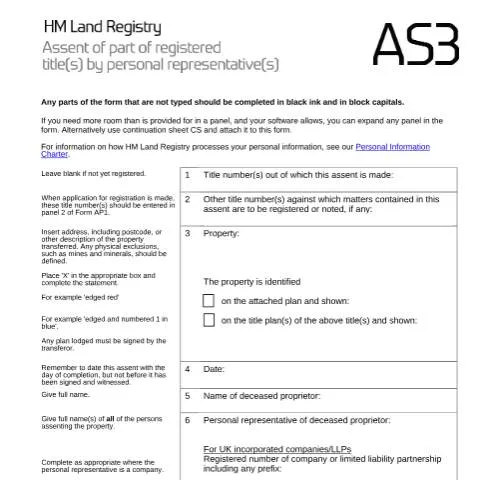
When Property Inheritance Meets Legal Transfer: Understanding the AS3 Assent Process
The death of a property owner triggers a complex legal process that extends far beyond the emotional aftermath of bereavement. When someone inherits real estate in England and Wales, the property doesn't automatically transfer to their name on the Land Register. This is where Form AS3 becomes crucial—a document that bridges the gap between inheritance law and property registration, allowing personal representatives to formally transfer property from a deceased person's estate to the rightful beneficiaries.
Unlike a standard property sale, an assent represents a unique legal instrument where no money changes hands, yet the transfer must satisfy both probate requirements and Land Registry protocols. The AS3 form serves as the official mechanism for this process, enabling executors or administrators to complete what the law recognises as a vesting assent—essentially confirming that the beneficiary now holds legal title to the inherited property.
Navigating the Distinction: AS3 Versus Other Property Transfer Documents
Many people confuse the AS3 assent with other property transfer mechanisms, particularly the standard Transfer of Registered Land (TR1) form. However, these documents serve fundamentally different purposes and operate under distinct legal frameworks.
The AS3 specifically addresses situations where property passes through inheritance, whether under a will or intestacy rules. It requires no consideration (payment) and operates under the Administration of Estates Act 1925, giving it unique characteristics that distinguish it from commercial property transactions.
| Document Type | Purpose | Legal Basis | Key Requirement |
|---|---|---|---|
| AS3 Assent | Inheritance transfer | Administration of Estates Act | Grant of representation |
| TR1 Transfer | Sale or gift | Land Registration Act | Consideration or deed |
| DJP Declaration | Joint proprietor death | Survivorship principle | Death certificate |
The AS3 also differs from a Declaration by Surviving Joint Proprietor (DJP), which applies when property was held in joint names and passes automatically to the survivor through the principle of survivorship. An assent becomes necessary when the deceased was either the sole proprietor or held the property as a tenant in common.
Part-Property Assents: When Inheritance Gets Complex
The AS3 form specifically handles situations involving "part of registered title", meaning the personal representative is transferring only a portion of the property originally owned by the deceased. This scenario commonly arises when:
- The will specifies that different parts of a large property should go to different beneficiaries
- Part of the property needs to be sold to pay estate debts while the remainder passes to beneficiaries
- Agricultural land is being divided among multiple inheritors
- Commercial premises are being split between family members running different aspects of a business
Dissecting the Personal Representative's Authority and Obligations
Section 6 of the AS3 form requires detailed information about the personal representative, but this seemingly straightforward requirement conceals several complexities that can trap the unwary.
Personal representatives fall into two categories: executors (appointed by the will) and administrators (appointed by the court when there's no will or no valid executor). Each type possesses different powers and operates under distinct timeframes, affecting how and when they can complete an AS3 assent.
Executors derive their authority from the will itself, technically holding power from the moment of death, though they typically need to obtain a Grant of Probate before dealing with registered land. Administrators, conversely, have no authority until the court issues Letters of Administration, making the timing of their actions more restrictive.
Corporate Personal Representatives: Additional Complexity Layers
When the personal representative is a company—such as a bank's executor and trustee department or a professional trust corporation—the AS3 requires specific company details including registration numbers and, increasingly important under recent legislation, overseas entity identification numbers.
The Economic Crime (Transparency and Enforcement) Act 2022 introduced new requirements for overseas entities, meaning that foreign companies acting as personal representatives must provide their Companies House overseas entity ID. The form specifically accommodates situations where this requirement doesn't apply, allowing representatives to state "not required" rather than leaving the field blank.
Property Identification: The Critical Foundation of Accurate Transfer
Section 3 of the AS3 addresses property identification, but this apparently simple task often becomes the most technically challenging aspect of the entire process. The form requires precise identification of exactly which part of the registered title is being transferred, and any ambiguity here can result in rejection or, worse, incorrect registration.
The property description must align perfectly with the existing title register while clearly defining any physical exclusions. Common exclusions include mineral rights, which were often retained by previous owners, or specific areas like access ways that serve neighbouring properties.
Plans and Boundaries: Where Precision Meets Legal Certainty
When transferring part of a registered title, a plan becomes essential. The AS3 provides two options: referencing the existing title plan with specific coloured markings, or attaching a new plan that clearly delineates the transferred area.
The form's guidance suggests using phrases like "edged red" or "edged and numbered 1 in blue" when referencing title plans. This colour-coding system, while seemingly archaic, provides legal certainty by creating unambiguous references that surveyors and lawyers can interpret consistently.
Any newly created plan must be signed by the transferor (personal representative), creating a legal declaration that the boundaries shown accurately represent the intended transfer. This signature requirement often catches people off-guard, particularly when dealing with digitally-created plans that need physical signatures before submission.
Transferee Details: Beyond Names and Addresses
Section 7 requires comprehensive transferee information, but the complexity extends beyond basic identification. The form must accommodate various ownership structures, from individual inheritors to companies, trusts, and overseas entities.
Each transferee can provide up to three addresses for service, with specific requirements about what constitutes acceptable addresses. At least one must be a postal address (whether UK-based or international), while others can include DX box numbers or email addresses. This flexibility reflects modern communication preferences while maintaining legal service requirements.
Multiple Beneficiaries: Joint Tenancy Versus Tenancy in Common
Section 11 addresses the crucial distinction between joint tenancy and tenancy in common when multiple people inherit property. This choice has profound implications for future ownership rights and inheritance patterns.
Joint tenants hold equal shares and benefit from survivorship rights—when one dies, their share automatically passes to the surviving joint tenant(s). Tenants in common hold distinct shares (not necessarily equal) that can be left to anyone in their will.
The AS3 form's checkbox system appears simple but requires careful consideration. Selecting joint tenancy means the property will automatically pass to survivors upon death, potentially frustrating future inheritance intentions. Choosing tenancy in common preserves individual control over inheritance but may complicate future property transactions.
Title Guarantee Levels: Understanding the Promise Being Made
Section 10 requires the personal representative to specify whether they're providing full title guarantee or limited title guarantee. This choice represents different levels of legal promise about the property's title quality.
Full title guarantee provides the strongest protection, with the personal representative promising that they have the right to transfer the property, that they'll do everything necessary to give the transferee good title, and that the transferee will enjoy quiet possession without interference from adverse claims.
Limited title guarantee offers reduced protection, typically used when the personal representative hasn't personally owned the property and therefore cannot make comprehensive promises about its title history. This option frequently applies in estate situations where executors are dealing with property the deceased owned for many years.
When Modifications Become Necessary
The form allows for modifications to standard title guarantee provisions, acknowledging that estate situations often involve unique circumstances requiring tailored legal protections. Common modifications might exclude liability for issues the personal representative couldn't reasonably know about or limit guarantees to specific time periods.
Additional Provisions: The Flexibility Panel That Handles Complex Estates
Section 12 provides space for additional provisions, definitions, and agreements that don't fit elsewhere in the form. This section often becomes crucial for complex estates involving multiple conditions, ongoing obligations, or special arrangements.
Typical additional provisions might include:
- Restrictive covenants that bind future owners to specific land use limitations
- Rights of way granted or reserved for access purposes
- Maintenance obligations for shared facilities or boundary features
- Indemnity provisions protecting against specific future liabilities
The form also accommodates a special certificate for conveyancers, allowing qualified legal professionals to certify that they hold original grant documents rather than submitting copies with the application. This streamlined approach reduces paperwork while maintaining verification standards through professional accountability.
Timing and Dating: The Critical Completion Moment
Section 4 requires the assent date, but this isn't simply when the form is completed. The date must reflect the actual completion moment—when all parties have signed and the transfer becomes legally effective. Dating the form before all signatures are complete can invalidate the entire document.
This timing requirement often creates practical challenges, particularly when multiple beneficiaries live in different locations or when overseas entities are involved. The form cannot be validly dated until every required signature and witness confirmation is complete.
Submission Pathways and Registration Integration
Completing the AS3 represents only the first step in a broader registration process. The form typically accompanies an Application to Register (AP1), creating a combined submission that updates the Land Register to reflect the new ownership structure.
The AS3 specifically references this integration, noting that title numbers should be entered in panel 2 of Form AP1 when making the registration application. This cross-referencing ensures that Land Registry staff can properly connect the assent document with the registration request.
Supporting documentation requirements vary depending on the estate's complexity and the personal representative's status. Standard requirements include the grant of probate or letters of administration, but additional documents might be needed for overseas entities, corporate representatives, or properties with complex title histories.
HM Land Registry's processing approach prioritises accuracy over speed, meaning that incomplete or ambiguous AS3 submissions will generate requisitions (requests for clarification) that can significantly delay registration. Understanding the form's requirements and preparing comprehensive supporting documentation helps avoid these delays and ensures smooth property transfer completion.
The integration with digital services continues evolving, with increasing emphasis on electronic submission where possible, though the fundamental requirement for proper completion and adequate supporting evidence remains constant regardless of submission method.
Property Valuation and Market Value Implications
When completing Form AS3, the property's valuation becomes a critical consideration that extends beyond mere documentation. The Land Registry requires accurate market value information, particularly when the assent involves inheritance tax considerations or when beneficiaries receive unequal shares of the estate.
For inheritance tax purposes, the property must be valued at its market value on the date of death, not the current market value when the assent is executed. This distinction proves crucial when property markets have fluctuated significantly between the deceased's death and the assent completion. HMRC may challenge valuations that appear inconsistent with comparable properties or professional valuations obtained for probate purposes.
Professional valuations become mandatory in specific circumstances. When the estate's total value approaches the inheritance tax threshold (£325,000 for 2023-24, or £500,000 with residence nil-rate band), HM Revenue and Customs typically requires a formal RICS (Royal Institution of Chartered Surveyors) valuation. This valuation must accompany the probate application and subsequently inform the AS3 completion.
Shared ownership scenarios present additional complexities. When multiple beneficiaries inherit different percentage shares, the AS3 must clearly delineate each party's beneficial interest. The form accommodates various ownership structures, including tenants in common with unequal shares, joint tenancies, and trust arrangements where beneficiaries hold equitable interests.
Capital gains tax implications may arise when beneficiaries subsequently dispose of inherited property. The AS3 establishes the base cost for future capital gains calculations, typically the probate value. However, when beneficiaries receive property through assent and later sell, they benefit from probate value uplift, potentially eliminating capital gains liability on value increases up to the death date.
Mortgage considerations require careful attention during the assent process. If the deceased property carries an outstanding mortgage, the personal representatives must address this liability before or concurrent with the assent execution. Some mortgage lenders require formal consent for ownership transfer, even when no change in mortgage terms occurs. Building societies, in particular, may impose specific requirements for membership transfer or account restructuring.
Leasehold properties introduce additional layers of complexity. When the assent involves leasehold property, the AS3 must reference the lease terms, ground rent obligations, and any service charge liabilities. Freeholders may exercise pre-emption rights or impose transfer fees, requiring coordination between the personal representatives and the managing agents or freeholder's solicitors.
Cross-Border and International Considerations
International elements significantly complicate AS3 proceedings, particularly when estates involve non-UK residents, foreign assets, or cross-border inheritance tax obligations. The Land Registry maintains strict requirements for overseas parties, demanding additional documentation and verification procedures.
Non-resident beneficiaries face enhanced scrutiny under anti-money laundering regulations. The AS3 application must include certified translations of foreign identity documents, proof of address verification from recognised overseas institutions, and potentially apostilled documentation depending on the beneficiary's country of residence. EU citizens may benefit from simplified procedures under retained EU law provisions, though Brexit has introduced additional verification requirements.
Double taxation agreements between the UK and other countries may affect inheritance tax calculations and reporting requirements. When the deceased held dual nationality or significant overseas assets, personal representatives must navigate complex tax treaties to determine the correct inheritance tax treatment. This often requires specialist tax advice and may delay the AS3 completion until international tax clearances are obtained.
Foreign currency considerations arise when overseas assets form part of the UK estate. Exchange rate fluctuations between the death date and assent completion can significantly impact valuations and beneficiary entitlements. The AS3 requires sterling valuations, necessitating currency conversion using appropriate exchange rates, typically those published by HMRC or major clearing banks on the relevant dates.
Beneficial ownership disclosure requirements under the Economic Crime and Corporate Transparency Act 2023 may apply when corporate entities or trusts feature in the inheritance structure. International trust structures, offshore companies, or complex beneficial ownership arrangements require detailed disclosure to comply with UK transparency requirements.
Anti-avoidance provisions target artificial schemes designed to circumvent UK inheritance tax through overseas structures. When the AS3 involves property previously held through overseas entities or trust arrangements, HMRC may investigate the commercial rationale and apply general anti-abuse rules or specific targeted anti-avoidance provisions.
Sanctions and politically exposed person (PEP) screening become relevant when beneficiaries have connections to sanctioned jurisdictions or hold prominent public positions overseas. Financial institutions and legal professionals must conduct enhanced due diligence, potentially requiring additional documentation and extended processing times for AS3 applications involving such parties.
Technology Integration and Digital Transformation
The Land Registry's digital transformation initiative fundamentally reshapes how AS3 applications are submitted, processed, and tracked. The transition from paper-based systems to digital platforms offers enhanced efficiency but introduces new procedural requirements and potential complications.
Electronic submission through the Land Registry portal requires specific technical formats and digital signatures. Personal representatives must ensure all supporting documents meet digital standards, including PDF/A compliance for long-term archival, maximum file sizes, and acceptable image resolution for scanned documents. The system automatically validates submissions against predetermined criteria, rejecting applications that fail technical requirements.
Digital identity verification processes replace traditional wet signatures and physical document presentation. The Land Registry accepts various digital identity solutions, including those provided by recognised certificate authorities and government-approved digital identity schemes. However, certain high-value transactions or complex inheritance structures may still require physical verification or enhanced identity checks.
Blockchain and distributed ledger technology pilot programmes may eventually impact property registration processes, though current AS3 procedures remain within traditional frameworks. The Land Registry continues exploring technological innovations that could streamline ownership transfer verification and reduce processing times while maintaining security standards.
Artificial intelligence and machine learning applications increasingly support application processing and risk assessment. Automated systems flag potentially fraudulent applications, identify common errors, and expedite straightforward cases. However, complex inheritance scenarios typically require human oversight and manual processing, maintaining traditional timescales despite technological advances.
Data integration between government departments enables cross-reference verification of probate grants, inheritance tax payments, and property ownership records. The AS3 system can automatically verify probate grant authenticity through direct connections with the Probate Registry database, reducing processing delays and fraud risks.
Cybersecurity requirements mandate specific protocols for sensitive inheritance data transmission and storage. Personal representatives and their advisers must implement appropriate security measures when handling digital AS3 applications, including encrypted communication channels, secure document storage, and access controls that comply with UK GDPR requirements.
Legacy system compatibility issues may arise when integrating modern digital processes with historical property records. Older property registrations may lack complete digitisation, requiring manual verification processes that extend processing times despite digital submission capabilities.