When Welsh Property Disputes Escalate to Court Proceedings
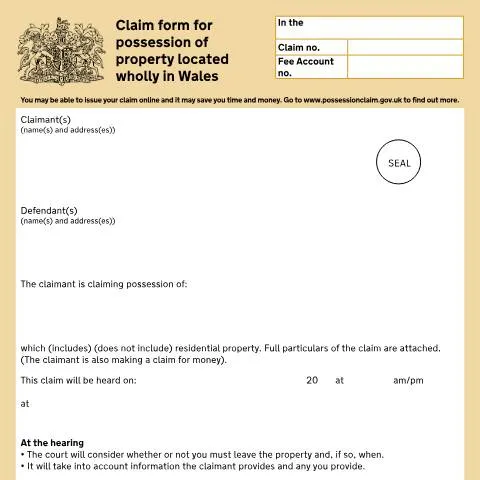
Property disputes in Wales can reach a critical juncture where landlords, mortgage lenders, or property owners must seek legal intervention to regain possession of their premises. The Form N5 Wales represents this decisive step—a formal claim for possession that initiates court proceedings specifically for properties located wholly within Wales. Unlike possession claims in England, this Welsh variant incorporates unique legal frameworks and procedural requirements that reflect Wales' distinct housing legislation and court processes.
The form serves as the gateway to the HM Courts & Tribunals Service possession procedure, whether dealing with unpaid rent, mortgage defaults, anti-social behaviour, or unauthorised occupation. Its completion triggers a legal process that can culminate in eviction orders, making accuracy and completeness absolutely crucial for claimants seeking to protect their property rights.
Identifying Your Legal Standing: Who Can Submit Form N5 Wales
The claimant categories eligible to use Form N5 Wales span various property ownership and management scenarios. Landlords represent the most common applicants, whether managing social housing, private rental properties, or commercial premises. This includes registered social landlords, local authorities acting as housing providers, and private individuals or companies letting residential or commercial space.
Mortgage lenders constitute another significant claimant group, particularly when borrowers default on repayment terms or breach mortgage conditions. Banks, building societies, and specialist lending institutions regularly utilise this form when standard recovery procedures prove insufficient.
Property owners facing trespass situations also qualify as legitimate claimants. This encompasses scenarios where unauthorised occupants have taken possession without any legal right, or where former tenants refuse to vacate after tenancy termination. Additionally, freeholders seeking forfeiture of leasehold properties due to covenant breaches can employ Form N5 Wales to initiate proceedings.
Commercial property managers dealing with business tenancy disputes, particularly those involving rent arrears or lease violations, represent another claimant category. The form accommodates both residential and commercial possession claims, though the legal grounds and procedural requirements may vary significantly between these contexts.
Navigating the Grounds for Possession: Legal Foundations for Your Claim
Form N5 Wales categorises possession grounds into distinct legal bases, each carrying specific evidential requirements and procedural implications. Rent arrears claims, eligible for online submission, require precise calculation of outstanding amounts and adherence to statutory notice periods. Claimants must demonstrate compliance with prescribed notice procedures and provide detailed rent accounts showing payment history and arrears accrual.
Mortgage arrears proceedings follow similar principles but involve different legal frameworks. Lenders must evidence attempts at alternative resolution, compliance with pre-action protocols, and consideration of borrower circumstances. The mortgage terms, payment history, and any previous arrangements or modifications require comprehensive documentation.
Anti-social behaviour grounds demand substantial evidence of conduct affecting neighbours or property use. This includes witness statements, local authority reports, police incident records, and documentation of warnings or interventions attempted. The court expects detailed chronologies of incidents and evidence of impact on community or property value.
Claims based on breach of occupation contracts or tenancy terms beyond rent issues encompass violations such as unauthorised subletting, property damage, or breach of use restrictions. Each breach type requires specific evidence demonstrating both the contractual obligation and its violation.
| Ground for Possession | Online Submission Available | Key Evidence Required | Notice Period Considerations |
|---|---|---|---|
| Rent arrears | Yes | Rent account, payment history, statutory notices | Minimum periods apply depending on tenancy type |
| Mortgage arrears | Yes | Mortgage agreement, payment records, pre-action compliance | Pre-action protocol requirements must be satisfied |
| Anti-social behaviour | No | Incident reports, witness statements, warnings issued | Varies by tenancy type and severity |
| Trespass | No | Proof of title, evidence of unauthorised occupation | No notice required for true trespassers |
Completing the Welsh-Specific Elements: Procedural Distinctions
Form N5 Wales incorporates specific provisions reflecting Welsh housing legislation and court procedures that distinguish it from English possession claims. The form explicitly addresses properties "located wholly in Wales", ensuring compliance with Welsh legal frameworks including the Renting Homes (Wales) Act 2016 and associated regulations.
One distinctive feature involves the Prohibited Standard Contract Order provision, unique to Welsh housing law. Claimants must indicate whether their claim seeks such an order, which prevents future occupation contracts for properties where serious breaches have occurred. This mechanism reflects Wales' approach to addressing persistent tenancy violations and protecting property standards.
The form's treatment of Human Rights Act 1998 considerations requires careful attention in Welsh contexts, particularly given the country's emphasis on housing rights and social justice. Claimants must explicitly declare whether their claim raises human rights issues, acknowledging the court's duty to balance property rights against occupiers' Article 8 rights to family and private life.
Welsh language considerations, whilst not explicitly detailed on the form itself, may influence proceedings. Courts in Wales accommodate Welsh language use, and supporting documentation may be submitted in Welsh without translation requirements in appropriate circumstances.
Statement of Truth Implications
The form's statement of truth section carries particular weight in possession proceedings, where false statements can result in contempt of court charges. Claimants must verify facts personally or through authorised legal representatives, understanding that deliberate misrepresentation risks serious legal consequences beyond mere case dismissal.
Digital vs Paper Submission: Choosing Your Filing Route
Form N5 Wales offers multiple submission pathways, with online filing available for specific ground types including rent arrears and mortgage arrears claims. The digital platform at possessionclaim.gov.uk provides streamlined processing and potential cost savings, automatically calculating court fees and enabling direct payment processing.
Online submission advantages include immediate acknowledgment, integrated payment systems, and faster processing times. The system validates essential information during completion, reducing rejection risks due to incomplete sections or calculation errors. Digital filing also maintains comprehensive audit trails and enables real-time status monitoring.
Paper submission remains necessary for certain claim types, particularly those involving anti-social behaviour, trespass, or complex breach allegations. Physical filing allows attachment of extensive documentary evidence more easily and may be preferred when claims involve multiple defendants or properties.
Court counter submission provides immediate receipt confirmation and allows clarification of procedural questions with court staff. This method suits claimants preferring personal interaction or those requiring assistance with form completion verification.
Fee Structures and Payment Methods
Court fees vary based on claim value and type, with specific rates applicable to possession proceedings. Fee account arrangements enable regular claimants to streamline payment processing, whilst individual submissions require immediate payment via acceptable methods including cheques, postal orders, or online payments for digital submissions.
Supporting Documentation: Building Your Evidentiary Foundation
Successful possession claims depend heavily on comprehensive supporting evidence attached as particulars of claim. This documentation must substantiate every assertion made in Form N5 Wales and demonstrate compliance with relevant legal requirements and procedural obligations.
For rent arrears claims, essential documents include the original tenancy agreement, rent payment schedules, detailed arrears calculations, and copies of all notices served. Bank statements showing missed payments, correspondence regarding arrears, and records of any payment arrangements strengthen the evidential foundation.
Mortgage possession claims require the mortgage deed, payment history, default notices, and evidence of pre-action protocol compliance. Correspondence demonstrating attempts to resolve arrears, offers of alternative arrangements, and borrower responses provide crucial context for court consideration.
Anti-social behaviour claims demand extensive documentation including incident logs, witness statements, photographs of damage or disturbance evidence, and records of warnings or interventions. Local authority or police reports add official weight to allegations, whilst neighbour impact statements demonstrate broader community effects.
Property ownership evidence through title deeds, Land Registry entries, or lease documentation establishes the claimant's legal standing. For corporate claimants, company registration details and authority to act documentation ensure proper representation verification.
Documentary Standards and Presentation
Courts expect professional document presentation with clear chronological organisation and comprehensive indexing. Original documents should be preserved, with certified copies submitted for court use. Welsh language documents may be submitted without translation in appropriate circumstances, reflecting Wales' bilingual legal framework.
Post-Submission Procedure: From Filing to Court Hearing
Once Form N5 Wales reaches the court, the HM Courts & Tribunals Service issues the claim and serves copies on named defendants. The court allocates a unique claim number and sets initial hearing dates, typically allowing defendants several weeks to respond with defence submissions or negotiate resolution.
Defendants receive comprehensive information about their rights and obligations, including guidance on seeking legal advice and completing defence forms. The court encourages early resolution through negotiation or mediation where appropriate, potentially avoiding contested hearings.
Case management may involve preliminary hearings to address procedural issues, evidence disputes, or settlement discussions. Complex cases might require multiple hearings addressing different aspects of the claim, whilst straightforward matters may proceed directly to final determination.
During hearings, courts consider all evidence presented by both parties, evaluate legal arguments, and determine whether possession orders should be granted. Factors including proportionality, defendant circumstances, and public interest considerations influence judicial decisions.
Potential Outcomes and Enforcement
Successful claims result in possession orders specifying timescales for property vacation. Orders may be immediate, suspended pending compliance with conditions, or postponed to allow defendant remedial action. Enforcement through court bailiffs becomes available if defendants fail to comply voluntarily with possession orders.
Unsuccessful claims may result in cost orders against claimants, emphasising the importance of thorough preparation and strong evidential foundations. Appeals procedures exist for both parties dissatisfied with initial determinations, though strict time limits and grounds restrictions apply.
Welsh Legal Context: Distinctive Features and Considerations
Form N5 Wales operates within Wales' evolving housing legal framework, incorporating recent legislative developments and distinctive procedural requirements. The Renting Homes (Wales) Act 2016 fundamentally altered landlord-tenant relationships, introducing occupation contracts replacing traditional tenancies and affecting possession procedures.
Welsh housing legislation emphasises tenant protection and social housing provision, influencing court approaches to possession claims. Judges consider broader social implications alongside strict legal entitlements, particularly in cases involving vulnerable occupiers or housing shortage areas.
The Welsh Government's housing policies promote homelessness prevention and sustainable tenancies, creating additional procedural requirements for social landlords and influencing private sector expectations. These policies may affect court attitudes toward possession claims and encourage alternative resolution approaches.
Local authority involvement in Welsh possession proceedings often exceeds English equivalents, reflecting Wales' integrated approach to housing provision and homelessness prevention. Courts may require evidence of local authority consultation or housing advice provision before granting possession orders in appropriate cases.
Understanding the Different Types of Possession Claims in Wales
The N5 form in Wales accommodates several distinct categories of possession claims, each with specific legal grounds and procedural requirements. Understanding which type applies to your situation is crucial for completing the form accurately and ensuring your claim proceeds smoothly through the Welsh courts.
Fill in your form directly online
No printing: type your details into the boxes of the official form, tick, then download the PDF ready to send.
- 1Type into the form boxes
- 2Tick in one click
- 3Save and download the PDF
Assured Shorthold Tenancy (AST) Claims
For assured shorthold tenancies, which represent the majority of private rental agreements in Wales, landlords can pursue possession under two main routes. Section 21 claims, often called 'no-fault' evictions, allow landlords to regain possession without proving breach of tenancy terms, provided proper notice has been served and the tenancy has reached its natural end or break clause. However, recent legislative changes in Wales have introduced additional requirements, including mandatory registration with Rent Smart Wales and compliance with fitness for human habitation standards.
Section 8 claims, conversely, require landlords to prove specific grounds for possession, such as rent arrears exceeding two months, persistent late payment, or breach of tenancy conditions. When completing the N5 form for Section 8 claims, you must specify which grounds you're relying upon from Schedule 2 of the Housing Act 1988, providing detailed evidence to support each ground claimed.
Excluded Occupancies and Licences
Properties where occupiers have limited legal protection, such as lodgers living with their landlord or licensees in hostels, require different approaches on the N5 form. These arrangements typically fall outside standard tenancy legislation, meaning possession procedures may be more straightforward but still require proper documentation. The form must clearly establish the legal basis for the occupancy arrangement and demonstrate that proper notice to quit has been served according to the terms of the agreement.
Commercial and Mixed-Use Properties
Business premises and mixed residential-commercial properties involve additional complexities when completing the N5 form. Commercial tenancies may be protected under the Landlord and Tenant Act 1954, requiring specific procedures for possession. Mixed-use properties must be carefully categorised to determine which legal framework applies, as this affects both the grounds available for possession and the notice periods required.
Compliance with Welsh Housing Legislation and Recent Reforms
Wales has implemented significant housing reforms that directly impact possession proceedings and must be carefully considered when completing the N5 form. The Renting Homes (Wales) Act 2016, though not yet fully implemented, introduces fundamental changes to the legal framework governing rental properties in Wales.
Rent Smart Wales Registration Requirements
All landlords and letting agents operating in Wales must register with Rent Smart Wales and obtain appropriate licences. Failure to comply with these requirements can affect your ability to serve valid possession notices and may impact court proceedings. When completing the N5 form, ensure you can demonstrate compliance with registration requirements, as courts may refuse to grant possession orders where landlords have failed to meet their legal obligations.
The registration system requires landlords to complete training courses and maintain ongoing compliance with licensing conditions. Properties that require Houses in Multiple Occupation (HMO) licences face additional scrutiny, and possession claims involving unlicensed HMOs may face particular challenges in court proceedings.
Fitness for Human Habitation Standards
The Homes (Fitness for Human Habitation) Act 2018 extends to Wales, requiring rental properties to meet specific habitability standards throughout the tenancy. Landlords pursuing possession must ensure their properties comply with these standards, as tenants may raise retaliatory eviction defences or counterclaims for disrepair. Document any remedial works completed and maintain records of property condition assessments to support your N5 claim.
Deposit Protection and Information Requirements
Tenancy deposits must be protected in government-approved schemes, with prescribed information provided to tenants within specified timeframes. Failure to comply with deposit protection requirements can prevent landlords from serving valid Section 21 notices and may affect possession proceedings. The N5 form should reference deposit protection compliance, particularly for AST claims where deposit issues frequently arise as tenant defences.
Navigating Court Procedures and Hearing Preparations in Welsh Courts
Once your N5 form is submitted to the appropriate Welsh court, understanding the subsequent procedural steps helps ensure effective case management and increases the likelihood of obtaining possession orders promptly.
Case Management and Allocation
Welsh county courts operate case management systems that allocate possession claims based on complexity and value. Straightforward possession claims typically follow the accelerated procedure, where decisions may be made without hearings if documentation is complete and uncontested. More complex cases, particularly those involving counterclaims or disputed facts, require substantive hearings with detailed case preparation.
Courts may issue case management directions requiring additional documentation or witness statements before hearings. Respond promptly to any court directions, as failure to comply can result in case dismissal or adverse cost orders. Monitor court listing systems regularly, as hearing dates may change with limited notice, particularly during periods of high court workload.
Preparing for Possession Hearings
Effective hearing preparation begins with comprehensive evidence gathering. Compile chronological files documenting the tenancy relationship, including original tenancy agreements, rent payment records, correspondence regarding breaches, and photographic evidence of property condition. Witness statements from property managers, neighbours, or other relevant parties should be prepared in accordance with Civil Procedure Rules, including statements of truth and proper formatting.
Consider potential tenant defences and prepare responses accordingly. Common defences include challenges to notice validity, claims of disrepair affecting habitability, allegations of discrimination or harassment, and counterclaims for deposit return or damages. Having pre-prepared responses and supporting documentation demonstrates thorough case preparation and may influence court decisions favourably.
Understanding Welsh Court Discretion and Considerations
Welsh courts retain discretion in possession proceedings, particularly regarding timing and conditions of possession orders. Judges consider factors including tenant vulnerability, availability of alternative accommodation, proportionality of eviction, and public interest considerations. Present your case emphasising legitimate property management needs while acknowledging any relevant welfare considerations affecting the tenant's circumstances.
Courts may grant suspended possession orders, allowing tenants to remain in occupation subject to specific conditions such as regular rent payments or compliance with tenancy terms. Understanding these possibilities helps inform negotiation strategies and realistic expectations for case outcomes. Demonstrate flexibility where appropriate, as courts favour landlords who show reasonable consideration for tenant circumstances while protecting their legitimate property interests.
Post-hearing procedures may include enforcement proceedings if tenants fail to comply with possession orders. Bailiff services through the county court can execute possession orders, but additional applications and fees are required. Plan for potential enforcement needs when budgeting for possession proceedings, as costs can accumulate significantly beyond the initial N5 application fees.