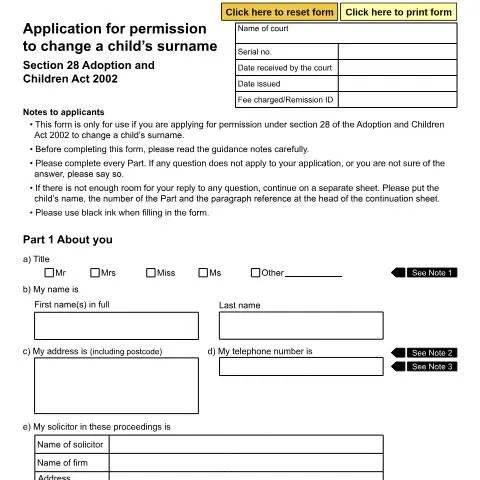
Understanding the Application Process for Changing a Child’s Surname under Section 28 of the Adoption and Children Act 2002
The process of applying for permission to change a child's surname in England and Wales is governed by Section 28 of the Adoption and Children Act 2002. This legal procedure is managed by the HM Courts & Tribunals Service, ensuring that such changes are made with appropriate oversight and in the best interests of the child. This guide aims to clarify the purpose, scope, and procedural steps involved in submitting an application using Form A55.
Objective of the Application
The primary aim of this application is to seek the court’s permission to alter a child's surname. Such a change may be requested by a parent, guardian, or an individual with parental responsibility, especially in cases where the child's circumstances or family arrangements have evolved. The court's involvement ensures that the child's welfare remains paramount and that the change is justified and properly documented.
Scope and Eligibility
This application form is exclusively used for requests under Section 28 of the Adoption and Children Act 2002. It applies to children who are not subject to a placement order or, if they are, the applicant must provide relevant details and documentation. The process is relevant for parents, guardians, or individuals with parental responsibility who wish to legally change the child's surname, often following adoption, guardianship, or family reorganization.
Key Components of the Application
Part 1: About the Applicant
The applicant must provide personal details, including their full name, address, contact information, and relationship to the child. If represented by a solicitor, their details are also recorded. The applicant's relationship to the child is crucial, as it establishes their authority to make the application.
Part 2: About the Child
This section requires details such as the child's current name, date of birth, gender, and address. Information about the child's living arrangements and the placement agency or local authority involved in their care is also included. If there are any ongoing or past court proceedings concerning the child or their siblings, these must be disclosed to provide a comprehensive background for the court's consideration.
Part 3: About the Child’s Parents or Guardians
The applicant must specify the child's parents' names and addresses, including whether they have parental responsibility. If the child has a guardian, their details are also recorded. This information helps the court assess the context of the application and the parties involved.
Reasons for the Application
In Part 4, the applicant states the desired new surname for the child and provides reasons for the request. These reasons may include family reunification, adoption, or personal preference, and must be clearly articulated to support the case for a court-approved change.
Legal Considerations and Court Involvement
Before submitting the application, applicants should review the guidance notes carefully, as detailed instructions and legal requirements are provided to ensure completeness. The application must be verified with a statement of truth, affirming that all information provided is accurate. Supporting documents, such as the placement order and any relevant court orders concerning the child or their siblings, should accompany the application.
Fill in your form directly online
No printing: type your details into the boxes of the official form, tick, then download the PDF ready to send.
- 1Type into the form boxes
- 2Tick in one click
- 3Save and download the PDF
Submission and Fees
The completed application form, along with the required documents and the applicable court fee, should be submitted to the designated court. If the applicant qualifies for a fee remission or exemption, they should contact the court directly for guidance. The court will process the application, and if approved, issue an order legally changing the child's surname.
Implications for Applicants and Families
Obtaining court permission to change a child's surname ensures that the change is legally recognised and that the child's welfare is safeguarded. This process provides clarity and legal certainty for families, especially in complex situations such as post-adoption or guardianship arrangements. It also formalizes the child's identity, which can be important for official documents, school registration, and future legal matters.
In summary, the application process under Section 28 is a structured legal procedure designed to protect the child's best interests while respecting family circumstances. Proper completion of Form A55 and adherence to the guidance notes facilitate a smooth legal process, ultimately resulting in a formal change of surname that is recognized by law.