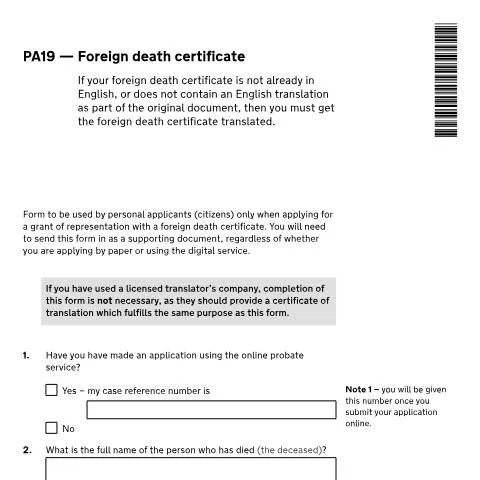
When Death Occurs Abroad: Understanding the PA19 Translation Certificate Process
Dealing with a death abroad presents unique challenges for bereaved families, particularly when it comes to obtaining probate in England and Wales. The PA19 form serves as a crucial bridge between foreign death certificates and the UK's legal requirements, addressing a specific gap in the probate application process that affects thousands of families each year.
When someone dies outside the UK, their death certificate will typically be issued in the local language and follow local conventions. However, HM Courts & Tribunals Service requires all supporting documentation to be in English, creating a translation requirement that must be handled with particular care given the legal implications of probate proceedings.
The PA19 form specifically addresses situations where applicants have arranged their own translation rather than using a licensed translation company. This distinction is crucial because licensed companies provide their own certificates of translation that automatically satisfy court requirements, whereas private translations require additional validation through the PA19 process.
Eligibility and Circumstances Requiring PA19 Completion
The PA19 form is designed exclusively for personal applicants – individuals applying for grants of representation in their capacity as executors, administrators, or beneficiaries. Professional users, such as solicitors or probate practitioners, follow different procedures and are not expected to use this form.
Several specific circumstances trigger the need for a PA19 form:
- The foreign death certificate is entirely in a non-English language
- The death certificate contains partial English but lacks a complete official translation
- The translation has been arranged privately rather than through a licensed translation service
- The applicant is proceeding with either paper-based or digital probate applications
Notably, the form is not required when the original death certificate already includes an official English translation as part of the document, or when a licensed translation company has provided their own certificate of translation. This exemption reflects the court's recognition that established translation services maintain professional standards and accountability that satisfy legal requirements.
The form applies regardless of the probate application method chosen. Whether applicants use the digital probate service or submit paper applications, the PA19 must accompany foreign death certificates that have been privately translated.
The Translation Validation Framework
The PA19 form establishes a formal framework for validating translations that fall outside the licensed company system. This framework balances accessibility with legal rigour, recognising that not all families have access to expensive professional translation services while maintaining standards necessary for court proceedings.
The form captures essential information about both the applicant and the translator, creating an audit trail that can be referenced if questions arise during the probate process. The case reference number field acknowledges the increasing use of digital services while accommodating traditional paper applications.
| Translation Source | Documentation Required | PA19 Needed |
|---|---|---|
| Licensed translation company | Company certificate of translation | No |
| Private qualified translator | Translation + completed PA19 | Yes |
| Family member/friend | Translation + completed PA19 | Yes |
| Original certificate includes English | Original certificate only | No |
The translator qualification section recognises different types of competency, from native language speakers to formally qualified professionals. This inclusive approach acknowledges that translation quality can come from various sources while requiring translators to declare their credentials honestly.
Translator Accountability Measures
The form includes significant accountability measures for translators. The signature requirement, combined with the warning about contempt of court proceedings, creates legal consequences for deliberate misrepresentation. This provision ensures that even non-professional translators understand the serious legal context of their work.
The public record warning serves multiple purposes: it informs translators that their work becomes part of permanent court records, it establishes transparency, and it creates a deterrent against careless or dishonest translation work.
Completing the PA19: Step-by-Step Requirements
The PA19 form follows a logical progression from application context through to translator validation. Each section serves specific legal and administrative purposes that support the overall probate process.
Application Context Section
The opening section establishes whether applicants are using digital or paper-based probate services. For digital applications, the case reference number creates a direct link between the PA19 and the online application, facilitating administrative processing and reducing potential delays.
The deceased person's full name must match exactly with the probate application and other supporting documents. Variations in name spelling or formatting can create administrative complications, particularly when dealing with names that may be transliterated differently from non-Latin alphabets.
Translation Details
Identifying the source language helps court staff understand potential translation challenges and may inform quality assessment procedures. Certain languages present particular difficulties due to different naming conventions, calendar systems, or administrative practices.
The translator's contact details serve multiple purposes: they enable verification if questions arise, provide accountability for the translation work, and create a record for potential future reference. The phone number requirement ensures direct communication possibilities beyond written correspondence.
Translator Qualification Declaration
The qualification section requires translators to categorise their competency honestly. Native speakers may lack formal translation training but possess intuitive language understanding, while qualified translators bring professional skills and potentially regulated accountability.
For qualified translators, specifying credentials allows court staff to assess the translation's reliability. Professional qualifications from recognised institutions carry different weight than informal certificates or online courses.
Legal Implications and Court Recognition
The PA19 form creates a legal document that becomes part of the probate court record. This status means that all information provided is subject to the same standards of accuracy and honesty required in court proceedings.
The contempt of court warning carries real consequences. Deliberate misrepresentation in translation or false claims about qualifications could result in criminal proceedings, fines, or imprisonment. This legal framework ensures that participants understand the serious nature of probate proceedings.
Once accepted by the court, the PA19 and accompanying translation become part of the permanent probate record. This documentation may be referenced in future legal proceedings, inheritance disputes, or administrative matters requiring proof of death.
Quality Standards and Accuracy Expectations
While the PA19 system accommodates non-professional translations, courts maintain expectations about accuracy and completeness. Translations must capture all essential information from the original death certificate, including dates, locations, cause of death, and official certification details.
Particular attention must be paid to names, which may be spelled differently in various languages or follow different conventions. Dates require careful handling, especially when source documents use different calendar systems or date formats.
The court reserves the right to reject applications where translations appear inadequate or incomplete, potentially requiring professional translation services despite the initial PA19 submission.
Document Submission and Processing Requirements
The PA19 form must be submitted alongside specific supporting documents, creating a complete package that enables court processing. The original foreign death certificate remains essential, as courts need to verify the translation against the source document.
The three-document requirement – original certificate, translation, and completed PA19 – ensures comprehensive documentation while providing multiple verification points. This approach balances thorough record-keeping with practical accessibility for bereaved families.
Processing Timeline Considerations
Applications involving foreign death certificates typically require additional processing time compared to standard UK probate applications. The translation validation adds an extra review stage, and court staff may need to seek specialist advice for complex cases.
Digital applications generally process faster than paper submissions, but foreign death certificates may reduce this advantage due to the additional verification requirements. Applicants should factor potential delays into their planning, particularly if they face time-sensitive financial or property matters.
Potential Processing Complications
Several factors can complicate PA19 processing. Unclear translations may prompt court queries or requests for professional translation services. Incomplete forms or missing signatures require resubmission, causing delays.
Complex foreign death certificates, particularly those from countries with very different legal systems, may require additional verification or specialist review. Names that cannot be clearly transliterated into English characters present particular challenges.
Cost Considerations and Alternative Options
The PA19 route offers significant cost advantages compared to licensed translation services, which typically charge substantial fees for certified translations. However, applicants must weigh these savings against potential risks and complications.
Licensed translation companies provide professional accountability, insurance coverage, and guaranteed court acceptance. Their certificates of translation eliminate the need for PA19 forms and reduce processing risks, though at considerably higher cost.
| Consideration | PA19 Route | Licensed Company |
|---|---|---|
| Direct cost | Minimal (form only) | £100-£500+ typically |
| Processing risk | Potential queries/delays | Minimal |
| Professional accountability | Limited | Full professional standards |
| Court acceptance | Subject to review | Automatic |
When Professional Translation Becomes Necessary
Certain circumstances strongly favour professional translation services despite the cost implications. Complex medical terminology in cause of death sections requires precise translation to avoid potential legal complications. Documents from countries with significantly different legal or administrative systems benefit from professional expertise.
High-value estates or contested probate situations may warrant professional translation to avoid any grounds for challenge. The additional cost becomes insignificant compared to potential legal complications or delays in estate administration.
Practical Guidance for Successful Applications
Successful PA19 applications require careful attention to detail and honest assessment of translation quality. Applicants should ensure that translators understand the legal significance of their work and the accuracy requirements involved.
When choosing translators, consider their familiarity with legal or official documents rather than just general language ability. Administrative terminology and formal language structures differ significantly from conversational translation requirements.
Review translations carefully before submission, checking that all information from the original certificate appears in the English version. Pay particular attention to proper names, dates, and official titles or certifications.
Common Documentation Pitfalls
Several recurring issues can complicate PA19 submissions. Incomplete translator contact information prevents verification if questions arise. Missing or unclear signatures invalidate the form's legal standing.
Inconsistent name spellings between the PA19, translation, and probate application create administrative complications. Dates that appear impossible or inconsistent with other information prompt additional scrutiny.
Translations that omit sections of the original certificate, even if they appear unimportant, can result in rejection or requests for professional alternatives. Complete translation ensures comprehensive court records and reduces processing complications.
Fill in your form directly online
No printing: type your details into the boxes of the official form, tick, then download the PDF ready to send.
- 1Type into the form boxes
- 2Tick in one click
- 3Save and download the PDF
The PA19 system reflects the UK's commitment to accessible justice while maintaining necessary legal standards. By providing a structured framework for translation validation, it enables families to navigate probate requirements without prohibitive costs, while ensuring that court records maintain accuracy and reliability essential for legal proceedings.
Digital Submission and Document Management Requirements
The Probate Registry has implemented specific digital protocols for PA19 applications involving foreign death certificates, recognising the unique challenges posed by untranslated documentation. Unlike standard grant applications that may be processed entirely online through the government's digital probate service, applications with foreign death certificates typically require a hybrid approach combining digital submission with physical document verification.
When preparing your digital submission, ensure all scanned documents maintain a minimum resolution of 300 DPI to allow registry staff to examine foreign text clearly. The Probate Registry's document management system can accommodate various file formats, though PDF remains the preferred standard for foreign certificates. Each page of multi-page foreign documents must be scanned separately and clearly labelled with sequential numbering (e.g., "Death_Certificate_Page_1_of_3").
The digital case management system assigns a unique reference number upon initial submission, which becomes crucial for tracking your application's progress through the various verification stages. This reference differs from the eventual grant number and should be quoted in all correspondence with the registry. Given the additional scrutiny required for foreign documentation, expect the digital status updates to reflect extended processing times compared to standard domestic applications.
Registry staff may request additional digital clarification of specific sections of foreign documents, particularly where handwritten entries or official stamps appear unclear in scanned format. Prepare high-quality close-up scans of critical sections such as cause of death, date entries, and official certifications. The system allows for supplementary document uploads throughout the application process, though each addition may trigger a fresh review cycle.
For applicants utilising legal representation, the digital portal enables solicitor access through Government Gateway credentials, allowing professional users to monitor application progress and respond to registry queries efficiently. However, the foreign certificate verification process often requires direct communication between registry officials and the applicant, regardless of professional representation, particularly when clarifying family relationships or addressing discrepancies in foreign documentation.
Common Rejection Scenarios and Remedial Actions
Understanding frequent rejection patterns for PA19 applications with foreign death certificates enables applicants to address potential issues proactively. The Probate Registry maintains detailed rejection statistics, with foreign documentation applications experiencing higher initial refusal rates due to verification complexities rather than fundamental eligibility issues.
Document authenticity concerns represent the most common rejection category. Registry officials may question the validity of foreign certificates lacking familiar security features or bearing unfamiliar official seals. When facing such challenges, applicants should contact the issuing country's consular services in the UK to provide additional authentication documentation, such as apostille certification or consular verification letters. The Foreign, Commonwealth & Development Office maintains relationships with international partners that can facilitate such verification processes.
Incomplete family relationship verification frequently triggers application suspension. Foreign death certificates may list family members using different naming conventions, maiden names, or cultural naming practices that don't immediately align with UK documentation. Prepare comprehensive genealogical documentation including birth certificates, marriage certificates, and any name change documentation for all relevant family members. Consider obtaining statutory declarations from family members or community leaders familiar with naming conventions in the deceased's country of origin.
Asset valuation discrepancies often emerge when foreign property or investments feature in the estate. UK probate law requires accurate sterling valuations at the date of death, but foreign asset valuations may be expressed in local currency or according to different valuation methodologies. Engage qualified surveyors or financial advisers with international expertise to provide formal valuation reports that satisfy UK probate requirements. The registry may request updated valuations if significant time has elapsed since the initial application.
Jurisdictional complications arise when the deceased held assets in multiple countries or when foreign legal systems have already initiated probate proceedings. The Probate Registry must ensure UK grants don't conflict with foreign legal processes or create dual administration scenarios. Provide comprehensive documentation of any foreign legal proceedings, including correspondence with foreign courts or legal representatives. In some cases, you may need to obtain formal confirmation from foreign courts that UK probate administration is appropriate and won't interfere with local legal processes.
Administrative errors, while seemingly minor, can cause significant delays in foreign certificate cases. Registry staff scrutinise foreign applications more thoroughly, making them particularly sensitive to inconsistencies in dates, names, or addresses across different documents. Maintain meticulous consistency in all submitted documentation, ensuring dates follow UK format conventions (DD/MM/YYYY) and that names appear identically across all forms and supporting documents. Create a comprehensive checklist comparing all submitted information to identify potential inconsistencies before submission.
Professional Support and Alternative Documentation Routes
Navigating PA19 applications with foreign death certificates often benefits from professional expertise, though applicants should understand the various types of support available and their respective limitations. The complexity of international documentation verification means that different professional services address different aspects of the application process.
Specialist probate solicitors with international experience offer comprehensive application management, though their services extend beyond simple form completion. These professionals maintain relationships with foreign consulates, international verification services, and specialist translators who understand legal terminology requirements. However, their involvement doesn't eliminate the need for direct applicant engagement with the Probate Registry, particularly during document verification phases. Expect solicitor fees to reflect the additional complexity of foreign certificate cases, with costs potentially doubling compared to standard domestic probate applications.
Independent translation services, while not replacing official licensed translation for final submission, can provide preliminary document analysis to identify potential issues before formal application. These services help applicants understand document content and identify missing information that might trigger registry queries. Some translation services specialise in legal documents from specific countries, offering insights into local legal conventions that may affect UK probate recognition.
Genealogical research services become particularly valuable when foreign death certificates reveal complex family structures or when establishing inheritance rights requires extensive family tree verification. Professional genealogists with international expertise can trace family relationships across multiple countries and legal systems, providing comprehensive documentation packages that satisfy registry verification requirements. Their research often uncovers additional heirs or potential claimants that applicants might not have considered.
Consular services from the deceased's country of origin provide crucial authentication support, though their involvement requires careful coordination with UK probate timelines. Most consulates offer document verification services, though processing times vary significantly between different diplomatic missions. Contact the relevant consulate early in your application process to understand their verification procedures and timeline requirements. Some consulates maintain expedited services for probate-related documentation, though these may incur additional fees.
International law firms operating in both the UK and the deceased's country of origin offer unique advantages for complex cross-border estates. These firms understand both legal systems and can coordinate simultaneous probate proceedings where necessary. However, their services typically target high-value estates where the cost of dual legal representation is justified by the estate's complexity and value.
Consider engaging forensic document examiners when facing registry challenges regarding document authenticity. These specialists can provide detailed technical analysis of foreign certificates, identifying security features and authentication markers that may not be immediately apparent to registry staff. Their reports can address specific registry concerns and provide the additional credibility needed for application approval.
Professional indemnity insurance becomes particularly important when engaging international services, as cross-border legal work involves additional risks and potential liability issues. Ensure any professional services you engage maintain appropriate insurance coverage for international probate work and understand their liability limitations for foreign documentation verification.