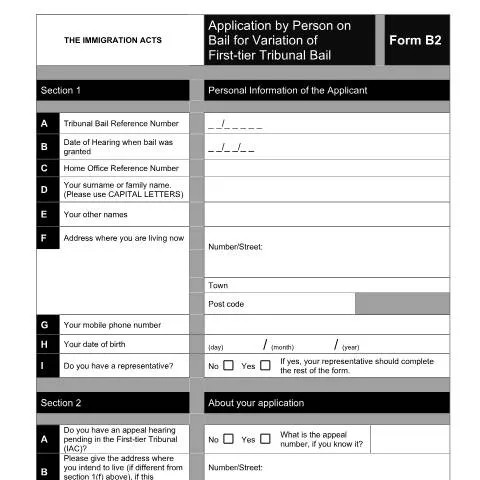
When Immigration Bail Conditions Become a Barrier: The B2 Variation Process
For individuals on immigration bail in the UK, the initial conditions set by the First-tier Tribunal can sometimes prove unworkable or disproportionately restrictive as circumstances evolve. A person granted bail might find themselves unable to comply with reporting requirements due to illness, discover that residence conditions prevent them from accessing essential services, or face financial hardship that makes existing arrangements unsustainable. Form B2 represents the formal mechanism through which these individuals can seek modifications to their bail conditions without surrendering their liberty.
The Immigration Acts framework recognises that bail conditions must remain both effective in ensuring compliance and proportionate to individual circumstances. This balance often requires adjustment as cases progress through the system, particularly given the lengthy timescales typical of immigration proceedings. The B2 application process acknowledges this reality, providing a structured pathway for legitimate requests while maintaining the integrity of the bail system.
Unlike initial bail applications, variation requests require applicants to demonstrate not merely that alternative conditions would be suitable, but that existing conditions have become problematic or inappropriate. This higher threshold reflects the tribunal's reluctance to repeatedly revisit bail arrangements without compelling justification.
The Architecture of Bail Variation: Understanding Form B2's Structure
Form B2 follows a methodical progression through nine distinct sections, each serving a specific function in the tribunal's assessment process. The opening personal information section captures not only standard identifiers but crucially records the tribunal bail reference number and the date when bail was originally granted. These details enable the tribunal to retrieve the complete bail history and understand the temporal context of the variation request.
The form's design reflects the complex interplay between different aspects of immigration bail. Section 2 immediately establishes whether an appeal hearing is pending in the First-tier Tribunal (Immigration and Asylum Chamber), as this can significantly influence both the urgency of the application and the tribunal's willingness to make substantial modifications. An imminent appeal hearing might prompt more conservative variation decisions, whilst lengthy delays could justify more substantial adjustments to conditions.
Financial condition arrangements occupy substantial space within the form, spanning sections 3 and 4. This emphasis reflects the central role that financial sureties play in the UK's immigration bail system. The form requires explicit commitment to financial penalty amounts, detailed information about supporters, and comprehensive documentation of their circumstances. The tribunal uses this information to assess both the credibility of financial commitments and their likely effectiveness in ensuring compliance.
Documentation Requirements and Supporting Evidence
The form mandates that applicants and financial condition supporters bring passports and bank statements to any hearing. This requirement serves multiple purposes: verifying identity, confirming immigration status, and demonstrating genuine financial capacity to meet proposed sureties. The tribunal has discretion to request additional financial documentation, particularly where substantial sums are involved or where supporters' circumstances appear unclear.
For electronic monitoring arrangements, the form specifically addresses GPS tagging requirements for those subject to deportation proceedings in England and Wales. This reflects the Home Office's increased reliance on technological monitoring as an alternative to detention, whilst acknowledging that such measures may not be appropriate in all circumstances.
Crafting Compelling Justifications: The Critical Section 5 Analysis
Section 5 represents the heart of any B2 application, requiring applicants to articulate precisely which conditions they seek to modify, how they propose these should be changed, and most crucially, why such changes are necessary. The quality of reasoning provided in this section often determines application success, making it essential that applicants understand what constitutes persuasive justification.
Acceptable grounds for variation typically include material changes in circumstances, practical impossibility of compliance with existing conditions, or disproportionate hardship caused by current arrangements. For instance, a requirement to reside at a specific address might become impossible if the accommodation provider withdraws consent, or reporting requirements might prove unworkable if the designated police station closes or if serious illness prevents attendance.
The tribunal distinguishes between genuine hardship and mere inconvenience. A request to change reporting requirements from weekly to fortnightly purely for convenience is unlikely to succeed, whereas the same request supported by medical evidence of mobility difficulties would carry significantly more weight. Similarly, requests to modify residence conditions must demonstrate that current arrangements have become genuinely unworkable rather than simply undesirable.
Electronic Monitoring Considerations
The form's specific provisions regarding GPS tagging reflect the increasingly prominent role of electronic monitoring in immigration cases. Whilst decisions about tagging appropriateness rest with the Home Office rather than the tribunal, applicants can use Section 5 to highlight circumstances that might make electronic monitoring problematic. Medical conditions affecting ankle circulation, employment requiring extensive travel, or caring responsibilities might all constitute relevant considerations.
The tribunal cannot override Home Office decisions on electronic monitoring but can factor such concerns into overall condition arrangements. An applicant facing inevitable GPS tagging might successfully argue for relaxed reporting requirements or modified curfew arrangements to balance the overall restrictiveness of their bail package.
Financial Sureties and Support Networks: Navigating Sections 3 and 4
The financial aspects of immigration bail often prove the most complex element of variation applications. Form B2's treatment of financial conditions recognises that circumstances affecting both applicants and their supporters can change significantly over time. A supporter who initially committed to substantial sureties might face changed financial circumstances, whilst new supporters might emerge offering more appropriate or substantial backing.
Section 3 requires applicants to specify the financial condition amount they're willing to accept, creating a framework for negotiation with the tribunal. This figure should reflect both the applicant's assessment of what the tribunal might consider appropriate and their realistic ability to secure such backing. Proposing unrealistically low amounts may suggest lack of seriousness about compliance, whilst excessive figures might prove impossible to secure.
| Supporter Category | Typical Evidence Required | Assessment Factors |
|---|---|---|
| Family Members | Bank statements, employment records, property ownership | Relationship strength, financial stability, previous compliance |
| Community Leaders | Organisational credentials, personal financial capacity | Community standing, experience with bail arrangements |
| Friends/Associates | Enhanced financial documentation, character references | Relationship longevity, motivation for support, risk assessment |
The form allows for up to two supporters, each potentially offering different amounts towards the total financial condition. This flexibility enables applicants to construct varied support packages, perhaps combining substantial backing from one supporter with modest contributions from others. The tribunal assesses both the aggregate amount and the distribution of risk across supporters.
Immigration Status and Supporter Suitability
Section 4's requirement for supporter immigration status information reflects the tribunal's need to assess the reliability and permanence of proposed arrangements. British citizens or settled persons generally provide more secure support than those with temporary status, though this doesn't automatically disqualify other categories. The tribunal considers factors such as the supporter's own immigration compliance history and the likelihood of their continued presence in the UK.
Supporters' occupations and relationship to applicants also influence tribunal assessment. Professional individuals with stable employment histories typically inspire greater confidence, whilst close family relationships often demonstrate stronger commitment to ensuring compliance. However, the tribunal also recognises that excessive reliance on vulnerable family members might be inappropriate.
Procedural Pathways: From Application to Decision
The B2 process operates within the First-tier Tribunal's established procedures whilst accommodating the specific urgency often associated with bail variation requests. Applications typically follow one of two pathways: paper-based determination for straightforward modifications, or oral hearings for more complex cases involving substantial changes or contested elements.
The tribunal's approach to B2 applications reflects the balance between ensuring access to justice and preventing abuse of the variation process. Repeat applications or requests lacking substantive justification may face more stringent scrutiny, whilst genuine emergency situations often receive expedited consideration. The form's requirement for detailed reasoning helps the tribunal distinguish between these categories.
Hearing arrangements, when required, follow similar protocols to initial bail applications but with modified focus. Rather than establishing general suitability for bail, variation hearings concentrate on the specific changes requested and their justification. This narrower scope often results in shorter hearings but requires more precise preparation from applicants and their representatives.
Home Office Transfer Provisions
Section 5's provisions regarding potential transfer of bail management to the Home Office represent a significant development in immigration bail procedures. This transfer mechanism allows the tribunal to grant variations whilst delegating ongoing supervision to the Home Office, potentially streamlining future modifications and reducing tribunal workload.
The consent requirement ensures that applicants understand the implications of such transfers, including the possibility that future variations would be determined by Home Office officials rather than independent tribunal judges. Whilst this might offer greater flexibility for minor adjustments, it could also result in less sympathetic consideration of complex cases.
Representation Frameworks and Professional Obligations
Section 7's comprehensive treatment of legal representation reflects both the complexity of immigration bail law and the tribunal's need to maintain effective communication channels throughout proceedings. The distinction between different categories of representatives—from solicitors to OISC-regulated advisers—ensures appropriate oversight whilst enabling diverse forms of professional support.
The Criminal Justice Secure Mail (CJSM) provisions demonstrate the tribunal system's adaptation to secure digital communications. Representatives accepting CJSM correspondence commit to maintaining appropriate security protocols whilst enabling faster communication than traditional postal methods. This technological integration proves particularly valuable in urgent variation cases where rapid information exchange is essential.
Fill in your form directly online
No printing: type your details into the boxes of the official form, tick, then download the PDF ready to send.
- 1Type into the form boxes
- 2Tick in one click
- 3Save and download the PDF
Professional obligations extend beyond mere form completion to encompass ongoing duties throughout the variation process. Representatives must notify relevant parties if they cease acting, ensure clients understand the implications of proposed changes, and maintain appropriate records of all proceedings. These obligations continue until formal conclusion of the variation application.
Publicly Funded Representation Considerations
The form's specific provisions for Legal Aid Agency references acknowledge the funding challenges facing immigration representation. Whilst immigration bail variations rarely qualify for public funding, exceptional circumstances might justify such support, particularly where detention is imminent or where complex legal issues arise.
Representatives working under public funding arrangements face additional obligations regarding cost management and outcome reporting. The form's capture of relevant reference numbers enables proper accounting whilst ensuring that funding limitations don't compromise application quality.
Compliance Mechanisms and Enforcement Realities
The Statement of Truth provisions in Section 8 carry significant legal weight, creating potential perjury liability for false statements. This mechanism serves both to deter frivolous applications and to provide enforcement options where applicants provide misleading information. The requirement for personal signature, even where representatives complete other sections, ensures individual accountability.
The tribunal's approach to false or misleading B2 applications can have consequences extending far beyond the immediate variation request. Credibility concerns arising from inaccurate applications may influence future bail decisions, appeal assessments, and overall case outcomes. This reality makes accurate, honest completion essential regardless of how unfavourable true circumstances might appear.
Enforcement of varied conditions follows similar patterns to original bail arrangements, but with added complexity arising from the modification history. Breaches of varied conditions may be viewed more seriously than initial breaches, particularly where variations were granted based on specific commitments or assurances that subsequently prove false.
The potential for Home Office management transfer adds another enforcement dimension, as different agencies may adopt varying approaches to compliance monitoring and breach response. Applicants accepting such transfers should understand that enforcement practices might differ from tribunal-managed arrangements, potentially affecting both supervision intensity and response to compliance concerns.
Strategic Timing and Case Management Implications
The timing of B2 applications often proves as crucial as their content, with strategic considerations influencing both success prospects and broader case management. Applications submitted immediately before substantive hearings may face skeptical reception, appearing calculated to avoid inconvenient conditions rather than addressing genuine problems. Conversely, applications delayed until conditions become genuinely unworkable might suggest poor planning or inadequate legal advice.
The relationship between variation applications and pending appeal proceedings requires careful consideration. Successful appeals typically render bail arrangements irrelevant, making extensive condition modifications potentially unnecessary. However, lengthy appeal delays might justify substantial variations, particularly where original conditions assumed shorter timeframes or different circumstances.
Form B2's integration with broader immigration procedures means that variation decisions can influence subsequent proceedings. Successful applications demonstrating changed circumstances might support arguments in other contexts, whilst unsuccessful applications could suggest ongoing risks or compliance concerns. This interconnectedness makes strategic application timing essential for overall case success.
The tribunal system's resource constraints mean that B2 applications compete with other urgent proceedings for hearing time and judicial attention. Well-prepared applications supported by clear evidence and cogent reasoning typically receive more favourable scheduling and consideration than poorly presented cases requiring extensive clarification or investigation.