When Family Support Becomes Legal Commitment: The Sponsorship Undertaking Framework
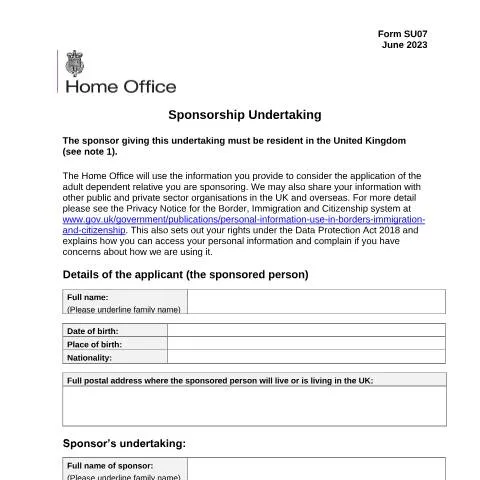
The form SU07 Sponsorship Undertaking represents one of the most significant financial commitments an individual can make within the UK immigration system. Unlike standard visa applications where responsibility ends at approval, this document creates a legally binding obligation that can span up to five years and potentially expose sponsors to criminal liability if breached.
This undertaking primarily supports applications for adult dependent relatives seeking to join family members in the UK—typically elderly parents or disabled adult children who require ongoing care. The form serves as both a declaration of intent and a formal contract with the Home Office, establishing clear boundaries around public fund access while the sponsorship remains active.
The weight of this commitment cannot be understated. Sponsors assume complete responsibility for maintenance, accommodation, and care costs, with the Department for Work and Pensions empowered to recover any public funds inadvertently accessed. This creates a parallel support system outside the traditional welfare framework, placing the financial burden squarely on family networks rather than the state.
The Five-Year Financial Guarantee: Understanding Your Obligations
The sponsorship period varies depending on the immigration route taken by the applicant. For those granted settlement following entry clearance, the five-year commitment begins from their date of entry to the UK. However, for applicants already in the UK who receive settlement, the clock starts ticking from the grant date itself.
Temporary permission holders face a different timeline—sponsors remain liable for the entire duration of the temporary grant, which could be shorter or longer than five years depending on the specific visa category. This flexibility acknowledges that some adult dependent relative applications may initially receive limited leave before progressing to settlement.
| Immigration Status | Sponsorship Duration | Start Date |
|---|---|---|
| Settlement (entry clearance route) | 5 years | Date of UK entry |
| Settlement (in-country application) | 5 years | Date settlement granted |
| Temporary permission | Duration of grant | Date permission granted |
The maintenance, accommodation and care obligation encompasses all basic living expenses including housing costs, food, utilities, healthcare not covered by the NHS, transportation, and any specialist care requirements. Sponsors cannot partially fulfil these obligations—the commitment is comprehensive and absolute.
Navigating the Public Funds Exclusion Maze
The sponsored person's exclusion from public funds creates a complex web of restrictions that sponsors must understand thoroughly. Public funds in this context includes Universal Credit, Jobseeker's Allowance, Housing Benefit, Child Tax Credit, Working Tax Credit, and various other DWP-administered benefits.
However, certain services remain accessible without triggering sponsor liability. NHS treatment at the point of use typically doesn't constitute a public fund, though some specialist services or prescriptions may incur charges. Education for children under 18 generally remains free, though university fees would fall under sponsor responsibility.
The Department for Work and Pensions maintains sophisticated systems to track benefit claims against immigration status. Should the sponsored person inadvertently access public funds—perhaps through administrative error or misunderstanding—the DWP will pursue recovery from the sponsor regardless of fault. This strict liability approach means sponsors must actively monitor their dependent's interactions with government services.
Criminal liability emerges when sponsors fail to provide adequate support after signing the undertaking, forcing the sponsored person to seek public assistance. The threshold for prosecution typically involves willful neglect rather than temporary financial difficulties, but the legal framework provides authorities with significant enforcement powers.
Residency Requirements and Address Verification Protocols
The sponsor's UK residency requirement extends beyond simple presence to encompass genuine habitual residence with demonstrable community ties. Short-term visitors, students nearing course completion, or individuals with uncertain immigration status cannot provide valid sponsorship undertakings.
Address verification demands recent documentation dated within 12 months, but the acceptable evidence list reveals varying reliability standards. Utility bills carry particular weight as they demonstrate ongoing financial responsibility at the address. However, sponsors sharing accommodation may struggle to provide bills in their name, making tenancy agreements or mortgage statements more suitable alternatives.
- Housing association rent books serve as primary evidence for social housing tenants
- Council tax letters provide official confirmation but may lag behind recent moves
- Bank statements showing the address offer financial institution verification
- Government department correspondence carries official weight but requires recent dating
Landlord letters must include specific details about the tenancy terms and duration, as immigration officers scrutinise housing stability when assessing long-term sponsorship viability. Temporary or precarious housing arrangements may undermine the application's credibility.
Employment Details and Financial Capacity Assessment
While form SU07 requests basic employer information, this represents merely the starting point for financial scrutiny. Immigration officers will examine the sponsor's earning capacity, employment stability, and existing financial commitments to determine whether the five-year obligation remains realistic and sustainable.
Self-employed sponsors face additional complexity as their income documentation must demonstrate consistent earnings patterns rather than sporadic high-value contracts. The requirement for National Insurance number disclosure enables HMRC cross-referencing to verify declared income levels against tax submissions.
Sponsors approaching retirement age must consider how pension income will sustain the obligation throughout the full commitment period. Similarly, those in industries subject to economic volatility should carefully assess their ability to maintain support during potential unemployment periods.
The employer address requirement serves multiple verification purposes—confirming legitimate employment, enabling workplace verification checks, and assessing job security through company research. Large, established employers typically strengthen applications, while small businesses or recently formed companies may trigger additional scrutiny.
Data Protection and Information Sharing Networks
The comprehensive data sharing arrangements outlined in form SU07 extend far beyond simple Home Office processing. Personal information flows between multiple government departments, local authorities, and potentially overseas agencies as part of ongoing monitoring and verification processes.
Under the Data Protection Act 2018 and UK GDPR, sponsors retain specific rights regarding their personal information use, including access requests and correction procedures. However, the legitimate processing basis for immigration control purposes limits practical restrictions on data sharing within the government network.
The Border, Immigration and Citizenship system privacy notice provides detailed explanations of information flows, but sponsors should understand that their financial and personal circumstances may be examined by:
- Department for Work and Pensions for benefit monitoring
- HM Revenue and Customs for income verification
- Local authorities for council tax and housing benefit checks
- Overseas immigration authorities in reciprocal information agreements
This interconnected monitoring system continues throughout the sponsorship period, with automated flags triggering reviews when benefit claims or other government service usage patterns suggest potential undertaking breaches.
Form Completion Strategies and Common Pitfalls
The deceptively simple SU07 layout masks several critical completion requirements that frequently trap unwary sponsors. Family name underlining serves administrative purposes in multilingual processing systems, but inconsistent name formatting across supporting documents can delay applications significantly.
Date formatting must follow UK conventions (DD/MM/YYYY), with particular attention to birth dates where overseas certificates may use different systems. Place of birth entries should match passport details exactly, including historical place names that may have changed since the applicant's birth.
The sponsored person's UK address presents unique challenges for applicants not yet resident in the country. Future accommodation details must align with housing evidence provided elsewhere in the application package. Temporary addresses with family members require careful coordination to avoid creating impression of inadequate permanent housing arrangements.
Immigration officers pay particular attention to address consistency across all application documents, viewing discrepancies as potential deception indicators rather than simple administrative errors.
Signature dating creates legally significant timestamps, as the undertaking obligations may begin from signature date rather than application submission. Sponsors should coordinate signing with their overall application timeline to avoid premature commitment commencement.
Recovery Mechanisms and Enforcement Procedures
The Department for Work and Pensions employs sophisticated debt recovery procedures when pursuing sponsors for inadvertently accessed public funds. Unlike typical benefit overpayments, sponsorship recoveries carry joint and several liability, meaning multiple sponsors for the same applicant share collective responsibility.
Recovery notices typically arrive within weeks of benefit payments, before sponsors may even realise their dependent has accessed public funds. The DWP's automated systems cross-reference National Insurance numbers with immigration status markers, triggering immediate recovery procedures without preliminary warnings.
Enforcement mechanisms include:
- Direct earnings attachment through employer cooperation
- Bank account freezing orders for substantial debt amounts
- County court judgments enabling asset seizure
- Criminal prosecution for willful support failure
The Immigration and Asylum Act 1999 Section 95 support recovery operates separately from DWP procedures, potentially creating dual recovery actions for sponsors whose dependents access both mainstream benefits and asylum support systems.
Sponsors facing genuine hardship may negotiate payment plans, but the underlying debt remains enforceable throughout the commitment period and beyond. Bankruptcy proceedings rarely discharge immigration-related debts, maintaining sponsor liability even through insolvency.
Strategic Timing and Long-Term Planning Considerations
The five-year commitment period demands careful consideration of life changes that may affect sponsorship capacity. Career transitions, family expansion, property purchases, or health issues can dramatically alter financial circumstances during the obligation period.
Sponsors approaching significant life events should consider delaying applications until their situation stabilises. Marriage, divorce, or bereavement can fundamentally change household finances and accommodation arrangements, potentially undermining the sponsorship foundation.
The irrevocable nature of signed undertakings means sponsors cannot withdraw support due to changed circumstances without facing enforcement action. Family disputes, relationship breakdowns, or evolving care needs don't release sponsors from their legal obligations.
Successful long-term sponsorships often involve comprehensive financial planning including emergency funds, insurance arrangements, and contingency support networks. Some sponsors establish dedicated savings accounts to ring-fence sponsorship costs, protecting against competing financial demands.
The timing of settlement applications versus temporary permission routes requires strategic assessment. While settlement provides certainty, the immediate five-year commitment may prove more challenging than staged temporary permissions with shorter initial sponsorship periods.
Common Challenges and How to Resolve Them
Completing form SU07 can present several hurdles, particularly for first-time sponsors or those dealing with complex circumstances. Understanding these challenges beforehand helps ensure a smoother application process.
Documentation Verification Issues
One frequent stumbling block involves providing acceptable evidence for financial requirements. UKVI requires specific types of documentation, and generic bank statements may not suffice. For instance, if you're demonstrating accommodation adequacy, a simple tenancy agreement might be insufficient if it doesn't clearly show the property size or number of occupants. Similarly, employment letters must be on official company letterhead and include specific details about your role, salary, and employment duration.
When submitting financial evidence, ensure bank statements cover the required period without gaps. UKVI typically requires six months of consecutive statements, and missing even one month can lead to refusal. If you've recently changed banks or accounts, you'll need to provide evidence from all relevant institutions during the qualifying period.
Relationship Evidence Complications
Proving genuine relationships can be particularly challenging for couples who've maintained long-distance relationships or have cultural backgrounds where traditional evidence of cohabitation isn't applicable. UKVI looks for consistent, ongoing contact and shared responsibilities rather than just romantic gestures.
Digital communication records should span the entire relationship period, not just recent months. Screenshots of messaging apps, email chains, and social media interactions should be organised chronologically. However, avoid submitting excessive documentation – quality trumps quantity. Select evidence that demonstrates regular communication patterns and shared future plans.
For married couples, ensure your marriage certificate is properly certified or apostilled if obtained outside the UK. Religious ceremonies may require additional documentation to prove legal recognition in the country where the marriage took place.
Employment and Income Verification Challenges
Self-employed sponsors often face additional scrutiny regarding income verification. HMRC documents such as SA302 tax calculations and tax year overviews must align perfectly with the figures you declare on form SU07. Any discrepancies, even minor ones, can trigger requests for additional evidence or potential refusal.
If your income varies seasonally or you've recently changed employment, you may need to provide additional context. A covering letter explaining income fluctuations, supported by contracts or business accounts, can help clarify your circumstances. Remember that UKVI assesses your ability to support the applicant without recourse to public funds, so consistent, sustainable income is crucial.
Fill in your form directly online
No printing: type your details into the boxes of the official form, tick, then download the PDF ready to send.
- 1Type into the form boxes
- 2Tick in one click
- 3Save and download the PDF
Special Circumstances and Exceptional Cases
Certain situations require additional considerations when completing form SU07, and understanding these nuances can prevent delays or refusals.
Previous Immigration History Complications
If either you or your sponsored applicant has previous UK immigration history, this significantly impacts your SU07 submission. Previous visa refusals, overstaying, or immigration violations must be declared honestly and comprehensively. UKVI maintains detailed records, and attempting to conceal past issues will likely result in refusal and potential future immigration bans.
When declaring previous refusals, provide complete context including the reasons for refusal, any appeals lodged, and steps taken to address the underlying issues. If circumstances have materially changed since a previous refusal, clearly explain these changes with supporting evidence.
For applicants who previously held UK visas, ensure you can account for all periods of residence and absence. UKVI may request additional documentation to verify compliance with previous visa conditions, particularly regarding work authorisation and residence requirements.
Complex Family Structures
Modern families often don't fit traditional nuclear family models, which can complicate visa sponsorship. Step-children, adopted children, or children from previous relationships may require additional documentation to establish legal relationships and dependency.
For step-children, you'll need evidence of your relationship with the child's biological parent, proof of the child's dependency, and demonstration of ongoing parental responsibility. This might include school records showing you as an emergency contact, medical records, or evidence of financial support.
Adopted children require comprehensive adoption documentation, which must be legally recognised in the UK. International adoptions may need additional certification or legal opinions to confirm UK recognition.
Financial Hardship and Alternative Evidence
If you cannot meet standard financial requirements due to exceptional circumstances, UKVI may consider alternative evidence in limited situations. However, this requires compelling justification and comprehensive supporting documentation.
Temporary income reductions due to illness, redundancy, or other unforeseen circumstances might be acceptable if you can demonstrate likely income recovery. Medical certificates, redundancy letters, or new employment offers can support such claims. However, UKVI expects sponsors to meet requirements at the time of application, not based on future projections.
Third-party financial support is generally not acceptable for meeting income requirements, but in exceptional circumstances involving British citizens or settled persons, UKVI may consider such arrangements. This requires detailed evidence of the third party's financial capacity and legally binding commitments to provide support.
Post-Submission Process and Managing Your Application
Understanding what happens after submitting form SU07 helps manage expectations and prepare for potential follow-up requirements.
UKVI Processing Procedures
Once submitted, your SU07 form enters UKVI's processing system, where it undergoes initial administrative checks before detailed assessment. Processing times vary significantly based on application complexity, current workloads, and whether additional evidence is required.
UKVI may request additional documentation even if your initial submission appeared complete. These requests typically arrive via email or through your online account, with specific deadlines for response. Failure to respond within the specified timeframe can result in application refusal, so monitor your communications regularly.
If UKVI identifies potential issues with your application, they may contact you for clarification before making a decision. These enquiries often focus on specific aspects of your relationship evidence, financial circumstances, or accommodation arrangements. Respond promptly and comprehensively, addressing each point raised specifically.
Biometric Appointment Coordination
Your sponsored applicant will need to attend a biometric appointment as part of their visa application process. The timing of this appointment in relation to your SU07 submission can impact overall processing times.
If possible, coordinate your SU07 submission with your applicant's visa application timeline. Submitting SU07 significantly before the main application can lead to your sponsorship approval expiring before it's used. Conversely, late submission can delay the entire process.
Ensure your applicant understands the importance of attending their biometric appointment as scheduled. Missed appointments typically require rebooking, which can add weeks to processing times and may necessitate updated documentation if your circumstances change during the delay.
Decision Communication and Next Steps
UKVI communicates decisions through multiple channels, depending on your application method and location. Email notifications typically arrive first, followed by formal documentation through post or courier services.
If your sponsorship is approved, you'll receive a sponsor approval letter containing important reference numbers your applicant needs for their visa application. This letter has a validity period, typically six months, during which your applicant must submit their visa application.
Should UKVI refuse your sponsorship application, the refusal letter will detail specific reasons and any right of appeal or administrative review. Understanding these reasons is crucial for any future applications, as you'll need to address the underlying issues comprehensively.
Successful sponsorship doesn't guarantee visa approval – your applicant must still meet all visa requirements independently. However, your approved sponsorship significantly strengthens their application by demonstrating adequate UK support arrangements.