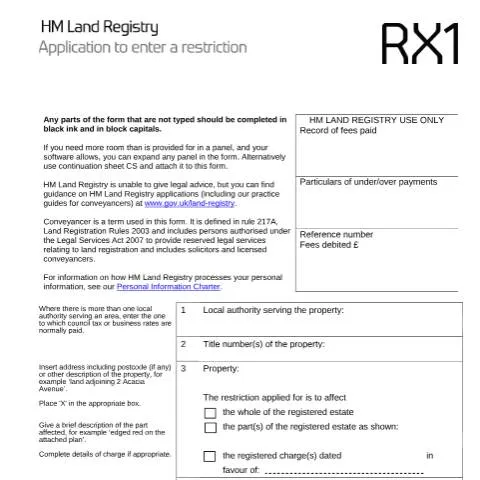
Securing Property Interests Through Formal Restrictions
When property ownership becomes complex—involving trusts, charges, or specific agreements that must be honoured before any future transactions can proceed—the RX1 form serves as a crucial protective mechanism within England and Wales' land registration system. This application enables interested parties to place formal restrictions on a property's title register, creating legally binding conditions that must be satisfied before HM Land Registry will register any subsequent dealing with the property.
Unlike simple notifications or informal agreements, restrictions entered via RX1 carry significant legal weight. They become part of the official register, visible to anyone conducting searches and enforceable against future purchasers or mortgagees. Whether protecting beneficial interests under a trust, securing rights of first refusal, or ensuring compliance with planning obligations, these restrictions serve as permanent safeguards that travel with the property regardless of ownership changes.
Establishing Your Right to Apply for Protection
The RX1 application process centres on establishing legitimate entitlement to seek restriction. Panel 8 of the form presents four distinct pathways, each requiring different evidence and serving different circumstances. Understanding which route applies to your situation determines both the supporting documentation required and the likelihood of successful registration.
Current Registered Proprietors
The most straightforward scenario involves registered proprietors seeking to protect their own interests. This commonly occurs when property owners discover they hold the legal title as trustees for beneficial owners, or when implementing arrangements requiring consent before future disposals. As the registered proprietor, you need only complete the relevant certification in Panel 8(A), confirming your status matches the current register entries.
This route proves particularly valuable for couples purchasing property where contributions differ significantly from legal ownership shares. By entering a restriction requiring both parties' consent to future dealings, the legal owner protects the beneficial owner's interest even if the relationship deteriorates.
Pending Proprietorship Claims
More complex situations arise when applicants hold equitable interests but aren't yet registered as legal proprietors. Panel 8(B) addresses scenarios where registration applications are pending or where clear entitlement exists despite incomplete legal transfer. This pathway requires substantial evidence demonstrating your right to be registered, typically involving contracts, court orders, or other documents establishing equitable ownership.
Beneficiaries under wills frequently use this route when executors delay property transfers. Similarly, purchasers who've completed contracts but not yet received legal title can protect their interests against competing claims or unauthorised disposals by current registered proprietors.
Consent-Based Applications
Panels 8(C) and 8(D) accommodate situations where restrictions benefit parties other than current or future proprietors. These provisions enable protection of third-party interests that might otherwise remain vulnerable to unauthorised transactions. Lenders, for instance, might seek restrictions requiring their consent to future mortgages, even when not holding primary charges over the property.
| Application Route | Typical Scenarios | Key Evidence Required |
|---|---|---|
| Panel 8(A) - Current Proprietor | Trust situations, protective arrangements | Confirmation of registered status |
| Panel 8(B) - Entitled to Registration | Pending transfers, equitable interests | Contracts, court orders, transfer documents |
| Panel 8(C) - With Proprietor Consent | Third-party protective interests | Written consent from registered proprietor |
| Panel 8(D) - With Future Proprietor Consent | Complex multi-party arrangements | Consent plus evidence of entitlement |
Defining the Scope and Impact of Your Restriction
Panel 3 of the RX1 form requires precise definition of the restriction's scope, determining whether protection extends across the entire registered estate or applies only to specific portions or charges. This decision carries significant practical implications for both current and future property dealings.
Whole estate restrictions provide comprehensive protection but may complicate routine transactions involving unrelated property areas. For example, restricting an entire commercial development might prevent straightforward disposals of individual units, even when the underlying concern relates only to common areas or specific obligations.
Partial restrictions, identified through attached plans or precise descriptions, offer targeted protection while preserving flexibility for unaffected property areas. These prove particularly valuable for large estates where different areas serve distinct purposes or where protective interests vary across the property's extent.
Charge-Specific Restrictions
When restrictions relate to specific mortgages or charges, Panel 3 requires detailed identification of the relevant security interests. This approach enables protection of subordinate lenders' positions or ensures compliance with inter-creditor arrangements without affecting unrelated borrowing or property dealings.
Timing becomes crucial when multiple charges exist or are anticipated. Restrictions entered before subsequent charges take priority, potentially affecting later lenders' enforcement rights. Conversely, restrictions applied after charge creation may require additional lender consents or risk rejection if they conflict with existing security arrangements.
Professional Certification and Evidence Requirements
The RX1 form accommodates both professional and personal applications, but conveyancer involvement significantly streamlines the evidence requirements and processing procedures. When solicitors or licensed conveyancers handle applications, their professional certificates can substitute for detailed documentary evidence, reducing both submission requirements and processing delays.
Panel 8's certification options reflect this professional accommodation. Conveyancers can certify their satisfaction with applicants' entitlements or confirm they hold relevant supporting documents, eliminating the need for HM Land Registry to examine original evidence directly. However, these certifications carry professional liability implications, as Land Registry relies on conveyancers' professional judgment and regulatory oversight.
Direct Applicant Challenges
Personal applicants face more stringent evidence requirements, as HM Land Registry must independently verify entitlements and supporting claims. This necessitates submission of original documents or certified copies demonstrating clear legal or equitable interests. Common evidence includes trust deeds, beneficial ownership declarations, court orders, or detailed contracts establishing protective rights.
The form's guidance notes emphasise that original documents may be destroyed after scanning, highlighting the importance of retaining copies for personal records. This destruction policy aims to prevent document accumulation but requires careful consideration when irreplaceable historical documents support applications.
Application Processing and Fee Structures
Panel 4 addresses fee payment mechanisms, offering both immediate payment and direct debit options for professional users. The application fee varies depending on the restriction's complexity and scope, with HM Land Registry's published fee schedules providing current rates for different scenarios.
Professional customers benefit from key number systems and direct debit arrangements, enabling streamlined processing and account management across multiple applications. These facilities prove particularly valuable for conveyancers handling numerous restriction applications or managing ongoing property portfolios requiring periodic restriction updates.
Fee payment timing affects application processing, as incomplete payments may trigger requisitions or delays. Direct debit arrangements eliminate this risk for professional users, while personal applicants should ensure cheques accompany applications and reflect current fee schedules available through government guidance channels.
Document Management and Supporting Evidence
Panel 5 requires comprehensive listing of all documents accompanying the RX1 application, creating an audit trail for Land Registry processing and ensuring complete evidence packages reach examining officers. This administrative requirement often proves crucial when applications face scrutiny or require clarification during processing.
The form's integration with other Land Registry applications—particularly AP1 first registration and FR1 forms—enables coordinated submission of related matters. When multiple applications affect the same property simultaneously, cross-referencing ensures consistent processing and reduces potential conflicts between competing interests or requirements.
Document Retention and Destruction Policies
HM Land Registry's document scanning and destruction policies reflect modern administrative efficiency but require careful consideration when submitting irreplaceable historical documents. While certified copies generally suffice for established titles, first registration applications may require original documents, which will be returned if certified copies accompany them.
This policy balance recognises both administrative efficiency needs and document preservation concerns. Applicants should consider document significance and replacement possibilities when determining submission approaches, particularly for historical properties with unique or irreplaceable supporting evidence.
Communication Channels and Application Tracking
Panel 7's communication preferences significantly affect application processing efficiency and outcome notification. Email addresses enable faster requisition delivery and response processing, while traditional postal communications may extend processing timeframes considerably.
Professional applicants benefit from warning cancellation procedures when email addresses are provided, enabling proactive response to potential processing issues. These warnings typically precede formal requisitions, offering opportunities to address concerns before applications face rejection or significant delays.
Reference number systems enable effective case tracking and correspondence management, particularly valuable when applications involve complex evidence or require extended processing periods. Clear reference systems also facilitate follow-up communications and ensure consistent case handling across different Land Registry officers or departments.
Strategic Implications and Long-Term Considerations
Successfully entered restrictions create permanent register entries affecting all future property dealings until formally removed or modified. This permanence requires careful consideration of long-term implications and potential impacts on property marketability or financing options. While restrictions protect specific interests effectively, they may also complicate routine transactions or limit future flexibility.
Property developers and investors should consider restriction implications for exit strategies and future disposal options. Restrictions requiring multiple consents or complex compliance procedures may affect property values or limit potential purchaser pools, particularly in commercial contexts where transaction speed and certainty prove crucial.
The RX1 application process ultimately serves as a gateway to formal legal protection within England and Wales' comprehensive land registration system. Success requires careful attention to procedural requirements, appropriate evidence assembly, and clear understanding of both immediate protective benefits and long-term strategic implications for property ownership and future dealings.
Common Scenarios and Practical Applications of RX1 Restrictions
The RX1 restriction serves diverse purposes across different property situations, each requiring specific documentation and justification. Understanding these practical applications helps clarify when this restriction becomes necessary and how it functions in real-world circumstances.
Family property disputes represent one of the most frequent uses of RX1 restrictions. When siblings inherit a family home but disagree on its disposal, one party may apply for an RX1 to prevent unilateral sale whilst legal proceedings are ongoing. The restriction typically specifies that disposal requires either consent from all named beneficiaries or a court order resolving the dispute. This prevents one co-owner from forcing through a sale that disadvantages other family members.
In matrimonial proceedings, RX1 restrictions prove essential for protecting spousal interests. During divorce proceedings, either party may seek to register a restriction preventing disposal without court approval or spousal consent. This safeguards against one spouse attempting to dispose of the matrimonial home to defeat the other's financial claims. The restriction remains until the court makes a final property settlement order or the parties reach agreement.
Commercial lending scenarios often involve RX1 restrictions where multiple security interests exist. For instance, when a property secures both a primary mortgage and additional business borrowing, lenders may require restrictions ensuring their consent to any disposal. This protects their security position and ensures proper redemption procedures are followed.
Property held in trust arrangements frequently requires RX1 restrictions to ensure compliance with trust terms. Where trustees hold property for beneficiaries, restrictions may require beneficiary consent or compliance with specific trust conditions before disposal. This is particularly relevant for family trusts where properties pass through generations subject to particular conditions.
Bankruptcy and insolvency situations create complex restriction scenarios. When a property owner faces bankruptcy, the Official Receiver or trustee in bankruptcy may register restrictions preventing disposal without proper authority. Similarly, when companies enter administration, administrators may use RX1 restrictions to preserve property assets pending resolution of the insolvency proceedings.
Local authorities sometimes employ RX1 restrictions in affordable housing schemes. Where properties are sold at below-market value under shared ownership or help-to-buy arrangements, restrictions ensure compliance with scheme conditions. These might require local authority consent to disposal or mandate specific procedures for calculating redemption amounts.
Legal Framework and Statutory Basis for Registration Restrictions
The legal foundation for RX1 restrictions rests primarily within the Land Registration Act 2002 and associated regulations, creating a comprehensive framework governing when and how restrictions may be entered on the register.
Section 40 of the Land Registration Act 2002 provides the statutory authority for entering restrictions. This section empowers the registrar to enter restrictions where they appear appropriate for protecting rights or interests in registered land. The section establishes that restrictions may be entered either on application or by the registrar's own initiative in specific circumstances.
The Land Registration Rules 2003 elaborate on the practical implementation of restrictions, specifying required forms, evidence, and procedures. Rule 91 sets out the general power to apply for restrictions, whilst subsequent rules detail specific circumstances and requirements for different types of restrictions.
Judicial precedent has refined the interpretation of restriction powers through various court decisions. The courts have established that restrictions must serve a legitimate purpose in protecting interests in land, rather than merely creating obstacles to disposal. This ensures restrictions cannot be used oppressively or without proper justification.
The overriding objective underlying restriction provisions is the protection of interests in registered land whilst maintaining the integrity and marketability of the registration system. This balance ensures that legitimate interests receive protection without unnecessarily hampering property transactions.
Human Rights Act 1998 considerations also influence restriction applications, particularly regarding Article 1 of Protocol 1 (protection of property) and Article 8 (right to family life). These provisions ensure that restrictions serve legitimate purposes and remain proportionate to the interests they protect.
The Data Protection Act 2018 governs how personal information is processed during restriction applications. HM Land Registry must comply with data protection principles when handling personal details of applicants, proprietors, and other affected parties. This includes ensuring information is processed lawfully, fairly, and transparently.
Equalities legislation requires consideration of potential discriminatory impacts when processing restriction applications. HM Land Registry must ensure their procedures do not unfairly disadvantage particular groups or create unnecessary barriers to accessing restriction protections.
The relationship with other legislation creates additional complexity. For instance, restrictions relating to matrimonial proceedings must comply with Matrimonial Causes Act provisions, whilst those involving trusts must align with Trustee Act requirements. This interconnection requires careful consideration of multiple legal frameworks.
Managing and Removing RX1 Restrictions: Procedures and Considerations
Once registered, RX1 restrictions require active management throughout their lifecycle, with specific procedures governing their modification, compliance, and eventual removal.
Ongoing compliance obligations fall primarily on the registered proprietor, who must ensure any proposed disposal meets the restriction's requirements. This involves obtaining necessary consents, court orders, or other specified approvals before proceeding with transactions. Failure to comply renders any purported disposal ineffective against purchasers with notice of the restriction.
When circumstances change, parties may need to vary existing restrictions rather than remove them entirely. This might involve changing the parties whose consent is required, modifying conditions for disposal, or updating references to reflect changed circumstances. Variation applications require similar evidence to original applications, demonstrating the need for changes and their appropriateness.
The removal process varies depending on how the restriction was originally entered. Where restrictions were entered by agreement or on application by the proprietor, removal typically requires consent from all parties who originally agreed to the restriction. This prevents unilateral removal where multiple parties have interests to protect.
Court-ordered removal becomes necessary where parties cannot agree on removal or where disputes arise about whether removal conditions have been met. Courts have discretion to order removal where restrictions no longer serve their intended purpose or where circumstances have fundamentally changed. Applications typically proceed under Civil Procedure Rules Part 8 procedure.
For restrictions protecting third-party interests, removal usually requires consent from those parties or evidence that their interests no longer require protection. This might involve demonstrating that debts have been repaid, disputes resolved, or other circumstances triggering the restriction have ceased to apply.
Automatic removal provisions apply in limited circumstances, such as when court orders specify particular conditions for removal or when restrictions include sunset clauses. However, most restrictions require active steps for removal rather than lapsing automatically.
The practical impact during removal can affect property transactions. Purchasers typically require evidence that removal applications are progressing satisfactorily, and completion may be delayed pending actual removal from the register. This emphasises the importance of beginning removal procedures well in advance of proposed transactions.
Costs implications of removal procedures can be significant, particularly where court applications become necessary. Parties should consider these costs when initially agreeing to restrictions and factor them into longer-term property strategies. Legal advice often proves essential for navigating complex removal procedures.
Record-keeping throughout the restriction's lifecycle helps facilitate eventual removal. Maintaining correspondence, agreements, and evidence supporting the restriction's original purpose assists in demonstrating when removal becomes appropriate and in satisfying HM Land Registry's requirements for processing removal applications.