Understanding the Search of Home Rights by Lenders (HR3)
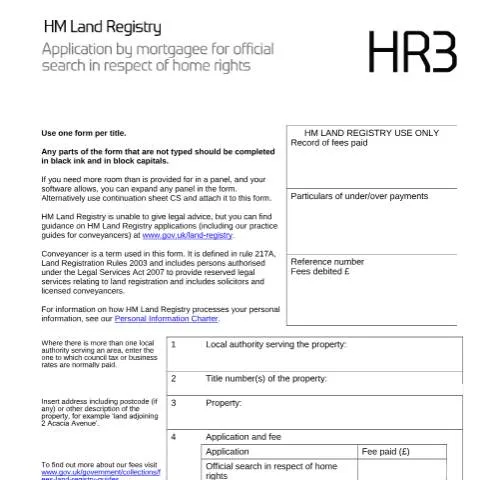
The Search of Home Rights by Lenders form (HR3) plays a crucial role in the UK property conveyancing process, particularly in the context of matrimonial home rights. When lenders seek to secure a mortgage, they must verify whether there are existing claims to the property, particularly those registered under the Family Law Act 1996. This ensures that any financial commitment made by the lender is safeguarded against potential claims from a spouse or civil partner.
Who Needs to Submit the HR3 Form?
The HR3 form is typically submitted by mortgage lenders, including banks and building societies, who are seeking to ascertain any home rights notices relating to a property. It's essential for lenders to ensure that their investment is protected, especially in circumstances where a property may be jointly owned by individuals who are or have been married or in a civil partnership.
- Mortgage Lenders: Primary users of the HR3 form, to investigate potential claims before proceeding with a mortgage.
- Conveyancers and Solicitors: Often responsible for submitting the HR3 as part of the due diligence process in property transactions.
The Significance of Home Rights Notices
Home rights notices are entered onto the title register to protect the interests of spouses or civil partners who may not be the legal owners of a property. These notices ensure that any sale or mortgage of the property cannot occur without the knowledge of the non-owning partner, protecting their respective interests.
By properly executing the HR3 form, the lender can confirm whether:
- A home rights notice exists on the property title.
- A matrimonial home rights caution has been entered.
- There are any pending applications for home rights notices.
Structured Approach to Filling Out the HR3 Form
Completing the HR3 form requires a meticulous approach to ensure all information is accurate and complete. Here’s a breakdown of the sections that must be filled out:
- Property Details: Include the address and the title number of the property being searched.
- Local Authority Information: Identify the local authority serving the property, as this can impact council tax and other obligations.
- Applicant Information: Provide the full name of the mortgage lender and their contact details, ensuring that all names are listed accurately according to official records.
- Search Request: Explicitly state that the application is for an official search as described in section 56(3) of the Family Law Act 1996.
Consequences of Incomplete or Incorrect Submissions
Submitting an incomplete or incorrect HR3 form can have significant repercussions. It may result in delays in processing the mortgage application or, worse, nullify the protections that the lender seeks. The lender must be aware of the following:
- Loss of Protection: A mistake in the register due to incomplete information may lead to a loss of the protection under the Land Registration Act 2002.
- Potential Legal Repercussions: Providing false information can lead to charges under the Fraud Act 2006, with severe penalties including imprisonment.
Important Considerations and Best Practices
When preparing to submit the HR3 form, it's vital to consider the context of the property transaction:
- Engage a Conveyancer: Given the complexities involved, working with a qualified conveyancer or solicitor can help in avoiding common pitfalls.
- Verify Documentation: Ensure that all supporting documents are accurate and correspond with the information provided in the HR3 form.
- Use Block Capitals: All forms must be filled out using black ink and block capitals to ensure clarity and legibility.
What to Expect After Submission?
Once the HR3 form has been submitted to the HM Land Registry, the following process will generally occur:
- Processing Time: The time taken to process the application can vary based on the workload of the registry and the complexity of the case.
- Search Results: Lenders will receive an official certificate detailing the results of the search, indicating any existing home rights notices or cautions.
If the search identifies a home rights notice, lenders may need to consult with their conveyancer on how to proceed, potentially requiring the consent of the spouse or civil partner before proceeding with the mortgage.
Follow-Up Actions in Case of Issues
In the event of a refusal or a delay in processing, it is advisable to take proactive measures:
- Contact HM Land Registry: Directly reach out to the registry for updates or clarifications on the status of your application.
- Check for Missing Information: If the application was incomplete, ensure that any missing details are addressed and resubmitted promptly.
- Legal Advice: Consult with a legal expert if complications arise that could affect the transaction.
Conclusion: The Broader Impact of the HR3 Form
The HR3 form is more than just a procedural requirement; it reflects the legal framework designed to protect individuals in property ownership situations. Understanding the form's implications can make a significant difference not only for lenders but also for the spouses or civil partners impacted by the decisions made in property transactions.
As property markets continue to evolve and personal circumstances change, the importance of accurately and efficiently completing the HR3 form will remain a cornerstone in ensuring fair dealings in the realm of property law.
Understanding Home Rights in Lender Searches
In the context of home ownership in the UK, it is crucial for both homeowners and potential lenders to understand the implications of home rights, especially when it comes to the search conducted by lenders, specifically through the HR3 form. A thorough understanding of these rights can significantly affect mortgage applications, property ownership, and the lender's ability to recover debts.
The HR3 form specifically relates to the lender's search for any home rights claimed against a property. Home rights are legal rights granted to individuals, usually former spouses or civil partners, that allow them to occupy a property even if their name is not on the title deed. These rights are particularly relevant in situations of divorce or separation, where one party may have contributed to the purchase or maintenance of the property but is not legally recognised as its owner.
When lenders perform a search for home rights using the HR3 form, they aim to identify any claims that could affect their ability to enforce a mortgage agreement. Understanding how this form interacts with the wider context of property law and personal rights is essential for anyone considering applying for a mortgage. Homeowners should be aware that if a lender discovers an existing home rights claim during their search, they may consider the application differently, potentially leading to delays or even refusals.
The Process of Filing an HR3 Search
Filing an HR3 search is a straightforward yet critical procedure in the home buying and borrowing process. The application typically requires completion of the form itself, which includes essential details such as the property address, details of the applicant, and any relevant information regarding potential home rights claims. The form must then be submitted to the Land Registry, along with any applicable fees. It's worth noting that while the process is largely standardised, variations may occur based on specific property circumstances or the nature of the claim.
Upon submission, the Land Registry will carry out the search and return the results, which may indicate whether any home rights exist. If there are registered home rights, the lender must proceed cautiously, as these rights can complicate the mortgage process. In some cases, additional documentation may be required to clarify the rights in question or to establish the priority of the lender's mortgage over the home rights.
It is also vital for applicants to consider the potential implications of a lengthy search process. Delays in receiving the results can affect the overall timeline for purchasing a property or securing a mortgage. Borrowers should therefore plan accordingly, allowing sufficient time for the HR3 search to be completed before any deadlines associated with property transactions.
Impact of Home Rights on Property Transactions
The existence of home rights can significantly impact property transactions, affecting everything from valuations to the potential issuance of mortgages. Lenders must evaluate the implications of these rights carefully before proceeding. In some instances, home rights can devalue a property, leading to lower offers from potential buyers or higher risk assessments from lenders.
Moreover, if a property is encumbered by home rights, lenders may be less willing to proceed with a loan unless there are satisfactory arrangements in place to address those rights. This can involve requiring the claimant to relinquish their rights formally or ensuring that they are adequately compensated before a mortgage can be secured. This aspect adds complexity to the mortgage process, requiring both borrowers and lenders to engage in thorough discussions and negotiations to reach a resolution.
Furthermore, it is essential for homeowners to understand that home rights can arise unexpectedly. For instance, if a relationship ends and one partner claims home rights, this can create significant complications for the remaining homeowner. In such cases, it is advisable to seek legal advice to navigate these claims effectively and understand the implications for any ongoing or future property transactions.
In conclusion, the HR3 search for home rights is a vital component in securing financial products tied to home ownership. Understanding the nuances of this process, the implications of home rights, and how they impact property transactions can lead to more informed decisions for both borrowers and lenders alike. It is advisable to seek expert legal guidance whenever navigating the complexities of home rights to ensure that all parties enter the mortgage process fully informed and prepared.