Understanding the Official Guidance on Leasehold Disputes in the UK
The HM Courts & Tribunals Service provides essential procedures for leaseholders and landlords seeking a formal decision regarding lease price and acquisition terms. This guidance clarifies the purpose of the official form known as Leasehold 9, its scope, the eligible applicants, and the necessary documentation to support such applications.
Scope and Purpose of the Leasehold 9 Form
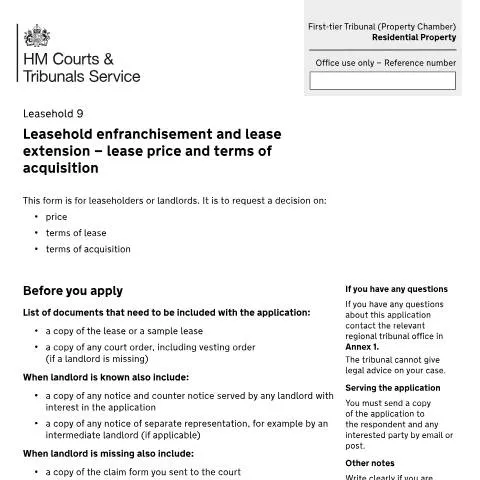
The Leasehold 9 form is an official document used within the context of leasehold enfranchisement and lease extension proceedings. Its primary purpose is to facilitate a request to the First-tier Tribunal (Property Chamber) for a binding decision on three critical aspects:
- The appropriate price for the lease or enfranchisement
- The specific terms of the lease extension or acquisition
- The conditions under which the lease or property rights may be acquired
This process is applicable to both leaseholders wishing to extend their lease or acquire the freehold, and landlords involved in such negotiations. The form ensures that the Tribunal has all relevant information and documentation to make an informed decision, which ultimately affects property rights and financial obligations.
Who Can Use the Leasehold 9 Form?
The form is designed for two main categories of applicants:
- Leaseholders or their representatives: Individuals or entities holding a lease who seek to determine fair lease extension terms or enfranchisement prices.
- Landlords or their representatives: Property owners or managing agents involved in lease extension or enfranchisement processes.
Applicants must specify whether the landlord is known or unknown, as this influences the procedural requirements and the documentation needed. Different statutory sections of the Leasehold Reform, Housing and Urban Development Act 1993, and the Leasehold Reform Act 1967, govern these procedures depending on the context.
Preparation and Submission of the Application
To ensure the application proceeds smoothly, applicants must include specific supporting documents:
- A copy of the lease or a sample lease document
- Any relevant court order, such as a vesting order, if applicable
- For known landlords, copies of notices, including any counter notices or notices of separate representation
- If the landlord is unknown, copies of the claim form sent to the court and any associated witness statements or affidavits
Applicants are required to complete all sections of the form and attach the requested documentation. Failure to do so may result in delays or rejection of the application. If an applicant cannot provide all information, they must explain the reasons at the end of the form, and the Tribunal will decide whether the application can proceed.
Role of the Tribunal and Contact Points
The First-tier Tribunal (Property Chamber) is the adjudicating body responsible for making decisions based on the submitted application. It is important to note that the Tribunal cannot provide legal advice; its role is limited to resolving disputes and determining fair terms based on the evidence provided.
Applicants are advised to contact the relevant regional tribunal office listed in Annex 1 for assistance with procedural questions. It is also necessary to serve a copy of the application on all respondents or interested parties via email or postal service, ensuring proper notification of all involved stakeholders.
Additional Considerations and Legal References
The application process is governed by specific legal provisions, notably Sections 24(1), 27(1)-(5), 48(1), and 51(1)-(5) of the Leasehold Reform, Housing and Urban Development Act 1993, as well as Sections 21(1)(a), (cza), 21(2), and 27(5) of the Leasehold Reform Act 1967. These legal frameworks establish the procedural requirements and criteria for leasehold enfranchisement and lease extension cases.
Applicants should carefully review these legal references and ensure their documentation aligns with statutory requirements. Proper preparation helps facilitate a timely and fair resolution through the Tribunal process.
Summary
The Leasehold 9 form is a critical tool for leaseholders and landlords seeking formal decisions on lease prices and acquisition terms. Its effective use requires thorough documentation, adherence to legal procedures, and clear communication with the Tribunal. Understanding these procedures ensures that property rights are managed fairly and transparently within the UK's leasehold system.