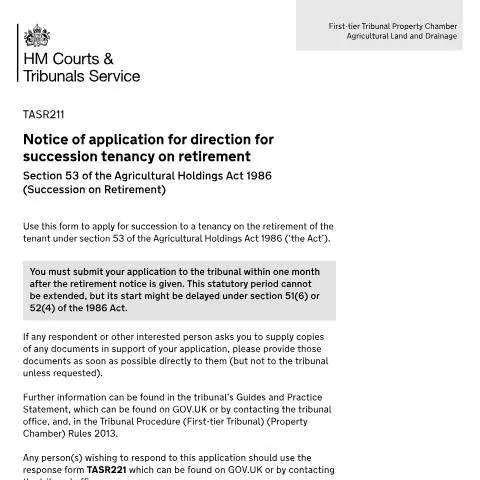
Navigating the TASR211: Your Essential Guide to Agricultural Tenancy Succession
If you're in the agricultural sector and the tenant of a holding has retired, you may find yourself needing to fill out the TASR211 form for succession. This form is pivotal for ensuring that the transition of tenancy is handled correctly under the Agricultural Holdings Act 1986. Understanding the intricacies of this document is crucial for both applicants and landlords, and this guide aims to unpack each element clearly.
Understanding the Context: The Agricultural Holdings Act 1986
The Agricultural Holdings Act 1986 provides a framework for the succession of tenancies in agriculture. Section 53 specifically addresses the situation when a tenant retires, enabling their nominated successor to take over the tenancy. This legal provision is not just procedural; it safeguards the agricultural practice and ensures continuity in farm management, which can be vital for the sustainability of farming operations.
Succession applications must adhere strictly to the timelines specified by the Act. You must submit the TASR211 form within one month of the retirement notice. Missing this deadline can jeopardize your right to succeed the tenancy. Thus, timely action is essential.
Step-by-Step Breakdown of the TASR211 Form
Filling out the TASR211 form may seem daunting at first glance, but breaking it down into sections can ease the process. Here's how to approach it:
1. Applicant Information
- Full Name: Ensure that your name is written clearly and matches official documents.
- Date of Birth: Input the date in the format: day, month, year.
- Address: Provide a full postal address, including postcode.
- Contact Details: Include a phone number and email address for future correspondence.
2. Retiring Tenant Details
For the section related to the retiring tenant, ensure that:
- You provide the full name(s) and date(s) of birth accurately.
- If there are multiple tenants, you can continue on a separate sheet but must maintain clarity.
3. Nominations and Intent
This part is critical as it establishes your claim to the tenancy:
- Date Notice Given: The date on which the retiring tenant communicated their intention.
- Retirement Date: The actual date of retirement must align with tenancy conditions specified in the Act.
Remember, the retirement date should be a date on which a notice to quit could have been given, typically within one to two years following the retirement notice.
4. Details of the Holding
When detailing the holding, you should include:
- Name of the Holding: This should be the officially registered name.
- Location: Provide a specific address, including the Ordnance Survey field numbers where applicable.
- Land Area: Accurately indicate the total hectares and their types (arable, permanent pasture, etc.) along with relevant maps.
5. Current Tenancy Status
In this section, you need to specify the nature of the current tenancy:
- Check the appropriate box indicating when the current tenancy was granted.
- Indicate the annual rent and the date of the tenancy agreement.
6. Respondents Information
Identifying the right respondents is vital:
- Include names and addresses of all landlords and any other relevant parties.
- If the land is in trust, ensure all trustees are named.
Scenarios: Who Should File the TASR211?
While the base requirement for submitting the TASR211 is straightforward, there are several scenarios where additional considerations come into play for applicants:
1. Foreign Tenants
For foreign nationals or non-residents, additional documentation may be required to establish your eligibility as a successor. Check the tribunal guidance for specifics on what documentation is necessary.
2. Minors
If the nominated successor is a minor, legal guardianship documentation must be provided alongside the TASR211 form. This often complicates the process, so early consultation with legal counsel is advisable.
3. Complex Situations
In scenarios involving multiple tenants or disputes among family members regarding succession, consider seeking legal advice to navigate the complexities effectively. The tribunal may require comprehensive documentation demonstrating the legitimacy of the nominated successor.
Key Timelines and What Comes Next
A clear understanding of the timeline surrounding the TASR211 application is crucial. Here’s what you need to know:
| Event | Deadline |
|---|---|
| Retirement Notice Given | Day of Notice |
| Submit TASR211 Form | Within 1 month of Retirement Notice |
| Tribunal Decision | Varies; typically within a few weeks after submission |
Once your application is filed, the tribunal will review the information provided and make a determination. It’s imperative to remain available for any additional requests for documentation or clarification from the tribunal or other concerned parties.
Submitting the TASR211: Channels and Their Nuances
The TASR211 can be submitted through several channels, each with its own considerations:
1. Online Submission
Submitting the form online is generally the quickest method. Ensure you have all supporting documents ready for upload, as the online system may require these to be submitted simultaneously.
2. Postal Submission
If you choose to submit by post, ensure that you send copies of all relevant documents and keep proof of postage. Delays in postal processing can be a risk, so factor this into your submission timeline.
3. In-Person Submission
For those who prefer face-to-face interaction or may have questions, visiting the tribunal office can be beneficial. Speak to an advisor about your application while delivering the form, ensuring that everything is in order.
Document Preparation: What You’ll Need
Having all necessary documents prepared before filling out the TASR211 can streamline the process significantly. Here’s a checklist of key documents you might need:
- Retirement Notice: A copy of the notice given by the retiring tenant.
- Identification: Proof of identity such as a passport or driving license.
- Proof of Tenancy: Existing tenancy agreement or any previous notices related to tenancy.
- Maps and Land Identification: Any maps indicating the holding and specifying Ordnance Survey numbers.
Being well-prepared with these documents can prevent delays and ensure a smoother process in your application for succession.
Understanding the Implications: Rights and Responsibilities
Successfully submitting the TASR211 and being granted succession comes with both rights and responsibilities.
Rights Post-Succession
- You gain the right to the tenancy of the holding as specified in the application.
- You're entitled to the benefits associated with the tenancy, including use of the land and any associated structures.
Responsibilities to Consider
- As the new tenant, you must adhere to the tenancy terms and conditions.
- Be prepared to handle any existing obligations, such as rent payments and land management duties.
Failing to fulfil these responsibilities can lead to disputes or even termination of the tenancy, so it’s essential to stay informed and proactive.
Final Thoughts: Mastering the TASR211 Process
Dealing with the TASR211 form can initially feel overwhelming, particularly with the potential complexities surrounding agricultural tenancy succession. However, by carefully assembling your application, understanding your rights and responsibilities, and following through on the necessary timelines, you can navigate this process effectively.
Remember, the success of your application hinges not only on filling out the form correctly but also on being proactive in communication with all parties involved. Whether you submit your application online, by post, or in person, ensure that you are prepared for each step along the way.
Understanding Agricultural Tenancy Succession Rights
In the context of agricultural tenancies in the UK, succession rights are a key consideration for tenants planning their retirement. The Agricultural Tenancies Act 1995 allows certain individuals to inherit a tenancy when the original tenant retires or passes away. This is particularly relevant for farming businesses, as it helps ensure the continuity of agricultural operations on the land. The person applying for succession must typically be a close relative of the original tenant, such as a spouse, civil partner, or child, and must have been involved in the farming enterprise for a specified period prior to the original tenant’s retirement.
It's essential to note the conditions that apply to succession rights. The applicant must have been working on the farm for an adequate amount of time, usually defined as at least three years, to demonstrate their involvement and understanding of the farming operation. If the original tenant was not the sole operator of the farm, the succession may become more complex, and additional requirements may be imposed by the landlord or governing bodies. In cases where the tenancy is governed by a different legal framework, such as the Agricultural Holdings Act 1986, the rules may differ significantly, so it’s imperative to verify the specific legislation applicable to your situation.
The Application Process for Form TASR211
Completing Form TASR211 is the first step in the succession process, and understanding its components is crucial for a successful application. This form must be filled out by the individual seeking to succeed the tenancy, and it requires detailed information about both the applicant and the original tenant. The form will ask for personal details, including the applicant's National Insurance number, and a description of their relationship to the original tenant. It is also necessary to provide evidence of your involvement in the farm, which can include references from the original tenant or other relevant documentation, such as pay slips or bank statements that reflect your contributions to the farm's operations.
Additionally, prospective applicants should prepare for possible interviews with the landlord or representatives from the relevant agricultural authority. During these discussions, it’s advisable to articulate your understanding of the agricultural business, future plans for the farm, and how you intend to maintain or improve its productivity. Documentation verifying your agricultural training or experience can bolster your application and provide assurance to the landlord about your competence to manage the farm.
Common Challenges in Agricultural Tenancy Succession
While applying for succession under Form TASR211 can be straightforward, several challenges may arise during the process. One common issue is the landlord's discretion; they may oppose the succession claim for various reasons, including concerns about the applicant's experience, financial stability, or suitability to manage the farm. Understanding the landlord's perspective and addressing any concerns proactively can significantly enhance your chances of a successful application.
Another challenge could arise from disputes about the validity of the relationship with the original tenant. If the tenant has not formalized relationships, such as through marriage or civil partnerships, proving eligibility can become contentious. It is advisable to seek legal counsel in situations where the relationship is unclear or contested, as they can provide guidance on how to present your case effectively to the landlord or tribunal.
Moreover, the issue of financial readiness should not be overlooked. While succession can provide an opportunity to take over a family farm, it often requires a hefty financial commitment, including the costs associated with operating the farm and potential rent payments. Prospective successors should develop a detailed business plan that outlines their financial strategy and demonstrates their ability to manage the farm's financial obligations successfully. This plan can be instrumental in negotiations with the landlord and other stakeholders, showing your commitment to maintaining the farm's viability for the long term.