Defence Personnel and Asbestos Exposure Documentation: The Critical Role of MOD Form 960
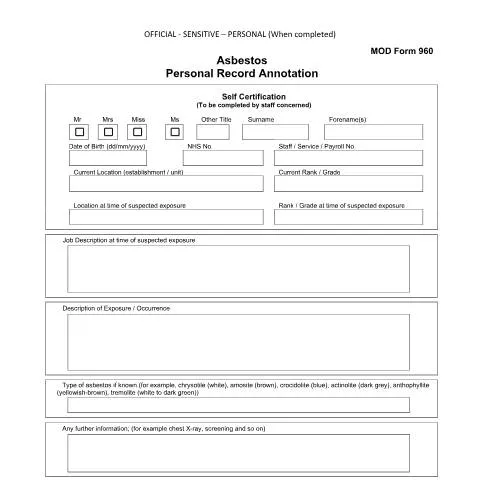
Within the vast infrastructure of Britain's military establishments, from historic naval dockyards to Cold War-era RAF bases, the spectre of asbestos exposure remains a pressing occupational health concern. The Ministry of Defence's Form 960, formally titled "Asbestos Personal Record Annotation Self Certification," serves as the primary mechanism for military and civilian personnel to formally document suspected or confirmed exposure to this hazardous material across the defence estate.
This self-certification process represents more than mere administrative procedure—it establishes a vital health record that may prove crucial for future medical monitoring, compensation claims, and epidemiological tracking within the defence community. The form's significance extends beyond individual health protection to encompass broader MOD responsibilities under the Control of Asbestos Regulations 2012 and corporate duty of care obligations.
The Defence Estate's Asbestos Legacy and Personnel at Risk
Military personnel face unique asbestos exposure risks stemming from the extensive use of asbestos-containing materials throughout the 20th century defence infrastructure. Service personnel across all three branches—Royal Navy, British Army, and Royal Air Force—may encounter asbestos during routine operations, maintenance activities, or building refurbishment projects on military installations.
The exposure scenarios vary significantly by service branch and role. Naval personnel working on vessels constructed before the 1980s face particularly high risks, as ships extensively incorporated asbestos in engine rooms, boiler spaces, and accommodation areas. Army personnel stationed in older barracks, particularly those dating from the 1950s-1970s construction boom, may encounter asbestos during building maintenance or renovation projects.
Civilian staff employed across the defence estate face similar exposure risks, including:
- Defence Equipment and Support (DE&S) personnel working in legacy facilities
- Contractors and subcontractors engaged in maintenance, demolition, or refurbishment activities
- Administrative staff in older MOD buildings and regional offices
- Defence Fire and Rescue Service personnel responding to incidents in older structures
Particularly vulnerable groups include trades personnel such as plumbers, electricians, and heating engineers who may disturb asbestos-containing materials during routine maintenance. The form specifically accommodates different ranks and grades, recognising that exposure can affect personnel from junior ratings to senior officers, and from industrial grades to senior civil servants.
Documenting Exposure Circumstances: Critical Details for Form 960
The self-certification process requires precise documentation of exposure circumstances, with particular emphasis on chronological accuracy and specific location details. Personnel must identify not only their current posting but crucially the exact establishment or unit where exposure occurred, alongside their rank or grade at that time.
The form demands detailed job descriptions at the time of suspected exposure, recognising that military roles often involve diverse duties beyond primary specialisations. A Royal Engineer, for instance, might document exposure during both construction activities and subsequent facility maintenance tasks, each requiring separate consideration.
| Asbestos Type | Colour/Appearance | Common Defence Applications |
|---|---|---|
| Chrysotile (white) | White fibrous | Insulation, gaskets, brake linings |
| Amosite (brown) | Brown/grey fibrous | Pipe insulation, ceiling tiles |
| Crocidolite (blue) | Blue fibrous | Naval applications, high-temperature insulation |
| Actinolite | Dark grey/green | Specialist military equipment |
The exposure description section requires comprehensive narrative detail. Personnel should document whether exposure involved direct handling of materials, proximity to disturbed asbestos, or environmental exposure from deteriorating materials. The duration and frequency of exposure periods significantly influence health monitoring requirements and potential compensation considerations.
Technical Identification Requirements
Where possible, personnel should attempt to identify the specific asbestos type encountered. This technical identification proves particularly challenging for non-specialist personnel, yet remains valuable for medical monitoring purposes. The form provides guidance on the six recognised asbestos types, from the commonly encountered chrysotile (white asbestos) to the more hazardous crocidolite (blue asbestos) frequently used in naval applications.
Medical Integration and Health Record Management
Form 960 operates within a broader occupational health framework that extends beyond simple exposure documentation. The certification triggers specific medical monitoring protocols and integrates with existing health surveillance systems across the defence medical services.
Service personnel must forward copies to their local Medical Centre, ensuring integration with their Service Medical Record (SMR). This integration proves crucial for ongoing health surveillance, particularly for personnel approaching discharge who require comprehensive medical documentation for Veterans UK services.
The medical centre integration serves multiple purposes: immediate health assessment, establishment of baseline monitoring protocols, and creation of searchable records for epidemiological studies. Medical officers may initiate chest X-ray programmes, respiratory function assessments, or specialist referrals based on exposure documentation.
For civilian staff, the process involves submission to the Defence Business Services (DBS) through the Digital Workplace scanning hub. This centralised approach ensures consistent record management across the civilian defence workforce while maintaining appropriate data protection standards under the Data Protection Act 2018.
Long-term Health Monitoring Implications
Asbestos-related diseases typically manifest decades after initial exposure, making accurate record-keeping essential for future medical care. The form establishes documentary evidence that may prove crucial for:
- Access to enhanced medical surveillance programmes
- Eligibility for Armed Forces Compensation Scheme claims
- Industrial Injuries Disablement Benefit applications
- Civil litigation support documentation
Navigating the Self-Certification Process: Practical Completion Guidelines
The self-certification nature of Form 960 places responsibility on individual personnel to accurately document their exposure history. This approach recognises that exposure incidents may not always occur under direct supervision or with immediate management awareness.
Personnel should approach completion systematically, beginning with accurate personal identification details including NHS number and current service or payroll number. The date format requirements (dd/mm/yyyy) must be strictly observed to ensure database compatibility and avoid processing delays.
Location details require precision beyond simple unit names. Personnel should include building numbers, facility designations, or ship names where relevant. A Royal Navy rating might specify "HMS Excellent, Block B, Workshop 3" rather than simply "HMS Excellent," providing crucial detail for future investigations or health studies.
Exposure Period Documentation
The certification section demands careful consideration of exposure periods. Personnel should document the earliest and latest possible exposure dates, erring on the side of caution where precise dates cannot be determined. Single-incident exposures require specific date documentation, while ongoing exposures need clear start and end periods.
Witnesses or colleagues present during exposure incidents should be noted in the additional information section, providing potential corroboration for future investigations. This proves particularly valuable for civilian staff whose exposure may not be documented through military reporting channels.
Data Protection and Sensitive Information Handling
Form 960 carries the protective marking "OFFICIAL - SENSITIVE – PERSONAL (When completed)," reflecting the sensitive nature of personal health information within the government security classification system. This marking triggers specific handling requirements under MOD security policies and the Data Protection Act 2018.
The form's data protection statement explicitly limits data use to "recording potential or actual exposure to asbestos," preventing secondary use for unrelated purposes. Personnel retain rights under UK GDPR to access, correct, or request deletion of their data, subject to legitimate health monitoring requirements.
Personal record retention represents a critical aspect of the process. Personnel must maintain personal copies indefinitely, as these may prove essential decades after initial exposure. The form serves as primary evidence for future medical treatment, compensation claims, or legal proceedings.
Inter-agency Data Sharing
Completed forms may be shared with multiple agencies within the defence and health sectors, including:
- Defence Medical Services for ongoing health surveillance
- Veterans UK for post-service medical support
- Health and Safety Executive for regulatory compliance monitoring
- NHS trusts for integrated care planning
Regulatory Compliance and Corporate Accountability
The MOD's implementation of Form 960 reflects statutory obligations under the Control of Asbestos Regulations 2012 and broader Health and Safety at Work Act 1974 requirements. The self-certification approach acknowledges practical limitations in documenting all exposure incidents through formal reporting channels while maintaining regulatory compliance.
Corporate accountability extends beyond individual exposure documentation to encompass systematic risk assessment and management across the defence estate. Form 960 data contributes to broader asbestos management strategies, informing priority refurbishment programmes and enhanced protective measures for high-risk activities.
The Ministry of Defence's duty of care obligations continue post-service for military personnel, with Form 960 providing essential documentation for Veterans UK health services. This long-term accountability recognises the delayed onset of asbestos-related diseases and the state's continuing responsibility to former service personnel.
Integration with Wider Safety Management
Form 960 operates within the broader JSP 375 safety management framework, which encompasses comprehensive health and safety procedures across defence activities. The asbestos exposure documentation integrates with incident reporting systems, risk assessment procedures, and occupational health surveillance programmes.
Regular analysis of Form 960 submissions enables the MOD to identify exposure patterns, high-risk locations, and emerging threats across the defence estate. This intelligence informs policy development, resource allocation, and preventive measures for future operations.
Future Implications and Evolving Health Surveillance
As the defence estate continues modernisation programmes and legacy building assessments, Form 960 documentation becomes increasingly valuable for epidemiological research and health outcome tracking. The accumulated data supports evidence-based policy development and resource allocation for veterans' health services.
Emerging understanding of asbestos-related diseases and their varied presentations means that comprehensive exposure documentation through Form 960 may prove relevant for conditions not currently recognised. The form's detailed exposure circumstances documentation provides essential baseline information for evolving medical understanding and treatment protocols.
Personnel completing Form 960 contribute to a vital health surveillance system that extends beyond individual protection to encompass broader public health objectives. The comprehensive exposure database supports medical research, policy development, and enhanced protection measures for future defence personnel, ensuring that lessons learned from past exposures inform improved safety practices across the military and civilian defence workforce.
Specialist Safety Documentation for High-Risk Defence Operations
Defence operations frequently involve activities that exceed standard workplace risk parameters, necessitating enhanced safety documentation protocols under JSP 375. These specialist forms address unique military hazards including explosive ordnance disposal, live firing exercises, maritime operations, and aviation activities where conventional risk assessment methodologies prove insufficient.
The Form JSP 375-14A (Explosive Safety Assessment) serves as the cornerstone document for any defence activity involving munitions, pyrotechnics, or explosive materials. This comprehensive form requires detailed mapping of explosive safety zones, calculation of potential explosion equivalent weights, and specification of protective construction requirements. Personnel completing this form must hold appropriate explosive safety qualifications and demonstrate understanding of Ministry of Defence explosive safety regulations. The assessment must account for factors including weather conditions, proximity to civilian populations, and potential secondary explosion risks from adjacent storage facilities.
For live firing exercises, the Form JSP 375-15B (Range Safety Certificate) establishes mandatory safety parameters before any weapon system deployment. This document requires range officers to verify clear danger areas, confirm communications protocols, and establish medical evacuation procedures. The form includes specific sections for different weapon systems, from small arms to artillery, each with distinct safety distance requirements and impact area calculations. Completion demands coordination with local air traffic control where applicable and confirmation that all personnel within the exercise area hold current medical fitness certificates.
Aviation safety documentation under JSP 375 encompasses both aircrew and ground personnel activities. The Form JSP 375-16C (Flight Safety Risk Assessment) addresses unique military aviation hazards including low-level flying, formation flying, and operations from unprepared landing sites. This form requires detailed weather assessments, aircraft serviceability confirmation, and crew competency verification. Ground handling operations utilise the complementary Form JSP 375-17A (Aircraft Ground Safety Protocol), covering fuel handling, munitions loading, and maintenance activities conducted on active flight lines.
Maritime defence operations employ the Form JSP 375-18D (Naval Safety Assessment) for activities ranging from small boat operations to major vessel movements. This documentation addresses unique maritime hazards including man overboard procedures, heavy weather protocols, and coordination with civilian maritime traffic. The form requires tidal calculations, weather routing assessments, and confirmation of emergency beacon functionality. Diving operations necessitate additional documentation through Form JSP 375-19B (Military Diving Safety Protocol), which mandates depth limitations, decompression schedules, and emergency surface procedures specific to military diving activities.
Integration with Civilian Emergency Services and Local Authorities
Defence safety management under JSP 375 requires sophisticated coordination mechanisms with civilian emergency services, particularly when military activities occur near populated areas or involve potential off-site consequences. This integration ensures seamless emergency response while maintaining operational security requirements inherent to defence activities.
The Form JSP 375-20E (Civilian Liaison Safety Protocol) establishes formal communication channels between military safety officers and local emergency services including fire brigades, ambulance services, and police constabularies. This document requires identification of primary and secondary contact points, specification of emergency access routes to military facilities, and detailed briefing schedules for civilian responders unfamiliar with military hazards. The form mandates regular joint training exercises to ensure civilian emergency personnel understand unique military risks such as unexploded ordnance, chemical agents, or radioactive materials that may be present on defence establishments.
Local authority coordination becomes particularly critical when military activities impact civilian infrastructure or require temporary road closures. The Form JSP 375-21C (Local Authority Notification Protocol) ensures appropriate consultation with county councils, district councils, and relevant statutory bodies. This documentation requires advance notification periods varying from 48 hours for routine convoy movements to several weeks for major exercises involving heavy equipment transport or temporary airspace restrictions. The form includes specific sections addressing environmental impact assessments, noise pollution considerations, and potential disruption to local businesses or schools.
Hospital liaison protocols under JSP 375 recognise that military medical facilities may lack specialist civilian trauma capabilities, particularly for complex industrial accidents or chemical exposures. The Form JSP 375-22A (Medical Emergency Coordination) establishes formal agreements with National Health Service trusts, specifying which civilian hospitals can receive military casualties and defining the medical information that can be shared while maintaining patient confidentiality under the Data Protection Act 2018. This form requires annual updates to reflect changes in hospital capabilities, specialist consultants, and emergency department capacity.
Environmental emergency coordination addresses potential contamination incidents that could affect civilian populations or water supplies. The Form JSP 375-23D (Environmental Emergency Protocol) requires liaison with the Environment Agency, local water companies, and Public Health England regional offices. This documentation establishes monitoring protocols for air quality, water contamination, and soil pollution that might result from military activities. The form includes specific notification procedures for different contamination levels and defines responsibilities for environmental remediation costs.
Audit Procedures and Compliance Verification Under JSP 375
The effectiveness of defence safety management systems requires rigorous audit procedures that verify compliance with JSP 375 requirements while identifying opportunities for continuous improvement. These audit mechanisms operate at multiple levels, from unit-level self-assessments to comprehensive Ministry of Defence inspections conducted by specialist safety auditing teams.
Internal audit procedures commence with the Form JSP 375-30A (Unit Safety Audit Checklist), which commanding officers must complete quarterly to assess compliance with safety documentation requirements within their units. This comprehensive checklist covers document completion rates, training record currency, and incident reporting timeliness. The form requires statistical analysis of safety trends, identification of recurring hazards, and assessment of corrective action effectiveness. Units must demonstrate that safety briefings reach all personnel, including temporary attachments and civilian contractors operating within military establishments.
External audit procedures involve specialist teams from the Defence Safety Authority who conduct unannounced inspections using the Form JSP 375-31B (Formal Safety Inspection Protocol). These inspections examine not merely document completion but practical implementation of safety procedures during live activities. Auditors assess whether personnel demonstrate genuine understanding of documented procedures and evaluate the effectiveness of safety equipment and emergency response capabilities. The inspection protocol includes witness interviews, practical demonstrations, and technical equipment testing to verify that written procedures translate into effective safety management.
Non-compliance identification utilises the Form JSP 375-32C (Safety Deficiency Report) to document instances where units fail to meet JSP 375 requirements. This form categorises deficiencies by severity level, from minor administrative oversights to major safety breaches requiring immediate operational restrictions. The document requires detailed corrective action plans with specific timelines and identifies responsible personnel for implementing improvements. Serious deficiencies may result in temporary suspension of certain activities until safety standards are restored to acceptable levels.
Trend analysis procedures employ the Form JSP 375-33D (Safety Performance Analytics) to identify patterns across multiple units and activity types. This analysis helps identify systemic issues requiring policy revision or additional training emphasis. The form tracks metrics including incident rates per thousand personnel, training compliance percentages, and audit finding frequencies. This data informs strategic safety policy development and resource allocation decisions at Ministry of Defence level.
Continuous improvement mechanisms operate through the Form JSP 375-34E (Safety Enhancement Proposal), which enables personnel at any level to suggest improvements to existing safety procedures. This form requires detailed justification for proposed changes, cost-benefit analysis, and assessment of implementation feasibility. Successful proposals may result in JSP 375 amendments or the development of new safety procedures that enhance protection for defence personnel while maintaining operational effectiveness.