The Critical Link Between Healthcare Professionals and Benefit Assessments
When Universal Credit claimants face work capability assessments or Personal Independence Payment applications, the medical evidence they provide can determine their financial lifeline. Behind these crucial decisions lies a sophisticated system where healthcare professionals must obtain specific DWP medical evidence forms—Med3 and Med10 certificates—to document their patients' conditions accurately. This ordering process, managed through the Department for Work and Pensions' dedicated system, ensures that GPs, occupational therapists, and other qualified practitioners can access the standardised documentation required for benefit assessments.
The Med3 and Med10 order form serves as the gateway for healthcare professionals to request these essential certificates. Unlike standard medical records, these forms carry specific legal weight in DWP assessments, making their proper completion and timely availability crucial for both healthcare providers and their patients navigating the benefits system.
Understanding the Two-Tier Medical Certificate System
The DWP operates a dual medical certificate framework designed to capture different aspects of a patient's condition and its impact on their ability to work. The Med3 certificate functions as the primary medical evidence document, typically used for short to medium-term incapacity assessments. Healthcare professionals complete these when certifying that a patient is unfit for work due to illness or injury.
The Med10 certificate serves a more specialised purpose, often employed in complex cases where additional medical detail is required or where the standard Med3 format proves insufficient. These certificates frequently support applications for Employment and Support Allowance or provide supplementary evidence for Personal Independence Payment assessments.
| Certificate Type | Primary Use | Pack Size | Maximum Order Quantity |
|---|---|---|---|
| Med3 A5 | Standard fitness for work certificates | 50 sheets per pad | 25 pads per order |
| Med10 | Detailed medical evidence for complex assessments | 50 sheets per pad | 25 pads per order |
Healthcare professionals must understand that these certificates aren't interchangeable with standard sick notes or private medical reports. The DWP requires these specific formats to ensure consistency in assessment processes and to meet the evidential standards set out in benefit regulations.
Eligibility Criteria and Professional Registration Requirements
The ordering system operates strict eligibility controls to prevent unauthorised access to these sensitive medical documents. Qualified healthcare professionals include doctors, registered nurses, occupational therapists, pharmacists, and physiotherapists who are actively providing NHS services or treating NHS-funded patients.
A critical distinction exists between different types of healthcare organisations. NHS entities—including NHS Trusts, Integrated Care Boards, GP surgeries, hospitals, and clinics—can order forms directly through their institutional status. However, third-party suppliers to NHS organisations face additional verification requirements and must demonstrate their legitimate role in providing NHS-commissioned services.
Private healthcare organisations encounter more stringent criteria. They must explicitly confirm they are providing NHS care or treating patients on behalf of the NHS. Simply being a registered healthcare provider isn't sufficient; there must be a direct NHS commissioning relationship or contract in place. This requirement prevents the forms from being used inappropriately in purely private healthcare contexts where DWP benefit assessments wouldn't apply.
HCP Registration Number: The Key Identifier
Every order requires a valid Health and Care Professions Council (HCP) registration number, which serves as the primary verification mechanism. This number links directly to the professional's registration status and confirms their eligibility to complete medical certificates for DWP purposes. Healthcare professionals must ensure their registration remains current, as expired or suspended registrations will result in order rejection.
Navigating the Order Form: Essential Details and Common Pitfalls
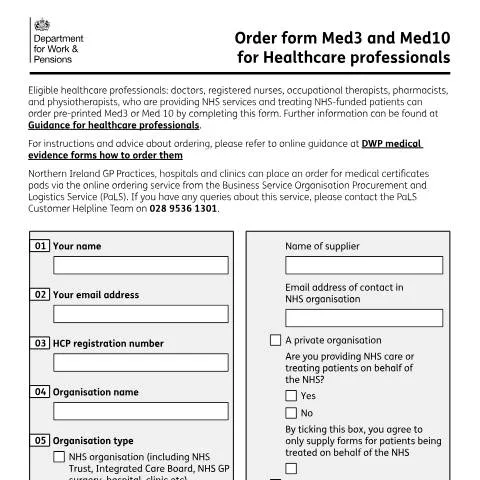
The order form demands precise completion across eleven distinct sections, each serving specific administrative and verification purposes. Section 01 requires the healthcare professional's full name exactly as it appears on their professional registration, while Section 02 captures their primary email address for order confirmations and delivery notifications.
The HCP registration number in Section 03 must be entered without spaces or hyphens, using the exact format provided by the relevant professional body. Healthcare professionals often overlook this formatting requirement, leading to processing delays or rejection of their orders.
Organisation details in Sections 04 and 05 require careful attention to the distinction between NHS organisations and third-party suppliers. The form explicitly asks whether the organisation is providing NHS care or treating patients on behalf of the NHS, with different obligations depending on the response. Ticking the confirmation box in this section creates a contractual commitment to use the forms only for NHS-related medical assessments.
Delivery Logistics and Contact Information
Sections 06 through 10 capture delivery and contact details, with particular emphasis on ensuring forms reach the correct location promptly. Healthcare professionals can specify alternative delivery addresses if their usual workplace isn't suitable for receiving medical forms. This proves especially important for community-based practitioners or those working across multiple sites.
The date of order request in Section 10 becomes crucial for tracking purposes and helps establish delivery timelines. Given the seven-day processing window, accurate dating ensures realistic expectations for form availability.
Order Quantities and Supply Chain Management
The ordering system imposes specific quantity limits designed to balance accessibility with security considerations. Healthcare professionals can order up to 25 pads of Med3 certificates and 25 pads of Med10 certificates in a single order, with each pad containing 50 individual sheets. This typically provides sufficient supply for several months of normal practice volume.
However, practices with high patient volumes or multiple practitioners may need to submit separate orders or coordinate ordering schedules to maintain adequate stock levels. The system doesn't prevent multiple orders from the same organisation, but each must be submitted separately with appropriate justification for the quantities requested.
Healthcare professionals should consider their patient demographics when planning orders. Practices serving areas with high levels of chronic illness, mental health conditions, or industrial injury may require more frequent Med3 orders, while those involved in complex disability assessments might need greater Med10 supplies.
Northern Ireland's Alternative Pathway
The order form specifically notes that Northern Ireland GP practices, hospitals, and clinics must use an alternative ordering system through the Business Service Organisation Procurement and Logistics Service (PaLS). This separate system, accessible via the PaLS Customer Helpline on 028 9536 1301, operates under different procedures and timelines from the standard DWP ordering process.
Healthcare professionals in Northern Ireland should not attempt to use the standard DWP order form, as this will result in automatic rejection and unnecessary delays in obtaining required medical certificates.
Digital Submission Process and Response Timelines
Orders must be submitted electronically to [email protected], with the completed form attached as a digital document. The system doesn't accept postal submissions or faxed orders, reflecting the DWP's commitment to digital-first processes and secure document handling.
Healthcare professionals should submit orders well in advance of anticipated need, as the system operates on a seven working day processing window from receipt to delivery. This timeline excludes weekends and bank holidays, so orders submitted on Fridays won't begin processing until the following Monday.
The processing timeline covers several verification stages, including professional registration checks, organisation validation, and quantity authorisation. Orders with incomplete information or questionable details may face additional scrutiny, extending the processing period beyond the standard seven days.
Tracking and Follow-up Procedures
Once submitted, healthcare professionals receive email confirmations acknowledging receipt of their order. However, the system doesn't provide detailed tracking information or delivery notifications beyond the initial acknowledgement. Practices should maintain their own records of order dates and expected delivery windows to manage stock levels effectively.
If forms don't arrive within the expected timeframe, healthcare professionals should contact the ordering system directly rather than submitting duplicate orders, which can complicate processing and potentially delay delivery further.
Integration with Clinical Practice and Patient Care
The availability of Med3 and Med10 certificates directly impacts healthcare professionals' ability to support their patients through benefit assessment processes. Without proper certificates, patients may face delays in Universal Credit payments, rejection of Personal Independence Payment applications, or challenges in accessing Employment and Support Allowance.
Healthcare professionals must balance their clinical judgement with the specific requirements of DWP assessment processes. The Med3 certificate requires clear statements about fitness for work, duration of incapacity, and recommendations for workplace adjustments. The Med10 format allows for more detailed clinical information but demands greater precision in documenting functional limitations and their relationship to specific benefit criteria.
Proper completion of these certificates requires understanding not just the patient's medical condition, but also how that condition interacts with benefit assessment frameworks. Healthcare professionals increasingly find themselves needing knowledge of DWP assessment criteria to provide effective support for their patients' benefit applications.
Confidentiality and Data Protection Considerations
The ordering and use of DWP medical certificates operates within the framework of the Data Protection Act 2018 and UK GDPR requirements. Healthcare professionals must ensure that completed certificates contain only information relevant to the specific benefit assessment, avoiding unnecessary personal details that don't relate to fitness for work or functional capacity.
The certificates themselves become part of the patient's DWP file and may be shared with assessment providers, decision makers, and appeals tribunals. Patients should be informed about this wider use of their medical information and consent to the completion of DWP certificates as distinct from standard clinical records.
Storage and security of blank certificates requires the same level of protection as other sensitive medical documents. Practices must prevent unauthorised access to unused forms and maintain audit trails for certificate completion and distribution.
Understanding Different Types of Medical Evidence and Their Strategic Use
The landscape of medical evidence extends far beyond the standard medical certificate, and understanding which type of evidence serves your specific DWP claim most effectively can significantly influence the outcome of your assessment. Each form of medical evidence carries different weight and serves distinct purposes within the benefits system.
Hospital discharge summaries often provide the most comprehensive overview of your condition, particularly following significant medical events or surgical procedures. These documents typically include detailed treatment plans, medication adjustments, and prognosis information that assessors find valuable when determining ongoing support needs. Unlike GP notes, which may focus on routine consultations, discharge summaries demonstrate the severity of your condition and its impact on your daily functioning.
Consultant letters represent another tier of medical evidence, often carrying substantial weight due to the specialist's expertise in your specific condition. These letters frequently include detailed assessments of functional capacity, treatment responses, and long-term prognosis that general practitioners may not be qualified to provide. When requesting consultant correspondence, specify that you need it for DWP purposes, as this often prompts the inclusion of more detailed functional assessments.
Mental health evidence requires particular attention to detail, as psychological conditions can be more challenging to document than physical ailments. Care coordinator reports, community psychiatric nurse assessments, and occupational therapy evaluations often provide the most relevant evidence for mental health-related claims. These professionals regularly assess daily living skills and social functioning, making their reports particularly valuable for Personal Independence Payment assessments.
Medication reviews and pharmacy records can serve as supporting evidence, particularly when demonstrating the ongoing nature of your condition or the complexity of your treatment regime. Some claimants overlook this type of evidence, but detailed medication histories can illustrate the progression of conditions and the impact of treatment side effects on daily functioning.
Physiotherapy and occupational therapy reports often contain specific functional assessments that directly relate to DWP criteria. These reports typically include detailed mobility assessments, cognitive evaluations, and recommendations for adaptive equipment – information that proves invaluable during benefit assessments.
Navigating Complex Medical Scenarios and Multi-Condition Claims
Managing medical evidence becomes significantly more complex when dealing with multiple conditions or fluctuating symptoms, requiring a strategic approach to documentation that captures the full scope of your health challenges. The interaction between different conditions often creates additional limitations that may not be apparent when considering each condition in isolation.
Fluctuating conditions present particular challenges for medical evidence collection, as traditional medical reports may not adequately capture the variability of symptoms over time. Conditions such as multiple sclerosis, fibromyalgia, or chronic fatigue syndrome require evidence that demonstrates both good and bad days, rather than a snapshot assessment. Consider requesting that your healthcare providers include specific comments about symptom variability and the unpredictable nature of your condition.
Pain management clinic reports often provide excellent evidence for chronic pain conditions, as these specialists understand the functional impact of pain on daily activities. These reports typically include detailed pain scores, functional capacity evaluations, and treatment response assessments that directly relate to DWP assessment criteria. When attending pain management appointments, explicitly discuss how pain affects your ability to perform daily tasks, as this information is crucial for benefit assessments.
Mental health comorbidities require careful documentation, particularly when psychological symptoms interact with physical conditions. Depression and anxiety commonly accompany chronic physical illnesses, but this interaction may not be adequately reflected in standard medical records. Consider requesting integrated assessments that address both physical and psychological aspects of your health, particularly from healthcare providers who understand the bidirectional relationship between physical and mental wellbeing.
Rare conditions or complex diagnoses may require additional specialist input to ensure assessors understand the condition's impact. When dealing with uncommon conditions, consider requesting that specialists include educational information about the condition alongside their assessment, as DWP assessors may have limited familiarity with rare disorders.
Childhood-onset conditions transitioning to adult services present unique documentation challenges, particularly when establishing the long-term nature of the condition. Ensure continuity of medical evidence during service transitions, and consider requesting summary reports that capture the historical progression of your condition from paediatric to adult care.
Progressive conditions require evidence that demonstrates both current functional limitations and expected disease progression. Neurological conditions, in particular, benefit from evidence that includes prognosis information and anticipated functional decline, as this information supports long-term benefit awards and reduces the frequency of reassessments.
Strategic Timing and Submission Tactics for Maximum Impact
The timing of medical evidence submission can significantly influence the assessment process, and understanding the optimal submission strategy can improve your chances of a successful outcome while minimising delays in benefit payments. The relationship between evidence timing and assessment scheduling requires careful coordination to ensure your strongest evidence is available when decisions are made.
Pre-assessment evidence submission often proves more effective than reactive submissions following assessment appointments. Submitting comprehensive medical evidence before your Work Capability Assessment or Personal Independence Payment assessment allows assessors to review detailed information prior to the face-to-face evaluation, potentially leading to more informed questioning and better understanding of your condition's impact.
Recent evidence carries more weight than historical documentation, but the definition of "recent" varies depending on your condition's nature. For stable, long-term conditions, evidence from the past six months typically suffices, while rapidly changing conditions may require evidence from the past month or even weeks. Understanding your condition's trajectory helps determine the optimal evidence timeframe.
Post-assessment evidence submission follows different rules and timelines, particularly if you're challenging an assessment decision. The mandatory reconsideration process allows for additional evidence submission, but this evidence must specifically address the decision points that led to an unfavourable outcome. Generic medical evidence submitted during mandatory reconsideration rarely changes decisions unless it directly contradicts specific assessment findings.
Seasonal considerations may affect evidence collection, particularly for conditions that fluctuate with weather or environmental factors. Seasonal Affective Disorder, arthritis, or respiratory conditions may benefit from evidence collected during symptomatic periods rather than during times when symptoms are naturally reduced.
Anniversary dates and review periods create strategic opportunities for evidence updates. If your condition has deteriorated since your last assessment, timing evidence collection to coincide with review periods ensures that changes in your condition are properly documented and considered during reassessment.
Emergency evidence situations require rapid response protocols, particularly when facing benefit suspension or urgent assessment deadlines. Understanding which healthcare providers can provide same-day medical evidence and which evidence types carry sufficient weight for emergency situations proves crucial during crisis periods.
Evidence coordination becomes essential when multiple healthcare providers are involved in your care. Ensuring that different medical professionals understand the assessment timeline and evidence requirements prevents duplication of effort while ensuring comprehensive coverage of all relevant medical information.