When Corporate Addresses Go Wrong: The RP07 Emergency Intervention
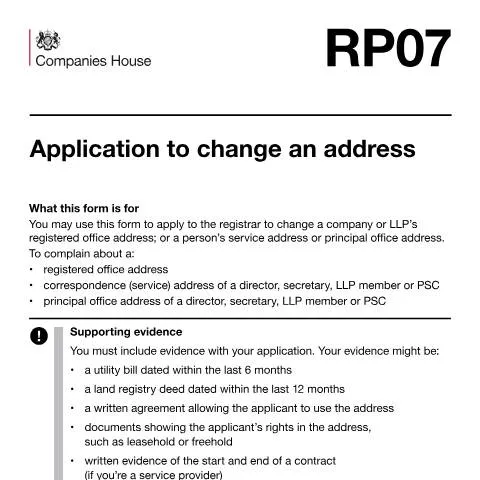
Imagine discovering your home address listed as the registered office for a company you've never heard of, or finding out that your former business address continues to receive official correspondence for a client whose contract ended months ago. These scenarios represent more than administrative inconvenience—they can expose individuals and businesses to unwanted legal obligations, regulatory scrutiny, and potential liability. The RP07 form serves as Companies House's mechanism for addressing these address disputes, providing a formal route to challenge inappropriate use of addresses in company records.
Unlike standard company filing procedures where businesses update their own information, the RP07 represents an external intervention process. This form allows affected parties—whether property owners, service providers, or other stakeholders—to formally request that Companies House investigate and potentially remove addresses from company records when those addresses are being used without proper authority or have become inappropriate.
The implications extend far beyond simple administrative tidiness. A registered office address carries significant legal weight: it's where official notices are served, where statutory books should be kept available for inspection, and where regulatory authorities direct their communications. When these addresses are incorrect, outdated, or unauthorised, they can create serious compliance gaps for the companies involved whilst potentially exposing innocent third parties to unwanted responsibilities.
The Legal Framework Behind Address Challenges
The RP07 procedure exists within a broader regulatory framework designed to maintain the accuracy and reliability of the Companies House register. Under the Companies Act 2006, companies must maintain a registered office within their jurisdiction of incorporation, and this address must be genuine and effective for receiving communications. The registrar has both the power and the duty to investigate situations where addresses appear to be inappropriate or ineffective.
This intervention mechanism became increasingly important as Companies House recognised patterns of address misuse. Some companies deliberately use addresses without permission to avoid proper service of documents, whilst others continue using addresses after contracts or arrangements have ended. In more serious cases, addresses may be used as part of broader attempts to obscure beneficial ownership or avoid regulatory oversight.
The registrar's powers under these procedures are substantial. Following an RP07 application, Companies House can require companies to provide evidence of their right to use an address, demand that companies change their registered details, or in extreme cases, initiate procedures that could lead to company dissolution if no satisfactory alternative address is provided.
For service providers—such as company formation agents, accountants, or legal firms—the framework recognises that professional relationships can end, and provides mechanisms to ensure that addresses are removed from company records when service contracts terminate. This protects service providers from ongoing obligations to companies they no longer represent.
Navigating the Three-Tier Address System
The RP07 form addresses three distinct types of addresses within Companies House records, each serving different functions and subject to different requirements:
| Address Type | Purpose | Legal Significance | Common Issues |
|---|---|---|---|
| Registered Office | Official company domicile | Legal service address; statutory book location | Unauthorised use of residential properties |
| Service Address | Correspondence address for officers | Where official notices are sent | Continued use after service contracts end |
| Principal Office | Main place of business for certain officers | Regulatory compliance location | Outdated addresses after business relocation |
Each address type requires different evidence standards when challenging through RP07. Registered office challenges typically require the strongest evidence of proprietary rights or explicit permission, since these addresses carry the heaviest legal obligations. Service address challenges often focus on demonstrating that communication arrangements have ended or were never properly established. Principal office challenges may centre on showing that the address no longer represents the person's main place of business activity.
The distinction matters practically because Companies House applies different scrutiny levels to each type. Registered office changes require the company to demonstrate ongoing right to use any replacement address, whilst service address changes may be processed more readily when supported by clear evidence of terminated arrangements.
Dissecting the RP07 Application Process
The RP07 form's structure reflects the investigative nature of the process, requiring applicants to build a comprehensive case rather than simply requesting an administrative change. Part A establishes standing—demonstrating that the applicant has legitimate grounds to challenge the address use. This isn't merely bureaucratic; it prevents vexatious challenges whilst ensuring that only parties with genuine interests can initiate investigations.
Applicant details require careful attention to title and naming conventions. Individual applicants should provide full forenames rather than initials, as Companies House may need to verify identity against supporting documents. Corporate applicants must use their precise legal name as it appears in their own registration documents. Inconsistencies here can delay processing whilst Companies House seeks clarification.
The email address field, whilst marked optional, serves important practical functions. Companies House increasingly uses email for status updates and requests for additional information. Without an email address, communications default to postal mail, potentially adding weeks to resolution times.
Part B's address verification serves dual purposes: confirming the exact address being challenged and establishing the type of challenge being made. The form's logic prevents applicants from using their own address as both applicant address and challenge address, recognising that most legitimate challenges involve addresses being used without the applicant's permission.
The three checkboxes for address use type aren't mutually exclusive—a single address might serve multiple functions for a company. However, each checked box requires separate justification in Part C, as the evidence standards and legal implications differ for each address type.
Building Your Evidential Case
Part C represents the substantive core of any RP07 application, where applicants must construct a compelling case for address removal. The form's guidance provides examples rather than exhaustive lists, recognising that address disputes can arise in numerous factual contexts. Successful applications typically demonstrate three elements: lack of permission for address use, evidence of the applicant's legitimate interest in the address, and specific identification of where the problematic address appears in Companies House records.
For property owners challenging unauthorised use, the strongest evidence combines proof of ownership with demonstration that no permission was granted. Land registry deeds establish ownership but may need supplementing with tenancy agreements, management company documentation, or other evidence showing the applicant's right to control address use. A utility bill dated within six months provides current connection to the property, whilst older bills might be rejected as insufficiently current.
Service providers face different evidential challenges, needing to demonstrate both the existence and termination of service relationships. Initial service agreements, final invoices, termination notices, and correspondence attempting to end the relationship all contribute to building this narrative. Companies House recognises that service relationships can end acrimoniously, so evidence of attempted communication is often as important as formal termination documentation.
The requirement to identify where addresses appear in Companies House records isn't simply administrative—it helps Companies House understand the scope of any necessary changes. Addresses might appear in annual returns, officer appointment forms, confirmation statements, or other filings. Applicants should specify form types and approximate dates where possible, though Companies House will conduct its own comprehensive search.
Documentation standards reflect Companies House's preference for contemporary evidence over historical claims. A six-month utility bill carries more weight than older documentation, whilst ongoing correspondence attempting to resolve address disputes demonstrates active engagement with the problem.
Strategic Timing and Processing Realities
RP07 applications don't follow the standard Companies House processing timelines applied to routine filings. Instead, they trigger investigative processes that can extend over several weeks or months, depending on the complexity of the case and the responsiveness of the companies involved.
The initial assessment phase typically takes 10-15 working days, during which Companies House reviews the application for completeness and basic merit. Applications lacking essential evidence or containing obvious deficiencies may be returned at this stage with requests for additional information. This initial rejection doesn't prevent resubmission with improved evidence, but it does restart the processing timeline.
Following initial acceptance, Companies House enters an investigation phase where the affected companies are contacted and given opportunities to respond. Companies typically receive 14-28 days to provide their own evidence of address rights or to voluntarily change their records. This period can extend if companies request additional time or if complex legal issues require resolution.
During investigation, Companies House may request additional information from applicants, particularly if company responses raise new issues or challenge the applicant's evidence. These information requests can add several weeks to processing times, making thorough initial applications strategically advantageous.
The resolution phase varies dramatically based on company cooperation. Voluntary compliance by companies can lead to rapid resolution, whilst contested cases may require formal determinations by Companies House. In extreme cases where companies refuse to provide alternative addresses, the process can extend to several months as Companies House considers whether to initiate dissolution procedures.
Fill in your form directly online
No printing: type your details into the boxes of the official form, tick, then download the PDF ready to send.
- 1Type into the form boxes
- 2Tick in one click
- 3Save and download the PDF
Understanding Companies House Decision-Making
Companies House approaches RP07 applications with investigative rigour, recognising that incorrect decisions can have serious consequences for all parties involved. The registrar's decision-making process balances protecting legitimate property rights and service arrangements against maintaining company register accessibility and avoiding unduly burdensome requirements on companies.
Evidence evaluation follows established principles but allows flexibility for unusual circumstances. Contemporary documentation generally receives greater weight than historical evidence, whilst official documents (such as land registry records or formal contracts) typically carry more authority than informal correspondence. However, Companies House recognises that some legitimate challenges may lack perfect documentation, particularly in cases involving long-standing informal arrangements or situations where companies have been uncooperative.
The proportionality principle influences decision-making, with Companies House considering whether address changes would create unreasonable burdens for companies whilst balancing this against the legitimate interests of applicants. For example, challenges to registered office addresses receive careful scrutiny because companies must maintain valid registered offices, whilst service address challenges may be resolved more readily.
When companies dispute RP07 applications, Companies House evaluates competing evidence and may request additional documentation from both parties. Companies claiming address rights must provide convincing evidence of permission or legitimate use, whilst applicants may need to respond to company counterarguments. This adversarial element means that applications with marginal evidence may face significant challenges if companies mount vigorous defences.
Successful outcomes vary depending on specific circumstances. Companies House may order complete address removal, require companies to change specific address types whilst allowing others to remain, or in some cases determine that current address use is legitimate despite applicant concerns. Partial outcomes recognise that addresses might be legitimately used for some purposes whilst being inappropriate for others.
Beyond Form Submission: Managing Ongoing Implications
RP07 applications can trigger broader consequences extending well beyond simple address changes. Companies required to change registered offices must identify alternative addresses within specified timeframes, typically 14-28 days. Failure to provide acceptable alternatives can lead to Companies House initiating dissolution procedures, potentially affecting company directors, creditors, and other stakeholders.
For applicants, successful RP07 outcomes don't automatically resolve all related issues. Ongoing monitoring may be necessary to ensure that companies don't revert to using challenged addresses or that new companies don't adopt the same addresses without permission. Companies House systems don't automatically flag potential future misuse, making vigilance important for property owners and service providers.
The precedential effect of successful RP07 applications can benefit applicants facing similar challenges with other companies. Evidence packages developed for one application often apply to related cases, whilst Companies House familiarity with specific addresses or applicants can streamline future processing.
Service providers may need to implement systematic procedures for monitoring client address use following contract termination. Regular searches of Companies House records, contractual clauses requiring prompt address changes upon service termination, and clear communication protocols can prevent problems requiring RP07 intervention.
Property owners, particularly those in areas popular for company registrations, might consider proactive measures such as clear signage indicating that addresses aren't available for company registration, regular monitoring of Companies House records, and swift action when unauthorised use is discovered. Early intervention typically proves more effective than addressing established misuse patterns.
The RP07 process represents Companies House's commitment to maintaining register accuracy whilst protecting legitimate interests in address use. Understanding its procedures, evidence requirements, and strategic implications enables effective navigation of address disputes, whether protecting property rights, managing service relationships, or ensuring corporate compliance obligations.