When Patent Protection Hangs in the Balance: Understanding the Critical Renewal Timeline
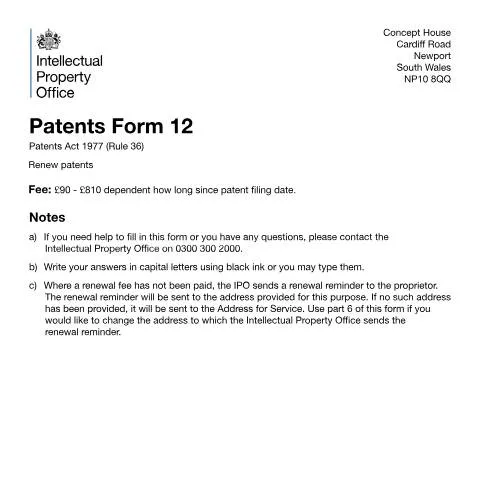
Patent protection doesn't last forever without action on your part. In the UK, maintaining your patent rights requires regular renewal payments to the Intellectual Property Office, and missing these deadlines can spell disaster for valuable intellectual property. Form 12, the official patent renewal document, serves as your lifeline to continued protection, but the process involves more than simply writing a cheque.
The renewal system operates on a strict annual cycle, with fees escalating dramatically as your patent ages. What starts as a manageable £90 for the fifth year spirals to £810 for the twentieth year, reflecting the increasing value of long-term patent monopolies. This sliding scale means patent holders must regularly reassess whether continued protection justifies the mounting costs.
The consequences of missing a renewal deadline extend far beyond administrative inconvenience. Once a patent lapses, your invention enters the public domain permanently. Competitors can immediately begin manufacturing, selling, or improving upon your previously protected innovation without paying royalties or seeking permission. For businesses built around patented technologies, this represents an existential threat that no amount of retrospective action can remedy.
Decoding the Annual Patent Renewal Obligation
Patent renewal fees become due annually from the fourth anniversary of your filing date, continuing until the patent's maximum 20-year lifespan expires. The Intellectual Property Office calculates renewal years based on your original filing date, not the grant date, meaning the clock starts ticking long before you receive formal patent protection.
Understanding this timeline proves crucial for budget planning and business strategy. The fifth year renewal costs £90, but by the tenth year, you're paying £200. The fifteenth year jumps to £400, and the final five years command the maximum £810 annually. These escalating fees reflect policy decisions designed to encourage patent holders to release less valuable inventions into the public domain while maintaining protection for truly significant innovations.
| Patent Year | Renewal Fee | Cumulative Cost |
|---|---|---|
| 5th | £90 | £90 |
| 10th | £200 | £740 |
| 15th | £400 | £2,290 |
| 20th | £810 | £6,340 |
The IPO sends renewal reminders to registered addresses, but these courtesy notifications carry no legal weight. Patent holders remain responsible for timely payment regardless of whether reminders arrive or reach the intended recipient. Address changes, corporate restructuring, or simple postal failures cannot excuse late payment penalties or patent lapses.
Navigating Payment Channels and Processing Realities
Form 12 accommodates multiple payment methods, each carrying distinct advantages and processing timelines that can determine whether your renewal succeeds or fails. The digital payment option through the IPO's secure website offers immediate confirmation and the fastest processing, crucial when approaching deadline pressures.
Online payments generate a unique 10-character reference code that serves as proof of transaction completion. This reference code must be recorded on Form 12 before submission – the IPO explicitly warns against writing credit card numbers on the form, emphasising data security protocols while ensuring payment traceability.
Traditional payment methods remain available but introduce processing delays that could prove fatal near renewal deadlines. Cheques require physical handling and bank clearance time, while bank transfers depend on accurate reference information to match payments with applications. The IPO's bank details include SWIFT and IBAN codes for international transfers, acknowledging the global nature of patent portfolios managed from UK addresses.
For frequent users, IPO deposit accounts offer streamlined payment processing. These prepaid accounts eliminate individual transaction delays and provide centralised billing for organisations managing multiple patents. However, maintaining adequate account balances requires forward planning, particularly for patent holders facing multiple renewals across different anniversary dates.
Dissecting Form 12: Critical Fields and Common Pitfalls
Form 12's apparent simplicity masks several potential complications that can derail renewal applications. The patent number field requires exact accuracy – transposed digits or formatting errors will cause processing delays that could extend beyond renewal deadlines. Similarly, specifying the correct renewal year demands careful calculation from the original filing date, not assumptions based on patent age or previous renewals.
The fee calculation section proves particularly treacherous for patent holders attempting renewals after deadline expiry. Late payment fees apply in addition to standard renewal costs, but calculating these penalties requires understanding the IPO's grace period provisions and escalating penalty structure. The form provides separate fields for renewal fees and late payment charges, emphasising that both components contribute to the total amount due.
Address information carries implications extending beyond the current renewal. Section 6 allows patent holders to designate specific addresses for future renewal reminders, separate from general correspondence addresses. This provision proves valuable for patent management companies, licensing organisations, or businesses where different departments handle patent administration versus day-to-day operations.
The authorisation confirmation requirement cannot be overlooked – unmarked or undated forms face rejection regardless of payment accuracy or timeliness. This signature requirement serves legal purposes, confirming that form submission represents deliberate action by authorised representatives rather than administrative error or unauthorised interference.
Strategic Considerations for Long-Term Patent Management
Successful patent renewal extends beyond completing individual forms to encompass comprehensive portfolio management strategies. Patent holders must regularly evaluate whether continued protection justifies escalating renewal costs, considering market conditions, competitive landscapes, and remaining patent lifespan.
The decision becomes particularly acute for patents approaching their expensive final years. Maintaining protection for patents in years 16-20 costs £810 annually, representing substantial investment that only makes sense for patents generating significant licensing revenue or providing crucial competitive advantages. Many patent holders strategically abandon protection for less valuable patents while maintaining renewals for core technologies.
International patent families complicate renewal decisions further. Patents covering the same invention in multiple jurisdictions require separate renewal payments according to different national schedules and fee structures. Coordinating these obligations while maintaining consistent protection levels across key markets demands sophisticated planning and robust administrative systems.
Corporate changes add another layer of complexity to renewal management. Mergers, acquisitions, corporate restructuring, or ownership transfers can disrupt established renewal processes, particularly if patent management responsibilities shift between organisations or departments. The IPO requires separate notification of ownership changes, but renewal obligations continue uninterrupted regardless of pending administrative updates.
Late Payment Recovery and Grace Period Provisions
The IPO provides limited grace periods for late renewal payments, but these safety nets carry significant financial penalties and operational risks. Understanding these provisions proves essential for patent holders facing unexpected cash flow problems or administrative disruptions that threaten renewal deadlines.
Grace periods extend six months beyond the original renewal deadline, but late payment fees accumulate throughout this period. The penalty structure encourages prompt payment while providing emergency options for patents facing temporary renewal difficulties. However, patents remain vulnerable during grace periods – third parties can monitor IPO records and prepare to exploit any patents that ultimately lapse.
More critically, patents cannot be restored once the grace period expires. Unlike some administrative procedures where retrospective correction remains possible, patent lapses represent permanent and irreversible losses of intellectual property rights. This finality means patent holders cannot afford to treat grace periods as routine extensions rather than emergency measures.
Electronic Submission Protocols and Document Management
The IPO strongly encourages electronic form submission through their designated email system, citing faster processing times compared to postal alternatives. However, electronic submission introduces technical requirements and security considerations that patent holders must address systematically.
PDF format represents the standard for electronic submissions, requiring patent holders to maintain appropriate software and technical capabilities for form completion and transmission. The IPO's email address ([email protected]) serves as the sole official channel for electronic submissions – alternative email addresses or unofficial submission methods risk processing delays or complete rejection.
Electronic submissions provide automatic delivery confirmation but not processing acknowledgment. Patent holders should monitor their renewal status through IPO online services or direct contact rather than assuming successful processing based solely on email delivery. This monitoring becomes particularly important approaching deadline periods when processing delays could prove catastrophic.
Data protection considerations govern electronic form submission under UK GDPR requirements. The IPO's privacy notices outline how personal and business information gets processed, stored, and potentially disclosed during patent administration. Patent holders submitting forms electronically must understand these data handling practices, particularly when forms contain sensitive commercial information or personal details of inventors and proprietors.
Managing Multiple Patents and Portfolio Renewals
Patent holders managing substantial portfolios face exponentially complex renewal obligations as individual patents reach different renewal years simultaneously. A portfolio of ten patents might require five different renewal payments in a single month, each carrying distinct fee calculations and deadline requirements.
The staggered nature of patent renewals reflects filing date variations rather than coordinated scheduling. Patents filed months apart will maintain different renewal anniversaries throughout their lifespans, preventing bulk renewal processing and demanding individualised attention for each patent. This reality makes renewal calendar management essential for avoiding costly oversights.
Portfolio renewal strategies often involve systematic evaluation of patent value and strategic importance. Patent holders might maintain renewals for core technology patents while allowing peripheral or defensive patents to lapse as renewal costs escalate. These decisions require careful analysis of patent claims, competitive positioning, and long-term business strategy rather than reflexive renewal of all patents.
Professional patent management services often prove cost-effective for substantial portfolios, providing systematic renewal monitoring, fee calculation, and deadline management. However, ultimate responsibility for renewal decisions remains with patent proprietors, who must balance professional advice against business realities and budget constraints. The IPO's reminder system provides some safety net, but proprietors cannot delegate fundamental responsibility for maintaining their intellectual property rights.
Fee Structures Across Different Renewal Categories
Renewal fees in the UK follow distinct pricing structures depending on the type of registration or licence you're maintaining. Understanding these variations helps you budget effectively and avoid unexpected costs when renewal deadlines approach.
Intellectual Property Renewals
Patent renewals through the Intellectual Property Office operate on an escalating fee structure that reflects the increasing value of maintaining protection over time. The fourth-year renewal typically costs significantly less than renewals in years fifteen through twenty, acknowledging that long-term patent holders derive greater commercial benefit from their intellectual property rights.
Trade mark renewals follow a different approach, with fixed fees for ten-year periods regardless of when you renew within that cycle. However, the IPO offers reduced rates for online renewals compared to paper applications, creating a clear incentive for digital submission. Class-based pricing means that trade marks covering multiple categories of goods or services incur additional fees for each class beyond the first.
Design right renewals present unique considerations, particularly for registered Community designs that require coordination between UK and EU systems post-Brexit. The UK IPO now processes these separately, potentially affecting your renewal strategy if you maintain protection in multiple jurisdictions.
Professional Licence Fee Variations
Professional bodies implement diverse fee structures that often reflect membership categories, practice areas, and continuing professional development requirements. Solicitors face different renewal costs depending on whether they hold practising certificates, maintain specialist accreditations, or operate in particular legal sectors.
Healthcare professionals encounter tiered pricing based on practice type and location. GP practices in certain regions may qualify for reduced renewal fees, whilst specialists maintaining multiple certifications face cumulative costs that can vary significantly based on their scope of practice.
Financial services professionals often deal with complex renewal schedules where different qualifications expire at different times throughout the year. The Financial Conduct Authority coordinates with various professional bodies to ensure that renewal requirements align with regulatory expectations, but this coordination doesn't necessarily standardise the fee structures across different credentials.
Business Registration Renewal Patterns
Companies House annual confirmation statements represent one of the most standardised renewal processes, yet even here, variations exist based on filing method and timing. Late filing penalties follow a structured approach that escalates based on how long you delay beyond the deadline, creating clear financial incentives for timely renewal.
VAT registration renewals don't follow traditional annual patterns but instead operate through ongoing compliance requirements with periodic reviews. However, changes to your business structure, turnover, or activities may trigger additional fees during what might otherwise be routine renewal periods.
Charity registrations with the Charity Commission involve renewal elements that vary significantly based on charity size, income thresholds, and reporting requirements. Large charities face more complex renewal processes with associated costs that smaller organisations don't encounter.
Digital Transformation and Online Renewal Systems
The shift towards digital-first government services has fundamentally changed how renewal processes operate across UK administrative systems. This transformation affects not only how you submit renewals but also influences fee structures, processing times, and the range of services available during renewal periods.
GOV.UK Integration and Single Sign-On
The Government Gateway system now serves as the primary access point for numerous renewal processes, creating a unified experience across different departments and agencies. Your Government Gateway credentials allow you to manage HMRC self-assessment renewals, DVLA vehicle tax, and various business registrations through a single login system.
This integration enables automatic data sharing between systems, reducing the need to repeatedly provide the same information across different renewal processes. However, you must ensure that your Gateway account details remain current, as outdated information can delay or complicate renewal submissions across multiple services simultaneously.
The digital identity verification requirements have become more sophisticated, particularly for high-value or security-sensitive renewals. Some processes now require two-factor authentication or documentary evidence uploads, adding steps to the renewal process whilst enhancing security and reducing fraud risks.
Real-Time Processing and Instant Confirmations
Many renewal systems now provide immediate processing and confirmation for straightforward cases. DVLA vehicle tax renewals typically complete within minutes, providing instant confirmation and eliminating the uncertainty that previously accompanied postal renewals. This immediate processing extends to road tax, where your vehicle becomes legally taxed the moment payment processes successfully.
Professional licence renewals increasingly offer similar real-time processing, particularly where continuing professional development requirements are met and fees are current. The General Medical Council, for instance, can process routine renewals immediately when all conditions are satisfied, allowing practitioners to continue working without interruption.
However, complex cases still require manual review, and the digital systems clearly distinguish between automatic and manual processing paths. Understanding which category your renewal falls into helps you plan timing appropriately, especially when renewal deadlines coincide with critical business or professional activities.
Mobile-First Design and Accessibility
Government renewal services increasingly prioritise mobile accessibility, recognising that many users prefer smartphone or tablet access over desktop computers. The DVLA's mobile-optimised renewal process allows you to complete vehicle tax renewals using your phone's camera to scan documents, significantly streamlining data entry.
Accessibility features now extend beyond basic mobile compatibility to include screen reader compatibility, high contrast options, and simplified navigation for users with various disabilities. These improvements benefit all users by creating cleaner, more intuitive renewal processes that reduce errors and completion times.
The mobile-first approach has also influenced how renewal reminders are delivered. SMS notifications, push notifications through government apps, and email reminders with mobile-friendly links ensure that renewal deadlines remain visible even when you're away from traditional computer access.
Data Analytics and Predictive Services
Government systems increasingly use data analytics to improve renewal experiences and identify potential issues before they become problems. HMRC's systems can flag unusual patterns in self-assessment renewals that might indicate errors or fraud, prompting additional verification steps that protect both taxpayers and the revenue system.
Predictive analytics help government departments anticipate renewal volumes and adjust processing capacity accordingly. This forward planning reduces system overloads during peak renewal periods, such as the January self-assessment deadline or the September vehicle tax renewal surge.
Machine learning algorithms increasingly support automatic renewals where legal frameworks permit. Insurance industry integration allows DVLA systems to verify continuous insurance coverage automatically, eliminating manual verification steps for compliant vehicle owners whilst flagging potential issues for investigation.
Cross-Border Considerations and International Implications
Brexit has significantly complicated renewal processes that previously operated seamlessly across European borders. Understanding these changes is crucial for businesses, professionals, and individuals who maintain registrations, licences, or rights that span multiple jurisdictions.
Post-Brexit Professional Recognition
Professional qualifications that were once mutually recognised across EU member states now require separate renewal processes in the UK and EU jurisdictions. Medical professionals, for instance, must now maintain separate registrations with the General Medical Council for UK practice and with relevant EU authorities for continental European work.
This separation has created new renewal burdens for professionals who work across borders. Architects maintaining both UK ARB registration and EU qualifications face duplicated continuing professional development requirements, separate fee structures, and potentially conflicting renewal deadlines that require careful coordination.
Legal professionals encounter particular complexity, as solicitor qualifications that previously allowed practice across EU member states now require specific local admissions and renewals. The Solicitors Regulation Authority has developed transitional arrangements, but these often involve additional fees and administrative requirements beyond traditional UK renewal processes.
Intellectual Property Rights Management
Trade mark and design rights that previously enjoyed unitary protection across the EU now require separate UK and EU renewals. The UK Intellectual Property Office automatically created equivalent UK rights for existing EU registrations, but maintaining protection in both jurisdictions now involves parallel renewal processes with separate fees and deadlines.
Patent renewals present different challenges, as the European Patent Office system continues to operate independently of Brexit changes. However, the unified patent court system's implementation creates new considerations for patent holders who must decide whether to opt into new European-wide enforcement mechanisms or maintain traditional national renewal approaches.
Copyright and design rights often involve complex territorial considerations that affect renewal strategies. Works that achieve protection through registration systems may require multiple renewals across different jurisdictions, whilst unregistered rights depend on use and publication patterns that Brexit has complicated through changes in territorial scope.
Business Registration and Cross-Border Trading
Companies that previously operated across EU borders through passport rights now face complex renewal requirements for maintaining market access. Financial services firms must renew regulatory permissions separately in each jurisdiction where they operate, creating multiplication of compliance costs and administrative burdens.
VAT registration presents particular complexity for businesses that continue trading across EU borders. The UK's departure from EU VAT systems means that businesses must now manage separate VAT registrations and renewals in multiple jurisdictions, with limited coordination between systems that previously operated as integrated networks.
Data protection registrations have evolved significantly, with the UK's departure from EU frameworks creating separate renewal requirements for businesses that process personal data across borders. The Information Commissioner's Office operates independently from EU data protection authorities, requiring separate compliance demonstrations and renewal processes for organisations maintaining European operations.
Individual Rights and Cross-Border Movement
Driving licence recognition agreements have changed substantially, affecting renewal decisions for individuals who drive in multiple countries. UK licence holders may need to obtain separate licences for extended EU residence or professional driving, creating new renewal obligations that didn't previously exist.
Pension rights and social security coordination involve complex renewal and maintenance requirements for individuals who have worked across UK and EU systems. The transition arrangements protect existing rights but create new administrative requirements for maintaining benefits access that may involve periodic renewals or confirmations.
Professional indemnity insurance and cross-border practice rights often require renewal coordination across multiple jurisdictions. Insurance providers may now treat UK and EU practice as separate risks, requiring distinct policies with separate renewal dates and coverage requirements that professionals must coordinate carefully to maintain continuous protection.