The Gateway to Employment Justice: Understanding Form ET1
When workplace disputes escalate beyond internal resolution, the Employment Tribunal system becomes the formal avenue for seeking redress. Form ET1 serves as the initial claim document that officially launches employment tribunal proceedings in England, Wales, and Scotland. This comprehensive form transforms workplace grievances into legal cases, requiring claimants to articulate their disputes with precision whilst navigating strict procedural requirements.
The ET1 represents more than administrative paperwork—it establishes the legal framework for your entire case. Every detail entered shapes how your claim will be processed, categorised, and ultimately heard. Employment tribunals received over 100,000 claims in recent years, making the accurate completion of this form crucial for standing out in a busy judicial system.
Personal Details Section: Building Your Legal Identity
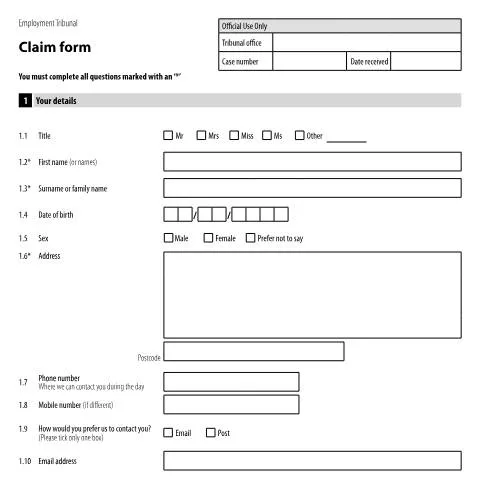
The opening section of Form ET1 establishes your identity within the tribunal system. Beyond basic contact information, this section determines how the tribunal will communicate with you throughout proceedings that can span several months.
Contact Preferences and Modern Hearing Methods
Question 1.9 requires choosing between email or postal communication. This decision affects the speed of case updates and document delivery. Email communication typically results in faster processing, but postal correspondence provides formal paper trails that some claimants prefer for record-keeping purposes.
The form's question 1.11 addresses the tribunal's increasing reliance on remote hearings. Since the pandemic, employment tribunals have embraced video and telephone hearings for preliminary matters and sometimes full hearings. Your response here influences scheduling options and may affect how quickly your case progresses. If you cannot participate in remote hearings, you must provide specific reasons—generic responses may delay proceedings whilst the tribunal seeks clarification.
Critical Mandatory Fields
Fields marked with asterisks demand particular attention. Missing mandatory information automatically triggers rejection, forcing resubmission and potentially causing you to miss crucial time limits. The date of birth field, whilst not marked mandatory, becomes essential for discrimination claims involving age, as it establishes your protected characteristic status.
Navigating the Acas Early Conciliation Maze
Section 2.3 addresses one of the most complex procedural requirements: the Acas early conciliation certificate number. This seemingly simple field represents a mandatory pre-claim process that can make or break your case's validity.
When Acas Conciliation Applies
Nearly all employment claims require attempting early conciliation through the Advisory, Conciliation and Arbitration Service (Acas) before submitting an ET1. This process involves contacting Acas, who then approach your employer to explore settlement possibilities. Even if conciliation fails, you receive a certificate number that validates your ET1 submission.
| Situation | Acas Certificate Required | Action Needed |
|---|---|---|
| Standard unfair dismissal claim | Yes | Complete early conciliation first |
| Discrimination claim | Yes | Complete early conciliation first |
| Multiple claimants, one has certificate | No for others | Tick appropriate exemption box |
| Interim relief application | No | Tick exemption and proceed |
| Collective redundancy claim | Sometimes | Check Acas guidance first |
Exemption Scenarios
The form provides specific exemption categories. If another claimant in your group claim already holds an Acas certificate, you can proceed without individual conciliation. Claims where Acas lacks jurisdiction—such as certain statutory rights claims—also bypass this requirement. Interim relief applications for trade union or whistleblowing dismissals carry such urgency that early conciliation would defeat their purpose.
Multiple Respondents and Complex Employment Relationships
Modern employment often involves intricate relationships between parent companies, subsidiaries, agencies, and individual managers. Section 2.5 accommodates claims against multiple respondents, but strategic thinking determines whether to include all potential defendants initially or focus on primary targets.
Strategic Considerations for Multiple Respondents
Including multiple respondents strengthens your position when liability questions arise, but complicates proceedings. Each additional respondent requires separate Acas certificates unless exemptions apply. Consider including:
- Parent and subsidiary companies when corporate structures obscure true employer identity
- Individual managers for personal discrimination claims
- Recruitment agencies alongside end-user companies in triangular employment
- Trade unions when discrimination involves union activities
However, excessive respondents can appear unfocused and may prompt tribunals to question the validity of claims against peripheral parties.
Employment History: Painting the Complete Picture
Section 5 through 7 constructs your employment narrative. These details determine tribunal jurisdiction, calculate potential compensation, and establish the context for your claims.
Continuous Employment and Qualifying Periods
Start and end dates in section 5.1 determine your qualifying period for various claims. Unfair dismissal generally requires two years' continuous employment, whilst discrimination claims have no qualifying period. Gaps in employment can break continuity unless they fall within statutory exceptions for illness, maternity leave, or other protected absences.
The "continuing employment" question catches many claimants. If you remain employed whilst claiming constructive dismissal or discrimination, answering accurately prevents respondents from arguing your claims lack foundation.
Mitigation of Loss Calculations
Section 7 addresses post-employment circumstances. Tribunals expect claimants to mitigate their losses by seeking alternative employment. Your new job details directly affect compensation calculations—higher earnings may reduce awards, whilst lower earnings demonstrate ongoing losses attributable to dismissal.
The timing of new employment matters crucially. Starting new employment before your tribunal hearing can complicate reinstatement claims, as tribunals rarely order return to previous roles when claimants have moved on.
Claim Types and Strategic Positioning
Section 8.1 represents the heart of your ET1, where legal theory meets practical reality. The claim types you select determine applicable law, potential remedies, and procedural requirements.
Unfair Dismissal Foundations
Unfair dismissal claims require establishing both dismissal occurrence and its unfairness. Constructive dismissal—where you resign due to employer breaches—faces higher evidential burdens. You must prove fundamental contract breaches that entitled resignation, not mere dissatisfaction with working conditions.
Discrimination Claim Complexities
The form lists nine protected characteristics under the Equality Act 2010. Multiple ticking is permitted and often strategic, as discrimination rarely occurs in isolation. However, each characteristic requires separate factual foundations. Age discrimination intersects with redundancy situations, whilst pregnancy discrimination often combines with sex discrimination in complex patterns.
Religion or belief extends beyond traditional faiths to include philosophical beliefs like environmentalism or veganism, provided they meet legal tests for qualifying beliefs. Recent cases have expanded this category significantly, making detailed explanation essential in your particulars.
Whistleblowing and Public Interest Disclosure
Whistleblowing claims require proving protected disclosures that reveal legal breaches, environmental dangers, or other specified categories. The public interest test means personal grievances rarely qualify unless they affect broader workplace safety or legal compliance.
Beyond the Form: Procedural Implications and Next Steps
Submitting your completed ET1 triggers a complex procedural sequence that unfolds over months. Understanding these implications helps you prepare for the journey ahead.
Case Management and Early Directions
Employment tribunals operate active case management systems. Within weeks of submission, you'll receive case management orders requiring disclosure of documents, witness statements, and evidence bundles. Your ET1 details influence these directions—complex discrimination claims trigger more extensive disclosure requirements than straightforward unfair dismissal cases.
The tribunal office assigned depends on your geographical location and respondent's address. Regional variations in listing times and judicial approaches can affect case strategy, making accurate address information crucial for appropriate allocation.
Financial Implications and Security
Whilst employment tribunal claims currently carry no fees, unsuccessful claimants risk costs orders in exceptional circumstances. Claims deemed vexatious or having no reasonable prospect of success can trigger substantial costs liability. Your ET1 must therefore demonstrate arguable legal foundations, not merely workplace dissatisfaction.
Deposit orders represent another financial risk. Tribunals can order deposits up to £1,000 where claims appear weak but not hopeless. Your ET1 particulars influence these assessments, making thorough preparation essential even at this initial stage.
Digital Submission and Administrative Processing
Modern ET1 submission occurs primarily through the tribunal's online portal, though postal submission remains available. Digital submission offers immediate confirmation and faster processing, but technical requirements can create barriers for some claimants.
Online Portal Navigation
The digital ET1 mirrors the paper version but includes validation checks that prevent common errors. File size limits restrict supporting document uploads, requiring strategic selection of essential evidence. The system generates automatic receipts showing submission timestamps crucial for meeting strict time limits.
Technical failures during submission can prove catastrophic if they occur near deadline dates. The tribunal accepts responsibility for system failures only when officially acknowledged, making screenshot evidence and confirmation emails vital for protecting your position.
Once submitted, your ET1 enters the tribunal's administrative system where initial reviews check completeness and jurisdiction. Defective applications trigger rejection notices requiring resubmission, potentially causing fatal delays in time-sensitive cases. This administrative gateway makes thorough preparation and accurate completion essential for accessing the tribunal system's substantive protections.
Understanding Time Limits and Extension Criteria for ET1 Claims
One of the most critical aspects of submitting Form ET1 is adhering to strict time limits, which vary significantly depending on your type of claim. Missing these deadlines can result in your case being rejected outright, though tribunals may grant extensions in exceptional circumstances.
For unfair dismissal claims, you must submit your ET1 within three months of your dismissal date, or the date your notice period ended if you worked it. However, if you were dismissed without proper notice, the clock starts from your actual last day of work. The tribunal calculates this as three months minus one day from the effective date of termination.
Discrimination claims follow the same three-month rule, but the starting point depends on when the discriminatory act occurred. For ongoing discrimination, such as persistent harassment, the time limit runs from the last act in a series of related incidents. Single incidents of discrimination start the clock from the date they occurred, whilst dismissal-related discrimination claims begin from your termination date.
Redundancy payment claims have a six-month time limit from your dismissal date, providing slightly more breathing room than other employment claims. However, waiting until the final weeks can create unnecessary pressure and may limit your ability to gather supporting evidence effectively.
The concept of "not reasonably practicable" serves as the primary gateway for late claims. Tribunals will only extend time limits if you can demonstrate that submitting within the standard timeframe was genuinely impossible or unreasonable. Acceptable reasons might include serious illness preventing you from taking action, misleading advice from ACAS that delayed your claim, or your employer failing to provide essential information like your P45 or final payslip.
Simply being unaware of the time limits rarely constitutes sufficient grounds for an extension. The tribunal expects claimants to seek appropriate advice promptly after workplace issues arise. Similarly, difficulties finding legal representation or waiting for internal appeal outcomes don't typically excuse late submissions, though exceptional personal circumstances may be considered.
If you're approaching a deadline, submit your ET1 immediately rather than risk missing it entirely. You can always provide additional supporting evidence later, but you cannot resurrect a claim that's been rejected for being out of time. The online tribunal system timestamps submissions, so ensure you complete the process before 11:59 PM on your deadline day.
Navigating Multiple Claims and Representative Actions
Employment tribunals frequently handle situations involving multiple claimants with similar grievances against the same employer, or individual claimants pursuing several different types of claim simultaneously. Understanding how to structure these complex scenarios can significantly impact both the efficiency of proceedings and your chances of success.
When multiple employees face identical treatment—such as collective redundancies handled improperly, widespread discrimination, or systematic wage underpayments—they may submit separate ET1 forms that tribunals will often consolidate for hearing efficiency. Each claimant must still complete their own Form ET1, as employment law treats each employment relationship individually, but the tribunal may hear evidence and arguments together where the core issues overlap substantially.
For collective redundancy situations, this approach proves particularly valuable. If your employer failed to consult properly under the Trade Union and Labour Relations (Consolidation) Act 1992, affected employees can each claim a protective award of up to 90 days' pay. However, each person must demonstrate their individual employment status and circumstances, even when the underlying consultation failure affects everyone similarly.
Individual claimants pursuing multiple claim types against the same employer should carefully consider whether to submit one comprehensive ET1 or separate forms for each issue. Generally, related claims arising from the same employment relationship can be included in a single ET1, which proves more cost-effective and prevents potential complications with different case management directions.
For instance, if you were dismissed following a period of disability-related harassment, you might combine unfair dismissal, disability discrimination, and harassment claims in one ET1. This approach allows the tribunal to consider the full context of your treatment and may strengthen arguments about the employer's overall conduct pattern.
However, claims with significantly different time limits may require separate submissions. If you're claiming ongoing discrimination that predates your dismissal by many months, plus redundancy payments with different limitation periods, separate ET1 forms might prove necessary to ensure all claims remain within their respective time limits.
Representative actions, where one person acts for a group sharing identical interests, remain relatively uncommon in employment law compared to other legal areas. The Employment Tribunals Rules of Procedure allow such arrangements, but each represented person must have given explicit consent and must share substantially identical interests in the proceedings. Trade unions often coordinate multiple individual claims rather than pursuing true representative actions, as this preserves each member's individual rights and remedies.
When considering group action approaches, remember that tribunals will scrutinise whether the claims genuinely raise common issues of law or fact. Superficially similar situations may involve different contractual terms, varying lengths of service, or distinct factual circumstances that make joint hearings inappropriate or unfair to either claimants or respondents.
Post-Submission Case Management and Tribunal Procedures
Once you've successfully submitted Form ET1, the employment tribunal system initiates a structured case management process designed to ensure fair, efficient resolution of workplace disputes. Understanding these procedures helps you prepare effectively and avoid common pitfalls that could weaken your position.
Within days of receiving your ET1, the tribunal will send a copy to your employer (now termed the "respondent") along with Form ET3, which they must complete to respond to your claims. Employers typically have 28 days to submit their response, during which they'll set out their version of events and any legal defences they intend to raise.
The tribunal's initial review focuses on jurisdictional issues—whether your claims fall within the tribunal's legal authority and meet basic procedural requirements. Claims submitted outside time limits, against inappropriate respondents, or lacking essential information may be rejected at this stage. However, you'll receive notification of any deficiencies and opportunities to remedy them where possible.
Preliminary hearings often follow for complex cases, serving multiple purposes including case management directions, consideration of jurisdictional challenges, and determination of preliminary issues that could dispose of claims without full hearings. These hearings may be conducted by telephone or video link, particularly for purely procedural matters.
During case management, the tribunal will issue directions specifying deadlines for exchanging documents, witness statements, and expert evidence. These deadlines are strict—failure to comply can result in evidence being excluded from consideration. The tribunal expects parties to cooperate in agreeing facts that aren't genuinely in dispute, focusing hearing time on areas of real disagreement.
The disclosure process requires both parties to reveal relevant documents that support or undermine either side's case. This extends beyond documents that favour your position to include anything material to the issues. Employment tribunals take a proportionate approach to disclosure, focusing on documents that could realistically influence the outcome rather than requiring exhaustive searches.
Witness statement preparation proves crucial for tribunal success. Statements should be comprehensive, addressing all factual matters the witness can speak to, and must include a statement of truth. The tribunal will typically direct that witness statements stand as evidence-in-chief, with witnesses attending only for cross-examination and re-examination.
Settlement discussions may occur throughout this process, with tribunals actively encouraging resolution where appropriate. ACAS provides ongoing conciliation services, and many cases settle before reaching final hearing. However, any settlement must properly address all your claims and comply with statutory requirements—particularly the need for proper legal advice on settlement agreements that prevent future claims.
Preparation for the final hearing requires careful attention to the tribunal's case management directions and hearing bundle requirements. The bundle should contain all relevant documents in chronological order, with clear page numbering and indexing. Both parties typically contribute to creating an agreed bundle, though disputes over inclusion of specific documents may require tribunal resolution.