The Company Secretary's Annual Deadline: Understanding AR01 Requirements
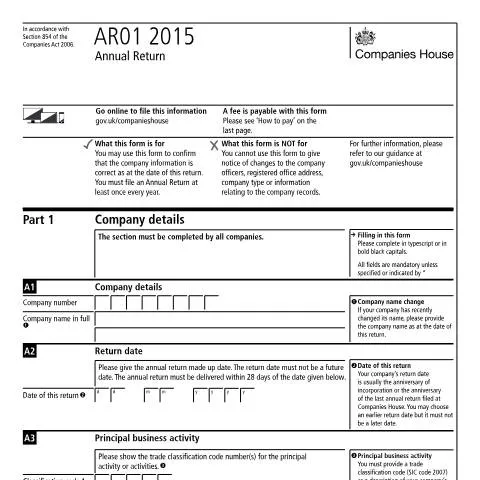
Every spring, thousands of UK company directors face the same administrative ritual: preparing their annual return. The AR01 form represents one of the most fundamental compliance obligations under the Companies Act 2006, yet its apparent simplicity masks several nuanced requirements that can catch even experienced business owners off guard. Unlike the more complex accounts filing process, the annual return serves as a statutory snapshot—a moment-in-time confirmation that your company's basic details remain accurate on the public record.
This obligation affects virtually every limited company registered in England, Wales, Scotland, and Northern Ireland, from single-director startups to established enterprises. The form's primary function centres on confirmation rather than notification—a crucial distinction that shapes how and when you complete it. While you cannot use AR01 to report new appointments or address changes, it serves as your company's annual check-in with Companies House, ensuring the public registry reflects your current operational reality.
Statutory Framework: Section 854 and Your Legal Obligations
The AR01 form operates under Section 854 of the Companies Act 2006, which mandates that every company must deliver an annual return to the registrar at least once every calendar year. This legal requirement applies regardless of your company's trading status, size, or activity level—dormant companies face identical obligations to active enterprises.
The legislation establishes your company's return date as typically the anniversary of incorporation, though you maintain flexibility to choose an earlier date if circumstances require. This date becomes your annual deadline, with the completed AR01 due within 28 days of your chosen return date. The penalty framework operates on an escalating scale: late filing attracts automatic penalties starting at £150 for companies filing up to one month late, increasing progressively to £1,500 for returns delivered more than six months after the deadline.
Importantly, the Act distinguishes between the annual return and other statutory filings. While your company accounts must reflect your financial year-end, the annual return operates on its own cycle. This separation allows Companies House to maintain current company information independent of accounting periods, ensuring the public registry remains up-to-date with basic corporate details throughout the year.
Decoding the AR01 Structure: Essential Sections and Requirements
The AR01 form follows a logical progression through your company's core details, beginning with basic identification and progressing through business activities, addresses, and officer information. Understanding each section's specific requirements prevents common completion errors that can delay processing.
Company Identification and Return Date
Section A1 requires your complete company name and Companies House number—details that must match exactly with your current certificate of incorporation. The return date in Section A2 demands particular attention: while you typically use your incorporation anniversary, you may select any date up to and including your chosen return date, but never a future date. This flexibility proves valuable when aligning return dates across group companies or accommodating administrative schedules.
Business Activity Classification
Section A3 addresses your principal business activity using the Standard Industrial Classification (SIC) system. You must provide either a valid SIC code from the 2007 classification or a clear description of your main business activity. Companies engaging in multiple activities should list their primary revenue-generating activity first, with up to four additional codes permitted. The classification system covers everything from traditional manufacturing (codes beginning with 1-3) through to modern service sectors and digital activities.
| Company Type | Section A4 Requirement | Common Variations |
|---|---|---|
| Private Limited by Shares | Most common selection | Standard trading companies |
| Private Limited by Guarantee | No share capital | Charities, clubs, associations |
| Public Limited Company | PLC designation required | Listed or unlisted public companies |
| Section 60 Exempt | Special charitable status | Requires specific incorporation |
Address Management and Record Locations
Sections A5 through A7 handle your company's various addresses and record-keeping arrangements. Your registered office address must match Companies House records exactly as at your return date. If you've recently moved, you must file form AD01 separately before or alongside your annual return—the AR01 cannot process address changes.
The Single Alternative Inspection Location (SAIL) provisions in sections A6 and A7 offer flexibility for companies maintaining statutory records away from their registered office. You may designate one alternative address where specified company records are available for inspection, but this arrangement requires careful consideration of which records you're relocating and ensuring public accessibility during standard business hours.
Officer Details: Current Appointments and Statutory Roles
Part 2 of the AR01 addresses your company's officers as they stand on your return date. This section operates on a confirmation-only basis—you cannot appoint new directors or secretaries using this form, nor can you update existing officer details such as addresses or service addresses.
The form distinguishes between individual and corporate officers, directing you to specific sections based on officer type. For individual directors, you'll complete Section E1 and also provide Part 3 details, while corporate directors require Section C1. Similarly, individual secretaries use Section D1, while corporate secretaries complete Section B1.
This structure reflects Companies House's need to maintain accurate public records while preventing the AR01 from becoming an overly complex change notification system. If you need to appoint new officers or update existing details, you must use the dedicated AP01-AP04 forms for appointments or CH01-CH02 forms for changes, either submitting these alongside your annual return or separately.
Understanding Officer Disclosure Requirements
The annual return captures officer information as it exists on your chosen return date, creating a statutory snapshot that becomes part of the public record. For individual directors, this includes full names, service addresses (which may differ from residential addresses), nationality, business occupation, and date of birth. The form requires disclosure of any other directorships held within the past five years, maintaining transparency about directors' broader business involvement.
Corporate officers face different disclosure requirements, focusing on the corporate entity's name, registered office, legal form, and the jurisdiction under which it's governed. These provisions accommodate international corporate structures while ensuring appropriate transparency for UK stakeholders.
Filing Methods: Digital Transformation and Traditional Routes
Companies House has progressively digitised its services, with online filing now representing the preferred method for annual return submission. The digital AR01 system offers immediate validation, instant confirmation of receipt, and automatic calculation of filing fees. The online system guides users through each section, highlighting mandatory fields and preventing common errors before submission.
However, paper filing remains available for companies preferring traditional methods or facing technical constraints. Paper AR01 forms require careful completion in typescript or bold black capitals, with all mandatory fields completed unless specifically marked as optional. The paper processing timeline typically extends beyond digital submissions, requiring additional time for data entry and validation.
Fee Structure and Payment Methods
The AR01 carries a standard filing fee regardless of your submission method, though Companies House periodically reviews fee structures. Online submissions typically offer slight cost advantages compared to paper filing, reflecting the reduced processing burden on Companies House systems.
Payment options vary by filing method: online submissions accept major debit and credit cards, while paper submissions require cheques payable to Companies House or can utilise account facilities for regular filers. The fee becomes due upon submission, with Companies House processing your return only upon receipt of both the completed form and appropriate payment.
Processing Timeline and Post-Submission Procedures
Once submitted, your AR01 enters Companies House's processing system, where it undergoes validation checks against existing company records. Digital submissions typically process within 24 hours during standard working days, while paper submissions may require 8-10 days for full processing. During this period, Companies House verifies that all information aligns with existing records and that any accompanying forms (such as address changes or officer appointments) process correctly.
Upon successful processing, Companies House updates your company's public record and issues confirmation of the annual return's acceptance. This confirmation serves as proof of compliance with your statutory obligations and resets your annual return cycle for the following year. The updated information becomes immediately available through the Companies House public registry, allowing stakeholders to access your current company details.
Handling Rejection and Resubmission
If Companies House identifies errors or inconsistencies during processing, they'll reject your submission and provide detailed feedback explaining the specific issues requiring correction. Common rejection reasons include mismatched addresses, incorrect officer details, or missing mandatory information. In such cases, you must address the identified problems and resubmit within your original deadline to avoid late filing penalties.
The rejection process includes return of fees for paper submissions, though online submissions typically allow immediate correction and resubmission without additional charges. Understanding common rejection triggers—such as using outdated officer information or incorrect return dates—helps ensure successful first-time submission.
Strategic Timing and Compliance Planning
Effective AR01 management extends beyond mere form completion to encompass broader compliance planning and strategic timing considerations. Many companies benefit from aligning their annual return preparation with other statutory obligations, creating efficient administrative cycles that minimise disruption to business operations.
The 28-day filing window provides flexibility for managing workload and ensuring accuracy, but early preparation prevents last-minute rushing that can lead to errors. Companies operating multiple entities should consider staggering return dates to spread administrative burden throughout the year, rather than concentrating all filings around the same period.
Furthermore, the annual return process offers an opportunity to review and update your company's statutory records, ensuring that officer details, business activities, and addresses remain current and accurate. This proactive approach supports broader corporate governance objectives while maintaining compliance with evolving regulatory requirements.
Regular monitoring of Companies House communications and guidance updates ensures your AR01 submissions reflect current requirements and benefit from any procedural improvements or digital enhancements introduced throughout the year.
Common Pitfalls and How to Avoid Rejection by Companies House
Filing your AR01 successfully requires attention to detail that many company directors overlook. Companies House processes thousands of annual returns daily, and certain recurring errors can trigger automatic rejection or delays that cost valuable time.
The most frequent mistake involves mismatched company numbers. Your company number appears on your incorporation certificate and must be entered exactly as registered—including any leading zeros. For instance, if your company number is 00123456, entering 123456 will cause immediate rejection. This eight-digit format is standard for companies incorporated after 1916, whilst earlier companies may have shorter numbers.
Share capital discrepancies represent another common stumbling block. If your company has issued new shares since the last annual return, you must ensure the total number of shares and their aggregate nominal value align with your statutory registers. The AR01 form calculates this automatically when filing online, but paper submissions require manual calculation. Remember that share premiums don't count towards nominal value—only the par value of shares matters for annual return purposes.
Director and secretary details cause frequent rejections when personal information doesn't match Companies House records exactly. This includes variations in name spelling, different address formats, or outdated service addresses. If John Smith was appointed as a director but you enter J Smith on the AR01, the system may flag this as inconsistent. Always cross-reference current officer details with your most recent confirmation statement or use the Companies House WebCheck service to verify existing records.
Date formatting presents particular challenges for international directors or those using different systems. Companies House requires dates in DD/MM/YYYY format throughout the AR01. American-style MM/DD/YYYY entries will either be rejected or, worse, accepted with incorrect information. Birth dates for directors must be complete—partial dates or "circa" entries are not acceptable.
Registered office addresses must be UK addresses and cannot be PO Box numbers alone. If you've recently moved your registered office, ensure you've filed the appropriate AD01 form before submitting your annual return. The AR01 will be rejected if it shows a registered office address that hasn't been officially updated with Companies House.
For companies with complex shareholding structures, particular care is needed when declaring persons with significant control (PSCs). The AR01 must reflect your current PSC register, including any recent changes in ownership thresholds. If someone has crossed the 25% ownership threshold since your last filing, they must be recorded as a PSC even if formal notification is still pending.
Special Circumstances: Dormant Companies, Group Structures, and Overseas Elements
Dormant companies face specific considerations when filing AR01 returns, though the basic requirements remain unchanged. A company is dormant if it has had no significant accounting transactions during the financial year—typically meaning no business activity beyond maintaining its corporate existence. Despite dormancy, you must still file your annual return with current director, secretary, and shareholding information.
Companies that have been dormant for multiple years often discover discrepancies in their records when preparing AR01 forms. Long-serving directors may have changed personal addresses without updating their service addresses at Companies House. These updates require separate forms (typically CH01 for directors or CH04 for secretaries) and should be completed before filing your annual return to avoid delays.
Subsidiary companies within group structures require careful attention to their individual AR01 filings. Each company must file separately, even if they share directors or have identical registered offices. Parent companies cannot file consolidated annual returns covering their subsidiaries—this differs from certain accounting requirements where group accounts may be permissible.
When your company is part of an international group, ensure that UK-resident directors provide UK service addresses where legally required. Non-UK directors may provide overseas service addresses, but these must be complete postal addresses including country information. Post-Brexit changes have affected some notification requirements for EEA directors, so verify current regulations if your company has European connections.
Companies with overseas shareholders face additional complexity in their AR01 submissions. Foreign corporate shareholders must be identified with their full registered names and addresses as they appear in their home jurisdiction. If a US corporation owns shares, use its complete legal name including "Inc." or "Corporation" as appropriate. Similarly, European entities should include designations like "GmbH" or "S.A." exactly as registered.
Share transfers involving overseas parties require particular attention to exchange rates and valuation. If shares were issued for non-sterling consideration, the AR01 should reflect the sterling equivalent at the time of issue, not current exchange rates. Companies House doesn't typically require supporting exchange rate documentation, but maintaining internal records helps explain any apparent discrepancies.
Professional service companies—such as solicitors, accountants, or medical practices—may have restrictions on share ownership that affect their AR01 filings. These companies must ensure their annual returns reflect compliance with professional body requirements regarding qualified ownership. Any changes in director qualifications or professional memberships might impact the validity of their shareholding structure.
Post-Filing Compliance and Maintaining Accurate Records Throughout the Year
Successfully filing your AR01 marks the beginning, not the end, of your annual compliance cycle. Companies House expects continuous maintenance of statutory records, and preparation for next year's annual return should commence immediately after filing the current one.
Establishing a monthly review system helps identify changes requiring notification to Companies House before they impact your next AR01. Director appointments, resignations, or changes in personal details must be reported within 14 days using appropriate forms. Waiting until annual return preparation often reveals multiple unreported changes, creating a cascade of required filings and potential late filing penalties.
Share transaction records deserve particular attention throughout the year. Each share transfer, allotment, or redemption affects your next AR01 filing. Maintaining a running total of issued shares and their classes prevents year-end surprises when preparing your annual return. Companies issuing employee share options should track when options are exercised, as this creates new share issues requiring reflection in subsequent AR01 filings.
Director service address changes represent a frequently overlooked compliance requirement. Directors must maintain current service addresses with Companies House, and changes require CH01 forms within 14 days. Many directors assume they can update all information during annual return filing, but this approach risks non-compliance penalties and complicates the AR01 process.
Companies planning significant corporate actions should consider their impact on annual return filings well in advance. Mergers, acquisitions, or major shareholding changes often require multiple Companies House filings beyond the standard AR01. Planning these transactions around your annual return due date can simplify the administrative burden and reduce the risk of missed deadlines.
Regular reconciliation between your internal registers and Companies House records helps identify discrepancies before they affect annual return filings. The free Companies House WebCheck service allows you to verify current public records against your internal information. Quarterly checks help ensure alignment and provide time to correct any inconsistencies through appropriate filings.
International companies with UK subsidiaries should establish clear procedures for gathering information from overseas parent companies or fellow subsidiaries. Share ownership details, director appointments, or changes in ultimate controlling parties often originate from foreign jurisdictions with different reporting timelines. Building buffer time into your AR01 preparation accounts for international coordination requirements.
Technology changes at Companies House occasionally affect annual return filing procedures. The online filing system receives regular updates, and new authentication requirements or data validation rules may impact your established filing routine. Subscribing to Companies House email updates ensures you receive advance notice of system changes that might affect your AR01 submission process.