Thames Lock and Weir Fishing: Unlocking Exclusive Access to Protected Waterways
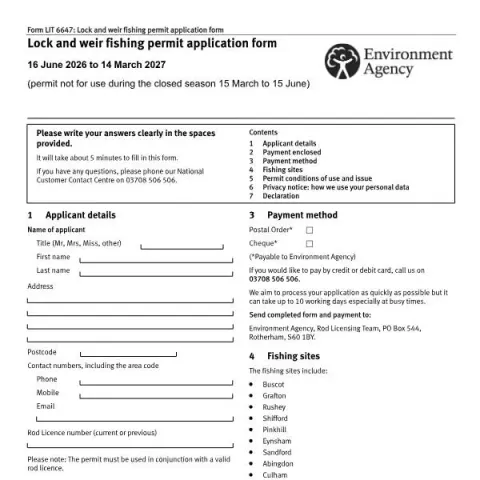
The River Thames holds some of England's most prized fishing spots, yet many remain frustratingly out of reach for the average angler. Behind the locked gates of 18 strategic locations—from Buscot in Oxfordshire to Molesey in Surrey—lie fishing platforms that the Environment Agency carefully manages through a specialist permit system. Form LIT 6647 serves as your gateway to these exclusive sites, where concrete structures and managed access points provide unparalleled opportunities for both coarse and specimen fishing along Britain's most historic waterway.
Unlike the standard rod licence that grants general fishing rights across England's waters, this lock and weir permit opens doors to specific Environment Agency-controlled infrastructure. These aren't public riverbanks or canal towpaths—they're purpose-built fishing stations integrated into the Thames's lock and weir system, where safety barriers, designated platforms, and controlled access create premium angling conditions unavailable elsewhere along the river.
Navigating the Seasonal Calendar and Permit Validity
The Thames lock and weir fishing calendar operates on a unique seasonal framework that differs significantly from standard fishing seasons. The 2025-26 permit covers a nine-month window from 16 June 2025 to 14 March 2026, deliberately excluding the statutory closed season that runs from 15 March to 15 June. This timing reflects the Environment Agency's commitment to protecting coarse fish spawning periods while maximising angling opportunities during peak feeding times.
During the closed season, these facilities remain completely inaccessible for fishing purposes, regardless of permit validity. This creates a distinctive rhythm for Thames lock fishing that experienced anglers build into their annual planning. The permit becomes active immediately upon issue but cannot override the fundamental seasonal restrictions that govern all Thames fishing activities.
| Period | Status | Key Considerations |
|---|---|---|
| 16 June - 14 March | Permit valid | Peak season for barbel, chub, and winter pike |
| 15 March - 15 June | Closed season | Sites completely inaccessible regardless of permit |
| Processing period | Up to 10 working days | Plan applications well before intended fishing dates |
Decoding the Dual-Tier Pricing Structure
The Environment Agency employs a two-tier pricing system that reflects both social accessibility commitments and the premium nature of these facilities. Adult permits cost £38.00, while a reduced rate of £24.00 applies to three distinct groups: senior citizens over 60, young anglers aged 13-16, and registered Blue Badge holders.
This pricing structure acknowledges that lock and weir fishing often requires physical capability to navigate concrete structures and safety barriers, while ensuring accessibility for those with mobility considerations through both reduced pricing and adapted access where possible. The inclusion of Blue Badge holders specifically recognises that these managed sites often provide easier access than natural riverbanks for anglers with disabilities.
Understanding Rod Licence Prerequisites
The lock and weir permit operates as an additional authorisation rather than a standalone fishing licence. Every applicant must hold a current rod licence, evidenced by providing their rod licence number on the application form. This dual-licence system ensures that all basic fishing regulations remain in force while adding the specific conditions attached to Environment Agency property access.
For anglers whose rod licences have expired, the Environment Agency accepts previous rod licence numbers on the application, but the permit remains invalid for actual fishing until a current rod licence is obtained. This flexibility allows advance planning while maintaining regulatory compliance.
Mastering the 18-Site Network Along the Thames Corridor
The permit grants access to 18 carefully selected locations that represent the cream of Thames lock and weir fishing opportunities. These sites stretch across 80 miles of river, from the upper Thames near Lechlade down to the tidal limit at Teddington, each offering distinct characteristics shaped by local hydrology and fish populations.
Upper Thames Locations: Rural Character and Specimen Potential
The upstream sites—Buscot, Grafton, Rushey, and Shifford—occupy the Thames's more rural reaches where the river maintains its countryside character. These locations typically offer excellent opportunities for barbel and chub fishing, with the deeper pools below weir structures creating perfect holding areas for specimen fish. Buscot, being the westernmost site, provides access to some of the Thames's least pressured waters.
Middle Thames: Balanced Urban and Rural Access
The central section encompasses Pinkhill, Eynsham, Sandford, Abingdon, Culham, Clifton, Day's, Benson, Goring, and Shiplake. This stretch represents the Thames's transition zone, where increased boat traffic and varied structures create diverse fishing opportunities. Sandford and Abingdon locks are particularly renowned for their mixed coarse fishing, while the weir pools at Goring and Shiplake offer excellent pike fishing during winter months.
Lower Thames Sites: Tidal Influence and Specimen Fish
Hurley, Bell Weir, Penton Hook, and Molesey represent the lower Thames locations where tidal influence begins to affect water levels and fish behaviour. These sites often produce the largest specimens, particularly during winter when big roach, perch, and pike concentrate in the deeper lock cuts. Molesey, being closest to London, provides premium fishing opportunities within easy reach of major population centres.
Application Processing: Postal Channels and Payment Methods
The Environment Agency maintains a centralised postal processing system for lock and weir permits, with all applications directed to the Rod Licensing Team in Rotherham. This centralisation ensures consistent processing standards across all Thames locations while maintaining detailed records for site management and conservation purposes.
Payment options remain deliberately traditional, accepting only postal orders and cheques made payable to the Environment Agency. For anglers preferring electronic payment, the National Customer Contact Centre (03708 506 506) handles credit and debit card transactions, though this requires telephone completion rather than online processing.
Processing Timelines and Seasonal Pressures
Standard processing takes up to 10 working days, but this timeframe extends during peak application periods, particularly in early June when the new season opens. Experienced applicants submit forms in late May to ensure permit arrival before the 16 June start date, avoiding the disappointment of missing prime early-season fishing opportunities.
The Environment Agency's processing system operates on a first-come, first-served basis, though permits don't guarantee fishing space availability. During popular periods, particularly weekends and school holidays, some sites reach capacity, leaving permit holders without access despite valid documentation.
Regulatory Framework: Multiple Rod Usage and Species-Specific Rules
The permit's conditions reflect the complex regulatory environment governing Thames fishing, incorporating elements from the Thames Conservancy Acts (1932-1972), Navigation Byelaws, and Fisheries Byelaws. This creates a multi-layered compliance requirement that goes beyond standard angling regulations.
Rod usage rules vary by target species: up to two rods for coarse fish and eels (where local byelaws permit), but only one rod when targeting other species. This distinction reflects both conservation priorities and practical safety considerations on concrete platforms where multiple rod setups could create hazards for other anglers or passing boat traffic.
Supervision Requirements for Young Anglers
Children under 16 require continuous adult supervision, with both adult and child needing valid permits. This dual-permit requirement ensures adequate supervision ratios while maintaining revenue streams that support site maintenance. The supervision must be continuous rather than periodic, reflecting the industrial nature of lock environments where safety risks exceed those found at natural fishing venues.
Risk Management and Liability Considerations
The Environment Agency's liability position reflects the industrial heritage of lock and weir sites, where concrete structures, moving machinery, and boat traffic create hazards absent from natural riverbanks. Permit holders enter entirely at their own risk, with the Agency accepting no liability for accidents, loss, or injury arising from site usage.
This risk allocation recognises that lock and weir environments present unique challenges: slippery concrete surfaces, deep water with strong currents, and proximity to navigation channels where large vessels create wash and suction effects. The permit system assumes that anglers understand these industrial-scale risks and accept personal responsibility for their safety.
Enforcement Powers and Site Exclusions
The Environment Agency retains broad enforcement powers, including the right to suspend permits, refuse site entry, or require immediate departure without notice. These powers reflect the dual-use nature of lock sites, where navigation requirements, maintenance activities, or safety incidents can override fishing permissions at any moment.
Permit non-transferability ensures that the Agency maintains accurate records of who accesses its property, supporting both security and emergency response capabilities. Authorised access routes prevent anglers from compromising operational areas or creating safety hazards for lock staff and boat users.
Data Protection Compliance and Information Retention
The Environment Agency's data handling procedures reflect contemporary privacy requirements while supporting effective permit administration. Personal information collection focuses on essential elements: name, address, contact details, and rod licence numbers, providing the minimum dataset necessary for permit issue and site management.
The six-year retention policy balances administrative needs with privacy principles, allowing sufficient time for permit validation, enforcement activities, and historical record-keeping while avoiding indefinite data storage. Processing remains entirely within UK servers, with no European Economic Area transfers, ensuring data sovereignty compliance post-Brexit.
Automated decision-making and profiling are explicitly excluded from the permit process, maintaining human oversight of applications while protecting against algorithmic bias. This approach ensures that individual circumstances, particularly those relating to disability access or special requirements, receive appropriate consideration during application processing.
Special Circumstances and Exemptions for Thames Fishing Permits
Whilst the standard Thames fishing permit covers most angling scenarios, several special circumstances warrant additional consideration or may qualify for exemptions. Understanding these nuances can save considerable time and potential disappointment when planning your fishing activities along England's most famous waterway.
Disabled anglers benefit from specific provisions within the Thames permit system. The Environment Agency recognises that traditional fishing positions may not always be accessible, and permit holders with mobility impairments can often fish from alternative locations that would normally be restricted. When completing your application, clearly indicate any accessibility requirements in the designated section. Supporting documentation from healthcare professionals may strengthen your case for accessing modified fishing positions near locks and weirs.
Young anglers under 13 years old do not require a fishing licence but must still observe all Thames-specific regulations regarding lock and weir fishing. However, accompanied minors between 13-16 years can fish under a supervising adult's permit in certain circumstances, though this arrangement has strict limitations. The supervising angler must hold a valid Thames permit and remain within immediate proximity—typically defined as within 10 metres and maintaining direct visual contact.
Seasonal workers and temporary residents face particular challenges with Thames permit applications. EU citizens and other international visitors can apply for permits, but documentation requirements differ significantly. Proof of UK address becomes crucial, though temporary accommodation such as holiday rentals may suffice if supported by booking confirmations and identification documents. Processing times for non-UK residents typically extend by 7-14 days due to additional verification procedures.
Military personnel on active duty qualify for expedited processing when stationed near Thames locations. Service personnel should include their military identification number and current posting details in their application. Some bases maintain agreements with local angling associations, potentially providing access to group permit arrangements that reduce individual costs.
Commercial fishing operations require entirely separate licensing through the Marine Management Organisation (MMO) rather than standard recreational permits. This distinction becomes critical near tidal sections of the Thames, where recreational and commercial boundaries overlap. Recreational permit holders cannot sell their catch under any circumstances, and violation carries substantial penalties including permit revocation and potential prosecution.
Research institutions and educational establishments often qualify for specialised permits allowing activities that would otherwise breach standard conditions. Universities conducting fisheries research, for instance, may obtain permits allowing sampling techniques typically prohibited for recreational anglers. These applications require detailed project proposals and often involve consultation with local fisheries officers before approval.
Understanding Thames Lock and Weir Fishing Regulations
Thames lock and weir fishing operates under a complex framework of regulations that extend far beyond basic fishing licence requirements. These rules reflect the unique challenges of angling in areas where recreational fishing intersects with commercial navigation, historic preservation, and public safety considerations.
Proximity restrictions vary significantly between different locks and weirs along the Thames. At Teddington Lock, for example, fishing is prohibited within 50 metres of the lock gates during operational hours (typically 9am-5pm), but this restriction relaxes to 20 metres during evening hours when commercial traffic diminishes. Conversely, at Marlow Lock, a blanket 30-metre exclusion zone applies at all times due to the proximity of the weir's turbulent outflow.
Fill in your form directly online
No printing: type your details into the boxes of the official form, tick, then download the PDF ready to send.
- 1Type into the form boxes
- 2Tick in one click
- 3Save and download the PDF
Navigation authorities maintain the right to suspend fishing permits temporarily during periods of high water flow or maintenance operations. The Environment Agency typically issues 48-hour advance notice through their flood warning system, but emergency suspensions can occur with minimal warning. Permit holders should regularly check the Thames flood information service before travelling to their intended fishing location.
Equipment restrictions become particularly stringent near lock and weir structures. Standard fishing tackle faces few limitations, but certain items require special consideration. Keep nets must not exceed 2 metres in length and cannot be positioned where they might impede navigation or become entangled in lock mechanisms. Unhooking mats are mandatory when fishing for species exceeding 1kg, reflecting the Thames' status as a premier coarse fishing destination.
Bait restrictions apply more strictly near locks and weirs than in open river sections. Live bait fishing is prohibited within 100 metres of any lock structure, primarily to prevent the introduction of invasive species through navigation channels. Ground bait use requires careful consideration—excessive quantities can alter water chemistry in the confined areas near weirs, potentially affecting fish populations and water quality.
Night fishing permissions operate under enhanced restrictions near lock and weir locations. Standard Thames permits allow 24-hour fishing in most river sections, but areas within 200 metres of lock structures typically impose sunset-to-sunrise restrictions. This limitation reflects safety concerns about navigating near potentially dangerous hydraulic features in reduced visibility conditions.
Parking and access arrangements vary considerably between different lock locations. Some sites provide dedicated angler parking, whilst others require use of public car parks that may impose time restrictions or parking fees. Hampton Court Palace grounds, for instance, restrict angler access to specific gates and pathways, with different arrangements for weekday and weekend fishing.
Catch and release policies receive particular emphasis near lock and weir locations due to these areas' role as fish population centres. The Environment Agency strongly encourages returning all coarse fish to the water, especially during spawning seasons (typically March-June). Pike fishing near weirs requires mandatory use of wire traces and barbless hooks to minimise injury to fish that may be feeding in the nutrient-rich waters below weir structures.
Processing Times and Application Status Tracking
Thames fishing permit applications follow a structured processing timeline that varies significantly depending on application type, seasonal demand, and individual circumstances. Understanding these timescales and monitoring procedures helps ensure your permit arrives when needed for planned fishing activities.
Standard processing times for new Thames fishing permit applications typically range from 10-15 working days during off-peak periods (September-February), but can extend to 20-25 working days during peak season (March-August) when application volumes surge. Renewal applications generally process more quickly—usually within 5-10 working days—as existing records streamline verification procedures.
The Environment Agency operates a tiered processing system that prioritises certain application types. Disabled angler applications receive priority processing, typically completing within 7-10 working days regardless of seasonal demand. Similarly, applications from angling clubs with existing group arrangements often benefit from expedited handling due to pre-verified organisational credentials.
Application status tracking utilises a reference number system generated upon submission. This alphanumeric code (typically beginning with 'THM' followed by six digits) allows applicants to check progress through the Environment Agency's online portal. Status updates occur at key processing milestones: application received, documentation verified, payment processed, and permit dispatched.
Payment verification represents a common bottleneck in application processing. Bank transfers and cheque payments require additional clearance time compared to debit card payments processed instantly online. International payment methods face particular scrutiny and may add 5-7 working days to standard processing times whilst banks verify cross-border transactions.
Document verification procedures vary based on application complexity. First-time applicants undergo more thorough identity verification, including cross-referencing with DVLA records where driving licence numbers are provided. Discrepancies between application details and supporting documentation trigger manual review processes that can add significant delays—typically 7-14 additional working days.
Seasonal staff fluctuations affect processing capacity, particularly during summer months when temporary staff handle increased application volumes. The Environment Agency typically recruits additional processing staff from April onwards, but training requirements mean peak efficiency doesn't occur until May-June. Applicants planning spring fishing activities should submit applications by February to avoid seasonal delays.
Expedited processing options exist for urgent applications, though these incur additional fees and require justification. Emergency permits for visiting anglers or those with time-sensitive bookings can sometimes be processed within 48-72 hours, but availability depends on current workloads and staff capacity. Medical circumstances, such as terminal illness, may qualify for emergency processing without additional fees.
Communication preferences significantly impact how applicants receive updates about their application status. Email notifications provide the fastest updates, typically within 24 hours of status changes. Postal communications add 2-3 days to notification timescales but remain necessary for certain legal documents and formal permit delivery.
Appeal and correction procedures handle applications that encounter processing difficulties. Common issues include address verification problems, payment discrepancies, or documentation concerns. The Environment Agency maintains a dedicated corrections helpline (operating 9am-5pm, Monday-Friday) specifically for Thames permit applications, with average response times of 2-3 working days for straightforward queries.