Preventing Property Fraud Through Corporate Ownership Verification
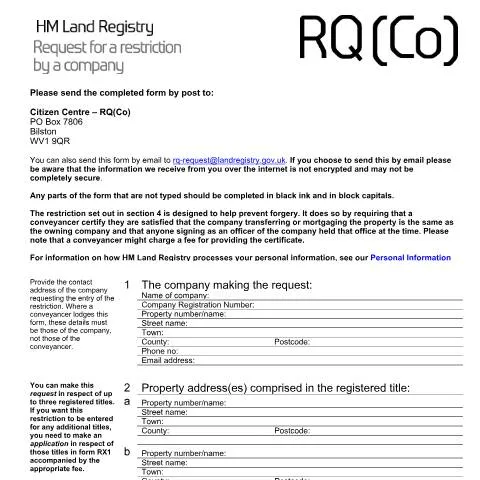
Corporate property ownership in England and Wales faces increasing threats from sophisticated fraud schemes, where criminals attempt to impersonate legitimate companies to steal or mortgage properties unlawfully. The RQ(Co) form represents HM Land Registry's response to this growing concern, offering companies a proactive mechanism to safeguard their registered estates through mandatory conveyancer certification requirements.
This protective restriction transforms routine property transactions involving corporate owners into verified processes, requiring qualified conveyancers to certify both the company's identity and the authority of individuals signing on its behalf. While adding a procedural layer, this measure significantly reduces the risk of fraudulent dispositions that could otherwise proceed unchallenged through the registration system.
Understanding the Corporate Restriction Mechanism
The restriction established through form RQ(Co) creates a mandatory checkpoint in the registration process whenever the protected company attempts to transfer, mortgage, or otherwise dispose of its registered property. Unlike voluntary measures, this restriction becomes a binding requirement that HM Land Registry cannot bypass during registration.
The restriction's wording, standardised across all applications, requires conveyancers to provide dual certification covering company identity verification and officer authority confirmation. This two-tier approach addresses the most common vulnerability points in corporate property fraud, where criminals either impersonate legitimate companies or forge director signatures.
Scope and Limitations of Protection
Each RQ(Co) application covers up to three registered titles, making it particularly suitable for companies with modest property portfolios. Larger corporate estates require multiple applications, with additional titles handled through separate RX1 applications accompanied by appropriate fees.
The form includes a built-in quota system limiting companies to a maximum of three such restrictions across their entire property portfolio when applied through RQ(Co). This limitation encourages selective application to the most valuable or vulnerable properties rather than blanket protection across extensive holdings.
Navigating the Application Process: Two Distinct Pathways
The RQ(Co) form accommodates two fundamentally different application routes, each reflecting distinct professional relationships and procedural requirements.
Direct Company Applications
Companies applying directly complete Section 4, requiring signature from a current officer—typically a director or company secretary. This pathway demands careful attention to the signatory's stated capacity, as HM Land Registry may verify officer status against Companies House records during processing.
Direct applications must include the company's registered address rather than correspondence addresses, ensuring alignment with official corporate records. The application becomes invalid if signed by individuals lacking proper officer status at the time of submission.
Professional Representation Through Conveyancers
Conveyancer-submitted applications utilise Section 5, requiring compliance with rule 217A of the Land Registration Rules 2003. This professional pathway often expedites processing, as HM Land Registry recognises qualified conveyancers' expertise in property law and corporate verification procedures.
Conveyancer applications benefit from email notification systems for warning letters, provided valid email addresses are supplied. This digital communication channel ensures timely awareness of potential restriction cancellations or administrative queries.
| Application Type | Required Section | Signatory Requirements | Key Benefits |
|---|---|---|---|
| Direct Company | Section 4 | Company officer with stated capacity | No professional fees |
| Conveyancer Representation | Section 5 | Qualified conveyancer under rule 217A | Professional expertise, email notifications |
Critical Form Completion Requirements
Accurate completion of the RQ(Co) form demands attention to specific formatting and content requirements that directly impact processing efficiency and legal validity.
Company Identification Standards
Section 1 requires precise company details matching Companies House records exactly. The Company Registration Number serves as the primary identifier, with HM Land Registry cross-referencing this against official corporate databases during processing.
Contact addresses must reflect the company's current registered address rather than trading addresses or temporary locations. Discrepancies between form details and Companies House records frequently trigger verification delays or application rejections.
Property Address Specifications
Section 2 accommodates up to three properties within registered titles, requiring complete addresses even when title numbers remain unknown. Properties within single titles need only one representative address, simplifying applications for developments or estate holdings.
Accurate property descriptions prevent processing delays, particularly where multiple properties share similar addresses or where title boundaries encompass several distinct buildings. Clear postcode inclusion proves essential for HM Land Registry's internal matching systems.
Title Number Coordination
Section 3 allows partial title number completion, acknowledging that companies may lack comprehensive title information. HM Land Registry's internal systems can identify missing title numbers through property address matching, though complete title information expedites processing.
Unknown title numbers should remain blank rather than estimated, as incorrect entries trigger verification procedures that extend processing timeframes significantly.
Submission Channels and Processing Considerations
HM Land Registry accepts RQ(Co) applications through two distinct channels, each carrying specific security and processing implications.
Postal Submission Protocol
Traditional postal submission to the Citizen Centre – RQ(Co), PO Box 7806, Bilston, WV1 9QR provides maximum security for sensitive corporate information. This channel suits companies prioritising confidentiality over processing speed, particularly where commercial sensitivity surrounds property ownership structures.
Postal applications require black ink completion for handwritten sections, with block capitals mandatory for legibility. Poor handwriting or inappropriate ink colours frequently cause processing delays as registry staff seek clarification.
Electronic Submission Considerations
Email submission to [email protected] offers convenience but carries explicit security warnings. HM Land Registry's transparency regarding unencrypted transmission allows informed decision-making about submission methods based on individual risk tolerance.
Electronic submissions benefit from faster initial processing but require careful attention to file formatting and attachment protocols. PDF formats generally prove most reliable, while image files may cause processing complications.
The Conveyancer Certification Framework
The restriction's effectiveness relies entirely on the conveyancer certification process, creating a professional verification layer that transforms routine transactions into scrutinised procedures.
Dual Verification Requirements
Conveyancers must satisfy themselves on two distinct elements before providing certification. Company identity verification requires confirmation that the disposing entity matches the registered proprietor exactly, preventing impersonation attempts.
Officer authority verification demands reasonable steps to establish that individuals signing possessed stated offices at execution time. This requirement addresses forgery attempts using outdated or false director information.
Professional Liability Implications
The certification requirement creates potential professional liability for conveyancers, encouraging thorough verification procedures. Most conveyancers charge additional fees reflecting this increased responsibility and the time required for proper verification.
Companies should anticipate conveyancer fees when planning future transactions, as the restriction makes professional certification mandatory rather than optional. Fee structures vary significantly between firms, making early consultation advisable for budgeting purposes.
Strategic Timing and Removal Procedures
The RQ(Co) restriction operates as a permanent protective measure until formally removed, requiring careful consideration of long-term property strategies and transaction planning.
Impact on Routine Transactions
Once registered, the restriction affects all future dispositions, including refinancing arrangements, partial sales, and corporate restructuring transactions. Companies must factor certification requirements into transaction timelines, particularly for time-sensitive commercial deals.
The restriction appears prominently on official copies of the register, alerting potential purchasers and lenders to the verification requirements. This transparency can actually enhance confidence in legitimate transactions while deterring fraudulent attempts.
Removal and Modification Options
Companies seeking restriction removal must follow separate procedures outside the RQ(Co) framework, typically requiring officer consent and formal application processes. The permanent nature encourages careful initial consideration rather than trial applications.
Warning letters preceding potential cancellation provide opportunities to maintain protection, though response timeframes demand prompt attention to preserve coverage continuity.
Legal Safeguards and Compliance Framework
The RQ(Co) form operates within strict legal parameters designed to prevent misuse while maintaining accessibility for legitimate protection needs.
Fraud Prevention Measures
Section 1 of the Fraud Act 2006 creates severe penalties for dishonest form completion, with maximum sentences reaching ten years imprisonment or unlimited fines. These provisions deter fraudulent applications while emphasising the form's serious legal status.
The warning explicitly covers false statements made with intent to gain or cause loss, encompassing both direct fraud attempts and reckless misrepresentation of company details or authority.
Land Registration Act Protection
Careful form completion maintains protection under the Land Registration Act 2002, while careless errors may compromise legal safeguards. This provision encourages professional assistance where companies lack experience with property registration procedures.
The relationship between form accuracy and legal protection emphasises the importance of thorough preparation and verification before submission, making professional guidance valuable for complex corporate structures.
Procedural Requirements and Documentation Standards
The RQ(Co) application process demands meticulous attention to documentation standards, as HM Land Registry operates under strict evidential requirements when processing company-initiated restriction requests. The foundation of any successful application rests on providing comprehensive proof of the company's legitimate interest in the property and demonstrating the specific circumstances that justify the restriction.
Company directors must submit certified copies of the memorandum and articles of association, alongside current filings from Companies House showing the company's active status. Where the restriction relates to security interests, original or certified copies of the charge documents must accompany the application. These might include debentures, mortgages, or other security agreements that establish the company's legal or equitable interest in the property.
Board resolutions carry particular weight in RQ(Co) applications, as they demonstrate internal corporate authorisation for the restriction request. The resolution must be properly minuted, dated, and signed by the company secretary or authorising director. HM Land Registry scrutinises these documents for compliance with the Companies Act 2006, particularly regarding directors' duties and proper corporate procedures.
Financial documentation often proves crucial, especially where the restriction protects against unauthorised disposals that might prejudice the company's position. This could include loan agreements, financial statements showing the company's exposure, or correspondence evidencing ongoing commercial relationships with the property owner. Each document must be authentic, dated within reasonable proximity to the application, and directly relevant to the restriction's purpose.
Identity verification extends beyond standard requirements when companies are involved. Directors or authorised signatories must provide current identification, proof of their authority to act for the company, and evidence of their appointment. Where solicitors act for the company, their authority must be clearly established through proper retainer documentation or powers of attorney.
The application form itself requires precise completion, with particular attention to the restriction's wording. Standard form restrictions may not adequately capture the company's specific needs, necessitating bespoke wording that accurately reflects the legal relationship and protection required. HM Land Registry's practice guides provide templates, but companies often need tailored provisions that address their unique circumstances.
Supporting evidence quality directly impacts processing times and success rates. Photocopies must be clear and legible, with all pages properly sequenced and authenticated where required. Digital submissions through the Business Gateway service must meet specific technical standards, including file formats, size limitations, and electronic signature requirements where applicable.
Interaction with Existing Charges and Third Party Rights
RQ(Co) restrictions operate within a complex framework of existing property interests, requiring careful consideration of how the proposed restriction interacts with registered charges, easements, covenants, and other encumbrances. Companies must navigate these competing interests strategically, as the effectiveness of their restriction may depend on its relationship to pre-existing rights.
Priority considerations prove particularly complex when multiple lenders or creditors hold interests in the same property. A company seeking an RQ(Co) restriction must understand how their protection ranks against existing mortgages, floating charges, or other security interests. The registration date typically determines priority, but equitable interests and constructive notice can complicate this hierarchy.
Existing restrictions already registered against the property may conflict with or complement a company's proposed RQ(Co) restriction. Where multiple restrictions apply, the cumulative effect might create practical difficulties for future transactions. Companies should review the register thoroughly before applying, identifying potential conflicts and considering whether their objectives can be achieved within the existing restriction framework.
Overriding interests present particular challenges, as these bind purchasers despite not appearing on the register. Companies must consider whether their interest qualifies for overriding status under the Land Registration Act 2002, and how this affects their restriction strategy. Actual occupation by the company or its representatives, for instance, might provide protection without requiring formal registration.
Third party consent requirements can significantly impact RQ(Co) applications where existing chargees or other interested parties hold rights that might be affected by the restriction. Mortgage lenders, in particular, may object to restrictions that could interfere with their enforcement remedies or disposal powers. Companies must often negotiate consent agreements or modify their restriction proposals to accommodate existing interests.
Joint ownership scenarios create additional complexity, particularly where the company's interest relates to only one co-owner. The restriction must be carefully worded to avoid interfering with the legitimate rights of other proprietors while still providing meaningful protection for the company. This often requires detailed analysis of the beneficial ownership structure and any underlying trust arrangements.
Commercial leases and tenancy arrangements may interact unexpectedly with RQ(Co) restrictions, particularly where the company holds landlord or tenant rights that could be affected by property disposals. Long-term commercial relationships often involve complex cross-guarantees, rent deposits, or performance bonds that justify restriction protection but must be carefully balanced against operational requirements.
Insolvency considerations add another layer of complexity, as restrictions applied by companies in financial difficulty may be challenged as preferences or transactions at undervalue. The timing of RQ(Co) applications relative to insolvency events requires careful consideration, with particular attention to the 'hardening periods' that apply to certain transactions under insolvency legislation.
Modification, Withdrawal, and Enforcement Mechanisms
The lifecycle of an RQ(Co) restriction extends well beyond its initial registration, encompassing ongoing management responsibilities and potential enforcement challenges that companies must navigate effectively. Understanding these post-registration obligations proves crucial for maintaining effective property protection over time.
Modification procedures allow companies to adapt their restrictions as circumstances change, but the process requires careful justification and appropriate documentation. Companies might need to modify restrictions following corporate restructuring, changes in the underlying commercial relationship, or evolving security arrangements. The modification application must demonstrate that changes serve legitimate purposes and don't prejudice other interested parties.
Withdrawal mechanisms provide essential flexibility when restrictions are no longer required, but companies must consider the timing and implications carefully. Premature withdrawal might expose the company to risks, while unnecessary delay could prejudice property transactions and potentially create liability issues. The withdrawal process requires proper corporate authorisation and consideration of any ongoing obligations to third parties.
Enforcement challenges arise when property owners or third parties attempt to circumvent or challenge RQ(Co) restrictions. Companies must understand their rights and remedies when restrictions are breached or threatened, including injunctive relief, damages claims, and potential criminal sanctions under the Land Registration Act 2002. The effectiveness of enforcement often depends on the restriction's precise wording and the strength of the underlying legal relationship.
Monitoring obligations require companies to maintain awareness of activity affecting the restricted property, as HM Land Registry's notification systems may not capture all relevant developments. Companies should establish internal procedures for tracking restriction status, monitoring register changes, and responding to enquiries or challenges from property owners or their advisers.
Consent procedures become operational reality when property owners seek to deal with restricted property. Companies must establish efficient systems for considering consent requests, balancing their legitimate interests against reasonable commercial requirements. Unreasonable refusal of consent may expose companies to damages claims or court applications for consent dispensation.
Dispute resolution mechanisms provide structured approaches for addressing conflicts between companies and property owners regarding restriction operation. These might involve direct negotiation, mediation, or formal court proceedings depending on the dispute's nature and complexity. Companies should maintain clear policies for handling such disputes and ensure appropriate legal representation when required.
Administrative compliance continues throughout the restriction's life, including maintaining current contact details with HM Land Registry, ensuring proper corporate authority for restriction-related decisions, and maintaining adequate documentation to support the restriction's ongoing justification. Companies must also consider how corporate changes such as mergers, acquisitions, or name changes affect their registered restrictions.
Performance monitoring helps companies assess whether their RQ(Co) restrictions achieve their intended objectives and identify opportunities for improvement. This might involve periodic reviews of restriction effectiveness, analysis of consent request patterns, and assessment of the restriction's impact on property values or transaction activity.