When Your Mortgage is Fully Paid: The Critical Link Between Lender and Land Register
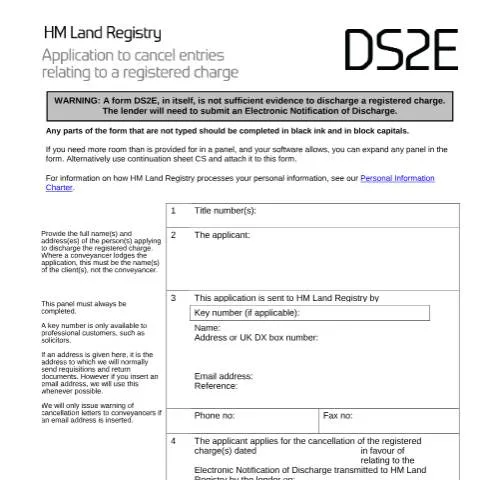
Completing your final mortgage payment marks a significant milestone in property ownership, but the administrative journey doesn't end with that last bank transfer. In England and Wales, your mortgage remains officially recorded on the land register at HM Land Registry until formally removed through a specific process. The DS2E form serves as the essential bridge between your lender's electronic notification of discharge and the final cancellation of your mortgage charge on the property register.
This process involves two distinct but interconnected steps: your mortgage lender must transmit an Electronic Notification of Discharge to HM Land Registry, while you as the property owner must complete and submit the DS2E form to formally request cancellation of the registered charge. Neither action alone suffices – both elements work in tandem to ensure your property title reflects its mortgage-free status.
The system operates on the principle that registered charges require formal discharge procedures. Until this administrative process concludes, your mortgage technically remains active on the land register, potentially affecting future property transactions, remortgage applications, or any dealings requiring clear title evidence.
Understanding the Electronic Discharge Framework
HM Land Registry's electronic discharge system revolutionised mortgage cancellation procedures, replacing the traditional paper-based charge certificate system. Under this framework, approved lenders can transmit Electronic Notifications of Discharge directly to the Registry's systems once mortgage conditions are satisfied.
However, this electronic notification alone cannot complete the discharge process. The DS2E form provides the crucial property owner consent and formal application for charge cancellation. This dual-requirement system protects against unauthorised discharge applications while streamlining legitimate mortgage cancellations.
| Process Stage | Responsible Party | Required Action | Timing |
|---|---|---|---|
| Electronic Notification | Mortgage Lender | Transmit discharge notification to HM Land Registry | Following final payment confirmation |
| DS2E Submission | Property Owner | Complete and submit discharge application form | After receiving form from lender |
| Register Update | HM Land Registry | Remove charge from property register | Following successful application processing |
The Land Registration Act 2002 provides the legislative foundation for these procedures, establishing electronic discharge as legally equivalent to traditional paper-based methods while maintaining robust safeguards against fraudulent applications.
Navigating the DS2E Application Process
Completing the DS2E form requires attention to specific details that directly correspond to your property's registered information. The process begins with accurate identification of your property through its title number, which appears on your title register and any previous Land Registry correspondence.
Essential Information Requirements
Panel 1 demands the complete title number or numbers if multiple titles are involved. These alphanumeric identifiers must match exactly with Land Registry records – even minor transcription errors can delay processing or trigger requisitions for clarification.
Panel 2 requires full applicant details, specifically the registered proprietor names and addresses as they appear on the current title register. When multiple owners exist, all parties must be listed precisely as registered. Conveyancers acting on behalf of clients must enter client names, not their own professional details in this section.
Panel 3 accommodates professional representation, allowing solicitors or licensed conveyancers to provide their contact information for correspondence. Key numbers, available exclusively to professional customers, enable streamlined communication and processing. Email addresses in this section trigger electronic correspondence wherever possible, including essential warning of cancellation notices for conveyancers.
Mortgage Charge Identification
Panel 4 presents the most technical aspect of the application, requiring precise identification of the charge being discharged. This includes the charge date and lender details exactly as recorded on the charges register. Your original mortgage documentation or title register copies provide this information, though lenders typically supply these details when forwarding the DS2E form.
The Electronic Notification of Discharge date represents a critical piece of information linking your application to your lender's electronic submission. This date must correspond exactly with the lender's transmission to HM Land Registry systems.
Signature Requirements and Legal Responsibilities
Panel 5 establishes clear signature protocols depending on representation arrangements. When conveyancers act for applicants, only the conveyancer's signature is required, accompanied by the application date. However, where no professional representation exists, every registered proprietor must sign individually.
The form's warning sections carry significant legal weight under the Fraud Act 2006. Dishonest information entry or knowingly false statements constitute criminal offences punishable by up to ten years' imprisonment or unlimited fines. This emphasises the importance of accuracy and honesty throughout the application process.
Additionally, the Land Registration Act 2002 provides protection against register mistakes, but this protection may be compromised if application forms are completed carelessly. Proper attention to detail therefore serves both legal compliance and practical protection purposes.
Special Circumstances and Complex Ownership Structures
Certain property ownership arrangements require modified approaches to DS2E completion. Joint ownership structures, particularly those involving tenants in common with unequal shares, demand careful attention to ensure all registered proprietors participate in the discharge application.
Corporate and Trust Ownership
When companies or trusts hold registered titles, discharge applications must reflect current directorial or trustee arrangements. Company dissolutions, trustee changes, or other structural modifications occurring after mortgage registration but before discharge may require additional documentation to establish proper authority for signature.
Overseas owners face particular challenges if their original registration addresses have changed or if they cannot easily access UK-based professional representation. In such cases, careful coordination with the mortgage lender becomes essential to ensure proper form completion and submission.
Deceased Proprietor Situations
Death of a registered proprietor between mortgage registration and discharge creates complex procedural requirements. The DS2E form cannot simply be signed by surviving joint owners or personal representatives without proper legal authority establishment. Such situations typically require professional legal assistance to navigate probate and succession issues alongside the discharge application.
Submission Procedures and Processing Expectations
HM Land Registry operates multiple regional offices, and DS2E forms must be directed to the office responsible for the relevant title number. This information appears on title registers and previous correspondence, ensuring applications reach the correct processing team.
The form explicitly states that no fee applies for mortgage discharge applications, distinguishing this process from many other Land Registry services. However, applicants remain responsible for postage costs and must not enclose return envelopes, as HM Land Registry follows specific document handling procedures.
Processing timeframes vary depending on application complexity and current workloads, though straightforward discharge applications typically complete within standard HM Land Registry processing periods. Electronic correspondence, where email addresses are provided, generally accelerates communication regarding any requisitions or clarifications needed.
Document Retention and Charge Certificates
Many applicants receive charge certificates alongside their DS2E forms – historical documents that previously served as evidence of mortgage discharge. While these certificates no longer carry legal significance under current electronic systems, they may retain value as personal property records.
Crucially, charge certificates must not be returned to HM Land Registry with DS2E applications. The Registry may destroy these documents if submitted, eliminating any historical value they might hold for property owners.
Potential Complications and Resolution Strategies
Despite the streamlined electronic discharge framework, various complications can arise during the DS2E application process. Understanding these potential issues and their resolution approaches helps ensure successful mortgage charge cancellation.
Mismatched Information and Requisitions
Discrepancies between DS2E form information and Land Registry records trigger requisitions – formal requests for clarification or correction. Common mismatches include name variations, address changes since original registration, or incorrect charge identification details.
When requisitions arise, HM Land Registry provides specific guidance on required corrections or additional evidence. Professional conveyancers typically receive warning of cancellation letters if applications face potential rejection, allowing opportunity for remedial action before formal cancellation occurs.
Resolution strategies include providing statutory declarations for minor name variations, submitting updated identification documents for address discrepancies, or obtaining clarification from mortgage lenders regarding charge details.
Missing Electronic Notifications
Occasionally, technical issues or administrative delays may prevent lenders from successfully transmitting Electronic Notifications of Discharge. Since DS2E forms cannot proceed without corresponding electronic notifications, such situations require direct liaison with mortgage lenders to resolve transmission problems.
Lenders maintain responsibility for ensuring their electronic notifications reach HM Land Registry systems successfully. Property owners experiencing delays should contact their lenders directly to verify notification status and request retransmission if necessary.
Professional Representation Considerations
While property owners can complete DS2E applications independently, professional conveyancer involvement offers several advantages, particularly for complex ownership structures or where complications arise during processing.
Conveyancers possess key numbers enabling enhanced communication with HM Land Registry, receive electronic correspondence including warning notices, and understand requisition resolution procedures. Their involvement becomes particularly valuable when register discrepancies exist or when applications form part of broader property transactions.
However, the DS2E process remains accessible to individual property owners, with HM Land Registry providing comprehensive guidance through their online resources and practice guides. The choice between self-completion and professional assistance depends on individual circumstances, complexity levels, and personal confidence in administrative procedures.
The electronic discharge system represents a significant advancement in property administration, transforming what was once a cumbersome paper-based process into a streamlined digital procedure. The DS2E form serves as the essential final step in this process, ensuring your property register accurately reflects your mortgage-free ownership status while maintaining the security and accuracy that characterises the English and Welsh land registration system.
When You Can't Find Your Original Mortgage Deed
A surprisingly common scenario occurs when homeowners discover their original mortgage deed has gone missing during the decades-long repayment period. This situation doesn't prevent you from removing the mortgage charge, but it does require additional steps to satisfy HM Land Registry's verification requirements.
If you cannot locate your original mortgage deed, you'll need to obtain a certified copy from your lender. Most major lenders maintain comprehensive archives of mortgage documentation, though the process for retrieval varies significantly between institutions. Building societies often have more accessible records than banks that have undergone multiple mergers or acquisitions over the years.
Fill in your form directly online
No printing: type your details into the boxes of the official form, tick, then download the PDF ready to send.
- 1Type into the form boxes
- 2Tick in one click
- 3Save and download the PDF
When requesting a certified copy, you'll typically need to provide your mortgage account number, the property address, and proof of your identity. Some lenders charge administrative fees for this service, ranging from nominal amounts to more substantial costs depending on the age of the mortgage and the complexity of retrieval. Former Woolwich mortgages now held by Santander, for instance, may require different procedures than more recent lending arrangements.
In exceptional circumstances where the original lender has ceased trading and records are unavailable, you may need to make a statutory declaration. This involves swearing before a solicitor or commissioner for oaths that the mortgage has been fully repaid, providing whatever documentary evidence you possess of the repayment. Such declarations carry legal weight and must include specific details about the original loan amount, repayment history, and circumstances leading to the missing documentation.
The Land Registry may also accept alternative evidence of mortgage discharge in cases where traditional documentation is unavailable. Bank statements showing final payments, correspondence confirming loan closure, or redemption certificates issued at the time of final payment can all support your DS2E application, though such cases typically require more detailed scrutiny during the registration process.
Special Circumstances: Joint Mortgages and Deceased Borrowers
Joint mortgages present particular complexities when removing charges from the Land Registry, especially when one or more borrowers have died during the mortgage term. The DS2E form must account for these changed circumstances, and the application process requires additional documentation beyond standard mortgage discharge procedures.
When a joint borrower dies before mortgage completion, the surviving borrower typically becomes solely responsible for the remaining debt. Upon full repayment, the charge removal must reflect the changed ownership structure. You'll need to provide the death certificate alongside your DS2E application, and the Land Registry will update both the mortgage charge status and the proprietorship register simultaneously if the property ownership has been affected.
Circumstances become more complex when the deceased borrower held the mortgage jointly but wasn't a registered proprietor of the property. This scenario often occurs with family arrangements where parents guarantee children's mortgages or where unmarried partners have unequal ownership stakes. The charge removal process must clearly identify which parties were bound by the original mortgage terms and confirm that all obligations have been satisfied.
For properties held as joint tenants where one borrower has died, the surviving owner automatically inherits the deceased's share through the right of survivorship. However, the mortgage charge typically remains against the entire property until formally discharged. Your DS2E application should reference the death certificate and may require a Form DJP (Death of Joint Proprietor) if you haven't previously notified the Land Registry of the changed circumstances.
Tenants in common arrangements require more careful handling, as the deceased's share doesn't automatically transfer to surviving joint owners. If the mortgage was jointly held but the property ownership was severed, you may need to coordinate the charge removal with probate proceedings or the administration of the deceased's estate. The Personal Representatives may need to be involved in signing the DS2E form or providing consent for the charge removal.
Islamic mortgage arrangements, becoming increasingly common, may involve different discharge procedures. Sharia-compliant products often use diminishing partnership structures rather than traditional interest-bearing loans. While the DS2E form itself remains the same, the supporting documentation may include final share transfer certificates or partnership dissolution agreements rather than conventional redemption statements.
Digital Integration and Future-Proofing Your Property Records
The Land Registry's ongoing digital transformation significantly impacts how mortgage charges are recorded and removed, with implications extending well beyond the immediate DS2E application process. Understanding these technological developments helps property owners navigate current procedures while preparing for future changes to the registration system.
Digital mortgage services now allow many lenders to submit discharge notifications electronically, often before borrowers receive their final statements. This means your mortgage charge might be removed from the register before you're fully aware the process has begun. While this streamlines the procedure, it can create confusion for homeowners who expect to initiate the removal process themselves through a DS2E form.
Electronic signatures are increasingly accepted for DS2E applications, though specific requirements vary depending on the complexity of your case. Simple discharge applications from major lenders often accept digital signatures, while more complex scenarios involving missing documentation or deceased borrowers may still require traditional wet signatures and postal submission.
The Land Registry's digital register now provides real-time updates in most cases, meaning successful DS2E applications typically show immediate effect rather than the historical delays of several days or weeks. This immediacy is particularly valuable for property transactions where mortgage-free status needs urgent confirmation, though you should always verify the updated register rather than assuming automatic processing.
Blockchain technology pilots are exploring how mortgage charges might be recorded and discharged in future, potentially eliminating the need for separate discharge applications entirely. While these developments remain experimental, they indicate the direction of travel toward automated mortgage lifecycle management integrated with property registration systems.
Data protection considerations under UK GDPR affect how mortgage discharge information is handled and retained. The Land Registry maintains permanent records of historical charges even after removal, ensuring property history remains traceable for future owners or legal proceedings. However, some personal details may be redacted from public searches after specified periods, balancing transparency with privacy protection.
Mobile applications and online portals increasingly provide real-time monitoring of DS2E application progress, replacing the traditional postal tracking methods. These systems often provide more detailed status updates than generic acknowledgment letters, showing exactly which stage of processing your application has reached and highlighting any additional requirements before completion.
Integration with other government databases means your mortgage discharge may trigger automatic updates to council tax records, electoral roll information, and other property-related databases. While convenient, this integration requires careful attention to ensure all linked records accurately reflect your changed circumstances, particularly important for properties with complex ownership structures or recent boundary changes.