Understanding the Official Proxy Voting Application Form for Armed Forces Members in Scotland
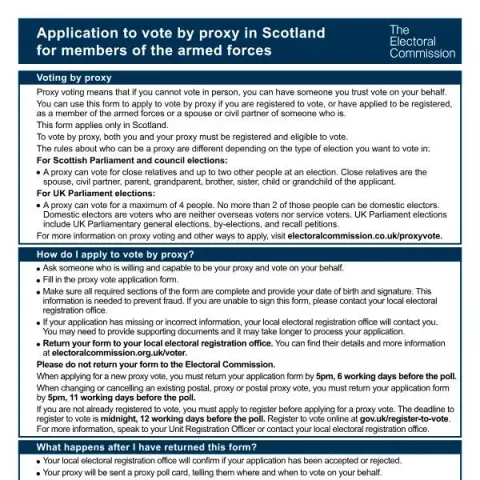
If you are a member of the armed forces stationed in Scotland, or a spouse or civil partner of such a member, you may wish to participate in elections even if you are unable to attend the polling station in person. The official form titled Application to vote by proxy in Scotland for members of the armed forces provides a legal and structured way to appoint someone to vote on your behalf. This article explains the purpose of this form, who can use it, and the key steps involved in completing and submitting your application.
What is Proxy Voting and Who Can Use This Form?
Proxy voting allows a registered voter to appoint a trusted individual to cast their vote at an election. This is particularly useful for members of the armed forces who may be away from their usual voting location due to service commitments. The form is specifically designed for eligible voters in Scotland who are either members of the armed forces or their spouses or civil partners.
To qualify to apply using this form:
- You must be registered to vote in Scotland, or have applied to be registered.
- You or your proxy must be eligible to vote.
It is important to note that this form applies only to elections in Scotland, including Scottish Parliament and local council elections, as well as UK Parliament elections such as general elections, by-elections, and recall petitions.
Who Can Be Your Proxy and How Many People Can They Vote For?
For Scottish Parliament and Local Council Elections
- Your proxy can vote on your behalf for close relatives and up to two other individuals.
- Close relatives include your spouse, civil partner, parent, grandparent, brother, sister, child, or grandchild.
For UK Parliament Elections
- Your proxy can vote for up to four people.
- No more than two of these voters can be domestic electors (people who are neither overseas voters nor service voters).
Understanding these rules ensures that your proxy can legally and effectively cast your vote in accordance with election regulations.
How to Complete and Submit the Proxy Voting Application
The process involves several clear steps:
- Identify a suitable proxy: Choose someone willing and capable of voting on your behalf.
- Fill out the form: Complete all relevant sections, ensuring your personal details, date of birth, and signature are provided. If you cannot sign, contact your local electoral registration office for assistance.
- Check for accuracy: Ensure all information is correct and complete; incomplete or incorrect applications may delay processing.
- Return the form: Send your completed application to your local electoral registration office. The address can be found at electoralcommission.org.uk/voter.
Remember, the deadline for submitting a new proxy application for a forthcoming poll is 5pm, six working days before the election. If you need to change or cancel an existing proxy vote, the deadline is 11 working days prior to the poll. Additionally, if you are not already registered to vote, you must register at least 12 working days before the election, which can be done online at gov.uk/register-to-vote.
After Submission: What Happens Next?
Once your application is received, your local electoral registration office will confirm whether it has been accepted or rejected. If approved, your proxy will receive a proxy poll card, which details where and when they should vote on your behalf.
It is essential to communicate your voting preferences to your proxy, specifying which candidate, party, or outcome you support. Your proxy must then attend the designated polling station to cast your vote, or they can apply for a postal vote if unable to attend in person. The proxy's ability to vote on your behalf is subject to the rules and deadlines outlined by the electoral authorities.
Fill in your form directly online
No printing: type your details into the boxes of the official form, tick, then download the PDF ready to send.
- 1Type into the form boxes
- 2Tick in one click
- 3Save and download the PDF
Privacy and Data Protection
This application involves the sharing of personal data, which is protected under UK data protection legislation. The Electoral Registration Officer acts as the Data Controller, ensuring that your information is processed securely and in accordance with the Data Protection Act 2018 and UK GDPR. For details on how your data is handled, refer to the privacy notice available from your local electoral registration office.
Final Advice for Applicants
Carefully review all instructions and deadlines before submitting your application. Ensure that your proxy is willing and able to vote on your behalf, and communicate clearly your voting preferences. If you have any doubts or require assistance, contact your local electoral registration office for guidance.
Participating in elections is a vital aspect of democratic participation, and this proxy voting process provides a practical solution for members of the armed forces in Scotland to exercise their voting rights despite service commitments.