Navigating Service Charge Disputes Through the First-tier Tribunal
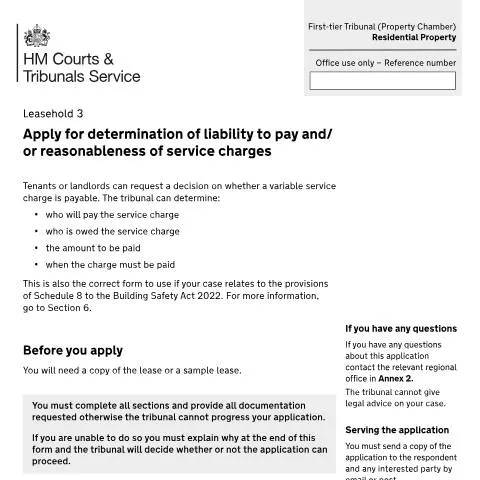
When service charge demands arrive through your letterbox, they can spark heated debates between leaseholders and landlords about what constitutes reasonable costs and who bears responsibility for payment. The Leasehold 3 form serves as the gateway to resolving these disputes through the First-tier Tribunal (Property Chamber), offering both tenants and landlords a formal mechanism to challenge or defend service charge determinations.
This tribunal application addresses fundamental questions that can make or break household budgets: whether variable service charges are actually payable, who owes what amount, and crucially, whether the charges represent value for money. The tribunal's determination carries legal weight, providing certainty in what can otherwise become protracted neighbourhood disputes that poison relationships and drain resources.
The form's scope extends beyond traditional service charge disputes to encompass provisions under Schedule 8 to the Building Safety Act 2022, reflecting the evolving landscape of building safety responsibilities following high-profile incidents. This dual functionality makes the Leasehold 3 form an increasingly important tool as building safety regulations tighten and associated costs filter through to residents.
Who Can Challenge Service Charges and When
Both leaseholders and landlords possess standing to initiate proceedings using this form, though their motivations typically diverge. Leaseholders commonly apply when they believe service charges are unreasonable, improperly calculated, or relate to works they never agreed to fund. Landlords might use the process to obtain tribunal confirmation that disputed charges are indeed recoverable, particularly when facing coordinated tenant resistance.
The capacity field on the form distinguishes between these roles, but situations can be more nuanced than they initially appear. Resident management companies controlled by leaseholders might find themselves in the landlord position when challenging their own managing agent's charges. Similarly, head leaseholders who sublet their properties occupy a dual role, potentially liable for service charges while simultaneously collecting them from their own tenants.
Multiple applicants can join forces on a single application, provided each signs the relevant documentation or provides email confirmation of their participation. This collective approach proves particularly valuable in blocks of flats where residents face identical service charge demands and can share both the application fee burden and legal costs.
Building Safety Act 2022 Applications
The form's reference to Schedule 8 of the Building Safety Act 2022 opens a specialist pathway for disputes arising from the new building safety regime. These cases might involve challenges to building safety charges levied on leaseholders in high-rise buildings, or disputes about the apportionment of costs for fire safety remediation works.
Leaseholders in buildings over 18 metres tall, or those containing at least seven storeys, may find themselves subject to additional charges related to building safety managers, fire risk assessments, or structural modifications. The tribunal can determine whether these charges represent reasonable costs properly recoverable through service charge mechanisms.
Decoding the Application Sections
The Leasehold 3 form divides into distinct sections, each requiring careful attention to avoid processing delays that could postpone your hearing by months. The tribunal explicitly states that incomplete applications cannot progress, making thorough preparation essential.
Section 1: Establishing Your Legal Standing
Beyond basic contact details, Section 1 requires you to define your capacity in the dispute. This seemingly simple field carries legal significance, as it determines your rights and obligations throughout the proceedings. Leaseholders must ensure their details match exactly with their lease documentation, while landlords need to demonstrate their legal title to collect the disputed charges.
The representative provisions allow you to appoint someone to handle correspondence on your behalf, but this decision requires careful consideration. Once appointed, all tribunal communications will be directed exclusively to your representative, potentially creating communication gaps if relationships break down mid-process.
For multiple applicants, the form requires separate documentation listing all participants. This might include residents across an entire block challenging the same service charge demand, or a group of landlords seeking confirmation of their right to recover specific costs.
Section 2: Property Particulars and Context
The property description section demands more than a simple address. Tribunals need to understand the physical context of service charge disputes, as this influences both the reasonableness of charges and the complexity of management arrangements.
A brief description should capture key characteristics: whether you're dealing with a converted Victorian house split into flats, a purpose-built 1960s block, or a modern development with extensive communal facilities. The age and construction type affect maintenance costs, while the number of units influences the arithmetic of service charge apportionment.
| Property Type | Typical Service Charge Elements | Common Dispute Areas |
|---|---|---|
| Purpose-built block | Lift maintenance, communal heating, exterior decoration | Major works consultation, reserve fund contributions |
| Converted house | Roof repairs, communal insurance, garden maintenance | Apportionment between flats, scope of landlord obligations |
| Modern development | Concierge services, gym facilities, estate management | Reasonableness of premium services, building safety costs |
Section 3: Respondent Identification
Correctly identifying respondents can make or break your application. The obvious respondent is typically the party demanding payment (for tenant applications) or refusing payment (for landlord applications), but service charge disputes often involve complex chains of responsibility.
Your immediate landlord might be a resident management company, while the freeholder could be a separate entity entirely. Managing agents frequently collect service charges but lack legal standing to defend them in tribunal proceedings. Getting this wrong means your application targets the wrong party, potentially leading to jurisdictional challenges that derail your case.
Strategic Applications to Limit Cost Recovery
The form incorporates two powerful protective mechanisms that savvy applicants should understand thoroughly. These applications can prevent landlords from adding their tribunal costs to future service charge bills, providing crucial financial protection even if you lose the main dispute.
Section 20C Applications: Service Charge Protection
Many leases contain clauses allowing landlords to recover their legal costs through service charges, effectively making all leaseholders contribute to disputes even if they're not directly involved. A Section 20C application under the Landlord and Tenant Act 1985 seeks an order preventing this cost recovery.
Tribunals generally grant Section 20C orders unless landlords can demonstrate exceptional circumstances justifying cost recovery. The application costs nothing additional when made alongside your main service charge challenge, making it a virtually risk-free protective measure.
The strategic value extends beyond your individual case. If granted, the order prevents the landlord from spreading their legal costs across all service charge payers, removing a significant financial incentive for landlords to pursue aggressive legal strategies.
Paragraph 5A Applications: Administration Charge Limits
The second protective mechanism addresses administration charges rather than service charges. Some leases allow landlords to charge tenants for legal costs through administration charge provisions, creating an alternative route for cost recovery that bypasses service charge protections.
Paragraph 5A applications under the Commonhold and Leasehold Reform Act 2002 seek orders reducing or eliminating liability for these litigation-related administration charges. The distinction between service charges and administration charges can be subtle, but both mechanisms can operate simultaneously to provide comprehensive cost protection.
Essential Documentation and Evidence Preparation
The tribunal cannot progress applications without complete documentation, making evidence preparation a critical success factor. The form explicitly requires lease copies or sample leases, but comprehensive evidence packages typically extend far beyond this minimum requirement.
Core Lease Documentation
Your lease document forms the foundation of any service charge dispute, as it defines the landlord's obligations and your payment responsibilities. The tribunal needs to understand exactly what services the lease requires, how costs should be calculated, and what consultation procedures apply to major works.
If multiple leases exist across a development, providing a sample lease may suffice, but ensure it accurately represents the terms affecting your specific dispute. Lease variations, side letters, or subsequent deeds of variation can materially affect service charge obligations and must be disclosed.
Financial Evidence and Calculations
Service charge disputes inevitably involve detailed financial analysis. Gather service charge demands, annual statements, supporting invoices, and any reserve fund calculations that relate to your challenge. The tribunal needs to understand both the disputed amounts and the methodology used to calculate them.
Where you're challenging the reasonableness of costs, comparative evidence proves invaluable. Alternative quotations for similar works, market rate analyses for management services, or expert valuations of completed works can demonstrate whether charges represent value for money.
Consultation and Communication Records
The Landlord and Tenant Act 1985 requires consultation before major works exceeding statutory thresholds. Gather all consultation notices, tenant responses, and landlord replies to demonstrate whether proper procedures were followed. Failures in consultation can render service charges unrecoverable regardless of whether the underlying works were reasonable.
- Section 20 consultation notices for major works or long-term agreements
- Tenant observation periods and response submissions
- Landlord explanations for contractor selection decisions
- Any correspondence about works quality or necessity
Submission Pathways and Service Requirements
Completing the form represents only the first step in a process that demands careful attention to service requirements and regional office procedures. The tribunal system operates through regional offices listed in Annex 2, each with specific submission preferences and contact protocols.
Service on Respondents and Interested Parties
You must serve copies of your completed application on all respondents and interested parties by email or post. This requirement goes beyond simple notification – proper service ensures all affected parties can participate in proceedings and protects your application from procedural challenges.
Interested parties might include other leaseholders affected by the same service charges, managing agents involved in cost collection, or superior landlords with financial interests in the dispute outcome. Identifying all relevant parties requires careful analysis of your lease structure and management arrangements.
Electronic service via email is generally acceptable, but ensure you retain delivery confirmations and consider following up with postal service for important applications. Some respondents may challenge electronic service, particularly if they can demonstrate technical difficulties or claim non-receipt.
Regional Office Variations
Different regional offices maintain varying procedures for application processing and case management. Some offices accept DX service for legal representatives, while others operate purely through postal and electronic channels. The form's reference to Annex 2 directs applicants to office-specific information that can influence your submission strategy.
Processing times can vary significantly between regions based on caseload and staffing levels. While the tribunal cannot provide legal advice on your specific case, administrative staff can clarify procedural requirements and help ensure your application meets technical standards for acceptance.
Understanding Tribunal Determinations and Their Impact
Successful applications result in tribunal determinations that carry the force of law, but understanding exactly what the tribunal can and cannot decide helps set realistic expectations for your case outcome.
The tribunal possesses jurisdiction to determine liability for payment, identifying who must pay disputed charges and in what proportions. This proves particularly valuable in complex lease structures where multiple parties might bear responsibility for different cost elements.
Reasonableness determinations address whether charges represent value for money, considering factors such as service quality, cost comparison with market rates, and the necessity of underlying works or services. The tribunal applies objective standards rather than individual affordability, meaning charges can be deemed reasonable even if they cause financial hardship.
Timing determinations establish when payments fall due, which can affect interest calculations and landlord enforcement rights. Some leases contain ambiguous payment timing provisions that create genuine uncertainty about when charges become legally recoverable.
Enforcement and Future Implications
Tribunal determinations create binding legal precedents for your specific property and lease arrangements. Landlords cannot subsequently re-challenge the same service charges through different legal routes, while leaseholders gain certainty about their ongoing payment obligations.
The determination's impact extends beyond the immediate dispute. Future service charge calculations must reflect any tribunal findings about apportionment methods, consultation requirements, or cost recovery limitations established through your case.
For landlords, adverse determinations can affect their ability to recover historical costs and may require refunds to leaseholders who have already paid disputed amounts. The financial implications can be substantial, particularly where determinations affect multiple years of service charge accounts or large-scale major works programmes.