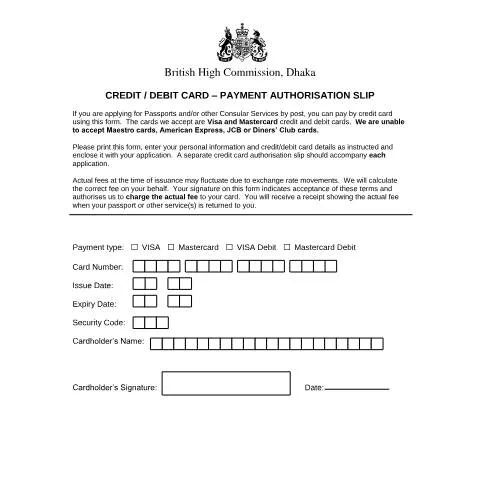
Understanding the Bangladesh Payment Authorisation Slip: A Key Administrative Tool
The Foreign & Commonwealth Office (FCO) has developed various administrative forms to streamline processes for British citizens abroad. One such document is the Bangladesh Credit/Debit Card Payment Authorisation Slip, which plays a fundamental role in facilitating payments for consular services. Whether you are applying for a new passport or seeking other consular assistance, understanding this form is vital for a smooth application process.
The Context Behind the Payment Authorisation Slip
In an increasingly digital world, the handling of payments for official services requires secure and efficient methods. The FCO introduced the Payment Authorisation Slip as part of its commitment to provide accessible services to UK nationals in Bangladesh. This document is particularly pertinent for those who choose to apply for consular services via postal routes, ensuring that payment can be made safely and efficiently without the need for physical transactions at the embassy.
Historical Perspective
The advent of online services has revolutionised the way governments interact with citizens. The FCO, recognising the need for adaptable and secure payment methods, has positioned the Payment Authorisation Slip as a critical component of the application process. By allowing payments via credit and debit cards, the FCO has not only enhanced user experience but also upheld stringent security measures in compliance with the Data Protection Act 2018 and UK GDPR regulations. This ensures that personal financial information is handled with the utmost care and confidentiality.
Navigating the Payment Authorisation Process
To ensure clarity and efficiency in submitting this important document, let's delve into the step-by-step process involved in completing and submitting the Bangladesh Payment Authorisation Slip.
Initial Steps: Preparing Your Application
- Gather your personal documents: Ensure all requisite forms are complete.
- Print the Payment Authorisation Slip: This form must be printed out for completion.
- Decide on payment method: Choose between Visa or Mastercard, as these are the only accepted card types.
Completing the Payment Authorisation Slip
Completing the Payment Authorisation Slip accurately is crucial. Here’s how to do it:
- Card Type: Indicate whether you are using a Visa or Mastercard.
- Card Number: Enter your 16-digit card number clearly.
- Issue and Expiry Dates: Fill in the card's issue and expiry dates.
- Security Code: Include the three-digit security code from the back of the card.
- Cardholder’s Name: Ensure that the name matches that on the card.
- Signature: Don’t forget to sign and date the slip to authorise the payment.
Enclosing the Payment Authorisation Slip
Once you have completed the Payment Authorisation Slip, it must be enclosed with your application. It's important to note that each application must have a separate authorisation slip. This means if you are applying for multiple services, you will need multiple copies of this slip.
Understanding the Payment Dynamics: Currency and Fees
The fees associated with consular services can vary due to exchange rate fluctuations. When submitting the Payment Authorisation Slip, you authorise the FCO to charge the actual fee relevant to your application at the time of processing. This is a key aspect to consider, as it ensures that you are only charged the correct amount.
Receipt and Confirmation
Upon processing your payment, you will receive a receipt detailing the actual fee charged. This receipt serves as proof of payment and will accompany the return of your passport or any other service you applied for. Keeping this receipt is essential for your records.
Timelines: When to Submit Your Payment Authorisation Slip
Being aware of the timelines associated with the application process can help streamline your experience significantly. Here’s what you need to know:
Submission Timeline
- Ensure your application and the Payment Authorisation Slip are submitted well in advance of any travel plans.
- The processing time can vary, so allow for sufficient lead time, especially during peak application periods.
Post-Submission: What to Expect
After you have submitted your application along with the Payment Authorisation Slip, you can expect the following:
- Processing time varies but typically ranges between four to six weeks for passport services.
- You will receive notifications via email regarding the status of your application.
- Your passport or services will be returned to you via the address provided in your application.
Specific Cases: Understanding Variations in Payment Processing
While most applications will follow the standard procedure outlined, certain situations may require additional considerations. Here are some particular scenarios:
Applying from Abroad
If you are a UK citizen applying from abroad, using the Payment Authorisation Slip is essential, as it’s one of the few ways to securely pay for services without needing to visit the consulate in person. It's particularly useful for those who may be located far from the consulate or those who have mobility issues.
Minor Applicants
For applications concerning minors, the Payment Authorisation Slip must be signed by the parent or legal guardian. It is crucial to ensure that the name of the cardholder matches the name of the guardian and that the payment is made in accordance with the application guidelines for minors.
Urgent Applications
In cases of urgent passport applications, completing the Payment Authorisation Slip becomes even more critical. Submit it alongside your urgent request to avoid delays. Ensure to specify the urgency in your application so the consular staff can prioritise processing.
Final Considerations: The Role of the Payment Authorisation Slip in Broader Administrative Processes
The Payment Authorisation Slip does not exist in isolation. It is an integral part of a broader framework designed to ensure that consular services are accessible, secure, and transparent. Here’s how it fits into the larger picture:
Part of a Comprehensive Application Package
The Payment Authorisation Slip is one element of a comprehensive application package that includes:
- Application Form: Complete forms such as the Passport Application Form for the service you are requesting.
- Supporting Documents: These may include proof of identity, photographs, and any other relevant documentation as required.
Facilitation of Financial Transactions
This slip ensures that financial transactions are processed efficiently which is aligned with the FCO’s objectives of modernising services. By offering a secure payment method, the FCO not only improves the application experience but also complies with necessary regulations regarding financial transactions.
Commitment to Transparency and Security
Through the Payment Authorisation Slip, the FCO demonstrates a commitment to maintaining high standards of transparency and data protection, as mandated by UK law. By processing payments via this slip, applicants can rest assured that their financial data is kept secure.
Engaging with the Process: A Citizen's Perspective
As a UK citizen navigating the application process for consular services from Bangladesh, your experience with the Payment Authorisation Slip will be a critical factor in your overall satisfaction. Here are a few practical tips to enhance your engagement with this process:
- Stay Informed: Keep abreast of updates or changes to fees or processes announced by the FCO.
- Verify Information: Ensure that all personal details on the Payment Authorisation Slip are accurate to avoid processing delays.
- Seek Assistance: If in doubt, do not hesitate to contact the consulate for guidance on filling out the form or any other queries you may have.
In conclusion, the Bangladesh Credit/Debit Card Payment Authorisation Slip is much more than a simple form; it is a gateway to essential services for British citizens residing or travelling in Bangladesh. By understanding its purpose, how to complete it, and its role within the greater administrative framework, you can navigate your consular needs with confidence and ease.
Understanding the Importance of Authorisation Slips
In the context of financial transactions, an authorisation slip plays a pivotal role, especially for international payments like those from Bangladesh to the UK. This document serves as a confirmation that a payment has been approved, ensuring both parties—the payer and the recipient—have a record of the transaction. For those in the UK dealing with international suppliers or service providers, understanding the significance of these slips is paramount.
Fill in your form directly online
No printing: type your details into the boxes of the official form, tick, then download the PDF ready to send.
- 1Type into the form boxes
- 2Tick in one click
- 3Save and download the PDF
The authorisation slip typically includes vital details such as the cardholder's name, card number (partially obscured for security), transaction amount, and merchant information. By retaining this slip, individuals can effectively manage their finances, track spending, and resolve potential disputes that may arise from unauthorized transactions. This is particularly important given the growing number of online transactions that can be susceptible to fraud.
Moreover, for businesses in the UK accepting payments from Bangladesh, understanding the specific requirements for these authorisation slips is critical. They may have to comply with the UK Payment Services Regulations and the Payment Card Industry Data Security Standard (PCI DSS), ensuring that sensitive payment information is handled securely. Failure to do so could result in financial penalties or loss of business reputation, highlighting why a sound understanding of this documentation is essential.
Compliance with International Payment Regulations
When making credit or debit card payments internationally, such as sending funds from Bangladesh to the UK, consumers and businesses alike must navigate a complex web of regulations and compliance requirements. The UK is governed by a strict regulatory framework that includes anti-money laundering (AML) laws, consumer protection regulations, and guidelines set by the Financial Conduct Authority (FCA).
For Bangladeshi residents wishing to make payments to UK-based businesses, ensuring compliance with these regulations is of utmost importance. The sender must verify that the payment method, often involving banks or financial institutions, follows the necessary protocols to prevent fraud and money laundering. This may include providing identification and proof of address as part of the Know Your Customer (KYC) process, which has become increasingly stringent in recent years.
Furthermore, users must be aware of the foreign exchange implications. International transactions may incur additional fees, and the exchange rate used for the conversion can vary significantly between providers. It is advisable to research and choose a payment method that offers the most favorable rates and minimal fees to ensure the recipient receives the intended amount without excessive deductions.
Challenges of Cross-Border Transactions
While making a credit or debit card payment from Bangladesh to the UK is straightforward, numerous challenges can arise during the process. One major concern is transaction limits imposed by banks and financial institutions. Many providers set restrictions on the amount that can be sent internationally, which may hinder larger business transactions. Therefore, it is essential to check with your bank or service provider regarding these limits before initiating a payment.
Additionally, time delays can be a significant issue. Cross-border payments may take longer to process due to various factors, including bank processing times, currency conversion, and international banking hours. Consumers should be aware of these potential delays, particularly when payments are time-sensitive.
Fraud is another prevalent concern in cross-border transactions. Users must be vigilant and ensure they are using trusted payment methods and platforms to mitigate the risk of fraudulent activities. Scammers often target individuals sending money abroad, prompting the need for thorough verification of merchants or individuals before approving payments.
Lastly, fluctuations in currency exchange rates can impact the final amount received by the payee in the UK. Users should stay informed about current rates, as even minor changes can affect the transaction outcome significantly. Understanding these challenges will help both consumers and businesses navigate the complexities of international finance more effectively.