When Cattle Documentation Goes Missing: The Critical Role of Replacement Passports
Every cattle keeper in England and Wales faces the same potential nightmare: discovering that one or more of their animals' passports have vanished without trace. Whether torn apart by weather, consumed by fire, snatched by thieves, or simply misplaced during a hectic moving day, missing cattle passports create immediate legal and commercial complications that demand swift action.
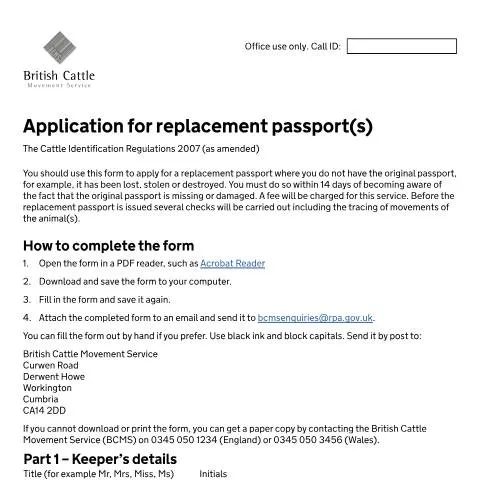
Under the Cattle Identification Regulations 2007, you have precisely 14 days from becoming aware that a passport is missing to apply for a replacement. This isn't merely bureaucratic box-ticking—without valid documentation, your cattle cannot legally move between holdings, attend markets, or enter the food chain. The British Cattle Movement Service (BCMS), operating under the Rural Payments Agency umbrella, provides the cpp9a form as your lifeline back to compliance.
The replacement process involves far more than simply requesting new paperwork. BCMS conducts thorough movement tracing investigations, cross-referencing databases and historical records to verify each animal's identity and history. This verification can make or break your application—incomplete movement histories result in Notices of Registration rather than full passports, permanently excluding affected animals from human consumption.
Qualifying Circumstances and Keeper Responsibilities
The cpp9a form serves keepers who find themselves without original passports through four recognised scenarios: destruction, theft, loss, or other circumstances. Each category carries distinct evidential requirements that significantly impact your application's success rate.
Destruction Cases: Insurance and Evidence Requirements
Fire, flood, or accident damage represents the most straightforward replacement scenario, provided you can demonstrate proper insurance procedures. BCMS expects full insurance company details, including your claim handler's name and telephone number. If you haven't filed an insurance claim, you must explain why—perhaps the damage value fell below your excess, or the loss occurred during a policy gap. This explanation becomes crucial supporting evidence.
Keepers often underestimate the detail required here. Simply stating "barn fire destroyed passports" won't suffice. BCMS wants to know when the incident occurred, which specific animals were affected, and how you've verified their current location and condition since the destruction.
Theft Incidents: Police Documentation Requirements
Stolen passports trigger the most complex verification procedures. You must provide complete police reporting details: the investigating officer's name, their station location, and direct telephone number. This allows BCMS to cross-reference your account with official police records, ensuring the theft genuinely occurred rather than covering up unauthorised movements or sales.
Rural crime specialists note that passport theft often accompanies livestock theft, making movement tracing particularly challenging. If your animals remain in your possession but their documentation was stolen separately—during office break-ins or vehicle theft—you'll need to explain how you've maintained custody throughout.
Simple Loss: The Documentation Challenge
Lost passports present unique verification difficulties since no external incident validates their disappearance. BCMS scrutinises these applications particularly carefully, seeking detailed explanations of when and where you last handled the documents, plus comprehensive accounts of your search efforts.
Your Part 3 narrative should demonstrate reasonable keeper behaviour: checking obvious locations, contacting recent visitors, reviewing movement records for clues about when you last saw the passports. Vague statements like "passports went missing" invite rejection—BCMS needs confidence that you're not concealing unauthorised activities.
Navigating the Animal Identification Matrix
Part 2's identification table demands precision that catches many keepers off-guard. Each row must contain the animal's complete official identity number—not your farm reference or ear tag number, but the unique identifier assigned at birth registration.
| Information Required | Critical Points | Common Errors |
|---|---|---|
| Official animal identity | Full UK identification number | Using farm reference numbers instead |
| Date of birth | Must match BCMS records exactly | Approximating or guessing dates |
| Sex designation | Current status, not birth status | Outdated information after castration |
| Breed classification | Registered breed name or "crossbred" | Using colloquial breed descriptions |
The breed field proves particularly troublesome for crossbred animals. BCMS requires either a recognised breed name from their approved list or simply "crossbred"—avoid creative descriptions like "Hereford-type" or "beef cross" that don't match database entries.
Date accuracy becomes crucial during verification. If your stated birth date doesn't align with BCMS records, your application faces automatic rejection. When uncertain, indicate "unknown" rather than guessing—BCMS can often retrieve accurate dates during their investigation process.
Multiple Animal Applications: Organisation Strategies
Large-scale replacement applications require methodical organisation to avoid costly errors. Group animals by acquisition date and source—this helps BCMS trace movement patterns more efficiently while reducing your risk of providing contradictory information.
Consider submitting separate applications for animals with different loss circumstances. While the £20-per-animal fee remains constant, separated applications allow BCMS to process straightforward cases quickly while dedicating additional investigation time to complex scenarios.
Financial Obligations and Payment Mechanics
The £20 per animal replacement fee represents a significant cost consideration for multiple applications, yet BCMS maintains strict payment procedures that brook no flexibility. Understanding these requirements prevents processing delays that could extend your animals' documentation gap.
BACS Transfer Procedures
Electronic payment through BACS transfer offers the fastest processing route, but requires precise reference formatting. Your County Parish Holding (CPH) number must appear exactly as shown on Part 1—including any sub-location codes—in your transfer reference field. Incorrect references delay application processing while BCMS attempts to match payments with applications.
The designated account details demand careful attention: Account name "GBS RE RPA (RC)", number 10018255, sort code 60-70-80. These details change periodically, so verify current information directly with BCMS rather than relying on cached versions from previous applications.
Cheque Payment Considerations
Traditional cheque payments remain acceptable but introduce additional processing time. Make cheques payable to "Rural Payments Agency"—not BCMS or any abbreviated version—and write your CPH number clearly on the reverse. Banking delays mean cheque applications typically process 5-7 days slower than electronic payments.
Cash payments receive absolute prohibition, creating complications for keepers who typically handle transactions in cash. This policy reflects fraud prevention measures and audit trail requirements governing public sector financial procedures.
Movement Tracing: The Investigation Behind Your Application
BCMS doesn't simply print replacement passports upon request—each application triggers comprehensive movement tracing investigations that determine whether full passports or restricted Notices of Registration emerge. Understanding this process helps set realistic expectations and identify potential complications early.
Database Cross-Reference Procedures
Movement tracing begins with electronic database searches across multiple systems. BCMS cross-references your animal identification numbers against movement records, slaughter house logs, market transactions, and veterinary treatment databases. Complete electronic trails typically generate straightforward approvals, while gaps or inconsistencies trigger manual investigation procedures.
The investigation extends beyond your current holding to previous keepers, transport operators, and market facilities. Each entity in the chain must provide corroborating evidence of their interactions with your animals. This process can uncover discrepancies between your account and official records, potentially impacting your application's outcome.
Incomplete History Consequences
When movement tracing fails to establish complete histories, BCMS issues Notices of Registration instead of full passports. These documents permit animal identification and movement between holdings but permanently exclude affected animals from human consumption pathways. This restriction cannot be reversed, even if missing movement records surface later.
The financial implications extend beyond the non-refundable £20 fee. Animals with Notices of Registration typically command significantly lower market values, affecting breeding programs and long-term herd planning. Some keepers find themselves maintaining animals that become economic liabilities rather than productive assets.
Submission Pathways and Processing Expectations
BCMS offers multiple submission routes designed to accommodate different technological capabilities and urgency levels. Your chosen method significantly impacts processing timelines and communication efficiency throughout the application journey.
Digital Submission Protocol
Email submission to [email protected] provides the fastest processing route, typically generating initial responses within 3-5 working days. The form must be completed using PDF software—Adobe Acrobat Reader represents the recommended option—then saved and attached to your email. Hand-completed forms photographed or scanned often generate formatting errors that delay processing.
Digital submissions enable efficient communication throughout the investigation process. BCMS can request additional information electronically, provide status updates, and deliver final decisions without postal delays. This proves particularly valuable for complex cases requiring multiple information exchanges.
Postal Submission Requirements
Traditional postal submission to the Workington address remains available for keepers preferring paper-based processes. Use black ink and block capitals exclusively—blue ink or cursive writing often becomes illegible during scanning procedures. Postal applications typically require 7-10 working days for initial acknowledgment, with subsequent communication following similar timelines.
The Cumbria processing centre handles applications from across England and Wales, occasionally creating geographic confusion among keepers expecting local processing. All correspondence and follow-up queries should reference the Workington address regardless of your holding's location.
Declaration Commitments and Legal Implications
The Part 5 declaration section contains binding legal commitments that extend far beyond simple form completion. Each numbered clause creates specific obligations that could generate prosecution proceedings if breached knowingly or recklessly.
Your signature confirms willingness to assist movement tracing investigations, potentially requiring detailed record searches, witness statements, or facility inspections. This cooperation obligation continues until BCMS completes their investigation, regardless of how long the process takes. Keepers who become uncooperative or obstructive risk having their applications rejected and facing potential regulatory action.
The commitment to return recovered original passports carries particular importance. Original passports that surface after replacement issuance must be surrendered immediately—retaining both documents constitutes a regulatory breach. This requirement applies even if the originals emerge years later, emphasising the permanent nature of your declaration commitments.
Perhaps most significantly, the false statement warning carries genuine prosecution risk. BCMS cross-references applications against multiple data sources, making deliberate misrepresentations difficult to conceal. Recent prosecutions have targeted keepers who submitted replacement applications to cover unauthorised movements or sales, resulting in substantial fines and potential imprisonment terms.
Digital Record-Keeping and Cross-Border Movement Considerations
Modern cattle passport management extends beyond the physical document itself, particularly for operations managing multiple animals across different regions. The British Cattle Movement Service (BCMS) maintains digital records that must align with your physical passport data, creating a dual-layer system that requires careful coordination.
When applying for a replacement passport, your existing digital records within the Cattle Tracing System (CTS) remain intact, but discrepancies can arise if previous movements weren't properly recorded. Before submitting your replacement application, log into your CTS online account to verify that all recorded movements match your farm records. Pay particular attention to animals that may have been moved between holdings during shows, breeding loans, or temporary grazing arrangements.
For cattle involved in cross-border movements, particularly between England, Scotland, Wales, and Northern Ireland, replacement passport applications require additional scrutiny. Each devolved administration maintains slightly different procedures, and animals that have moved between jurisdictions may have records distributed across multiple databases. If your animal has previously moved from a Scottish holding to an English farm, for example, you'll need to confirm that both the Animal and Plant Health Agency (APHA) and Scottish Government records are consistent before the replacement passport can be issued.
International movement history adds another layer of complexity. Cattle that have previously been exported and re-imported, or animals imported from EU countries before or after Brexit, may have additional documentation requirements. The replacement passport must reflect any EU Health Certificates, veterinary health certificates, or Intra Trade Animal Health Certificates (ITAHCs) that remain relevant to the animal's status.
Digital photograph requirements have become increasingly stringent for replacement applications. While original passport applications may have accepted basic identification photos, replacement requests often require high-resolution images that clearly show distinctive markings, ear tag numbers, and any permanent identification marks. These photos must be recent—typically taken within 30 days of the application—and meet specific technical standards regarding lighting, angle, and image quality.
For pedigree animals, replacement passport applications must be coordinated with the relevant breed society. The Shorthorn Society, Aberdeen Angus Cattle Society, or other breed registries maintain independent records that must align with your BCMS application. Submit your replacement request to both organisations simultaneously to avoid processing delays, and ensure that any recent registration updates, ownership transfers, or genetic testing results are reflected in both systems.
Emergency Movement Procedures and Temporary Documentation
Livestock emergencies don't wait for administrative processes, and understanding temporary movement procedures becomes crucial when your cattle passport replacement is still pending. The BCMS operates specific emergency protocols that allow limited animal movement under controlled circumstances, but these require advance authorization and strict compliance with movement restrictions.
If your animal requires urgent veterinary treatment at a different location while the replacement passport application is processing, you can apply for an Emergency Movement Licence through your local Animal and Plant Health Agency office. This application requires detailed veterinary documentation confirming the medical necessity, proposed treatment location, and expected duration of the temporary movement. The licence typically permits direct movement from your holding to the treatment facility and back, with no intermediate stops or diversions permitted.
Emergency slaughter situations present particular challenges when dealing with missing or damaged passports. If an animal requires immediate slaughter for welfare reasons, you must notify both the slaughterhouse and BCMS before movement. The Food Standards Agency requires specific documentation for animals without valid passports, and emergency slaughter without proper notification can result in carcass detention and significant financial penalties.
Temporary grazing arrangements during passport replacement processing require careful documentation. Many farmers rely on seasonal grazing agreements, particularly for upland or conservation grazing, but these movements cannot proceed without valid documentation. If your replacement application coincides with planned seasonal moves, contact BCMS to request expedited processing or explore whether alternative identification methods might be temporarily acceptable.
Fire, flood, or other natural disasters that damage multiple passports simultaneously trigger specific mass replacement procedures. BCMS maintains emergency response protocols for major incidents affecting multiple holdings, but these require immediate notification and comprehensive livestock inventories. Document all affected animals immediately, including photographs, ear tag numbers, and any surviving identification records, as this information will be crucial for batch replacement applications.
Market attendance during passport replacement processing requires advance planning. Most livestock markets will not accept animals without valid passports, regardless of the circumstances surrounding the replacement application. If you have animals entered for specific sales dates, contact the market operator immediately to discuss options. Some markets may accept animals with temporary movement licences under specific conditions, but this varies significantly between different market operators and regions.
Priority Processing and Expedited Applications
Standard replacement passport processing typically takes 10-15 working days, but certain circumstances may qualify for expedited processing. Priority applications are generally reserved for situations involving imminent movement deadlines, such as pre-booked slaughter dates, confirmed breeding appointments, or time-sensitive veterinary treatments.
To request priority processing, include detailed supporting documentation with your application explaining the urgency. Acceptable justification might include veterinary certificates confirming time-sensitive medical treatment, confirmed breeding bookings with specific dates, or pre-arranged transport bookings for high-value animals. Commercial convenience or general preference for faster processing typically doesn't qualify for expedited handling.
Post-Replacement Compliance and Record Integration
Receiving your replacement cattle passport marks the beginning of a crucial compliance period where proper record integration prevents future administrative complications. The new passport contains updated security features and a revised document number that must be reflected across all your farm management systems, insurance records, and any third-party databases where the animal is registered.
Your farm assurance scheme records require immediate updating with the new passport details. Whether you operate under Red Tractor, RSPCA Assured, or organic certification schemes, these organisations maintain independent animal databases that must reflect current passport information. Failure to update these records within specified timeframes—typically 7-14 days of receiving the replacement passport—can result in non-conformities during scheme inspections.
Insurance policy updates become particularly critical for high-value breeding animals or show cattle. Livestock insurance policies often reference specific passport numbers, and claims may be rejected if policy records don't match current documentation. Contact your insurance provider immediately upon receiving the replacement passport to update policy schedules and confirm that coverage remains valid under the new document number.
Veterinary practice records also require systematic updating. Your regular veterinary practice maintains treatment records linked to passport numbers, and these must be updated to prevent confusion during future treatments or health scheme testing. This becomes particularly important for animals enrolled in health schemes such as CHeCS (Cattle Health Certification Standards) or BVD (Bovine Viral Diarrhoea) eradication programmes, where treatment histories must be accurately maintained.
Genetic testing and genomic evaluation records present another integration challenge. If your animal has undergone DNA testing, genomic evaluation, or parentage verification, these results are typically linked to the original passport number. Contact the relevant testing laboratory—whether Weatherbys Scientific, ICBF, or other genetic testing providers—to ensure that genomic records are transferred to the new passport number without losing historical data.
Movement notification systems require recalibration after passport replacement. If you use electronic identification (EID) readers or automated movement reporting systems, these must be updated to associate the new passport number with existing EID tag numbers. This prevents discrepancies between electronic reports and passport-based records that could trigger compliance investigations.
Breeding record integration demands particular attention for animals with extensive progeny records. If the animal has offspring registered with breed societies, pedigree databases, or artificial insemination companies, all these records must reflect the updated passport information. The British Cattle Breeding Club and individual breed societies maintain strict requirements for passport number accuracy in pedigree records, and discrepancies can affect offspring registration eligibility.
For animals previously involved in research trials or government schemes, replacement passport details must be communicated to relevant research institutions or scheme administrators. This might include participation in genetic improvement programmes, environmental land management schemes, or academic research projects where individual animal identification is crucial for data integrity.
Finally, establish a systematic review process for your replacement passport to identify any discrepancies or missing information before the document becomes essential for movement or other official purposes. Compare the replacement passport against your farm records, previous movement documentation, and any third-party registrations to ensure complete accuracy and consistency across all systems.