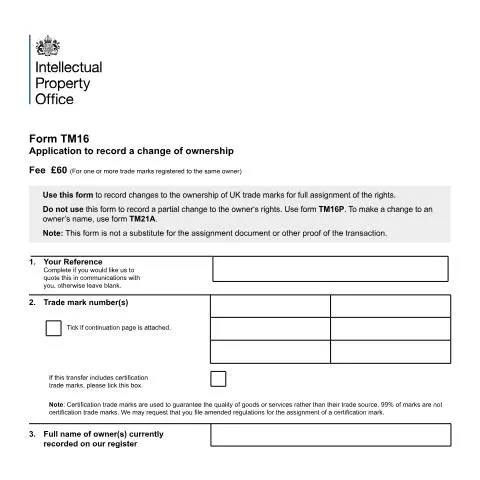
When Trade Mark Ownership Changes Hands: The TM16 Gateway to Legal Transfer
The moment a business acquisition completes or a brand licensing deal reaches its conclusion, a critical administrative step awaits: recording the change of ownership with the Intellectual Property Office. Form TM16 serves as the official mechanism to update the UK trade marks register when full assignment of rights occurs, ensuring the new proprietor gains legal recognition and protection under UK law.
This isn't merely bureaucratic housekeeping. Without proper registration of ownership changes, the new owner faces potential challenges in enforcing their trade mark rights, pursuing infringement actions, or even renewing the marks when the time comes. The TM16 application bridges the gap between commercial agreements and legal certainty, transforming private transactions into public record.
Distinguishing Full Assignment from Partial Rights: The TM16 Boundary
Understanding when to deploy form TM16 rather than its counterpart TM16P requires careful attention to the nature of the ownership change. The TM16 application exclusively handles complete transfers of ownership where all rights in the trade mark pass from one party to another.
Consider a technology startup selling its entire intellectual property portfolio to a multinational corporation. Here, TM16 captures the full assignment of trade mark ownership. Contrast this with a licensing arrangement where the original owner retains certain geographical rights whilst transferring others—such scenarios demand form TM16P for partial assignments.
| Scenario | Appropriate Form | Key Indicator |
|---|---|---|
| Complete business acquisition | TM16 | All rights transfer to buyer |
| Geographic licensing deal | TM16P | Rights split by territory |
| Product category assignment | TM16P | Rights divided by goods/services |
| Company name change only | TM21A | Same entity, different name |
The form explicitly warns against using TM16 for name changes alone—where the same legal entity continues ownership but operates under a different name, form TM21A provides the correct pathway.
Certification Trade Marks: The Specialist Consideration
Among the thousands of trade marks processed annually, certification marks represent a distinct minority—approximately 1% of all registrations. These marks guarantee quality or standards rather than indicating commercial source, making their transfer more complex than conventional trade marks.
When completing section 2 of form TM16, applicants must identify whether certification trade marks feature in their transfer. The Intellectual Property Office may request amended regulations accompanying such assignments, as certification marks carry specific responsibilities regarding standards maintenance and quality control.
Example scenario: The British Wool Marketing Board transferring its certification mark for pure wool products would require not only the TM16 form but potentially revised regulations detailing how the new owner will maintain certification standards and testing procedures.
Navigating the Critical Data Fields: From Reference Numbers to Representatives
Section 1's reference field offers applicants the opportunity to establish their own tracking system. Whilst optional, entering a meaningful reference—perhaps linking to internal transaction codes or legal matter numbers—facilitates correspondence and file management throughout the process.
The trade mark numbers section demands precision. Each registration carries a unique numerical identifier, and errors here can derail the entire application. For multiple marks sharing common ownership, continuation pages accommodate extensive portfolios, but applicants must ensure comprehensive coverage to avoid partial registrations.
Owner Information: Precision in Identity
Sections 3 and 4 require exact replication of registered owner details alongside comprehensive new owner information. The IPO maintains strict standards for name accuracy—variations in spelling, punctuation, or formatting between the current register and the TM16 application can trigger rejection or delay.
For companies, the registration number and country of incorporation provide additional verification layers. US entities must specify their state of incorporation, recognising the federal structure of American corporate law. This granular detail reflects the international nature of modern trade mark portfolios and the need for precise jurisdictional identification.
Representative Requirements and Geographic Constraints
Section 5 addresses representation, but with geographic limitations reflecting post-Brexit administrative boundaries. Representatives must maintain addresses within the United Kingdom, Gibraltar, or the Channel Islands—a requirement that affects international applicants seeking local representation.
This geographic constraint extends to correspondence addresses. New owners based outside these territories must appoint qualified representatives or risk communication failures that could jeopardise their trade mark rights. The email provision offers modern convenience, but physical addresses remain mandatory for official record-keeping.
Transfer Methods and Their Legal Implications
Section 7's method selection carries significant legal weight, as different transfer mechanisms trigger distinct documentary requirements and legal consequences. Assignment represents the most common method, covering negotiated sales and voluntary transfers between commercial parties.
Assent specifically addresses inheritance situations where executors or administrators transfer deceased persons' intellectual property rights. This method requires different supporting documentation and may involve probate considerations beyond the TM16 process itself.
Court orders reflect judicial determinations, perhaps following dispute resolution or insolvency proceedings. Company mergers represent corporate restructuring where trade mark ownership transfers through statutory processes rather than negotiated agreements.
Timing Considerations and Future-Dating Restrictions
The transfer date field in section 6 cannot accommodate future dates, reflecting the principle that ownership changes must have already occurred before registration. This seemingly simple requirement can complicate transactions where commercial completion and legal documentation follow different timelines.
For complex international acquisitions, parties must coordinate their TM16 submission timing with underlying transaction completion to ensure accuracy whilst avoiding unnecessary delays in securing registered ownership.
Stamp Duty Declarations: Navigating HMRC Requirements
Section 8's stamp duty declaration intertwines intellectual property law with tax obligations, requiring careful consideration of HMRC requirements alongside IPO procedures. The 28 March 2000 watershed date determines whether stamp duty applies to intellectual property transfers, reflecting legislative changes that simplified IP transactions.
Transfers involving intellectual property only or IP with related goodwill completed after 28 March 2000 typically escape stamp duty obligations. However, transactions including unrelated goodwill or other transferable property may trigger HMRC liability regardless of timing.
The form's reference to HMRC's specialist helpline (0300 200 3510) acknowledges the complexity surrounding stamp duty calculations and the need for expert guidance in borderline cases. Incorrect declarations can delay IPO processing whilst creating potential tax compliance issues.
Dual Authorisation Requirements: Securing Both Parties' Agreement
Section 9 mandates signatures from both transferring and receiving parties, reflecting the bilateral nature of ownership changes. This requirement protects against unauthorised transfers whilst ensuring both parties acknowledge the transaction's implications.
Where dual signatures prove impossible—perhaps due to geographic separation or timing constraints—supporting documentary evidence must compensate. Assignment agreements, board resolutions, or court orders may substitute for missing signatures, but applicants must clearly identify their reliance on alternative documentation.
The distinction between owners and their representatives adds another layer of complexity. Representatives signing on behalf of principals must demonstrate appropriate authority, whether through formal appointment letters or embedded powers within existing agency relationships.
Processing Pathways and Administrative Coordination
Section 11 recognises that ownership changes often coincide with other register modifications—address updates, representative appointments, or classification amendments. Cross-referencing multiple forms through consistent reference numbers enables coordinated processing and reduces administrative confusion.
The IPO's preference for bundled submissions reflects operational efficiency whilst helping applicants avoid inconsistent register entries that might emerge from separately processed forms with different completion dates or administrative handling.
Fee Structure and Payment Mechanics
The £60 fee applies regardless of the number of trade marks included in a single TM16 application, provided they share common current ownership. This structure encourages comprehensive portfolio transfers rather than piecemeal submissions, benefiting both applicants and administrative efficiency.
Payment options accommodate diverse preferences and administrative systems. The online card payment system provides immediate confirmation through ten-character reference codes, whilst deposit accounts serve frequent users with streamlined processing. Bank transfer options support international applicants, though the SWIFT and IBAN details reflect the UK banking system's specific requirements.
The cheque option, whilst traditional, may introduce processing delays compared to electronic alternatives. Applicants prioritising speed should favour online or deposit account payments over postal submissions requiring manual handling.
Beyond Submission: Monitoring Progress and Addressing Challenges
Once submitted, TM16 applications enter the IPO's examination process where officials verify submitted information against existing records and supporting documentation. This examination may reveal discrepancies requiring applicant response or additional evidence provision.
Common examination queries include name variations between current registration and submitted details, incomplete supporting documentation, or stamp duty declaration inconsistencies. Responding promptly to IPO correspondence prevents unnecessary delays and demonstrates commitment to accurate record-keeping.
The confirmation process concludes with updated register entries reflecting new ownership details. These changes become publicly searchable, providing third parties with current ownership information essential for licensing negotiations, infringement assessments, or due diligence investigations.
For applicants managing extensive trade mark portfolios, the TM16 process represents just one element in broader intellectual property management strategies. Successful completion ensures legal certainty whilst enabling new owners to exercise their full range of trade mark rights within the UK marketplace.
Navigating Complex Ownership Structures and Special Circumstances
Certain ownership changes involve intricate structures that require additional documentation and careful handling. When multiple parties are involved, such as in corporate acquisitions or partnership dissolutions, the application process becomes more nuanced and may require supplementary forms.
Corporate Ownership Transfers
When a limited company acquires ownership of assets or property, you'll need to provide the company's Certificate of Incorporation and current Companies House filing information. The application must clearly identify whether the transfer represents a genuine change of beneficial ownership or merely a restructuring within the same group. HMRC may require additional declarations regarding Stamp Duty Land Tax obligations, particularly for property transactions exceeding specific thresholds.
Directors and company secretaries should be prepared to provide personal guarantees in certain circumstances, especially when the acquiring company has been recently incorporated or has limited trading history. The application may be subject to enhanced scrutiny if the transaction appears to be structured primarily for tax avoidance purposes.
Trust and Estate Complications
Ownership changes involving trusts present unique challenges that require specialist documentation. When assets transfer from an individual to a trust, or between different trust arrangements, you must provide the trust deed and details of all trustees and beneficiaries. The application should clearly distinguish between legal ownership (held by trustees) and beneficial ownership (held by beneficiaries).
Executors dealing with estate assets face particular complexities when ownership passes to multiple beneficiaries. Each beneficiary's entitlement must be precisely documented, and the application may require probate court documentation or letters of administration. When assets are sold to third parties as part of estate administration, the timing of the ownership change application becomes critical for tax purposes.
International Ownership Elements
Cross-border ownership changes trigger additional compliance requirements under various international agreements and UK domestic legislation. When foreign entities acquire UK assets, anti-money laundering checks become more stringent, and you may need to provide certified translations of overseas corporate documents.
The application must address whether the new owner is resident in a jurisdiction with a Double Taxation Agreement with the UK, as this affects withholding tax obligations and reporting requirements. EU citizens may still benefit from certain transitional arrangements post-Brexit, but these must be specifically claimed and evidenced in the application.
Technology Integration and Digital Processing Trends
The landscape of ownership change applications is rapidly evolving as government departments embrace digital transformation initiatives. Understanding these technological developments helps applicants navigate the system more effectively and anticipate future changes to established processes.
Digital Identity Verification Systems
Many government departments are implementing enhanced digital identity verification systems that cross-reference multiple databases simultaneously. When completing ownership change applications online, the system may automatically verify certain details against HMRC records, Companies House filings, or Land Registry entries. This integration can expedite processing but may also flag discrepancies that require manual resolution.
The Government Gateway system increasingly serves as a central hub for multiple applications, allowing users to track progress across different departments from a single dashboard. However, each department maintains its own specific requirements and timescales, so automated progress updates should be interpreted carefully.
Artificial Intelligence in Application Assessment
Several government departments now employ AI-powered systems to conduct initial application assessments, particularly for routine ownership changes. These systems can identify potential issues such as incomplete documentation, inconsistent information, or transactions that require additional scrutiny under anti-money laundering regulations.
While AI assessment can significantly reduce processing times for straightforward applications, complex cases involving multiple parties or unusual circumstances may still require human intervention. Understanding how these systems prioritise applications can help you structure your submission to avoid unnecessary delays.
Blockchain and Distributed Ledger Pilots
The UK government is exploring blockchain technology for certain types of ownership records, particularly in areas where immutable transaction histories provide clear benefits. While still in pilot phases, these developments may eventually streamline ownership change applications by providing real-time verification of transaction chains.
Current pilots focus primarily on intellectual property registrations and certain types of financial instruments, but the technology's application may expand to property and business ownership records in future years.
Post-Application Compliance and Ongoing Obligations
Successfully recording an ownership change marks the beginning of new compliance responsibilities rather than the end of the administrative process. Understanding these ongoing obligations helps prevent future complications and ensures continued regulatory compliance.
Notification Requirements for Future Changes
Once ownership is officially recorded, you become responsible for notifying relevant authorities of any subsequent changes within specified timeframes. These obligations vary significantly depending on the type of asset and the nature of your ownership interest.
For business ownership, Companies House requires notification of changes in shareholdings above certain thresholds, typically within 14 days of the change occurring. Property ownership changes must be reported to the Land Registry, while intellectual property transfers require notification to the Intellectual Property Office within specific deadlines that vary by registration type.
Tax Reporting Synchronisation
Your ownership change may trigger ongoing tax reporting obligations that must be carefully coordinated across different submission deadlines. Self Assessment returns must reflect ownership changes in the correct tax year, which runs from 6 April to 5 April. Corporation Tax returns require precise allocation of profits and losses before and after ownership change dates.
Capital gains tax calculations become particularly complex when ownership changes occur partway through a tax year, especially if the asset generates ongoing income. Professional advice is often essential to ensure accurate reporting across multiple tax returns and to identify available reliefs or exemptions.
Record Retention and Documentation Standards
UK regulations typically require retention of ownership change documentation for minimum periods ranging from three to seven years, depending on the specific context. HMRC may require access to original application documents during tax investigations, while other authorities may need evidence of ownership changes for regulatory compliance purposes.
Digital storage systems must comply with Data Protection Act 2018 requirements, particularly when personal information about previous or current owners is involved. Regular backup procedures and secure access controls become essential components of ongoing compliance.
Some ownership changes create indefinite record retention obligations, particularly when they involve pension scheme assets or long-term trust arrangements. Understanding these requirements at the application stage helps establish appropriate documentation systems from the outset.