Understanding the Appeal Process for Property Regulation Penalties in the UK
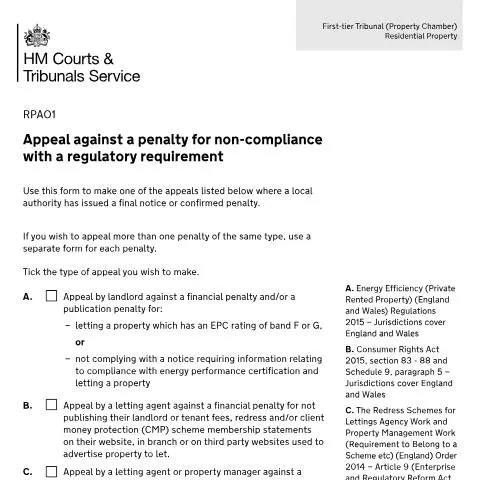
The HM Courts & Tribunals Service provides a structured process for landlords, letting agents, property managers, and other relevant parties to challenge penalties issued for non-compliance with specific property regulations. The official form designated for this purpose is the Form RPA01, which facilitates appeals against penalties related to energy efficiency, safety, and transparency requirements in the private rental sector.
Scope and Purpose of Form RPA01
Form RPA01 is specifically designed for individuals or entities who wish to contest penalties imposed by local authorities for breaches of property regulations. These penalties may include fines or publication notices for violations such as letting properties with poor energy performance, failing to comply with safety or information notices, or not adhering to scheme membership obligations. The form is applicable across various regulations, including the Energy Efficiency (Private Rented Property) (England and Wales) Regulations 2015, the Smoke and Carbon Monoxide Alarm (England) Regulations 2015, and the Redress Schemes for Lettings Agency Work and Property Management Work (Requirement to Belong to a Scheme) (England) Order 2014.
Who Can Use Form RPA01?
The appeal process is available to:
- Landlords who have received penalties for issues such as low EPC ratings or non-compliance with remedial notices concerning safety alarms.
- Letting agents or property managers who have been penalized for failing to publish required fees, redress scheme memberships, or for not belonging to approved schemes.
Each appeal must be initiated separately for individual penalties, and the form must be completed in full, with all supporting documentation, to be considered valid.
Key Elements of the Appeal Process
Submission Requirements
Applicants are required to submit a completed Form RPA01 along with a copy of the final or confirmed penalty notice issued by the local authority. The form collects detailed information about the appellant, the property involved, and the respondent (usually the local authority). It also asks for contact details and may include representatives acting on behalf of the appellant.
Completing the Form
The form is divided into sections covering the applicant’s details, the property address, details of the local authority, and the specifics of the penalty. Applicants should ensure all sections are fully completed and that they provide any relevant evidence or explanations to support their appeal.
Legal and Administrative Considerations
Appeals must be lodged within the stipulated timeframe following receipt of the penalty notice. The tribunal, specifically the First-tier Tribunal (Property Chamber), will review the application. In some cases, the tribunal may decide to handle the appeal solely through written submissions, without requiring a personal hearing.
It is important to note that the tribunal cannot offer legal advice. Applicants are encouraged to seek legal guidance if needed, especially in complex cases or where legal interpretations of the regulations are involved.
Fill in your form directly online
No printing: type your details into the boxes of the official form, tick, then download the PDF ready to send.
- 1Type into the form boxes
- 2Tick in one click
- 3Save and download the PDF
Implications for the Appellant
Successfully appealing a penalty can result in the cancellation or reduction of fines, or an overturning of publication notices. Conversely, if the tribunal dismisses the appeal, the original penalties remain enforceable. Therefore, providing comprehensive and accurate information, along with supporting evidence, is crucial for a favorable outcome.
Additional Notes
Applicants should be aware that the appeal process involves formal procedures, including serving copies of the application to all relevant parties, such as the local authority and any interested parties. Clear communication and adherence to deadlines are vital for the smooth processing of the appeal.
For further assistance or clarification regarding the process, applicants are advised to contact the regional office listed in the official guidance or seek legal advice, as the tribunal cannot provide legal counsel.