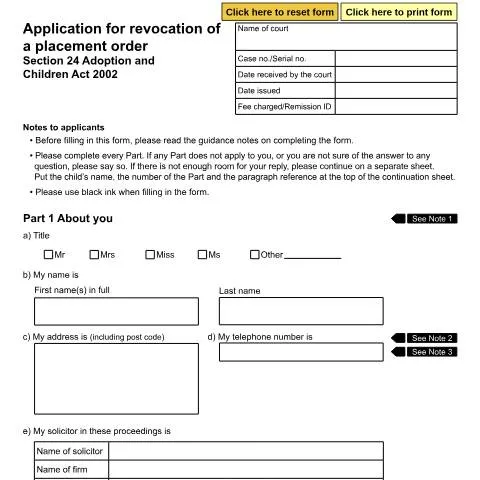
Understanding the Application for Revocation of a Placement Order under Section 24 of the Adoption and Children Act 2002
The Application for Revocation of a Placement Order is a formal legal process managed by the HM Courts & Tribunals Service in the United Kingdom. This procedure allows certain parties involved in the care and placement of a child to request the court to revoke an existing placement order, effectively ending the child's placement for adoption. This guide provides an overview of the purpose, eligibility, and key components of the application process, based on the official Form A52.
The Purpose and Scope of the Application
The primary aim of this application is to seek the court's permission to revoke a placement order issued under Section 24 of the Adoption and Children Act 2002. Such orders are typically made to facilitate the child's adoption process, but circumstances may change, prompting a party to request the order's revocation. The process is initiated through the submission of a formal application, which must be supported by relevant evidence and documentation.
Who Can Apply for a Revocation?
Various parties involved in the child's care may apply for revocation, including:
- The child named in the placement order, if they are of sufficient age and understanding;
- The child's parent(s), including the mother or father, if they have parental responsibility;
- The child's guardian or an authorized representative of the local authority that placed the child;
- Prospective adopters, under certain confidentiality conditions.
It is important to note that the applicant must have a legal standing to make such an application and must clearly specify their relationship to the child or the authority involved.
Key Components of the Application
Part 1: About the Applicant
This section requires personal details of the applicant, including title, full name, address, and contact information. If the applicant is represented by a solicitor, details of the legal representative must also be provided. The applicant must indicate their relationship to the child, such as whether they are the child's parent, guardian, or a local authority representative.
Part 2: Details of the Child
This section captures essential information about the child, including their full name, gender, date of birth, and the local authority responsible for their placement. It also asks about any other legal proceedings involving the child or their siblings, which could influence the revocation process.
Part 3: Information on the Child’s Parents or Guardians
The application requires details of the child's parents or guardians, including their names, addresses, and whether they hold parental responsibility. If a parent has deceased, this should be clearly indicated. The applicant must also specify if the parent intends to apply for any other orders concerning the child's care or contact arrangements.
Part 4: Reasons for the Application
This section is crucial, as the applicant must clearly state the grounds for requesting the revocation. Reasons might include changes in circumstances, concerns about the child's welfare, or procedural issues with the original placement order. Supporting evidence or explanations should be attached as necessary.
Legal and Procedural Considerations
Before submitting the application, the applicant should review the guidance notes accompanying the form. The application must be completed in black ink, and all relevant parts should be filled out, even if certain sections do not apply. If additional space is needed, continuation sheets should be used, with clear references to the relevant part and paragraph.
The court may require the applicant to attend a hearing, where they might need to demonstrate the reasons for revocation. Additionally, the applicant must provide copies of the original placement order and any other relevant legal documents.
Next Steps and Legal Implications
Once the application is submitted, the court will review the case to determine whether revocation is appropriate. Factors considered include the child's best interests, the reasons provided by the applicant, and any other relevant legal or procedural issues.
It is advisable for applicants to seek legal advice or assistance from a solicitor experienced in family law and child care proceedings to ensure the application is correctly prepared and submitted.
References and Further Information
For detailed guidance, applicants should consult the official HM Courts & Tribunals Service instructions and the Adoption and Children Act 2002. Additional support can be obtained from legal professionals or local authority child care departments involved in the child's placement.