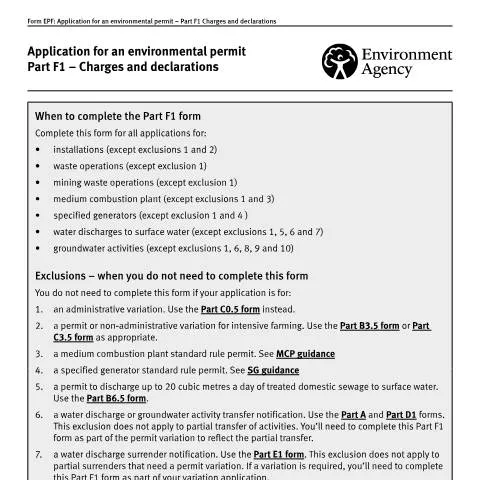
The EPF1 Form: Your Gateway to Environmental Permit Processing
Environmental compliance in the UK hinges on a complex web of permits, each requiring meticulous documentation and precise fee calculation. The EPF1 form – officially titled "Application for an environmental permit: part F1 – charges and declarations" – sits at the heart of this system, serving as the mandatory financial and legal companion to virtually every environmental permit application processed by the Environment Agency.
Unlike the technical sections of environmental permit applications that focus on operational details, the EPF1 form addresses the administrative backbone: calculating charges, declaring commercial confidentiality, and providing legally binding statements that determine how your application proceeds through the regulatory system. This form affects everyone from multinational industrial operators to small waste management companies, yet its intricacies often catch applicants unprepared.
Decoding the EPF1's Role Within Environmental Permitting
The EPF1 form functions as part of a modular application system where different document components address specific regulatory requirements. While Part B forms handle technical specifications and Part C forms manage variations, the EPF1 tackles the financial and declaratory aspects that the Environment Agency requires before processing can begin.
Integration with other permit components means the EPF1 cannot stand alone. Depending on your facility type, you'll simultaneously submit forms such as Part B1 for standard facilities permits or bespoke application forms for complex installations. The EPF1 essentially tells the Environment Agency "here's what you need to charge us, and here are our legal commitments" while the technical forms explain "here's what we want to do environmentally."
The form's version control – currently at Version 20 as of April 2026 – reflects ongoing refinements to charging structures and regulatory requirements. Each version update typically introduces changes to charge categories, exclusions, or declaration requirements, making it essential to verify you're using the current iteration before beginning completion.
Facility Types and Application Scope
The EPF1 covers six primary facility categories, each with distinct charging implications:
- Installations: Industrial facilities subject to integrated pollution prevention and control
- Waste operations: Activities involving waste treatment, disposal, or recovery
- Mining waste operations: Extractive industry waste management facilities
- Medium combustion plant: Combustion installations between 1-50MW thermal input
- Specified generators: Particular types of electricity generation plant
- Water discharge activities: Surface water and groundwater discharge operations
Each facility type carries different charging structures, with installations typically incurring the highest fees due to their regulatory complexity, while some water discharge activities qualify for reduced charges or simplified procedures.
Understanding the Ten Exclusions: When EPF1 Becomes Unnecessary
The Environment Agency has identified ten specific scenarios where completing the EPF1 form becomes redundant or inappropriate. Understanding these exclusions prevents unnecessary work and ensures you're following the correct procedural pathway.
| Exclusion Category | Alternative Form Required | Key Characteristics |
|---|---|---|
| Administrative variations | Part C0.5 | Simple changes not affecting environmental risk |
| Intensive farming permits | Part B3.5 or C3.5 | Poultry and pig farming installations |
| Standard rule MCP/SG permits | Specific guidance documents | Pre-defined operational parameters |
| Small domestic sewage discharges | Part B6.5/B6.6 | Up to 20 cubic metres daily (surface) or 15 cubic metres (ground) |
Partial transfers and surrenders create particular complexity within the exclusion framework. While straightforward transfers and surrenders use simplified notification procedures, partial operations requiring permit variations bring you back into EPF1 territory. This distinction frequently causes confusion, as operators assume all transfer or surrender activities follow the same simplified route.
The source protection zone 1 exclusion for existing groundwater discharges represents a geographically specific exemption. If your facility sits within a designated source protection area and discharges up to 2 cubic metres daily of treated domestic sewage, you'll use Part B6.6 instead of the standard EPF1 process.
Standalone vs. Integrated Facilities
Exclusion 10 introduces an important distinction for groundwater activities at onshore oil and gas facilities. While most groundwater surrender notifications bypass the EPF1 requirement, standalone groundwater activities at these energy facilities must complete the full EPF1 process, reflecting the heightened regulatory scrutiny applied to hydrocarbon extraction operations.
Navigating the Charging Calculation Matrix
Section 1 of the EPF1 form requires you to identify your facility type and application type combination, which determines your specific charges through the Environment Agency's complex fee structure. This seemingly straightforward task contains multiple decision points that significantly impact your final costs.
The facility type selection from the six available categories must align precisely with your operational activities. A waste operation that includes some installation-type activities might qualify for either category, but the choice affects both immediate charges and future regulatory obligations. The Environment Agency expects applicants to select the category that best represents their primary environmental risk profile.
Application type classification spans three main categories – new permits, variations, and transfers/surrenders – each subdivided into specific types with distinct charging implications:
New Permit Categories
- Bespoke permits: Custom-designed authorizations requiring detailed technical assessment
- Standard rules permits: Pre-defined templates for common, low-risk activities
Variation Classifications
- Minor variations: Small changes with minimal environmental impact
- Normal variations: Moderate changes requiring standard assessment procedures
- Substantial variations: Major modifications approaching new permit complexity
The boundary between variation types isn't always clear-cut. A change that seems minor to an operator might trigger substantial variation procedures if it affects pollution control systems or increases environmental risk. The Environment Agency's variation guidance provides detailed criteria, but borderline cases often benefit from pre-application discussions.
Special Charging Scenarios and Premium Services
Section 1.2 of the EPF1 form identifies five special circumstances that modify standard charging arrangements. These scenarios reflect specific regulatory policies or operational complexities that warrant different fee structures.
Part B installation surrenders receive simplified treatment unless they require permit variations, reflecting the reduced regulatory burden when facilities permanently cease operations. However, partial surrenders that necessitate permit modifications to address remaining activities return to standard charging protocols.
Waste mobile plant surrenders acknowledge the unique nature of mobile waste treatment operations, where equipment moves between sites but requires consistent regulatory oversight. The surrender process for these operations involves different administrative requirements compared to fixed installations.
Maritime and Mobile Operations
Authorised ship recycling facilities operate under specialized international regulations governing end-of-life vessel processing. Both initial applications and renewals carry specific charges that reflect the complex environmental and safety considerations involved in maritime waste management.
Bespoke groundwater mobile plant represents operations where groundwater treatment or monitoring equipment moves between locations while maintaining consistent regulatory standards. All application types for these operations – from initial permits to variations and transfers – require EPF1 completion, recognizing the heightened oversight needed for mobile groundwater activities.
The staged application option allows complex projects to submit permit applications in phases, spreading both regulatory assessment and charging across multiple submissions. This approach particularly benefits large industrial developments where construction and commissioning occur over extended periods.
Commercial Confidentiality and Information Protection
Sections 5 and 6 of the EPF1 form address information protection concerns that frequently arise in environmental permit applications. The Environment Agency operates under public access to environmental information regulations, but recognizes legitimate commercial and security interests that may warrant confidential treatment.
Commercial and industrial confidentiality claims must meet specific legal criteria established under the Environmental Information Regulations 2004. The Environment Agency cannot automatically accept confidentiality requests; each claim requires justification demonstrating how disclosure would harm legitimate commercial interests. Common successful claims include:
- Proprietary process technologies and operational parameters
- Commercial relationships and contractual arrangements
- Financial information beyond that required for charging calculations
- Technical specifications that could compromise competitive advantage
The confidentiality assessment balances commercial interests against public environmental information rights. Information directly related to environmental impacts typically cannot qualify for confidential treatment, while supporting commercial details may receive protection.
National Security Considerations
National security provisions apply to facilities with defence or critical infrastructure connections. These declarations require careful consideration, as they trigger additional regulatory pathways and may involve consultation with security agencies. The Environment Agency maintains specialized procedures for handling applications with national security implications, including secure information handling and restricted consultation processes.
Ecological Survey Requirements and Environmental Assessment
Section 7 of the EPF1 form addresses ecological survey information, reflecting the Environment Agency's duty to consider biodiversity impacts in permit decisions. This section often creates confusion because it requires forward-thinking about environmental assessment requirements rather than simply declaring current conditions.
The ecological survey requirement depends on your facility's location, operational characteristics, and potential environmental impacts. Sites near designated conservation areas, watercourses, or sensitive habitats typically require comprehensive ecological assessment, while low-risk operations in industrial areas may need minimal survey work.
Timing considerations for ecological surveys can significantly affect application scheduling. Many species surveys must occur during specific seasons, and some habitats require monitoring across multiple seasons to establish baseline conditions. Early identification of survey requirements prevents delays once you submit your application.
Habitat Assessment Scope
Survey requirements typically encompass several assessment categories:
- Phase 1 habitat surveys: Basic habitat identification and mapping
- Protected species surveys: Focused assessments for bats, birds, reptiles, or other protected fauna
- Aquatic ecology assessment: Water quality and aquatic life evaluation for discharge operations
- Invasive species mapping: Documentation of non-native species presence and management
The Environment Agency expects survey work to follow established methodologies and be conducted by appropriately qualified ecologists. Survey timing, methodology, and reporting standards must align with current best practice guidance, and surveys older than two years may require updating before application submission.
Declaration Responsibilities and Legal Commitments
Section 8 establishes the legal foundation of your permit application through formal declarations that carry significant regulatory and legal weight. These declarations go beyond simple form completion, creating binding commitments that influence both application assessment and ongoing compliance obligations.
The primary declaration confirms the accuracy and completeness of all submitted information, establishing legal responsibility for application content. This declaration creates liability for false or misleading information, with potential consequences including permit refusal, prosecution, or permit revocation if inaccuracies are discovered later.
Technical competence declarations confirm that appropriately qualified personnel will manage the permitted activities. The Environment Agency maintains detailed technical competence criteria for different facility types, and operators must demonstrate that their management arrangements meet these standards throughout the permit's lifetime.
Financial Provision Commitments
Certain facility types require financial provision declarations confirming adequate financial resources for ongoing compliance and eventual closure costs. These commitments extend beyond immediate operational expenses to include long-term monitoring, remediation, and decommissioning costs that may arise decades after operations commence.
The financial provision assessment considers facility-specific risks, potential environmental liabilities, and closure cost estimates. Waste operations and mining facilities typically face the most stringent financial provision requirements, reflecting the long-term environmental risks associated with these activities.
Appendix 1 provides space for additional people to make formal declarations when applications involve multiple responsible parties. This provision addresses complex corporate structures, partnerships, or joint ventures where several individuals share legal responsibility for the permitted activities.
Application Processing and Environment Agency Review Procedures
Section 9 of the EPF1 form initiates the formal review process, triggering statutory timeframes and procedural requirements that govern how the Environment Agency processes your application. Understanding these procedures helps manage expectations and identify when additional action may be needed to progress your application.
The duly made assessment represents the first critical checkpoint in application processing. The Environment Agency has 20 working days to confirm whether your application contains sufficient information to begin substantive assessment. Applications failing the duly made test return to applicants with specific requests for additional information.
Common duly made failures include incomplete charging information, missing technical assessments, or inadequate supporting documentation. The EPF1 form's completion directly affects duly made success, as charging calculations and declarations must align with submitted technical information.
Statutory Consultation Requirements
Public consultation periods vary depending on application type and facility characteristics. Standard applications trigger 20 working day consultation periods, while complex or controversial applications may extend to longer timeframes. The Environment Agency cannot issue permits until consultation requirements are satisfied, regardless of technical assessment completion.
Consultation responses may identify issues requiring additional information or assessment, potentially extending determination timeframes beyond standard periods. Early engagement with potentially affected parties can help identify concerns before formal consultation, reducing the likelihood of significant objections.
Statutory consultee engagement involves organizations such as Natural England, Historic England, or local planning authorities, depending on your facility's characteristics and location. These consultations run parallel to public consultation but may continue beyond standard timeframes if complex issues arise.
Payment Mechanisms and Charge Administration
Section 3 of the EPF1 form establishes payment arrangements that must align with the Environment Agency's financial procedures and statutory charging requirements. Payment timing and methods directly affect application processing, as the Environment Agency cannot begin substantive assessment until charges are received and cleared.
The charging scheme calculation depends on multiple variables identified throughout the EPF1 form, including facility type, application type, operational scale, and special circumstances. The Environment Agency updates its charging scheme annually, typically in April, meaning charge calculations must reflect the scheme in force when applications are submitted.
Payment methods include bank transfer, cheque, or online payment systems, each with different processing timeframes and administrative requirements. Electronic payments typically clear faster than cheque payments, potentially reducing overall application processing time by several days.
Large applications may qualify for staged payment arrangements where charges are split across multiple instalments aligned with assessment milestones. These arrangements require prior agreement with the Environment Agency and typically apply to complex bespoke permits with charges exceeding specified thresholds.
Charge Variations and Adjustments
Applications requiring additional work beyond standard assessment procedures may incur additional charges calculated on an hourly basis. Common triggers include complex technical assessments, extensive consultation requirements, or novel regulatory approaches requiring specialist input.
The Environment Agency provides advance notice of potential additional charges, allowing applicants to consider whether to proceed with current approaches or modify applications to reduce assessment complexity. This transparency helps manage both costs and expectations throughout the application process.