The Maritime Labour Convention Framework: Understanding Crew Documentation Requirements
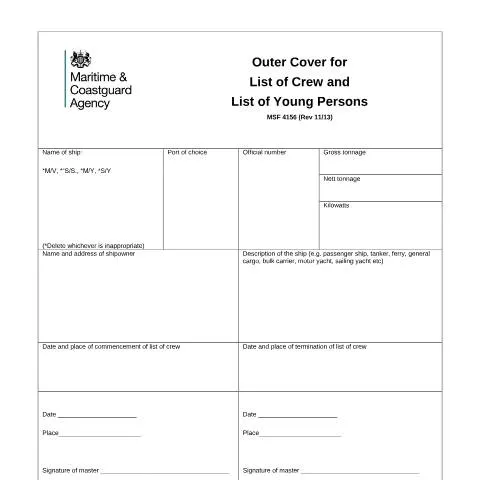
When a commercial vessel prepares for departure from a UK port, or when British-flagged ships operate internationally, the master must ensure comprehensive crew documentation meets both domestic and international standards. The MSF 4156 outer cover for list of crew and list of young persons serves as the standardised wrapper document that consolidates essential crew information under the Maritime Labour Convention 2006 framework, administered by the Maritime and Coastguard Agency.
This outer cover document operates as more than a simple administrative wrapper—it establishes the legal framework for crew member protection and vessel compliance with international labour standards. Under the MLC 2006, ratified by the UK in 2013, every commercial vessel above 500 gross tonnage engaged in international voyages must maintain detailed crew records that demonstrate compliance with working time regulations, accommodation standards, and employment conditions.
Vessel Categories and Documentation Thresholds
The requirement to complete this outer cover varies significantly depending on vessel classification and operational scope. Commercial vessels above 500 gross tonnage engaged in international trade must comply without exception, whilst smaller commercial craft operating solely in UK waters may face different documentation requirements administered through the MCA's domestic commercial vessel division.
| Vessel Type | Gross Tonnage Threshold | Documentation Requirement | Submission Timeline |
|---|---|---|---|
| International cargo vessels | 500+ GT | Full MLC compliance including MSF 4156 | Before departure from UK port |
| Passenger ships (international) | 500+ GT | Enhanced documentation with passenger manifest | 24 hours before sailing |
| Domestic commercial vessels | Under 500 GT | Simplified crew records (MCA guidance) | As per operating licence conditions |
| Private yachts (commercial use) | 24m+ length overall | MLC compliance if carrying paying guests | Voyage-specific requirements |
Motor yachts and sailing yachts present particular complexities. A privately-owned yacht operating purely for personal use faces no MLC documentation requirements, regardless of size. However, the same vessel becomes subject to commercial vessel regulations the moment it carries paying guests or operates under charter arrangements. The MSF 4156 outer cover must then accompany crew lists whenever the yacht operates commercially in international waters.
Special Considerations for Superyachts
Superyachts above 24 metres operating under the Large Yacht Code (LY3) must navigate between recreational and commercial regulatory frameworks. When such vessels employ professional crew on a permanent basis, they typically require MLC compliance documentation even during private use, as the employment relationship itself constitutes commercial maritime activity under UK interpretation of international conventions.
Completing the Essential Vessel Information Fields
The outer cover demands precise vessel identification details that must correspond exactly to official registry documents. The name of ship field requires careful attention to prefixes—M/V (motor vessel), S/S (steamship), M/Y (motor yacht), or S/Y (sailing yacht)—with inappropriate designations struck through rather than simply omitted.
The port of choice represents the vessel's registered home port, not necessarily the departure port for the current voyage. This distinction proves crucial for vessels registered in UK overseas territories, where the port of choice might be Georgetown (Cayman Islands) or Road Town (British Virgin Islands), whilst the vessel operates primarily from UK waters.
Official number verification requires cross-reference with the vessel's Certificate of Registry. For UK-flagged vessels, this appears as a numerical sequence assigned by the Registry of Shipping and Seamen, whilst foreign-flagged vessels operating in UK waters must provide their flag state official number. Gross tonnage and net tonnage figures must match exactly those recorded on the International Tonnage Certificate, as discrepancies can trigger port state control inspections.
Engine Power and Propulsion Details
The kilowatts field records total installed propulsion power, converted from horsepower where necessary using the standard maritime conversion factor (1 HP = 0.7457 kW). For vessels with multiple engines, the figure represents combined maximum continuous rating. Sailing vessels with auxiliary engines must include auxiliary power ratings, whilst pure sailing vessels without engines may enter "0" or "N/A" with appropriate notation.
Shipowner Information and Legal Responsibilities
The shipowner details section requires the legal entity holding ultimate responsibility for vessel operation, which may differ from the registered owner, managing agent, or operator. For vessels owned through complex corporate structures—common in international shipping—the entry should reflect the entity bearing legal liability under the MLC 2006 rather than beneficial ownership arrangements.
Bareboat charter arrangements create particular complexity. When a vessel operates under bareboat charter, the charterer assumes shipowner responsibilities for MLC purposes, and their details should appear in this section rather than the registered owner's information. However, this requires careful documentation to demonstrate the legal transfer of operational responsibility.
The address field must provide a genuine business address where the Maritime and Coastguard Agency can serve legal notices. Post office boxes or accommodation addresses are generally unacceptable for commercial vessel operations, though they may be permitted for smaller recreational craft operating under commercial endorsement.
Voyage Documentation and Master's Attestations
The commencement and termination sections establish the legal framework for crew employment periods aboard the vessel. Date and place of commencement typically corresponds to the beginning of the current crew list validity period, which may predate the specific voyage covered by this documentation.
For vessels operating regular trading patterns, crew lists often commence at the beginning of a calendar month or specific voyage rotation, remaining valid for periods up to twelve months under MLC provisions. The commencement location should specify the port where crew members first joined the vessel under the current crew list arrangement, not necessarily where individual crew members embarked for the immediate voyage.
Master's Signature Requirements and Legal Implications
The master's signature carries significant legal weight under both UK domestic law and international maritime conventions. By signing the outer cover, the master certifies that accompanying crew lists accurately reflect all persons aboard the vessel and that employment conditions comply with MLC 2006 standards.
The signature must be witnessed or completed in the presence of MCA officials or British consular staff when submitted at foreign ports. Masters should ensure they hold valid signing authority under the vessel's management structure, as unauthorised signatures can invalidate the entire crew documentation package and potentially result in detention orders.
The master bears personal liability for the accuracy of crew documentation under Section 25 of the Merchant Shipping Act 1995, with penalties including unlimited fines and potential imprisonment for serious breaches involving crew welfare or safety.
Young Persons Employment and Protection Measures
The specific inclusion of young persons in the document title reflects strict international requirements for protecting seafarers under 18 years of age. Under MLC 2006 Standard A1.1, young persons may only be employed aboard vessels when their health, safety, and moral welfare are protected through enhanced documentation and monitoring procedures.
Young seafarers require additional documentation including medical fitness certificates specifically addressing their developmental needs, educational records demonstrating completion of basic maritime training, and detailed employment contracts specifying restricted duties and working hours. The outer cover must accompany separate young persons lists that detail these enhanced protections.
Night work restrictions apply universally to seafarers under 18, with exceptions only permitted for training purposes under qualified supervision. The crew documentation must demonstrate compliance with these restrictions through detailed duty rosters and supervision arrangements.
Training and Certification Requirements
Young persons must hold appropriate STCW (Standards of Training, Certification and Watchkeeping) certificates before joining commercial vessels. For UK nationals, this typically requires completion of approved pre-sea courses through maritime education institutions recognised by the MCA. The crew list accompanying this outer cover must reference these certification details for verification purposes.
Submission Procedures and Official Processing
The completed outer cover and accompanying crew lists must be submitted to either MCA offices at UK ports or British consular posts at foreign locations. Submission timing varies by vessel type and operational pattern, with cargo vessels typically required to lodge documentation before departure, whilst passenger ships face more stringent advance notice requirements.
At major UK ports including Southampton, Felixstowe, and Liverpool, dedicated MCA marine offices process crew documentation during normal business hours. Smaller ports may require arrangements through regional MCA offices or designated port agents authorised to receive documentation on behalf of the Agency.
The official use section records receipt by MCA or consular officials, creating the legal record of submission. This endorsement proves crucial for demonstrating compliance during port state control inspections or crew repatriation situations where official documentation of crew status becomes essential.
Electronic Submission and Digital Processing
Whilst the MSF 4156 form maintains a paper-based format, the MCA increasingly accepts electronic submission of supporting crew lists through the Maritime Single Window system. However, the outer cover itself typically requires physical submission with original master's signatures, reflecting its legal significance as a master's declaration document.
Vessels operating regular UK port rotations may establish standing arrangements for crew documentation submission, reducing administrative burden whilst maintaining full compliance with international requirements. These arrangements require prior agreement with relevant MCA marine offices and typically involve designated shipping agents or port operators.
Integration with Broader Maritime Compliance Systems
The crew list outer cover forms part of a comprehensive maritime labour compliance framework that intersects with numerous other regulatory requirements. Vessels must simultaneously satisfy SOLAS (Safety of Life at Sea) manning requirements, MARPOL environmental standards, and flag state labour regulations, creating complex documentation obligations that extend far beyond this single form.
Port state control inspections increasingly focus on crew welfare and employment conditions, using crew lists as primary evidence for compliance verification. Inspectors may cross-reference the MSF 4156 documentation against crew interviews, accommodation inspections, and working time records to identify potential violations of international labour standards.
Brexit implications have added complexity to crew documentation for vessels trading between UK and EU ports. Whilst MLC 2006 requirements remain unchanged, immigration and work permit documentation for crew members now requires careful coordination with crew list submissions to ensure compliance with post-Brexit employment regulations.
The outer cover documentation also supports crew repatriation arrangements under MLC 2006 Standard A2.5, providing official evidence of crew employment status essential for consular assistance and transportation arrangements. Masters should ensure crew list accuracy extends beyond immediate operational needs to encompass potential emergency situations requiring official intervention.
Understanding these interconnected requirements helps maritime operators appreciate why the apparently simple MSF 4156 outer cover carries such significance within the broader framework of international maritime labour protection and vessel compliance obligations.
Specific Requirements for Young Persons Documentation Under MLC 2006
The Maritime Labour Convention 2006 places particular emphasis on protecting young seafarers, defined as those under 18 years of age. The list of young persons forms a critical component of vessel documentation, requiring meticulous attention to detail and adherence to specific formatting protocols that differ from standard crew listings.
When preparing the outer cover for young persons documentation, vessel operators must ensure that the age verification details are prominently displayed. This includes not only the birth date but also documentary evidence reference numbers, such as passport details or birth certificate registration numbers. The Maritime and Coastguard Agency emphasises that these reference numbers must be clearly legible on the outer cover to facilitate rapid verification during port state inspections.
The recommended format stipulates that young persons' entries should include additional fields not required for adult crew members. These encompass parental or guardian consent documentation reference numbers, medical fitness certificate details specific to young seafarers, and educational programme participation where applicable. The outer cover must indicate whether any young person aboard is participating in structured training programmes, as this affects their permitted working hours and duties under Convention standards.
Port authorities frequently scrutinise vessels carrying young seafarers more thoroughly, making the clarity of outer cover information paramount. The format should include a separate section highlighting any restrictions on young persons' duties, such as night work limitations or hazardous task prohibitions. This information helps inspection officers quickly assess compliance without requiring detailed examination of internal documentation.
Special attention must be paid to vessels operating in multiple jurisdictions, as some flag states impose additional requirements beyond the basic MLC 2006 standards. The outer cover format should accommodate space for supplementary endorsements or stamps that certain authorities may require. Operators should be aware that some port states maintain their own databases of young seafarer documentation, requiring specific formatting to ensure electronic compatibility.
Digital Integration and Electronic Submission Protocols
Modern maritime administration increasingly relies on digital systems for crew documentation processing. The Maritime and Coastguard Agency has developed specific guidelines for electronic submission of crew and young persons lists, requiring adherence to standardised data formats that complement the physical outer cover requirements.
Electronic versions of crew lists must maintain the same hierarchical information structure as their paper counterparts, with metadata fields corresponding to outer cover sections. The digital format typically employs XML or JSON schemas that mirror the physical document layout, ensuring consistency across different submission methods. Vessel operators using electronic systems must ensure their software generates outer cover previews that match MLC 2006 formatting requirements exactly.
The integration between physical and digital documentation presents unique challenges for outer cover design. QR codes or similar machine-readable elements are increasingly incorporated into outer cover layouts, linking physical documents to electronic databases. These codes must be positioned to avoid interference with mandatory text fields while remaining easily scannable by port authority equipment.
Data protection considerations under the UK GDPR significantly impact how crew information appears on outer covers, particularly for electronic systems. Personal data minimisation principles require that outer covers display only essential identification information, with detailed personal data accessible through secure digital channels. This creates a need for carefully balanced outer cover designs that provide sufficient information for identification while protecting seafarer privacy.
Backup procedures for electronic systems necessitate specific outer cover formatting provisions. When digital systems fail, port authorities must rely entirely on physical documentation, making the completeness and clarity of outer cover information critical. The recommended format includes contingency fields for manual processing, such as additional signature blocks and timestamp areas for manual validation procedures.
Synchronisation between ship and shore-based systems requires outer cover formats that accommodate version control information. This includes revision numbers, last update timestamps, and system compatibility indicators. Such information helps port authorities determine whether they are examining the most current version of crew documentation, particularly important for vessels with frequent crew changes.
Compliance Monitoring and Audit Trail Requirements
The outer cover format for crew and young persons lists serves as more than mere identification; it functions as a compliance monitoring tool that enables systematic tracking of regulatory adherence throughout a vessel's operational cycle. Maritime authorities use outer cover information to establish audit trails that demonstrate ongoing compliance with MLC 2006 requirements.
Effective audit trail documentation requires outer covers to include sequential numbering systems that link individual crew list versions to specific operational periods. This numbering should incorporate vessel identification codes, reporting period indicators, and version control markers that enable authorities to reconstruct crew complement changes over time. The format must accommodate space for cross-reference numbers that link crew lists to other mandatory documentation, such as safe manning certificates and training record summaries.
Port state control officers rely heavily on outer cover information to assess the likelihood of deeper inspection requirements. The format should include risk assessment indicators, such as flags highlighting recent crew changes, first-time young seafarer embarkations, or crew members from countries requiring additional documentation verification. These indicators help authorities prioritise inspection resources while ensuring comprehensive coverage of high-risk situations.
The outer cover must facilitate rapid identification of crew members subject to specific regulatory monitoring, such as those holding endorsements under the Standards of Training, Certification and Watchkeeping (STCW) Convention or individuals with restricted medical fitness certificates. Clear marking systems on outer covers enable inspection officers to quickly identify crew members requiring detailed document examination without disrupting normal vessel operations.
Compliance history tracking represents an increasingly important aspect of outer cover design. The format should accommodate endorsement areas where port authorities can record inspection outcomes, compliance confirmations, or requirement notifications. This creates a permanent record of regulatory interactions that travels with the vessel, providing valuable context for subsequent inspections and helping establish patterns of compliance or concern.
Multi-jurisdictional operations require outer cover formats that accommodate various national compliance marking systems. Different port states may use distinct endorsement procedures, requiring flexible outer cover designs that provide adequate space for multiple authority markings without compromising document clarity. The recommended format includes standardised endorsement areas that can accommodate various national requirements while maintaining overall document coherence.
Record retention requirements under MLC 2006 necessitate outer cover designs that facilitate long-term archival storage. This includes using materials and printing methods that ensure document longevity, as well as formatting that remains legible when photocopied or scanned for digital archiving. The outer cover should include metadata fields that assist in document cataloguing and retrieval systems, supporting the comprehensive record-keeping requirements that underpin effective maritime labour regulation.