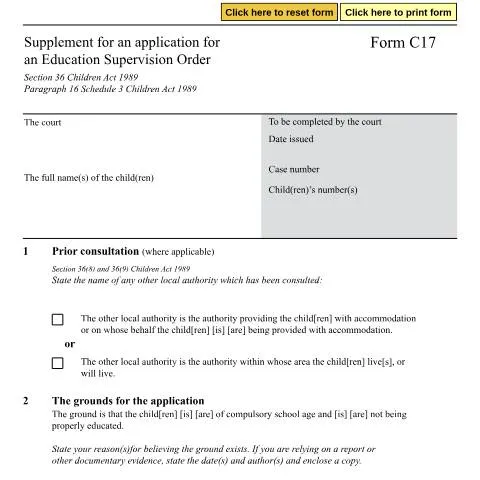
Navigating the Education Supervision Order Process with Form C17
In the landscape of child welfare and educational oversight within the UK, the Form C17 plays a pivotal role. When a child's education is deemed insufficient, local authorities may seek an Education Supervision Order (ESO) through the courts. Understanding the nuances of this application process is essential for parents, guardians, and local authorities alike. The C17 form serves as a supplementary document that provides specific details to support the primary application for an ESO.
From Concern to Action: Triggers for Filing Form C17
Before filling out Form C17, one must identify the circumstances that trigger its necessity. A common scenario arises when a child of compulsory school age is identified as not receiving a proper education. This may stem from various issues such as persistent absence from school, failure to engage with educational services, or educational neglect.
In such cases, the local authority may consult with other relevant bodies to assess the child's situation comprehensively. Once concerns are substantiated, Form C17 becomes a crucial step in formalizing the request for an Education Supervision Order.
Key Stakeholders in the Application Process
- Local Authorities: They are responsible for the welfare of children within their jurisdiction and can initiate the ESO process.
- The Court: The HM Courts & Tribunals Service evaluates the application, aided by Form C17.
- Parents/Guardians: They may be the subjects of the application or may need to be informed and involved in proceedings.
A Deep Dive into Form C17: Section-by-Section Breakdown
Form C17 is structured to ensure that all relevant information is captured accurately. Each section plays a distinct role in supporting the application for an ESO.
Understanding the Prior Consultation Section
The first section of Form C17 addresses prior consultations that have occurred regarding the child in question. This section is essential for contextualizing the application and demonstrating that the local authority has undertaken reasonable steps to resolve the educational issues.
Here, the applicant must state the full names of the child or children involved and mention any local authorities consulted. These are typically the local authority providing the child's accommodation or the authority where the child resides.
Common Pitfalls: Failing to accurately document prior consultations or omitting relevant local authorities can lead to delays or complications in the application process.
Grounds for the Application: Articulating Concerns
The second section requires the applicant to clearly articulate the grounds for the application, specifically that the child is not being properly educated. This necessitates a detailed explanation of the reasons behind this belief.
If the application is based on supporting reports or documentation, the applicant must reference these documents within the form. It’s crucial to include specific dates and authors of the reports and to attach copies with the application.
Tip: Be thorough and precise in this section. The more robust the evidence presented, the stronger the application will be.
Specification of the Order: What is Being Requested?
In the third section, the applicant must outline the specific order and directions sought from the court. This includes providing the case number and any relevant details regarding the children involved.
Things to Remember: Ensure that all information is current and accurately reflects the situation of the child or children. Any discrepancies could hinder the application’s progress.
Common Misunderstandings: C17 vs. Similar Forms
It is not uncommon for applicants to confuse Form C17 with other forms related to child welfare and education. Understanding these differences is crucial.
| Form | Purpose | Key Differences |
|---|---|---|
| Form C17 | Supplement for an Education Supervision Order | Specifically designed to support ESO applications with evidence of educational neglect. |
| Form C100 | Application for a Children Act Order | Focuses on custody and care arrangements, not specifically educational issues. |
| Form C2 | Application to vary or discharge an order | Used to modify existing court orders, not to initiate a new ESO. |
Handling Rejections and Complications with the C17 Submission
Even with due diligence, an application using Form C17 may be met with challenges or rejections. Navigating the aftermath of a denied application requires awareness of the next steps.
If the court rejects the application, the applicant will receive a notification detailing the reasons for the rejection. Common reasons may include insufficient evidence or lack of prioritization of the child’s educational needs.
Next Steps: Upon receiving a rejection, the applicant has the option to address the concerns raised in the rejection notice and resubmit the application. It’s advisable to consult legal advice if circumstances seem complex.
The Timeline: When to Expect What?
The timeframe for the entire application process can vary significantly based on several factors, such as the court's workload and the complexity of the case.
- Initial Filing: Once Form C17 is submitted, the court will typically schedule a hearing date within a few weeks, depending on the urgency of the situation.
- Decision-Making: After the hearing, a decision is generally made within one to two weeks, although it may take longer if further evidence is required.
Following the court's decision, it’s essential for the parties involved to understand their rights and obligations. If an ESO is granted, local authorities will often work closely with families to ensure compliance with the order.
Consequences of Non-Compliance: What Lies Ahead
Failing to adhere to the stipulations of an Education Supervision Order can lead to significant consequences, both for the child and the parents or guardians.
- Potential Legal Action: Persistent non-compliance may result in further legal action against the guardians, including penalties or restrictions on parental rights.
- Impact on the Child: Non-compliance can adversely affect the child’s educational development and well-being, making it crucial for guardians to engage proactively with the local authority.
Final Considerations for Applicants
Understanding the intricacies of the Form C17 process is essential for those navigating the sometimes overwhelming world of child welfare and education support. From identifying the need for an Education Supervision Order to effectively completing the C17 form, every detail counts. Engaging with legal professionals or local authorities for guidance can prove invaluable throughout this process.
The path to securing a positive outcome for a child’s educational needs depends largely on the thoroughness of the documentation provided and the clarity of the applicant's intentions. Being proactive and well-informed will not only facilitate the application process but also contribute significantly to the child's educational success.
Understanding the Education Supervision Order (ESO)
The Education Supervision Order (ESO) is a court order designed to ensure that a child receives the education they require. This legislation primarily applies to children who have been identified as needing assistance due to irregular school attendance or other educational challenges. The premise behind an ESO is that the local authority, through a designated supervisor, will be appointed to oversee the educational needs and welfare of the child. The court typically considers this order when parents or guardians are unable to provide adequate educational support or when a child is at risk of falling behind academically.
It is essential to note that an ESO does not remove parental responsibility; rather, it adds a layer of support to ensure that the child's educational needs are prioritized. The local authority is charged with supervising the child's education while still allowing parents to maintain their role. The court may issue an ESO for a duration deemed suitable, and reviews may occur to assess the effectiveness of the order. Additionally, the order requires collaboration between the local authority and the child's educational institution, ensuring a holistic approach to the child's learning and development.
Completing Form C17: Key Sections Explained
Form C17 is the official document used to apply for an Education Supervision Order. Completing this form accurately is critical, as it serves as the foundation for the court's decision-making process. The form comprises several sections, each requiring specific information pertinent to the applicant, the child, and the circumstances surrounding the application.
1. Personal Information of the Applicant: In this section, you must provide your full name, address, contact information, and relationship to the child in question. It’s essential to ensure the information is up-to-date and accurate, as this could affect correspondence from the court and local authority.
2. Details about the Child: Here, you will need to enter the child's full name, date of birth, and any known special educational needs (SEN) that the child may have. Including any relevant educational history, such as previous schools attended and reasons for lack of attendance, can strengthen your application.
3. Reasons for Applying: This section requires a thorough explanation of the educational issues faced by the child. Clearly outline the circumstances that have led you to seek an ESO, including any previous interventions attempted to resolve the issues. Providing evidence, such as reports from teachers or social workers, can support your claims and enhance the application’s credibility.
4. Proposed Supervision Arrangements: Applicants should suggest how the local authority could assist in supervising the child's education. This could include tailored support programs, regular meetings with educational consultants, or mentoring. Your suggestions demonstrate your commitment to the child's educational progress and readiness to collaborate with local authorities.
5. Consent and Signatures: The final part of Form C17 must include your signature and the date of submission. If applicable, ensure that any other parties involved in the child's education (such as co-guardians) are aware of the application and provide their consent.
After Submission: What to Expect
Once you have submitted Form C17, the next steps will involve several key processes that may vary depending on the local authority and court schedules. Upon receipt of your application, the local authority will initiate an assessment of the child's needs. This assessment is critical, as it will guide the local authority on what measures should be enacted to support the child's educational journey.
Your application will also be reviewed by a judge, who will determine whether the conditions warrant an Education Supervision Order. The court typically schedules a hearing to discuss the application, allowing all parties, including the local authority and any other involved individuals, to present their views. It is advisable to prepare for this hearing by gathering relevant documentation, such as the child's educational records and any reports from educational professionals.
If the court approves the application, an ESO will be issued, detailing the terms of supervision and the responsibilities of the local authority. Additionally, regular reviews will be scheduled to assess the child's progress and the effectiveness of the support provided. During these reviews, you, as the applicant, may be required to present updates on the child's educational status and any changes in circumstances. It’s important to remain engaged in this process to ensure that the child benefits fully from the support that an ESO can provide.