Applying for a Death Certificate in Northern Ireland: A Guide to the GRO41 Form
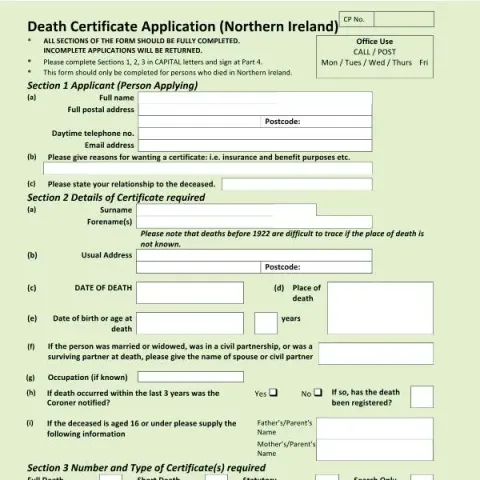
When a loved one passes away in Northern Ireland, obtaining an official death certificate is often a necessary step for legal, personal, or administrative reasons. The official form used for this purpose is the GRO41, known as the Death Certificate Application (Northern Ireland). This document, issued by the Registrar General, is a vital record that provides essential details about the deceased and is required for various processes such as settling estates, claiming benefits, or updating personal records.
Understanding the Purpose and Usage of the GRO41 Form
The GRO41 form is specifically designed for individuals who need to request a death certificate for a person who died within Northern Ireland. It is a formal application that must be fully completed and submitted either by mail or in person. The form serves multiple purposes:
- Legal paperwork, including estate settlement and inheritance claims.
- Insurance and benefit claims that require official proof of death.
- Family history research or genealogical investigations.
It is important to note that incomplete applications will be returned, so accuracy and thoroughness are crucial when filling out this form.
Key Sections of the GRO41 Form and Their Significance
Section 1: Applicant Details
This section requires the person applying for the certificate to provide their full name, address, and contact information, including a daytime telephone number and email address if available. Additionally, the applicant must specify the reason for requesting the certificate, such as insurance claims or family history research, and describe their relationship to the deceased. For example, an executor, next of kin, or legal representative may be the applicant.
Section 2: Details of the Deceased
This segment gathers vital information about the deceased individual:
- Surname and Forenames: Full name of the deceased. Note that deaths prior to 1922 may be difficult to trace due to limited records.
- Usual Address: The last known residence of the deceased. If unknown, this should be indicated.
- Date and Place of Death: Precise date and location where the death occurred.
- Date of Birth or Age at Death: To assist in identification, especially in cases of common names.
- Marital Status and Spouse/Civil Partner: Name of the surviving spouse or partner, if applicable.
- Occupation: If known, provides additional identification details.
- Coroner Notification: Indicate if the death was recent (within the last three years) and whether the Coroner was notified or the death registered.
- Details of Parent(s): For individuals aged 16 or under, parental information is required.
Section 3: Certificate Specification
The applicant must specify whether a full or short death certificate is required. Additional copies can be requested, but this may incur extra charges. The distinction is important: full certificates contain comprehensive details, while short certificates are more concise and usually used for legal or administrative purposes.
Submitting the Application and Important Considerations
The completed GRO41 form should be signed by the applicant in Part 4. Payment details, including cheque, postal order, or credit/debit card information, must be provided if applying by post. It is essential to enclose the correct fee, as refunds cannot be issued for incorrect payments.
Fill in your form directly online
No printing: type your details into the boxes of the official form, tick, then download the PDF ready to send.
- 1Type into the form boxes
- 2Tick in one click
- 3Save and download the PDF
Applications can be submitted by post to the Registrar General or handed in at designated offices. Ensure all sections are fully completed to prevent delays or rejection. Incomplete forms will be returned, so double-check all entries for accuracy.
Points of Attention and Practical Advice
- Accuracy is vital: Providing correct details about the deceased ensures the certificate is issued promptly.
- Record the reason for application: Clarify whether the certificate is for legal, personal, or genealogical purposes.
- Keep copies of your application: For reference and follow-up.
- Allow processing time: Be aware of the current turnaround times, especially during busy periods.
- Legal compliance: The form and process adhere to UK data protection laws, ensuring your personal information is handled securely.
Obtaining a death certificate via the GRO41 form is a straightforward but detailed process. By carefully completing each section and providing accurate information, applicants can ensure a smooth application process and receive the necessary documentation to proceed with legal or personal matters related to the deceased.