When Official Records Need to Reflect Your True Identity: The Protected Route
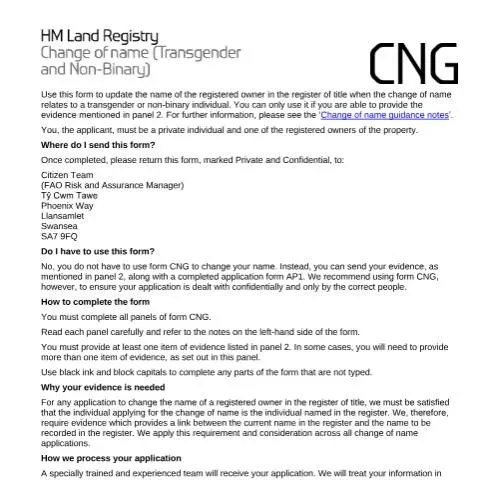
Property ownership records at HM Land Registry carry significant legal weight, forming the cornerstone of England and Wales' land registration system. Yet for transgender and non-binary property owners, these official documents can become sources of distress when they display names that no longer reflect their lived identity. The Change of name (Transgender and Non-Binary) form, known as CNG, represents HM Land Registry's recognition that updating property records requires both legal precision and human dignity.
Unlike standard name change procedures that expose personal information to public scrutiny, form CNG creates a confidential pathway specifically designed for transgender and non-binary individuals. This specialised approach acknowledges that traditional deed poll notifications—which can be sent to registered addresses using former names—may compromise privacy or create unwanted disclosure risks. The form establishes a protective framework where sensitive personal information remains shielded from public inspection whilst ensuring the integrity of the land register.
The CNG form serves registered property owners exclusively. You cannot use this form to change someone else's name on a title, nor can solicitors or family members submit it on your behalf. You must be both a private individual and one of the registered owners listed on the property's title. This restriction ensures direct control over personal information whilst preventing unauthorised changes to official records.
Documentary Evidence Framework: Building Your Case
HM Land Registry operates on evidential principles: they must establish a clear link between your current registered name and your chosen name. The CNG form structures this evidence into three distinct categories, each serving different circumstances and offering varying levels of privacy protection.
| List A Documents | List B Documents | List C Documents |
|---|---|---|
| Deed poll | New birth certificate | Medical practitioner's letter |
| Statement of truth | Gender recognition certificate | Supporting evidence for List B |
| Statutory declaration | Current passport | Additional verification |
| Current driving licence |
List A documents contain both your previous and current names, providing direct evidence of the name change. A deed poll represents the most straightforward option, though it typically requires notification procedures that the CNG form's confidential process helps circumvent.
List B documents show your current name but require additional supporting evidence. A gender recognition certificate offers the strongest foundation here, as it represents formal legal recognition of gender identity. New birth certificates issued following gender recognition carry similar weight. Current passports or driving licences in your chosen name, whilst valuable, need backing from List A or C documents.
List C documents primarily consist of medical practitioner letters. These carry particular significance as HM Land Registry will directly contact the named medical professional to verify the information provided. This verification process ensures authenticity whilst maintaining confidentiality within the medical-legal framework.
Strategic Evidence Selection
Your choice of evidence affects both processing time and privacy levels. Gender recognition certificates, new birth certificates, or updated passports/driving licences supported by List A or C evidence trigger the highest privacy protections—HM Land Registry will not send notification letters to your registered address in these circumstances.
Conversely, standalone deed polls or widely obtainable documents may still trigger notification procedures, potentially exposing your former name at your registered address. This risk assessment forms part of HM Land Registry's fraud prevention measures, balancing security requirements against privacy concerns.
The Confidential Processing Channel: How Your Application Travels
Form CNG applications bypass standard processing routes, entering a specialised workflow designed for sensitive personal information. Your completed form must be marked "Private and Confidential" and sent to a specific address in Swansea, directed to the Risk and Assurance Manager within the Citizen Team. This targeting ensures your application reaches trained personnel immediately, avoiding general administrative channels where confidentiality might be compromised.
The receiving team undergoes specific training in transgender and non-binary issues, understanding both the legal requirements and the personal significance of these applications. Your information remains restricted to essential personnel only, with access controls preventing unauthorised viewing even within HM Land Registry systems.
Behind the Scenes: Verification and Security
Processing involves multiple verification stages. When medical practitioner letters form part of your evidence, HM Land Registry contacts the named doctor directly to confirm the application details. This verification occurs discreetly, maintaining professional confidentiality whilst ensuring document authenticity.
For other evidence types, verification may involve cross-referencing with issuing authorities or checking document security features. The process balances thorough verification against expedited handling, recognising that delays can cause ongoing distress for applicants living with mismatched official documents.
Legal Safeguards and Long-term Implications
The CNG form and accompanying evidence receive the highest access classification within HM Land Registry's filing system. These documents become permanently exempt from public inspection rights, meaning members of the public cannot view or order copies of your application materials, even under statutory inspection rights that normally apply to land registry documents.
This protection extends beyond immediate privacy concerns. Under rule 133 of the Land Registration Rules 2003, CNG forms enjoy automatic exception status, creating lasting protection that doesn't depend on individual assessments or changing policies. The legal framework recognises that transgender and non-binary individuals face particular risks from unwanted disclosure of personal information.
Historical Record Limitations
While your current name will appear in new register entries, previous names cannot be removed from historical register editions. Property transactions completed before your name change will retain original documentation, and these historical records remain part of the permanent land registry archive.
Similarly, if you're named as a party to existing deeds or charges registered against the property, those entries cannot be retrospectively amended. The land registry maintains historical accuracy whilst protecting future entries under your chosen name. This balance reflects legal principles requiring permanent, unalterable records whilst acknowledging personal identity development.
Alternative Routes and Strategic Considerations
Form CNG represents the recommended approach, but not the only option. You could submit standard form AP1 with appropriate evidence, following general name change procedures. However, this route lacks the specific confidentiality protections built into the CNG process, potentially exposing your application to wider administrative handling and standard notification procedures.
The choice between CNG and AP1 often depends on your comfort level with potential disclosure risks. If you've already transitioned publicly and have strong documentary evidence, AP1 might suffice. However, for individuals seeking maximum privacy protection, CNG offers superior safeguards specifically designed for transgender and non-binary circumstances.
Timing and Property Transaction Coordination
Consider coordinating name changes with planned property transactions. If you're selling or remortgaging soon after changing your name, ensure your solicitor understands the situation. They may need to explain the name change to buyers or lenders, potentially requiring disclosure of the change even if your land registry records are updated.
Conversely, if you're purchasing additional properties after changing your name, the new purchases will automatically reflect your current name, avoiding the need for subsequent change applications on those titles.
Practical Completion Guidance and Common Complexities
Form CNG requires completion in black ink using block capitals for handwritten sections. Each panel demands careful attention, as incomplete applications face delays while additional information is requested. The form's structure reflects the evidential requirements, guiding you through each necessary disclosure whilst maintaining focus on essential information only.
Panel 1 captures property identification details—the full address and title number. You can obtain title numbers through the online property search service if you don't have them readily available. Accuracy here is crucial, as incorrect property identification can misdirect your entire application.
Panel 2 structures your evidence selection, requiring clear indication of which documents you're providing and from which list categories. This categorisation helps processing staff immediately understand your evidential approach and apply appropriate verification procedures.
Complex Ownership Scenarios
Joint ownership situations require particular consideration. If you own property with others, only your name changes on the register—other owners' names remain unaffected. However, you must still be one of the registered proprietors to use form CNG. Beneficial owners or those with interests short of legal ownership cannot use this form.
Multiple property ownership creates multiplication effects. If you own several properties, you'll need separate CNG applications for each title number. There's no mechanism for bulk processing, though you can submit multiple applications simultaneously to the same address.
Leasehold properties present additional considerations. Your name change affects the leasehold title, but may not automatically update related documentation like lease agreements or service charge accounts. Coordinate with your landlord or managing agent to ensure consistency across all property-related records.
Data Protection and Information Sharing Framework
HM Land Registry operates within UK Data Protection legislation, maintaining your information according to strict legal requirements whilst recognising legitimate sharing needs. Your CNG application information may be shared with other government departments or law enforcement bodies, but only within defined legal frameworks and for specific purposes like fraud prevention.
The Serious Crime Act 2007 permits information sharing with anti-fraud organisations, helping detect registration fraud or land banking schemes. However, these sharing arrangements operate under strict controls, maintaining confidentiality whilst enabling legitimate crime prevention activities.
For detailed information about data handling practices, HM Land Registry maintains a Personal Information Charter accessible through their main website. This charter explains retention periods, sharing arrangements, and your rights regarding personal information held within their systems.
Understanding these frameworks helps set realistic expectations about information confidentiality. While your CNG form remains protected from public inspection, certain government and law enforcement access rights continue to apply within defined legal parameters. The system balances individual privacy rights against legitimate public interests in property security and fraud prevention.
Medical Evidence and Gender Recognition Certificate Considerations
When pursuing a formal name change as part of gender transition, understanding the relationship between your deed poll and potential medical documentation becomes crucial for comprehensive identity alignment. The Gender Recognition Certificate (GRC) represents the most formal legal recognition of gender identity in the UK, though it operates independently from your name change process.
A deed poll can be executed immediately without medical evidence, whilst a GRC requires meeting specific criteria under the Gender Recognition Act 2004. These include living in your acquired gender for at least two years, having a diagnosis of gender dysphoria from a recognised medical practitioner, and demonstrating commitment to living permanently in your acquired gender. The name documented in your deed poll often becomes the name used throughout this medical and legal journey.
For transgender individuals accessing NHS gender identity services, consistency between your deed poll name and medical records proves essential. Gender Identity Clinics (GICs) such as those at Charing Cross Hospital or the Laurels in Exeter maintain detailed records spanning years of treatment. Your deed poll establishes the legal foundation for updating these medical files, ensuring continuity between your chosen name and any specialist referrals, hormone therapy prescriptions, or surgical consultations.
Private healthcare providers offering gender-affirming treatments similarly require updated identification reflecting your deed poll. When seeking services from recognised practitioners who can provide medical reports for GRC applications, having consistent documentation streamlines the process considerably. Letters from psychiatrists or endocrinologists supporting your GRC application will reference the name established in your deed poll, creating a coherent narrative of your transition journey.
Fill in your form directly online
No printing: type your details into the boxes of the official form, tick, then download the PDF ready to send.
- 1Type into the form boxes
- 2Tick in one click
- 3Save and download the PDF
Non-binary individuals face particular complexities, as the UK's binary gender recognition system doesn't currently accommodate non-binary identities for GRC purposes. However, your deed poll remains fully valid regardless of whether you pursue or qualify for a GRC. Many non-binary people find that a deed poll provides sufficient legal recognition for most practical purposes, from employment to banking, even without the formal gender marker changes that accompany a GRC.
Medical insurance considerations also intersect with your name change documentation. Private medical insurance policies, including those covering gender-affirming treatments, require notification of name changes through your deed poll. Some insurers maintain specific protocols for transgender policyholders, recognising that continuity of coverage during transition periods requires careful documentation management.
International Recognition and Cross-Border Implications
A UK deed poll's international recognition varies significantly across jurisdictions, creating important considerations for transgender and non-binary individuals with international commitments. Understanding these variations proves crucial for travel, employment abroad, or maintaining international relationships during your transition.
Within the European Union, recognition patterns differ markedly between member states. Countries like Ireland and Malta, which have implemented progressive gender recognition legislation, typically accept UK deed polls as valid evidence of name change when accompanied by appropriate documentation. However, some EU jurisdictions may require additional certification or apostille authentication for official recognition, particularly for employment or residence applications.
The Hague Apostille Convention, to which the UK remains a signatory post-Brexit, provides a framework for international document authentication. Your deed poll can be apostilled through the Foreign, Commonwealth & Development Office, creating internationally recognised certification. This process typically takes several weeks and incurs additional fees, but proves invaluable for transgender individuals planning extended overseas residence or employment.
Commonwealth countries often maintain more straightforward recognition protocols for UK legal documents, though specific requirements vary. Canada and Australia, both having comprehensive gender recognition frameworks, generally accept properly executed UK deed polls within their immigration and citizenship processes. However, some Commonwealth jurisdictions with more restrictive approaches to gender identity may present additional challenges requiring specialist legal advice.
United States recognition presents particular complexities due to the federal structure and varying state-level approaches to gender identity. Whilst many US states accept foreign deed polls for certain purposes, others require additional documentation or local court orders. Transgender individuals planning US travel, employment, or residence should research specific state requirements and consider consulting immigration specialists familiar with gender identity issues.
Travel document implications extend beyond simple name recognition. When your deed poll name differs from previous passport or visa entries, immigration officials may require explanation or additional documentation. Carrying certified copies of your deed poll alongside travel documents helps address potential queries, though some countries may require additional authentication or translation.
International employment considerations become particularly complex for transgender professionals. Multinational corporations often maintain global HR policies addressing gender transition, but local legal requirements in various jurisdictions can create complications. Your UK deed poll provides the foundation for international name changes, but specific country requirements for work permits, professional licensing, or tax documentation may necessitate additional steps.
Digital Identity and Technology Platform Updates
The digital landscape presents unique challenges and opportunities for transgender and non-binary individuals updating their legal names through deed polls. Modern identity verification systems, social media platforms, and digital service providers each maintain distinct protocols for name changes, requiring strategic navigation to ensure comprehensive digital identity alignment.
Government digital services, accessed through GOV.UK Verify or the newer GOV.UK One Login system, require systematic updating following your deed poll execution. These platforms serve as gateways to numerous public services, from tax management to benefit claims, making accurate name records essential for seamless digital government interaction. The digital identity verification process typically requires uploading clear images of your deed poll alongside other identifying documents, with processing times varying between services.
Banking and financial technology platforms have evolved sophisticated name change protocols, particularly as digital-first banks have gained prominence. Challenger banks like Monzo or Starling Bank often provide streamlined online processes for deed poll updates, requiring digital document submission and verification calls. Traditional banks increasingly offer similar digital pathways, though some still require branch visits for complex cases or high-value accounts.
Social media platforms maintain varying approaches to name authenticity and change procedures. Professional networking sites like LinkedIn require documentation for name changes, accepting deed polls as valid evidence whilst maintaining policies against frequent alterations. Personal social media platforms may offer more flexibility, though maintaining consistency across platforms helps establish your digital identity credibility during transition periods.
Employment-related digital platforms present particular considerations for transgender professionals. Applicant tracking systems used by major employers, professional licensing bodies' online portals, and digital credential verification services all require updated information following your deed poll. Early engagement with HR departments or professional bodies often smooths these digital transitions, particularly where employment continuity during gender transition requires careful coordination.
Educational technology platforms and digital credentialing systems pose specific challenges for transgender students or professionals with historical qualifications. Universities increasingly maintain digital alumni networks and credential verification systems requiring updated information. Professional qualification bodies, from medical royal colleges to engineering institutions, maintain online member directories and continuing professional development tracking systems necessitating deed poll-based updates.
Digital subscription services, from streaming platforms to professional software licenses, typically require individual attention following name changes. Whilst these updates may seem administrative minutiae, maintaining accurate billing and account information prevents service interruptions and supports consistent digital identity presentation across platforms.
Cybersecurity considerations become particularly relevant during comprehensive digital identity updates. The period following deed poll execution often involves numerous online account modifications, creating temporary vulnerabilities if not managed systematically. Implementing robust password management, enabling two-factor authentication where available, and maintaining detailed records of completed updates helps secure your digital transition process whilst ensuring comprehensive coverage across all relevant platforms and services.