Joining the Department for Business and Trade's Expert Network: A Gateway to Policy Influence
The Department for Business and Trade College of Experts registration of interest represents more than a standard recruitment form—it's a strategic pathway for seasoned professionals to shape the UK's economic landscape. This registration process connects industry veterans, academic specialists, and policy practitioners with the government's most pressing commercial challenges, from international trade negotiations to regulatory reform initiatives.
The College of Experts functions as an elite advisory network, drawing upon external expertise to inform ministerial decisions on everything from post-Brexit trade relationships to emerging technology regulations. Unlike traditional civil service appointments, this registration opens doors to flexible, project-based engagements that leverage your professional background whilst maintaining career independence.
What sets this registration apart is its dual purpose: identifying potential advisors whilst simultaneously gathering comprehensive diversity data to ensure the expert pool reflects modern Britain's varied perspectives. This approach acknowledges that effective policy-making requires voices from across society's spectrum, not merely those from traditional corridors of power.
Understanding Your Role as a Registered Expert
Once registered, experts become part of a dynamic network called upon for specific assignments ranging from weeks to several months. These engagements might involve:
- Trade mission leadership: Heading business delegations to emerging markets, drawing on sector-specific knowledge to identify opportunities for British companies
- Regulatory review panels: Examining proposed legislation's practical implications, ensuring rules support business growth whilst protecting consumer interests
- Investment promotion: Advising on strategies to attract foreign direct investment, particularly in high-value sectors like technology, manufacturing, and green energy
- Policy development workshops: Contributing to white papers and consultation documents that will shape the UK's economic future
The Department specifically seeks experts who can bridge the gap between theoretical policy and real-world implementation. This means professionals who've navigated regulatory challenges, built international partnerships, or transformed struggling businesses into success stories.
Sector-Specific Expertise Areas
The College particularly values knowledge in priority sectors aligned with the UK's economic strategy. These include advanced manufacturing, financial services, life sciences, digital technology, clean energy, and aerospace. However, the Department also recognises expertise in emerging areas like artificial intelligence governance, sustainable supply chains, and digital trade frameworks.
Regional knowledge proves equally valuable, especially regarding markets where the UK seeks deeper commercial relationships. Experts with experience in Indo-Pacific economies, African markets, or Latin American business environments often find their insights highly sought after for trade policy development.
Navigating the Diversity Monitoring Framework
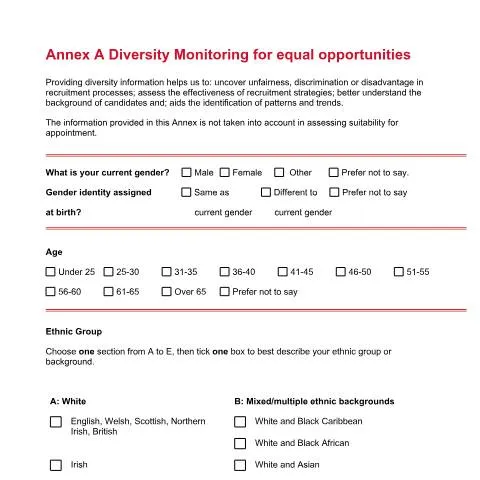
The comprehensive diversity monitoring section—Annex A—reflects the Department's commitment to building an inclusive expert network. This isn't mere box-ticking; it's a strategic approach to ensuring policy advice draws from Britain's full talent pool.
| Category | Purpose | Policy Impact |
|---|---|---|
| Gender Identity | Identify underrepresentation | Ensure women's business perspectives inform trade policy |
| Ethnic Background | Reflect UK's diversity | Leverage cultural insights for international market entry |
| Educational Background | Assess recruitment patterns | Balance academic theory with practical experience |
| Disability Status | Enable reasonable adjustments | Incorporate accessibility perspectives in business support |
The Guaranteed Interview Scheme for disabled candidates demonstrates the Department's commitment to inclusive recruitment. Candidates meeting minimum criteria automatically progress to interview stage, ensuring disability doesn't become a barrier to contributing expertise.
Completing Diversity Information Strategically
While all diversity questions remain optional, providing comprehensive information helps the Department understand its expert pool's composition. This data influences future recruitment strategies, potentially opening opportunities for underrepresented groups in specific sectors.
The educational background question particularly interests the Department, as it seeks to balance traditional academic credentials with vocational expertise. The distinction between state and independent schooling helps identify potential barriers to expert network participation.
Strategic Timing and Application Cycles
Unlike standard job applications, expert registration operates on a continuous basis, though the Department experiences peak demand periods aligned with government priorities. Budget cycles, trade negotiation phases, and major policy announcements typically trigger increased expert recruitment.
The optimal timing for registration often coincides with your career transition moments—perhaps when stepping back from full-time executive roles whilst remaining professionally active, or when seeking to apply decades of industry experience to public service.
Recent registrants report the Department being particularly active in recruiting experts during:
- Trade deal negotiation phases: When sector-specific knowledge becomes crucial for understanding commercial implications
- Regulatory reform periods: Following general elections or major policy shifts requiring fresh expert input
- Crisis response situations: Such as supply chain disruptions or market volatility requiring rapid expert assessment
Beyond Registration: The Expert Engagement Process
Registration marks the beginning, not the conclusion, of your expert journey. Successful registrants typically undergo additional vetting processes depending on the sensitivity of proposed assignments. This might involve security clearance procedures for trade-sensitive roles or detailed conflict-of-interest assessments for regulatory positions.
The Department maintains registered experts through regular communication, including policy briefings, sector updates, and invitations to networking events. This ensures experts remain current with government priorities whilst the Department understands evolving expert capabilities.
Matching Process and Assignment Allocation
When specific expertise needs arise, the Department's expert coordination team searches its database using sophisticated matching criteria. This includes not just technical qualifications, but also geographic experience, language capabilities, and previous government engagement history.
The matching process considers practical factors like availability, location, security clearance status, and potential conflicts of interest. Experts based outside London shouldn't assume this disadvantages them—many assignments now operate on hybrid or fully remote bases, particularly following post-pandemic working pattern changes.
Preparing Supporting Documentation and Professional Profile
While the registration form itself focuses on diversity monitoring, successful experts typically prepare comprehensive supporting materials demonstrating their expertise credibility. This includes:
- Detailed CV emphasising policy-relevant experience: Focus on achievements with measurable economic impact, international experience, and stakeholder management capabilities
- Professional references from senior figures: Ideally including former government officials, international business leaders, or recognised academic authorities
- Published work samples: Articles, reports, or presentations demonstrating thought leadership in relevant policy areas
- Conflict of interest declarations: Proactive disclosure of potential conflicts helps streamline future assignment processes
The Department particularly values experts who can demonstrate cross-sector experience. For instance, a manufacturing specialist who's also worked in financial services brings valuable perspective to trade finance policy discussions.
Language and Cultural Competencies
With the UK's renewed focus on global trade relationships, language skills and cultural knowledge significantly enhance expert value. This extends beyond obvious commercial languages like Mandarin or Spanish to include regional languages that facilitate deeper market penetration.
Cultural competency proves equally important—understanding business practices, negotiation styles, and regulatory frameworks in target markets can determine trade mission success or failure.
Managing Expectations and Professional Development
Expert assignments vary dramatically in scope, duration, and intensity. Some involve single-day workshops, whilst others might require months of intensive engagement. The Department strives to provide clear assignment briefs, but experts must remain adaptable as government priorities shift.
Financial arrangements reflect assignment nature—some positions offer daily rates comparable to senior consultancy fees, whilst others provide modest expenses-only compensation in recognition of public service contribution. The Department typically clarifies remuneration levels before formal appointment.
Many experts find the professional development opportunities exceptionally valuable. Working alongside senior civil servants, international counterparts, and fellow experts from different sectors provides insights impossible to gain through commercial work alone.
Building Long-term Government Relationships
Successful expert engagement often leads to expanded opportunities across government. The Department for Business and Trade frequently shares expert details with other departments facing similar challenges, potentially opening doors to Treasury, Foreign Office, or sector-specific ministry assignments.
This network effect means initial registration can evolve into sustained government advisory relationships, providing experts with unique insights into policy development whilst contributing meaningfully to national economic strategy.
The registration process itself reflects the Department's recognition that effective governance requires external expertise integration. By completing this registration thoughtfully and thoroughly, you position yourself to influence policies that will shape Britain's economic future for decades to come.
Navigating Conflicts of Interest and Declaration Requirements
The Department for Business and Trade maintains stringent protocols regarding conflicts of interest for College of Experts members, recognising that experts often operate across multiple professional spheres. Understanding these requirements is crucial for maintaining your registration and avoiding inadvertent breaches that could compromise both your standing and the integrity of departmental processes.
Financial interests represent the most straightforward category requiring declaration. This encompasses direct shareholdings, partnership stakes, or beneficial ownership in companies that may engage with DBT policy areas. However, the threshold isn't merely about size—even modest holdings in businesses operating within your area of expertise warrant disclosure if they could reasonably be perceived as influencing your advice. For instance, an expert in renewable energy technologies must declare shares in solar panel manufacturers, regardless of whether the holding represents 0.1% or 10% of their investment portfolio.
Professional relationships require equally careful consideration. Consultancy arrangements, advisory roles, or retainer agreements with organisations that might benefit from your DBT involvement must be declared, even if currently dormant. The department recognises that experts' value often stems from their industry connections, but transparency ensures these relationships enhance rather than compromise the advisory process. This includes pro bono work, which despite generating no direct financial benefit, may create reputational or relationship benefits requiring disclosure.
Family and personal connections add another layer of complexity. The definition extends beyond immediate family to include close personal relationships where financial or professional benefits might flow indirectly. If your spouse serves on the board of a company operating in your field of expertise, or your adult child works for an organisation that might be affected by your advice, these connections require declaration even if you derive no direct benefit.
The temporal aspect of declarations often causes confusion among experts. Past interests don't automatically become irrelevant—recent professional relationships, particularly those ending within the past two years, may still require disclosure if they could be perceived as influencing current advice. Conversely, future interests must be declared as they arise, with experts required to update their declarations within 28 days of any material change in circumstances.
Managing ongoing declarations involves more than initial disclosure. The department expects experts to actively monitor their circumstances and proactively identify potential conflicts as they develop. This might involve declining certain commercial opportunities, recusing yourself from specific advisory work, or implementing management arrangements that isolate conflicted interests from your DBT activities.
Professional Development Opportunities and Career Progression
Membership in the College of Experts opens doors to professional development opportunities that extend far beyond the immediate advisory role. The department recognises that maintaining cutting-edge expertise requires continuous learning and provides various mechanisms to support members' professional growth while enhancing their value to government.
Cross-departmental collaboration represents one of the most valuable aspects of College membership. Experts frequently find their expertise relevant to multiple government departments, leading to involvement in interdisciplinary projects spanning various policy areas. For example, a digital security expert might contribute to both DBT's trade policy development and Cabinet Office cybersecurity initiatives, providing exposure to different governmental approaches and broadening professional networks within Whitehall.
International engagement opportunities emerge regularly through the department's extensive global network. The UK's participation in multilateral trade negotiations, bilateral economic partnerships, and international standard-setting bodies creates opportunities for experts to represent British interests on the global stage. These assignments might involve participating in World Trade Organization technical committees, contributing to OECD working groups, or advising on UK positions in bilateral trade discussions.
The department's commitment to evidence-based policy creates opportunities for experts to contribute to significant research initiatives. This might involve leading or participating in commissioned studies, contributing to policy impact assessments, or helping design evaluation frameworks for new policy interventions. Such involvement provides valuable experience in translating technical expertise into policy-relevant insights while contributing to the broader evidence base supporting UK economic policy.
Mentoring and knowledge transfer represent increasingly important aspects of expert engagement. Senior experts often find opportunities to guide newer members, participate in capability-building initiatives, or contribute to training programmes for civil servants. This reciprocal relationship ensures knowledge flows in both directions, with experts gaining insights into governmental processes while sharing their technical expertise.
Publication and dissemination opportunities allow experts to share insights gained through their advisory work, subject to appropriate clearances and confidentiality requirements. The department encourages experts to contribute to academic publications, industry journals, or policy briefings that enhance public understanding of trade and business issues while maintaining appropriate boundaries around sensitive information.
Professional recognition often follows from high-quality contributions to government advisory work. The department maintains records of expert contributions and provides references or testimonials acknowledging significant contributions to policy development. This recognition proves valuable for career advancement, professional accreditation, or academic progression.
Technology Integration and Digital Advisory Processes
The Department for Business and Trade has increasingly embraced digital technologies to enhance the efficiency and effectiveness of expert advisory processes. Understanding these technological aspects is essential for maximising your contribution and navigating the evolving landscape of government advisory work.
Digital consultation platforms have revolutionised how experts engage with policy development processes. The department utilises sophisticated online systems that allow for real-time collaboration on policy documents, enabling experts to provide input asynchronously while maintaining version control and audit trails. These platforms support multimedia inputs, allowing experts to incorporate charts, technical diagrams, or data visualisations directly into their advice, enhancing the quality and clarity of technical input.
Virtual advisory meetings have become integral to the expert engagement model, particularly following lessons learned during the pandemic period. The department has invested in advanced video conferencing capabilities that support breakout sessions, screen sharing, and collaborative whiteboarding, enabling complex technical discussions to occur effectively in virtual environments. This technology has democratised participation, allowing experts from across the UK and internationally to contribute without the time and cost barriers associated with travel to central London.
Data analytics capabilities within government have created new opportunities for experts to contribute quantitative insights to policy development. The department increasingly seeks experts who can work with large datasets, apply advanced analytical techniques, or interpret complex economic models. This evolution requires experts to maintain familiarity with relevant analytical tools and methodologies, even if they're not primarily data scientists.
Artificial intelligence and machine learning applications are beginning to feature in government policy analysis, creating demand for experts who understand both the technical capabilities and limitations of these technologies. Experts may find themselves advising on the appropriate use of AI tools in policy development, interpreting AI-generated analyses, or ensuring that algorithmic approaches appropriately account for real-world complexities in their areas of expertise.
Cybersecurity considerations permeate all digital engagement with government systems. Experts must understand and comply with security protocols governing access to government networks, handling of sensitive information in digital formats, and appropriate use of personal devices for government work. The department provides guidance on these requirements, but experts bear responsibility for implementing appropriate security measures in their own working environments.
Digital accessibility requirements ensure that expert advice remains accessible to diverse audiences within government. This involves understanding how to format documents for screen readers, providing alternative text for images and charts, and ensuring that technical content remains comprehensible to non-specialist readers who may need to act on expert advice.
The integration of digital tools with traditional advisory processes requires experts to maintain flexibility in their working methods. While technology enhances many aspects of advisory work, face-to-face interaction remains valuable for building relationships, exploring complex issues, and ensuring that technical advice translates effectively into practical policy recommendations.