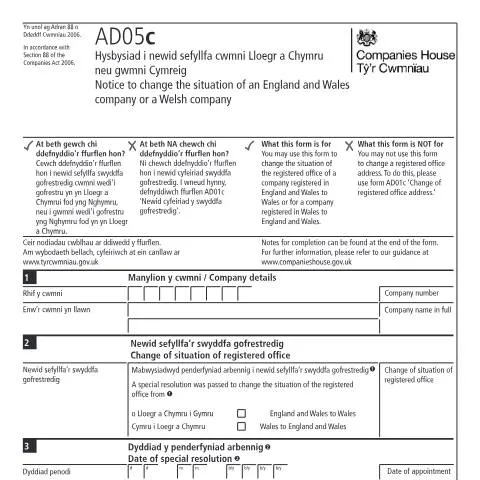
Navigating the Change Situation of England and Wales or Welsh Company Form (AD05c)
The process of changing the situation of a registered office for a company in England and Wales or a Welsh company is a critical administrative requirement that demands attention to detail. The AD05c form, specifically designed for this purpose, plays a vital role in ensuring that such changes are legally recognised and appropriately recorded. Understanding when and how to use this form can streamline the administrative burden associated with company restructuring or relocation.
Who Must Engage with the AD05c Form?
This form is required primarily by companies registered under the Companies Act 2006 that wish to alter the situation of their registered office from:
- England to Wales
- Wales to England
Any company contemplating this change must ensure that it meets the requirements set forth by the Companies House to maintain compliance. The key parties involved in this process typically include:
- Company Directors
- Company Secretaries
- Authorised Persons
Each of these roles has specific responsibilities when it comes to completing and submitting the AD05c form.
Understanding the Context: The Importance of Registered Office Location
The registered office of a company serves as its official address for communications and legal notifications. Changing this address can impact various aspects of business operations, including taxation, jurisdiction, and even customer perceptions. For example, moving from England to Wales could affect local legislation compliance or tax obligations, making it essential for businesses to carefully consider the implications of such a move.
Furthermore, a change in the registered office may also necessitate updates to other documents, such as the company's registration with HMRC or alterations to the VAT registration details. Therefore, companies must engage with this process thoughtfully, ensuring that they remain compliant with all legal requirements.
Document Preparation: Gathering Necessary Evidence
Completing the AD05c form requires careful attention to several crucial details. Before starting, companies should prepare the following evidence and documentation:
- Special Resolution: A special resolution must be passed by the company to authorise the change. This decision must be properly recorded in the company’s minutes.
- Identification Details: Ensure that the company name and number match the information held on the public register. Discrepancies can lead to delays or rejections.
- New Address: Clearly specify the new registered office address, ensuring it complies with the local jurisdiction’s requirements.
- Signatures: The form must be signed by an appropriate officer of the company, such as a director or secretary.
A Step-by-Step Guide to Completing the AD05c Form
Filling out the AD05c form correctly is crucial for ensuring that the application process goes smoothly. Here’s a step-by-step guide:
- Header Information: At the top of the form, enter the full company name and its registration number.
- Change Details: Indicate whether the change is from England to Wales or from Wales to England.
- Resolution Date: Provide the date on which the special resolution was passed by the company.
- Authorized Signatory: Ensure that the form is signed by an authorised person, which can include a director or company secretary.
- Submission: After completing the form, submit it to Companies House along with any necessary additional documentation.
The Submission Process: Where and How to Send the AD05c Form
Once the AD05c form is completed, it must be submitted to Companies House for processing. The submission can typically be done via:
- Online Submission: If the company is registered for online services, forms can be submitted through the Companies House WebFiling service.
- Postal Submission: Alternatively, you can send the completed form by post to the appropriate Companies House address. Be sure to send it via a trackable method to confirm receipt.
Upon successful processing, Companies House will issue a new certificate of incorporation reflecting the change in the registered office’s location.
Monitoring Your Application: What Happens Next?
After the AD05c form is submitted, monitoring the status of your application is crucial. Companies House typically processes forms within a certain timeframe, but this can vary based on volume and accuracy. To ensure that your application is proceeding without issues:
- Keep a copy of the submitted form and any cover letters for your records.
- Check the Companies House registration database to confirm that the changes have been reflected.
- If you encounter delays or issues, contact Companies House directly for clarification or assistance.
Potential Issues and Considerations When Using the AD05c Form
While the process for submitting an AD05c form is generally straightforward, several common issues can arise. Being aware of these can help prevent complications:
- Incomplete Information: Double-check that all required fields are filled out correctly; incomplete forms are often returned.
- Incorrect Signatures: Ensure that the form is signed by an appropriate person, as specified in the Companies Act 2006.
- Timing of Submission: If the special resolution was passed but the form is submitted late, it may complicate the company’s records.
Additionally, understanding the broader implications of relocating a registered office—such as changes in local taxation laws—can aid in making an informed decision.
Conclusion: Ensuring Smooth Transitions with the AD05c Form
The AD05c form is a crucial component in managing the legalities surrounding a company’s registered office location in England and Wales. By understanding the form’s requirements, preparing the necessary information, and following the submission process meticulously, companies can successfully navigate this important administrative task. Always consider consulting with a legal or business professional to ensure compliance with all aspects of the Companies Act 2006, thereby safeguarding the interests of your business.
Understanding the Process of Changing the Situation of a Company
Changing the situation of a company in England and Wales, particularly through the AD05c form, involves a detailed understanding of the circumstances under which such a change may occur. This can include alterations in the registered office address, changes in the company’s activities, or updates to the company’s particulars that are necessary for compliance with the Companies Act 2006. Each of these instances requires specific documentation and adherence to established protocols to ensure that the change is legally recognized.
One common scenario prompting the use of the AD05c form is the relocation of a company’s registered office. This is particularly important for businesses that may be expanding their operations or seeking a more strategic location. When shifting the registered office, it is crucial to notify Companies House as this change will affect where legal documents can be served and where official correspondence will be directed. Failure to notify can result in penalties or complications in legal matters.
Additionally, changes in the nature of a company's business activities must be reflected in the company's records. If a business decides to diversify its services or products, updating the particulars with Companies House is essential. This ensures that all stakeholders, including customers and service providers, have accurate information about what the company now offers. It's also important for tax purposes and can affect compliance with regulatory requirements.
Common Pitfalls When Submitting AD05c
When submitting the AD05c form for changing a company’s situation, there are several common pitfalls that directors should be aware of to avoid delays or rejections. One major issue is incomplete or incorrect information. The AD05c requires specific details about the company and the changes being made. Any discrepancies or omissions can lead to the form being returned for correction, which can be time-consuming and complicate business operations.
Another pitfall is the misunderstanding of the timelines involved. It’s important for company directors to be aware that while submitting the AD05c form can be done quickly online, the processing time by Companies House may vary. Directors should factor this into their plans, especially if the change is time-sensitive or part of a larger strategy that relies on the completion of this form.
Furthermore, ensuring that the company’s internal records are updated in tandem with the information submitted to Companies House is often overlooked. This includes updating company registers and any internal documentation that reflects the new situation. A failure to do so can lead to confusion among shareholders and employees, and potential issues with regulatory bodies.
Post-Submission Actions and Compliance Requirements
Once the AD05c form has been submitted and accepted, there are additional actions and compliance requirements that need to be addressed. The company should ensure that it communicates the changes to all relevant stakeholders, including employees, clients, suppliers, and any other parties that may be affected by the new situation. This is not only a best practice in maintaining good business relationships but may also be required under certain contractual obligations.
Moreover, it is advisable for companies to revisit their internal policies and procedures in light of the changes made. For example, if the registered office has moved to a new location, companies should consider updating any advertising materials, websites, and other public-facing documents that contain the old address. This helps to maintain clarity and professionalism in all communications.
Companies must also remain aware of ongoing compliance requirements related to their new situation. Depending on the nature of the change, this may include alterations to insurance policies, updating licenses, or complying with local regulations that may differ in the new area. Staying proactive in these areas helps mitigate risks and aligns the company with its legal obligations.