Restructuring Company Secretarial Information on the Public Register
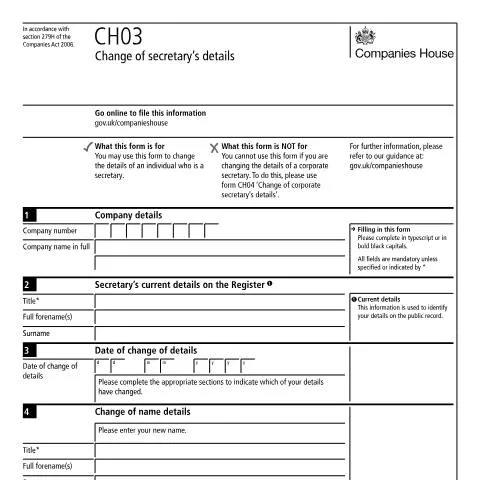
When a company secretary's personal details undergo changes—whether through marriage, relocation, or professional reorganisation—the CH03 form serves as the statutory mechanism for updating these particulars on Companies House records. This document bridges the gap between a secretary's evolving circumstances and the legal requirement to maintain accurate public information under section 279H of the Companies Act 2006.
Unlike broader company restructuring forms, the CH03 specifically targets individual secretaries' personal details, excluding corporate secretarial entities which require separate documentation. The form's precision reflects Companies House's commitment to maintaining granular control over different types of secretarial appointments whilst ensuring public transparency through the official register.
Distinguishing Individual from Corporate Secretary Updates
The CH03 form exclusively handles changes for individual secretaries, creating a clear administrative boundary that prevents confusion with corporate secretarial structures. Companies attempting to use CH03 for corporate secretary amendments will face rejection, as these entities require the dedicated CH04 form designed for organisational secretarial changes.
This distinction becomes particularly relevant for businesses operating complex secretarial arrangements. A company might simultaneously employ individual secretaries alongside corporate secretarial services, necessitating different procedural approaches when updating their respective details. The legislative framework deliberately separates these processes to ensure appropriate scrutiny levels for each category.
| Secretary Type | Required Form | Key Differentiator |
|---|---|---|
| Individual Secretary | CH03 | Personal details (name, address) |
| Corporate Secretary | CH04 | Company registration details |
Navigating the Form's Core Sections
Company Identification Requirements
Section 1 demands precise company identification through both the complete company name and official company number. Companies House maintains strict verification protocols, requiring exact matches with existing register entries. Minor discrepancies in company name formatting—such as missing punctuation or abbreviated words—can trigger form rejection, emphasising the importance of referencing the official register before completion.
The company number serves as the primary identifier, offering a failsafe against potential name variations or recently changed company names. Directors should verify this number through the Companies House website, as incorrect numbers immediately invalidate the submission regardless of other form accuracy.
Current Secretary Details Documentation
Section 2 requires comprehensive documentation of the secretary's existing details as they appear on the public register. This verification step prevents unauthorised changes and ensures the form targets the correct individual where multiple secretaries exist. The section captures both personal identification (title, forenames, surname) and the current service address registered with Companies House.
Service addresses merit particular attention, as they represent the publicly accessible contact point for the secretary. Companies House distinguishes between residential addresses and service addresses, allowing secretaries to maintain privacy whilst fulfilling transparency obligations. The form explicitly permits using "The company's registered office" as the service address, providing a standard alternative to personal address disclosure.
Timing and Change Documentation
Section 3 establishes the crucial date of change, which becomes the official effective date for the amendments. This date cannot be retrospective beyond the actual change occurrence, as Companies House requires contemporaneous reporting of secretarial modifications. The date format follows standard UK conventions (DD/MM/YYYY), with clear field demarcation preventing common formatting errors.
Section 4 captures the new name details following changes such as marriage, divorce, or deed poll alterations. The form accommodates various title preferences whilst maintaining consistency with official documentation. Companies should ensure new name details align with supporting evidence, as discrepancies may prompt additional verification requests.
Service Address Modifications and Public Record Implications
Section 5 addresses service address changes, representing one of the most frequently updated secretarial details. The form mandates physical location addresses, explicitly prohibiting PO Box, DX, or Legal Post numbers. This requirement ensures genuine accessibility for legal service and maintains the register's credibility for third-party verification purposes.
Service address changes carry significant implications for ongoing company operations. Legal notices, regulatory communications, and third-party correspondence rely on accurate service address information. Delays in updating these details can result in missed critical communications, potentially affecting company compliance and legal standing.
Companies operating from multiple locations must carefully consider which address best serves their operational needs whilst maintaining appropriate accessibility. The service address becomes part of the permanent public record, searchable by creditors, potential partners, and regulatory bodies seeking to establish contact with company representatives.
Authentication Protocols and Authorised Signatories
The CH03 form requires authentication from specific categories of authorised individuals, reflecting Companies House's commitment to preventing unauthorised secretarial changes. Directors, existing secretaries, and specifically authorised persons under sections 270 or 274 of the Companies Act 2006 possess signing authority, creating multiple legitimate pathways for form submission.
Authentication extends beyond simple signature requirements, demanding printed name disclosure that becomes part of the public record. This transparency measure allows stakeholders to identify who authorised specific changes, supporting accountability and reducing fraudulent submissions.
For United Kingdom Societas (UKS) entities, authentication requirements adapt to reflect their unique governance structures. The form accommodates various UKS organs, requiring specific identification of the authorising body member rather than standard directorial authentication.
Specialist Appointment Categories
Beyond standard directors and secretaries, the CH03 accepts authentication from various specialist appointment holders including administrators, receivers, and judicial factors. These provisions recognise that secretarial changes often occur during company restructuring, insolvency proceedings, or other exceptional circumstances where traditional management structures may be suspended or altered.
- Administrative receivers and receiver managers can authenticate during formal insolvency processes
- Charity Commission receivers handle authentication for charitable company secretarial changes
- CIC managers address Community Interest Company specific requirements
- Judicial factors manage authentication in Scottish legal proceedings
Processing Timeline and Public Record Integration
Companies House processes CH03 forms through established workflows designed to maintain register accuracy whilst minimising processing delays. Electronic submissions typically receive faster processing than postal submissions, though both methods undergo identical verification procedures to ensure information accuracy and authorisation legitimacy.
Upon successful processing, the secretarial changes become immediately visible on the public register, accessible through Companies House search facilities. This immediate publication ensures third parties can access current secretarial information for legal service, commercial inquiry, and regulatory purposes.
The processing timeline varies depending on submission method, form accuracy, and current Companies House workload. Incomplete or inaccurate forms face return to the submitter with specific correction requirements, potentially extending the overall processing period. Companies requiring urgent processing should ensure meticulous form completion and consider electronic submission methods where available.
Error Prevention and Submission Verification
The CH03 form includes a comprehensive checklist designed to prevent common submission errors that trigger form rejection. This proactive approach reduces processing delays whilst ensuring companies understand the verification standards applied to their submissions.
Critical verification points include ensuring company name and number accuracy, confirming the change date falls within acceptable parameters, and verifying that service addresses meet physical location requirements. The checklist specifically highlights the prohibition on PO Box addresses, a frequent source of form rejection.
Contact Information Strategy
The presenter information section offers optional contact details for Companies House queries during form processing. Whilst not mandatory, providing accurate contact information can significantly expedite resolution of minor queries that might otherwise result in form rejection and resubmission requirements.
Contact information becomes part of the public record, requiring careful consideration of privacy implications. Companies may choose to provide corporate contact details rather than personal information, maintaining appropriate separation between individual privacy and business transparency requirements.
Submission Methods and Administrative Coordination
Companies House offers multiple submission pathways for CH03 forms, accommodating different organisational preferences and technical capabilities. Electronic submission through the official Companies House website provides the most efficient processing route, offering immediate confirmation of receipt and typically faster processing times.
Postal submissions require careful attention to addressing requirements, as incorrect postal destinations can result in significant processing delays. Companies House maintains specific addresses for different form types and jurisdictions, requiring verification of the correct destination before submission.
The form's availability in alternative formats demonstrates Companies House's commitment to accessibility, ensuring companies with specific requirements can fulfil their statutory obligations regardless of format preferences or accessibility needs. These alternative formats maintain identical legal validity whilst accommodating diverse organisational capabilities.
Important: All information provided on the CH03 form becomes part of the permanent public record, accessible to anyone conducting company searches through official channels or authorised third-party services.
Successful CH03 submission marks the completion of the secretarial change process, with the updated information immediately reflecting across all Companies House systems and public search facilities. This integration ensures consistent information availability across different access methods whilst maintaining the register's role as the definitive source for UK company secretarial information.
Special Circumstances and Complex Secretary Changes
Certain situations require additional considerations when filing form CH03, particularly where the secretary change involves complex corporate structures or unusual circumstances. Understanding these scenarios helps ensure compliance and avoid potential complications with Companies House.
Corporate Secretary Appointments
When appointing a corporate entity as secretary, the CH03 form requires specific additional information. The corporate secretary must be a body corporate, meaning a company incorporated under the Companies Act or equivalent legislation. You'll need to provide the corporate secretary's registered name exactly as it appears on their certificate of incorporation, along with their company registration number and registered office address.
Corporate secretaries cannot be the same entity as the company itself, nor can they be a subsidiary of the appointing company. This restriction prevents conflicts of interest and ensures independent administrative oversight. If the corporate secretary is incorporated outside the UK, you must provide equivalent registration details from their jurisdiction of incorporation.
Multiple Secretary Changes
Companies with multiple secretaries may need to file several CH03 forms simultaneously, particularly during restructuring or following significant governance changes. Each secretary change requires a separate form, though they can be submitted together as a batch. When processing multiple changes, ensure the effective dates align logically – you cannot have gaps where no secretary is appointed if your articles of association require one.
Joint secretaries present particular considerations. If joint secretaries are resigning simultaneously, their departure dates should typically match to avoid confusion about authority and responsibility. Similarly, when appointing joint secretaries, consider whether they can act independently or must act together, as this affects how they execute their duties.
Secretary Changes During Administration or Liquidation
Companies in formal insolvency procedures face restrictions on secretary appointments. During administration, the administrator typically assumes many secretarial functions, though a secretary may remain in post for specific purposes. Any secretary changes during administration require the administrator's consent, and the CH03 form should include a note referencing the administration order.
In liquidation scenarios, the liquidator often acts as secretary or may appoint someone to fulfil this role. Voluntary liquidations may see the secretary resign as part of the winding-up process, while compulsory liquidations involve the official receiver taking control. These circumstances require careful coordination with the insolvency practitioner to ensure proper filing of secretary changes.
Data Protection and Privacy Considerations for Secretary Details
The public nature of Companies House records raises important privacy considerations for individuals serving as company secretaries. Understanding these implications helps both companies and individuals make informed decisions about secretary appointments and manage personal data appropriately.
Public Record Implications
All information submitted on form CH03 becomes part of the public record, accessible through Companies House searches. This includes the secretary's full name, service address, and appointment date. Unlike directors, secretaries cannot use a service address different from their residential address for privacy protection – the service address shown must be where documents can be effectively served.
For individuals concerned about privacy, consider the long-term implications of having personal details on public record. Former secretaries' information remains accessible in historical filings, even after resignation. This permanent accessibility affects personal privacy and security considerations, particularly for high-profile individuals or those in sensitive positions.
GDPR Compliance in Secretary Appointments
Companies must ensure their processing of secretary personal data complies with UK GDPR requirements. This includes having a lawful basis for processing (typically legal obligation under the Companies Act), providing appropriate privacy notices, and implementing suitable data security measures.
The secretary should receive clear information about how their personal data will be used, including its publication on the public record. Companies should maintain records of consent or other lawful basis for processing, particularly where additional personal data beyond statutory requirements is collected for internal purposes.
Data retention policies must balance legal requirements to maintain statutory records with GDPR principles of data minimisation. While Companies House records remain publicly available, internal company records containing additional personal data should be reviewed and deleted when no longer necessary for legitimate business purposes.
International Data Transfer Considerations
Companies with international operations or overseas parent companies must consider cross-border data transfer implications when appointing secretaries. If secretary personal data will be accessed or processed outside the UK, appropriate safeguards must be in place, such as adequacy decisions or standard contractual clauses.
This becomes particularly relevant where overseas parent companies require access to UK subsidiary records containing secretary details, or where shared corporate systems store secretary information across multiple jurisdictions. Companies should document these arrangements and ensure compliance with both UK GDPR and any applicable foreign data protection laws.
Common Errors and How to Avoid Them
Filing form CH03 incorrectly can result in rejection, delays, or compliance issues. Understanding frequent mistakes helps ensure successful submission and maintains accurate company records.
Documentation and Evidence Issues
One of the most common rejection reasons involves insufficient or incorrect supporting evidence. When a secretary resigns, Companies House may require evidence of the resignation, particularly if the timing or circumstances appear unusual. Always retain copies of resignation letters, board resolutions, or other documentation supporting the change.
Signature discrepancies cause frequent problems. Ensure the person signing the CH03 form is authorised to do so under the company's articles of association. Typically, this means a director or the existing secretary, but check your specific articles for any variations. Electronic signatures are acceptable, but they must comply with Companies House requirements for digital submissions.
Date inconsistencies between the CH03 form and supporting documentation create confusion and potential rejection. Ensure all dates align logically – the resignation date should match resignation letters, and appointment dates should reflect when the person actually began acting as secretary, not when the paperwork was completed.
Address and Identity Verification Problems
Service address errors frequently cause filing issues. The address must be a place where documents can be effectively served during normal business hours. Post office boxes are generally unacceptable, and residential addresses require careful consideration of privacy implications.
Name formatting causes surprising numbers of problems. Use the secretary's full legal name exactly as it appears on official identification documents. Avoid nicknames, abbreviations, or alternative spellings that might create confusion in future filings or legal proceedings.
For corporate secretaries, ensure the company name and registration number are exactly correct. Minor spelling variations or incorrect registration numbers will cause rejection and delay processing.
Timing and Deadline Complications
Companies often underestimate the time required for proper secretary change procedures. While the CH03 form must be filed within 14 days of the change, the underlying corporate processes may take longer to complete properly. Plan ahead to ensure adequate time for board resolutions, documentation, and filing.
Retrospective filings require particular care. If you're filing after the 14-day deadline, provide clear explanations for the delay and ensure all supporting documentation demonstrates the actual change date. Companies House may accept late filings with appropriate justification, but repeated late filing can trigger regulatory attention.
Weekend and holiday timing can affect effective dates and filing deadlines. Companies House processing times don't include weekends or bank holidays, so factor these into your planning, particularly around Christmas, Easter, or other extended holiday periods when processing may be further delayed.