When Corporate Expansion Meets Partnership Structure: The LL AP02 Imperative
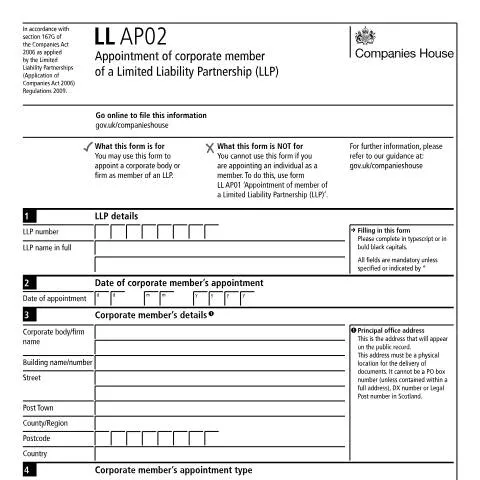
The business landscape often presents scenarios where established companies seek to join forces with limited liability partnerships, creating hybrid structures that leverage both corporate stability and partnership flexibility. When a corporate entity – whether a UK-registered limited company or an overseas firm – wishes to become a member of an existing LLP, the regulatory machinery demands precise documentation through form LL AP02.
This appointment process represents more than mere administrative compliance; it fundamentally alters the LLP's membership composition and can trigger significant changes in liability distribution, profit-sharing arrangements, and regulatory obligations. Unlike individual appointments which follow a different pathway entirely, corporate membership appointments involve complex verification procedures that reflect the heightened due diligence required when legal entities merge their interests.
The form operates under the authority of section 167G of the Companies Act 2006, as applied through the Limited Liability Partnerships (Application of Companies Act 2006) Regulations 2009. This legislative framework ensures that corporate appointments undergo scrutiny comparable to director appointments in traditional companies, maintaining the integrity of the UK's business registration system.
Navigating the Corporate Member Appointment Landscape
The LL AP02 form serves a highly specific function within the broader ecosystem of LLP documentation. While form LL AP01 handles individual member appointments, LL AP02 exclusively addresses situations where the prospective member is itself a legal entity – a distinction that carries profound implications for both the appointment process and subsequent operational requirements.
Corporate members bring unique characteristics to LLPs: they possess separate legal personality, may have complex ownership structures, and often operate across multiple jurisdictions. These factors necessitate enhanced verification procedures that extend beyond simple identity confirmation to encompass corporate status validation and jurisdictional compliance checks.
| Member Type | Required Form | Key Verification Elements | Public Record Impact |
|---|---|---|---|
| Individual Person | LL AP01 | Identity, address, designated status | Personal details visible |
| UK Limited Company | LL AP02 | Company number, registered address | Corporate details visible |
| Overseas Corporate Body | LL AP02 | Legal form, governing law, registration details | International structure visible |
The appointment process also requires consideration of designated member status. Corporate members can assume designated responsibilities, thereby accepting enhanced regulatory duties including filing obligations and compliance oversight. This decision, captured in section 4 of the form, cannot be reversed through subsequent amendments – only through resignation and reappointment.
Decoding the Documentation Requirements
The form's architecture reflects the complexity of corporate appointments through its branching structure. Sections 5 and 6 present mutually exclusive pathways depending on whether the prospective member is a UK-registered limited company or falls into the broader category of other corporate bodies and firms.
UK-registered companies follow a streamlined verification process through section 5, requiring only their Companies House registration number. This approach leverages the existing UK corporate database, enabling automated cross-referencing that validates the company's current status, registered address, and compliance history.
Conversely, overseas entities and non-company structures navigate section 6's more complex requirements. This section demands comprehensive disclosure including:
- Precise legal form designation (e.g., "Société à Responsabilité Limitée" for French companies)
- Governing law identification (specifying the jurisdiction under which the entity operates)
- Registration details including the specific register name and registration number
- State or jurisdiction specification where registration occurred
These requirements reflect Companies House's need to verify foreign entities' legitimacy and ensure appropriate regulatory oversight despite jurisdictional boundaries. The information provided becomes part of the UK's public corporate record, creating transparency for potential business partners and creditors.
The Authentication and Consent Framework
Section 7's consent mechanism addresses a critical legal principle: no entity can be compelled into partnership membership against its will. The confirming party – typically a designated member of the LLP – must verify that the prospective corporate member has explicitly agreed to join the partnership. This consent requirement protects against unauthorized appointments that could create unwanted legal obligations.
The authentication process, handled through section 8, restricts signing authority to designated members or judicial factors. This limitation ensures that only individuals with formal authority over the LLP can alter its membership structure. Notably, the form explicitly states that signatures are unnecessary – printed names suffice, reflecting Companies House's evolution toward streamlined digital processes.
Authentication carries legal weight: the authenticating party accepts responsibility for the accuracy of all information provided and confirms their authority to make the appointment on behalf of the LLP. False or misleading information can trigger penalties under company law, making careful verification essential before submission.
Timing Considerations and Strategic Implications
The appointment date specified in section 2 holds particular significance, as it establishes when the corporate member's rights and obligations commence. This date cannot be retrospective – it must align with or follow the actual appointment decision and the prospective member's consent. The chosen date affects profit-sharing calculations, voting rights distribution, and liability assumptions.
Strategic timing considerations often influence appointment dates:
- Financial year alignment – coordinating appointments with accounting periods simplifies profit allocation and tax calculations
- Regulatory compliance – ensuring appointments occur before specific deadlines or regulatory changes take effect
- Commercial arrangements – aligning membership commencement with contract execution or milestone achievements
The appointment becomes effective once Companies House processes the form and updates the public register. Processing typically occurs within 8-10 working days for correctly completed submissions, though complex overseas entity verifications may require additional time.
Addressing Complex Corporate Structures
Modern business arrangements often involve intricate corporate hierarchies where the appointing entity may be a subsidiary, holding company, or part of a multinational group. The form accommodates these complexities through its flexible approach to corporate identification and address requirements.
The principal office address requirement in section 3 demands particular attention. This address becomes the official contact point for legal documents and regulatory communications, making its accuracy crucial. The address must represent a physical location capable of receiving documents – virtual offices and PO boxes (unless part of a complete address) are explicitly prohibited.
For overseas entities, the principal office address may differ from the registered office in their home jurisdiction. Companies House accepts this distinction, recognizing that multinational operations often require UK-specific contact arrangements. However, the chosen address must enable reliable document delivery and should align with the entity's actual UK business operations where applicable.
Group structures present additional considerations when determining which specific entity should become the LLP member. Parent companies, subsidiaries, or special purpose vehicles may each offer different strategic advantages depending on tax efficiency, liability limitation, and operational requirements.
Navigating Submission Channels and Processing Expectations
Companies House operates a dual-channel system for LL AP02 submissions, offering both digital upload capabilities and traditional postal routes. The choice between channels often depends on organizational preferences, technical capabilities, and specific circumstances surrounding the appointment.
Digital submission through the Companies House website provides several advantages: immediate confirmation of receipt, faster processing times, and reduced risk of postal delays or document loss. The system performs basic validation checks during upload, flagging obvious errors or omissions before formal processing begins.
Postal submission remains available for organizations preferring traditional methods or facing technical constraints. However, this route requires careful attention to addressing requirements, as forms sent to incorrect offices experience significant processing delays. The current postal system routes submissions through specific regional offices based on the LLP's registered location.
Processing timelines vary depending on submission quality and the complexity of verification required. UK company appointments typically process within 5-8 working days, while overseas entity appointments may require 10-15 working days to accommodate international verification procedures.
Companies House may return incorrectly completed forms or request additional information, extending processing times significantly. The built-in checklist serves as the primary defense against such delays, highlighting common omissions that trigger rejection.
Post-Appointment Obligations and Ongoing Compliance
Once processed, the corporate appointment triggers several ongoing obligations that extend beyond the initial filing. The newly appointed corporate member assumes responsibility for various LLP compliance requirements, particularly if designated member status was selected.
Designated corporate members inherit comprehensive filing obligations including annual confirmation statements, accounting record maintenance, and regulatory correspondence handling. These responsibilities cannot be delegated to other LLP members and require sustained attention throughout the membership period.
The public record entry created by the appointment becomes immediately searchable, providing transparency for creditors, potential business partners, and regulatory authorities. This visibility carries reputational implications, as the corporate member's association with the LLP becomes permanently documented in publicly accessible records.
Subsequent changes to corporate member details – such as name changes, address updates, or structural reorganizations – require separate filings to maintain record accuracy. Failure to report such changes can result in penalties and may complicate future transactions involving the LLP.
The appointment also establishes the foundation for potential future actions including member resignation, profit share modifications, or LLP dissolution procedures. Each of these scenarios requires specific documentation and may involve complex unwinding of the relationships established through the initial LL AP02 appointment.
Understanding these long-term implications ensures that corporate appointments align with broader business strategies and compliance frameworks, creating sustainable partnership structures that support organizational objectives while meeting regulatory requirements.
Specific Requirements for Different Corporate Entity Types
The LL AP02 form accommodates various corporate structures as new members, each with distinct documentation and disclosure requirements. Understanding these variations ensures proper completion and avoids delays in processing.
UK Limited Companies as Corporate Members
When appointing a UK private or public limited company, you must provide the company's full registered name exactly as it appears on the Companies House register. The company number is mandatory—this eight-character alphanumeric identifier enables Companies House to verify the entity's existence and current status. Ensure the company is not struck off, in liquidation, or subject to a winding-up order, as this would invalidate the appointment.
For companies incorporated after 2016, you'll typically find a confirmation statement reference helpful for verification. The registered office address must be current—if the company has recently relocated, check their latest filing to avoid using outdated information that could trigger rejection.
Overseas Corporate Entities
Foreign companies present additional complexity. The form requires the entity's full legal name in its jurisdiction of incorporation, along with the equivalent of a company number or registration identifier. For EU entities, this might be a registration number from the national commercial register. US corporations require their state of incorporation and relevant filing number.
The registered office address must be provided in the format used in the entity's home jurisdiction. For countries using non-Latin alphabets, provide both the original script and a transliteration. Some overseas entities may need to register as overseas companies with Companies House before becoming LLP members—verify this requirement with Companies House guidance for the specific jurisdiction.
Limited Liability Partnerships as Members
An existing LLP can become a member of another LLP, creating a multi-layered structure. Use the target LLP's full registered name and its unique LLP number (format: OC followed by six digits). The principal place of business address is required rather than a registered office, as LLPs operate under slightly different terminology.
Consider the implications of LLP-to-LLP membership on profit-sharing arrangements and management structure, as these relationships can create complex reporting obligations for both entities.
Managing Member Changes and Succession Planning
Corporate membership in LLPs often forms part of broader succession planning or corporate restructuring strategies. The LL AP02 filing represents just one element in potentially complex arrangements requiring careful coordination.
Simultaneous Appointments and Resignations
When replacing one corporate member with another—common during acquisitions or group reorganisations—timing becomes crucial. The outgoing member must file form LL AP03 (Notice of resignation of corporate member) while the incoming member files LL AP02. These forms can be submitted simultaneously, but ensure consistency in effective dates to avoid gaps in membership or unintended dual membership periods.
If the change involves altering profit-sharing ratios or management responsibilities, update the LLP agreement before or concurrent with the Companies House filings. Members should receive formal notice of these changes according to the procedures specified in the existing agreement.
Corporate Restructuring Implications
Corporate members often join LLPs as part of wider restructuring exercises. Consider whether the appointment triggers other regulatory requirements—for example, if the corporate member holds professional qualifications relevant to the LLP's business, regulatory bodies may need notification of the structural change.
Tax implications can be significant. The appointment might affect the LLP's tax transparency status or trigger capital gains considerations for existing members. HMRC's guidance on LLP taxation should be reviewed, particularly regarding the 'trade or business' test that determines tax treatment.
Maintaining Corporate Good Standing
Once appointed, the corporate member must maintain its good standing in its jurisdiction of incorporation. For UK companies, this means filing annual confirmation statements and accounts on time. Failure to maintain good standing could affect the member's legal capacity to participate in LLP decisions or receive distributions.
Establish monitoring procedures to track the corporate member's compliance status. Many LLP agreements include provisions requiring corporate members to notify other members of any changes to their legal status, including insolvency proceedings or regulatory sanctions.
Post-Appointment Compliance and Ongoing Obligations
The successful filing of form LL AP02 marks the beginning of ongoing compliance obligations that extend beyond the initial appointment process. Corporate members face distinct responsibilities that differ from those of individual members.
Annual Return and PSC Register Implications
Corporate membership affects the LLP's annual return preparation and persons with significant control (PSC) register maintenance. If the corporate member holds more than 25% of the rights to share in capital or profits, or exercises significant influence or control, it must be recorded in the PSC register with detailed ownership information.
For corporate members that are themselves controlled by other entities or individuals, the LLP must trace through ownership layers to identify ultimate beneficial owners. This 'look-through' requirement can create complex reporting chains, particularly for corporate members owned by trusts or offshore structures.
The PSC register must be updated within 14 days of any changes to the corporate member's ownership or control structure. Establish clear communication channels with corporate members to receive prompt notification of relevant changes in their ownership or management.
Financial Reporting and Disclosure Requirements
Corporate members may trigger additional disclosure requirements in the LLP's accounts, particularly regarding related party transactions. Transactions between the LLP and its corporate members, or entities connected to those members, require disclosure under accounting standards and may need separate approval processes under the LLP agreement.
Consider whether the corporate member's appointment affects the LLP's audit requirements. Large LLPs must appoint auditors, and corporate membership might push the entity over relevant thresholds for turnover, balance sheet totals, or employee numbers.
Regulatory and Professional Body Notifications
LLPs operating in regulated sectors must notify relevant authorities of corporate member appointments. Professional service LLPs—such as those providing legal, accounting, or financial services—often face specific requirements regarding member qualifications and regulatory approval.
For example, solicitors' practices structured as LLPs must ensure corporate members meet Solicitors Regulation Authority requirements. Similarly, accounting practices must verify that corporate members don't breach professional body rules about ownership and control.
Some regulators require pre-approval of corporate membership changes, while others operate on a notification-only basis. Review the specific requirements for your LLP's sector and jurisdiction, as non-compliance could result in loss of professional authorisation or regulatory sanctions.
Banking and insurance regulators may require 'fit and proper' assessments of new corporate members, particularly where those members will exercise significant influence over the LLP's operations. These assessments can take several weeks or months, so factor this timing into your appointment planning.