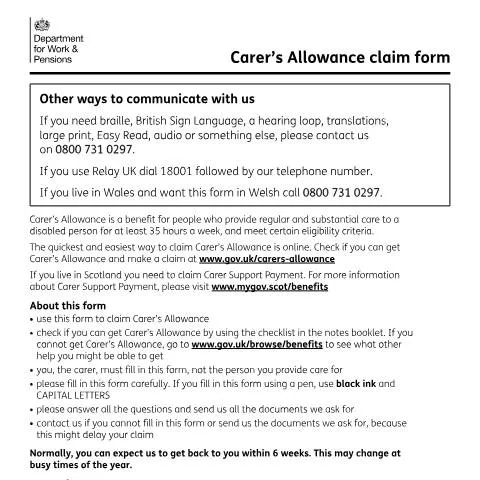
When Caring Becomes a Recognised Service: Understanding the Carer's Allowance Landscape
Across the UK, approximately 6.5 million people provide unpaid care for family members, friends, or neighbours who are disabled, ill, or elderly. Yet only a fraction receive formal recognition through the social security system. The Carer's Allowance claim form represents the gateway to this support—a document that transforms invisible care work into a measurable, valued contribution worthy of financial assistance.
This isn't simply another benefits application. The form acknowledges that providing substantial and regular care for at least 35 hours weekly constitutes work deserving of state recognition. At £81.90 per week (as of April 2024), Carer's Allowance may seem modest, but it carries significant implications beyond the payment itself, affecting both the carer's and care recipient's benefit entitlements in complex ways.
The Department for Work and Pensions processes tens of thousands of these applications annually, each representing a person who has stepped into a caring role that fundamentally reshapes their life, employment prospects, and financial circumstances.
The Qualifying Framework: Who Steps Through This Administrative Door
The Carer's Allowance system operates on strict eligibility criteria that create distinct categories of potential claimants. Understanding these boundaries helps explain why the form includes seemingly intricate questions about residence, nationality, and care arrangements.
The Core Care Requirement
Claimants must provide care for someone receiving specific qualifying benefits, including Personal Independence Payment (daily living component), Disability Living Allowance (middle or highest care rate), Attendance Allowance, or Constant Attendance Allowance. This isn't assessed through the form alone—the DWP cross-references existing benefit records to verify the care recipient's status.
The 35-hour weekly threshold represents a significant commitment. Unlike employment hours, this includes overnight supervision, being "on call," and the emotional labour of managing another person's care needs. The form doesn't require detailed hour-by-hour breakdowns, but applicants should understand this encompasses the full spectrum of caring responsibilities.
Residency and Nationality Complexities
Questions 10-15 on the form address increasingly complex post-Brexit immigration scenarios. European Economic Area nationals who arrived in the UK before 1 January 2021 retain different rights compared to those arriving afterward. The three-year residence requirement creates particular challenges for recent immigrants, refugees, or those with complex migration histories.
| Claimant Status | Residence Requirement | Special Considerations |
|---|---|---|
| British nationals | Present in Great Britain when claiming | Temporary absences may be permitted |
| EEA nationals (pre-2021) | Three years in Great Britain | EU Settlement Scheme status relevant |
| Other foreign nationals | Three years plus immigration status | Must have right to reside and work |
The Single Carer Rule
One of the form's most challenging aspects addresses situations where multiple people care for the same individual. The DWP's "only one carer benefit per care recipient" rule forces difficult decisions within families. If both a spouse and adult child provide substantial care, they must negotiate who claims—or face DWP determination of the matter.
Navigating the Digital Divide: Online Versus Paper Pathways
The DWP strongly promotes online claiming through the gov.uk portal, describing it as "quickest and easiest." However, this digital-first approach creates disparities in access and experience that the paper form DS700 attempts to address.
When Digital Falls Short
The paper form serves specific populations who cannot or prefer not to claim online. This includes older carers uncomfortable with digital systems, those with limited internet access, people with learning difficulties requiring support to complete applications, and individuals in complex situations where the online system's logic trees cannot accommodate their circumstances.
Completing the paper form requires black ink and capital letters—seemingly archaic requirements that reflect the document's journey through automated scanning systems. Hand-written applications undergo optical character recognition, making legibility crucial for processing speed and accuracy.
Processing Timeline Realities
The standard six-week processing time represents the DWP's target rather than a guarantee. Paper applications typically take longer than online claims due to additional handling stages: postal delivery, manual data entry, and physical document verification. During peak periods—particularly after benefit rate changes in April or around Christmas when family circumstances often shift—processing times can extend significantly.
The form warns applicants that incomplete submissions or missing documents cause delays. Unlike online applications that prevent progression without required fields, paper forms can be submitted incomplete, leading to correspondence cycles that extend processing by weeks or months.
The Ripple Effect: How Carer's Allowance Transforms Other Benefits
Perhaps the most complex aspect of the Carer's Allowance system involves its interaction with other benefits—both for the carer and the person receiving care. These interactions often surprise applicants and can create unintended financial consequences.
Impact on the Care Recipient
When Carer's Allowance is awarded, the care recipient typically loses their severe disability premium or the severe disability element of Pension Credit. This can amount to £76.40 per week—nearly offsetting the carer's £81.90 allowance. The net household benefit may be minimal, but the symbolic recognition of the carer's contribution often justifies the claim despite limited financial gain.
Council Tax reductions for severely disabled people may also cease, creating additional financial pressure. Local authorities receive notification of Carer's Allowance awards and adjust Council Tax support accordingly.
Carer Benefit Interactions
Universal Credit claimants cannot receive Carer's Allowance simultaneously—instead, they receive a carer element within their Universal Credit award. This creates a choice point: claim Carer's Allowance as a standalone benefit or maintain Universal Credit with its carer addition. The financial calculation isn't straightforward, as Universal Credit includes housing costs, childcare support, and other elements that Carer's Allowance doesn't provide.
National Insurance credits represent a crucial long-term benefit of Carer's Allowance. Even when the monetary payment is minimal, these credits protect the carer's state pension entitlement during years of reduced employment due to caring responsibilities.
Scottish Divergence: Understanding the Carer Support Payment Alternative
Scotland's devolution of social security powers created a parallel system that affects how the DS700 form operates north of the border. Since June 2023, new carer benefit claims in Scotland must be made for Carer Support Payment rather than Carer's Allowance, though existing Carer's Allowance recipients continue under the UK system until they choose to transfer.
Transition Complexities
Scottish residents completing the DS700 form encounter warnings directing them to Social Security Scotland instead. However, transition arrangements create confusion—existing Carer's Allowance recipients moving to Scotland don't automatically transfer systems, and those moving from Scotland to England must navigate between different administrative frameworks.
The Scottish system promises higher payment rates and more flexible eligibility criteria, but also requires separate application processes through mygov.scot rather than gov.uk. This creates practical challenges for families spanning the border or carers who relocate frequently.
Backdating Opportunities and Time-Critical Decisions
Question 5 on the form—requesting the desired start date—carries significant financial implications that many applicants underestimate. Unlike most benefits that begin from the claim date, Carer's Allowance can be backdated to align with the care recipient's qualifying benefit award, provided the claim is made within three months of their decision date.
Strategic Timing Considerations
Families often discover Carer's Allowance eligibility only after the care recipient receives their disability benefit award. The three-month window for backdating creates pressure to submit claims quickly, sometimes before carers fully understand the implications for their broader financial circumstances.
The form requires evidence that care was provided for at least 35 hours weekly throughout the backdated period. Unlike prospective care arrangements that rely on intentions and plans, backdated claims require factual demonstration of past care provision—often challenging to document retrospectively.
Employment and Education Interactions
Carer's Allowance rules permit limited earnings (£151 per week after allowable expenses as of 2024) and full-time education restrictions that can affect backdating decisions. Carers who were employed or studying during the proposed backdated period must carefully calculate whether they remained within these limits throughout.
Communication Accessibility and Multilingual Provisions
The DS700 form acknowledges the UK's linguistic diversity and disability access requirements through specific provisions that extend beyond standard government form accessibility measures.
Language Support Infrastructure
Welsh language provision reflects statutory requirements under the Welsh Language Act, with dedicated Welsh-language claim processing available through 0800 731 0297. This isn't simply translation—Welsh claims are processed by Welsh-speaking staff familiar with cultural contexts and terminology differences.
For other languages, the DWP provides interpretation services, though the form itself remains in English. Relay UK integration (dial 18001 plus the DWP number) ensures deaf and hard-of-hearing claimants can access telephone support throughout the application process.
Alternative Format Provisions
The commitment to braille, Easy Read, audio, and large print versions addresses the reality that many carers themselves have disabilities or accessibility needs. British Sign Language interpretation and hearing loop availability acknowledge that caring relationships often exist within disabled communities where multiple access requirements intersect.
These provisions aren't afterthoughts—they reflect legal obligations under the Equality Act 2010 and recognition that excluding carers with disabilities from the benefits system would undermine the policy's fundamental purpose of supporting care provision across all communities.
Beyond the Form: Post-Submission Processes and Ongoing Obligations
Submitting the DS700 form initiates a complex administrative process that extends far beyond the initial decision. Understanding these subsequent stages helps carers prepare for their ongoing relationship with the DWP system.
Assessment and Verification Procedures
The DWP conducts cross-system checks that verify the care recipient's benefit status, confirm the carer's National Insurance record, and assess any conflicting claims. This automated checking can identify discrepancies that trigger manual review—extending processing times but ensuring accuracy.
Unlike disability benefit assessments that may require medical examinations, Carer's Allowance relies primarily on documentary evidence and existing benefit records. However, the DWP reserves rights to investigate care arrangements, particularly in cases involving multiple potential carers or complex living arrangements.
Change Reporting Obligations
Successful applicants enter an ongoing reporting relationship with the DWP that requires notification of changes affecting eligibility: alterations in care hours, the care recipient's benefit status, employment changes, or relationship developments. The form establishes this obligation but doesn't fully prepare carers for its practical implications.
These reporting requirements create particular challenges for carers whose circumstances fluctuate—such as those caring for people with variable conditions or managing multiple caring relationships. The system's binary approach to eligibility doesn't easily accommodate the fluid nature of many caring situations.
The Carer's Allowance claim form ultimately represents more than an administrative process—it embodies society's recognition that caring constitutes valuable work deserving of support. While the form itself may seem bureaucratic, it opens access to a system that, despite its limitations, acknowledges the crucial role carers play in supporting vulnerable people within their communities. Understanding its intricacies empowers carers to navigate the system effectively and access the recognition their dedication deserves.
Special Circumstances and Complex Caring Arrangements
Carer's Allowance applications become more intricate when your caring situation doesn't fit the standard template. The DWP recognises that modern caring arrangements often involve multiple carers, shared responsibilities, or fluctuating care needs that require careful documentation on your claim form.
When caring for someone with intermittent conditions such as multiple sclerosis, bipolar disorder, or chronic fatigue syndrome, you'll need to demonstrate how your caring role adapts to their varying needs. Include details of how you provide support during flare-ups, manage medication schedules during acute phases, and coordinate with healthcare professionals when symptoms worsen. The 35-hour weekly requirement must still be met, but you can explain how this manifests differently during stable periods versus crisis episodes.
Shared caring arrangements require particular attention to detail. If you and another family member, friend, or professional carer share responsibilities, clearly delineate your specific contributions. For instance, you might handle all personal care and meal preparation whilst your sibling manages medical appointments and financial affairs. Document your individual 35-hour contribution without including overlapping time when you're both present unless you're each providing distinct types of care simultaneously.
Distance caring presents unique challenges for Carer's Allowance eligibility. Whilst you must normally live in the same household or very close proximity, exceptions exist for temporary separations due to hospitalisation, respite care, or your own brief absences. If you're caring for someone in a different location, perhaps an elderly parent in their own home whilst you maintain your residence elsewhere, you'll need to provide substantial evidence of your regular presence and hands-on care provision.
Multiple caring responsibilities require strategic consideration. You cannot claim Carer's Allowance for more than one person simultaneously, even if you care for several individuals who each receive qualifying disability benefits. Choose the person for whom your caring role is most intensive or where the claim is most likely to succeed. However, caring for multiple people can strengthen your application by demonstrating your experience and commitment to the caring role.
Professional carers face additional scrutiny regarding their Carer's Allowance applications. If you're employed as a care worker but also provide unpaid care to a family member or friend, you must clearly distinguish between your paid professional duties and your personal caring relationship. The care you're claiming for must be provided outside your employment hours and cannot duplicate services for which you're professionally compensated.
Managing Changes in Circumstances and Ongoing Obligations
Your responsibilities don't end when your Carer's Allowance claim is approved. The DWP requires prompt notification of any changes that might affect your entitlement, and understanding these ongoing obligations prevents overpayments that you'd later need to repay.
Changes in the cared-for person's condition require immediate reporting. If they no longer receive their qualifying disability benefit, perhaps because their condition has improved or they've sadly passed away, your Carer's Allowance entitlement ends. Similarly, if they enter residential care permanently, you must notify the DWP within one month. Temporary hospital stays or respite care periods up to four weeks don't affect your benefit, but longer admissions will suspend your payments.
Your own circumstances changes also trigger reporting requirements. Starting employment, increasing your working hours, or receiving a pay rise that pushes your weekly earnings above £132 after allowable deductions must be reported immediately. Beginning full-time education, even if it's distance learning or part-time by hours but considered full-time by the institution, affects your eligibility and requires notification.
Changes in living arrangements need careful handling. If you move house, particularly if this affects your proximity to the person you care for, notify the DWP promptly. If you separate from a partner who was receiving Carer's Allowance for the same person, this might affect which of you remains eligible. Relationship changes can also impact means-tested benefits that interact with Carer's Allowance.
The DWP conducts periodic reviews of Carer's Allowance claims, typically every two to three years or when triggered by changes in circumstances. These reviews might involve detailed questionnaires about your current caring role, requests for updated medical evidence about the cared-for person's condition, or interviews with DWP staff. Maintaining good records of your caring activities, medical appointments you attend, and correspondence with healthcare professionals helps you respond comprehensively to these reviews.
Overpayment recovery procedures can be financially challenging if you've failed to report changes promptly. The DWP calculates overpayments from the date your circumstances changed, not from when you eventually reported the change. Recovery typically occurs through reduced future benefit payments, but in serious cases might involve immediate repayment demands or deductions from other benefits you receive.
Understanding your right to challenge DWP decisions protects your interests throughout the Carer's Allowance journey. If your claim is refused, your benefit is stopped, or you disagree with an overpayment calculation, you can request mandatory reconsideration within one month of the decision. This involves a different DWP officer reviewing your case with any additional evidence you provide. If you remain dissatisfied, you can appeal to an independent tribunal through HM Courts and Tribunals Service.
Integration with Other Benefits and Financial Planning
Carer's Allowance interacts complexly with the broader benefits system, and understanding these relationships helps you maximise your household's financial support whilst avoiding unintended consequences for the person you care for.
The Carer Premium, worth £38.85 per week in 2023-24, automatically applies to means-tested benefits like Universal Credit, Housing Benefit, or Council Tax Support when you receive Carer's Allowance. This premium continues even during the eight-week linking period if your Carer's Allowance stops temporarily, providing valuable protection during transitions. However, if you're in a couple claiming Universal Credit jointly, only one Carer Premium applies regardless of whether both partners have caring responsibilities.
National Insurance credits accompanying Carer's Allowance protect your future State Pension entitlement during periods when caring responsibilities prevent you from working or earning enough to qualify for credits through employment. These Class 1 National Insurance credits count towards the 35 qualifying years needed for the full new State Pension, making Carer's Allowance valuable even if the monetary amount seems modest.
The interaction between Carer's Allowance and the cared-for person's benefits requires careful navigation. Your Carer's Allowance doesn't directly affect their Personal Independence Payment, Disability Living Allowance, or Attendance Allowance. However, if they receive means-tested benefits like Pension Credit or Universal Credit, your Carer's Allowance might reduce their Severe Disability Premium or the severe disability element of Universal Credit, potentially leaving your household worse off overall.
This 'better off' calculation becomes crucial in determining whether to claim Carer's Allowance. If the person you care for loses £69.40 per week in Severe Disability Premium whilst you gain £69.40 in Carer's Allowance, there's no net household benefit. However, your National Insurance credits and potential Carer Premium in your own means-tested benefits might still make claiming worthwhile. The DWP doesn't automatically perform this calculation, so you'll need to assess the overall impact yourself or seek advice from welfare rights organisations.
Pension age considerations affect Carer's Allowance eligibility and interactions with other benefits. You cannot receive Carer's Allowance alongside State Pension if the pension amount exceeds your Carer's Allowance entitlement. However, you might still qualify for Carer Premium in means-tested benefits or Carer's Credit for National Insurance purposes. If you're approaching State Pension age whilst receiving Carer's Allowance, consider the timing of your pension claim to maximise your overall benefit entitlement.
Tax implications of Carer's Allowance are straightforward but worth understanding. Carer's Allowance counts as taxable income, but with the current rate of £69.40 per week (£3,608.80 annually), it falls well below the personal tax allowance threshold for most recipients. However, if you have other income sources, Carer's Allowance contributes to your total taxable income and might affect your entitlement to tax credits or other income-related benefits.
Financial planning whilst receiving Carer's Allowance requires balancing immediate needs with long-term security. The earnings limit restricts your ability to supplement Carer's Allowance through employment, but permitted work includes self-employment where you can potentially structure your income to remain within limits. Consider timing of bonus payments, dividend income, or other irregular earnings to avoid breaching the weekly threshold.
Savings and capital limits don't directly affect Carer's Allowance eligibility, unlike means-tested benefits. However, if you're also claiming Universal Credit or other means-tested support, your savings above £6,000 will affect those benefits. Investment income from savings might also push you over the Carer's Allowance earnings limit, so balance your need for emergency funds with the impact on your benefit entitlements.