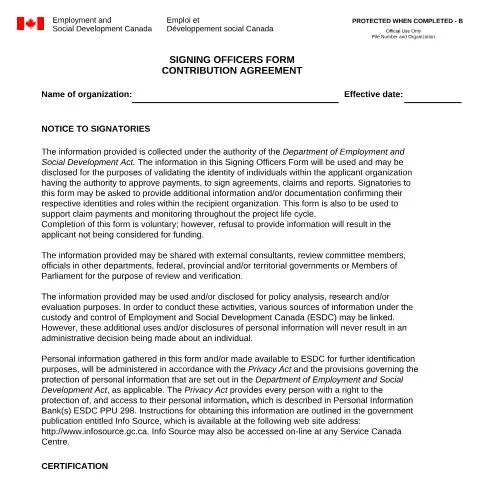
Understanding the Role of the Signing Officers Form in Contribution Agreements
The Signing Officers Form (EMP5567) is an essential document used by organizations in Canada seeking funding or support from Employment and Social Development Canada (ESDC). Its primary function is to validate the identity and authority of individuals within an organization who are authorized to make financial decisions and sign agreements on behalf of the organization. This form is crucial in ensuring compliance and accountability in the management of public funds.
Who Should Fill Out the EMP5567?
This form must be completed by organizations that have applied for or received a contribution agreement from ESDC. Typically, this includes non-profits, community organizations, and sometimes businesses that are engaged in projects aligned with ESDC’s objectives. Key stakeholders involved often include:
- Executive Directors
- Board Members
- Finance Officers
- Project Managers
It is important to note that the individuals listed on this form must have the legal authority to bind the organization to financial and contractual obligations.
Diving Into the Sections of the Form
The structure of the EMP5567 is composed of three primary sections, each designated to capture specific information regarding the signing officers. Understanding each section can help in avoiding common pitfalls during completion.
Section 1: Agreement Purposes and Disposition of Capital Assets
This section requires the names, titles, and specimen signatures of individuals who are authorized to sign agreements. It is crucial to ensure that:
- The representatives listed have appropriate authority as per the organization’s bylaws.
- The number of signatures required to bind the organization is correctly specified to avoid potential disputes.
Inaccuracies in this section can lead to delays in processing or potential rejection of the application.
Section 2: Payment Authorization
In this section, organizations must list individuals authorized to approve payments. Transparency is key here, and it’s essential to ensure that:
- All individuals listed can be easily reached for verification.
- The number of signatures required for payment authorization reflects the organization’s internal policies.
Misidentifying signatories can result in improper payments and financial discrepancies.
Section 3: Claims and Reporting
This section focuses on individuals authorized to sign claims and reports submitted to ESDC. It's imperative to include:
- Individuals who have firsthand knowledge of project activities.
- Those who can attest to the accuracy of the reports being submitted.
Failure to include the right signatories can impede the reimbursement process and affect the organization’s cash flow.
Chronological Flow: From Submission to Funding
Understanding the journey of the Signing Officers Form from submission to funding can be crucial for organizations. Here’s a typical chronological flow:
- Preparation: Gather necessary documentation to establish authority of signatories.
- Completion: Fill out the EMP5567 carefully, ensuring all signatories are accurately represented.
- Submission: Send the completed form to ESDC as part of the funding application package.
- Verification: ESDC reviews the form to confirm the identities and authorities of the signatories.
- Approval: Upon acceptance, the organization will be notified of funding decisions.
- Disbursement: Funds are released as per the terms of the contribution agreement.
This sequence highlights the importance of accuracy and timely submission in the process.
Legal and Ethical Considerations
Completing the Signing Officers Form involves significant legal and ethical responsibilities. The information provided is governed under the Department of Employment and Social Development Act and the Privacy Act. Organizations must ensure compliance with these laws to protect the personal information of signatories. Considerations include:
- Understanding the implications of signing on behalf of the organization.
- Ensuring that the organization’s bylaws are followed when designating signatories.
- Recognizing the importance of maintaining accurate records for accountability.
Special Cases: Addressing Unique Situations
There are specific scenarios where filling out the Signing Officers Form may require additional attention:
- Non-Profit Organizations: May have unique governance structures that necessitate special consideration in signatory authority.
- International Applicants: Organizations operating in Canada but registered elsewhere may need to demonstrate compliance with both Canadian and foreign regulations.
- Minor Organizations: If an applicant organization is led by individuals under the age of majority, additional documentation may be needed to verify authority.
Understanding these nuances can prevent potential legal pitfalls.
Post-Submission: What Happens Next?
After submitting the EMP5567, organizations must remain proactive. Possible next steps include:
- Communication with ESDC: Be ready to provide any further information or clarification as requested.
- Monitoring Deadlines: Keep track of any deadlines for project implementation or reporting requirements.
- Updating the Form: If there are changes in signatories, an updated form must be submitted to ESDC immediately.
Staying engaged is essential for maintaining the integrity of the funding agreement.
| Section | Purpose | Key Consideration |
|---|---|---|
| Section 1 | Signing Officers for Agreements | Authority as per bylaws |
| Section 2 | Payment Authorization | Accessibility for verification |
| Section 3 | Claims and Reporting | Knowledge of project activities |
Final Thoughts: The Importance of Compliance
Filling out the Signing Officers Form correctly is not just about adherence to bureaucratic processes; it’s about fostering trust and accountability in public funding. Organizations that take the time to ensure accuracy and compliance position themselves for successful partnerships with ESDC, ultimately enabling them to better serve their communities.
Understanding the Signing Officers Form: Key Elements and Requirements
The Signing Officers Form is a critical aspect of establishing a Contribution Agreement in Canada, particularly for organizations seeking funding from various governmental bodies, such as Employment and Social Development Canada (ESDC). This form serves to designate the individuals within your organization who are authorized to sign documents on behalf of your entity. Understanding its key elements and requirements is essential to ensure compliance and facilitate the funding process.
When filling out the Signing Officers Form, you need to provide detailed information about each signing officer. This includes their full name, title within the organization, and specimen signature. It's important to double-check that the names match the official records held by your organization to avoid any discrepancies. Moreover, ensuring that these individuals are indeed authorized to execute agreements on behalf of your organization is crucial. This adds an extra layer of validation to your submission, which can streamline the approval process.
In addition to the basic identification details, the form often requires the organization to outline the scope of authority granted to each signing officer. For instance, you might indicate if a signing officer has the authority to enter into contracts, manage funds, or represent the organization in negotiations with government representatives. Clearly defining these roles can help mitigate risks and clarify responsibilities during the implementation of the Contribution Agreement.
Another aspect to consider is the internal policies that your organization may have regarding the authorization of signatories. It's good practice to ensure that your organization’s bylaws or policies are aligned with the information provided in the Signing Officers Form. If there are any changes to your organization’s structure or personnel, it’s critical to update the form promptly to reflect these changes. Failing to do so could lead to confusion or disputes regarding authority, which can complicate the administration of the Contribution Agreement.
Common Pitfalls When Completing the Signing Officers Form
Completing the Signing Officers Form may seem straightforward, but several common pitfalls can cause delays or complications in your Contribution Agreement process. Recognizing these pitfalls will allow you to prepare accordingly and avoid potential setbacks.
One frequent issue is the failure to provide complete and accurate information. Incomplete forms will often lead to a rejection or request for resubmission, which can extend the timeline for funding. Review the requirements carefully, and ensure that every section of the form is filled out thoroughly. Pay special attention to the spelling of names, titles, and any numerical data you provide. Any errors could lead to significant delays.
Another common pitfall is not having the necessary internal approvals before submitting the Signing Officers Form. Some organizations have rigorous protocols for approving official documents, and neglecting to adhere to these can result in rejection or non-compliance. Make sure that the individuals listed as signing officers not only have the authority but also that their appointments have been ratified by your board or relevant governing body.
Additionally, organizations sometimes overlook the requirement for a fresh submission of the Signing Officers Form if there are any changes in personnel. It’s not merely a formality; updating this information is crucial for legal compliance and financial accountability. Always keep the form up to date with the current signing officers to ensure that your organization can act swiftly and legally.
Impact of the Signing Officers Form on Future Funding Opportunities
The Signing Officers Form is not just a procedural requirement; it can significantly impact your organization’s future funding opportunities. A well-completed form can enhance your credibility and demonstrate organizational stability to funding agencies. Conversely, errors or inconsistencies may raise red flags for future applications.
When funding bodies review applications, they often assess the governance structure of the organization. A properly filled Signing Officers Form can showcase your organization's commitment to transparency and accountability. It signals to funders that your organization has the necessary protocols in place to manage funds responsibly, which can ultimately improve your chances of securing grants or funding agreements.
Additionally, a history of compliance in filling out forms, including the Signing Officers Form, will reflect positively in your organization’s records with funding agencies. If your past submissions have been accurate and timely, it may result in more favorable treatment in future applications, including expedited review processes and increased funding amounts.
Moreover, if your organization applies for multiple funding streams, consistency across all forms can build a solid reputation. Different funding programs may have specific requirements, but maintaining accuracy in your Signing Officers Form across the board will create a cohesive narrative about your organization's governance. It is also prudent to keep a comprehensive database of all submissions for tracking purposes; this database can be an invaluable resource for future applications.